


The growth and introduction of Artificial Intelligence have transformed the sports industry significantly over the past decade, around the world. In the vast sector of sports performance, AI-powered analytics have become crucial for performance enhancement, preventing injuries and training athletes. Sophisticated algorithms continuously analyze the player data for identifying areas of improvement and personalizing training programs. The impact of AI in sports has been profound. It enables the delivery of hyper-personalized content as well as recommendations that foster robust connections among sports, athletes, professionals, and even fans.
AI in the sports market globally was valued at $1.2 billion in the past year, and by 2034, it is expected to touch $4.7 billion, and Machine Learning will be a leading tech in the segment.
By leveraging AI-powered algorithms, the ticket price strategies can be optimized optimally.
The AI-powered tools for athlete performance analysis enable managers to make well-informed decisions regarding the composition of teams as well as game strategies.
Data-driven insights aid in recruitment and talent scouting, allowing managers to determine promising players with precision.
But yes, there are issues with algorithmic bias, data privacy, and fair competition which need to be addressed for ensuring equitable and responsible utilization of AI in sports management, from optimizing administrative tasks to strategic decision making.
Fan engagement to enhance athlete performance; the impact of Artificial Intelligence in the sports domain steadily continues to expand.
Sports fans consider real-time updates as the top priority for improving engagement with Gen AI, followed by tailored content, unique insights, and near-accurate predictions.
Right now, nearly 50% of the global sports fans are positive about the rising impact of AI in sports. The share spikes to 58% among fans aged 18 to 29 years old.
Proquantic Software today will be highlighting the use of AI in sports and shedding light on how the tech is transforming user engagement digitally, worldwide.

Market overview and application of AI in sports
AI is transforming all aspects of sports, right from games to competition, as well as entertainment. The AI-powered tools are already being utilized, virtually, in all major sports forms and disciplines, like:
- American football
- Soccer
- Cricket
- Baseball
- Basketball
- Wrestling
And many non-professional leisure sports are played on the field.
In a survey by IBM, it was found that AI, along with other advanced technologies, will positively impact the evolution of sports in areas like training and sports medicine, game strategy, coaching, injury prevention, fan engagement, and talent acquisition.
| Application cases | Application areas |
| Management and operations |
|
| Fan and media experience |
|
| Post-game analysis |
|
| Talent selection and ID |
|
| Pre-game preparation |
|
| In-game activity |
|
AI in the main fields of application
| Fan engagement | During sports events, the sports companies can leverage AI-powered software to offer the fans real-time subtitles in various languages, based on nationality. The companies can also offer deeper insights and additional stats for enriching the fan experience. |
| AI can also be blended with Augmented Reality for displaying AI-generated strategic breakdowns through image overlays. | |
| Virtual Reality can also be coupled with AI in sports to integrate insights into 3-D environments. | |
| AI enables sports event management companies and clubs to provide better customer support through smart assistants and chatbots. Such tools have already been widely adopted by various leagues and sports teams like the NBA and NHL for addressing fan questions regarding parking, tickets, and other organizational functions. | |
| Talent development and coaching | AI-powered analysis software enables coaches with valuable data to create effective strategies for the game. AI systems can assess the information gathered through sensors and cameras, including ball trajectories, movement speed of the player, rebounds, scored goals, etc., which help in identifying the patterns of opponents and adjusting the game accordingly. |
| Coaches can even use AI-based software for running simulations of the potential in-game environments, assessing the tactical changes, and making informed decisions during matches. | |
| At the same time, Artificial Intelligence enables coaches to know about the athlete’s weaknesses and strengths and creates a more personalized training program for optimizing their performance. | |
| Recruiting | AI can give shape to the relationship between sports companies and athletes from the very beginning. Specifically, AI-based predictive modeling is used for analyzing data of players' performance parameters like playing style, technique, agility, and speed, and analyzing their potential and market value before any sports club decides to invest in them. |
| The adoption of AI-powered tools through AI Software Development is becoming increasingly beneficial to players, as the technology can reduce bias during recruitment. Furthermore, AI software can assess game footage from anywhere in the world, amplifying the chances for athletes to get noticed even when they live in remote locations or in areas where sports are not widely prevalent. | |
| Athlete well-being management | Combined with the health-monitoring wearables, AI-powered systems can monitor biomechanical parameters and biometrics like muscle loading or heart rate, for assessing the player's physical condition, spot health problems at an early stage or potential injuries, helping physicians choose the suitable therapies for quicker recovery. |
| Such solutions provide coaches with data-packed insights for developing a more balanced training regime, adjusting the duration and intensity of each activity to avoid harmful overtraining and minimize injury risk. | |
| Betting | Sports betting operators have shown interest in predictive analytics for a long time. SO much that high-tech companies like Sportlogiq have already started selling analytical data to the bookmakers of the US, enabling them to set the odds-on bets. |
| However, the reliable forecasts would need massive amounts of data, including weather conditions, scores, locations, team performance, and historical data on individual performance. | |
| A lot of such details are not public but lie in the control of sports clubs. So, the rising use of AI in betting leads to intensified data trading between various sports organizations. | |
| Advertising | Providing an unparalleled fan experience with Artificial Intelligence is fundamentally reshaping sports advertising, resulting in maximizing advertising commissions. |
| Machine Learning powered marketing solutions analyze shopping behavior, patterns of media consumption, demographics, viewer preferences, etc, to deliver relevant and personalized ads and segmentize customers. | |
| Along with these, AI solutions can also identify the most exciting actions in-game based on the emotional response of fans, enabling the broadcasting companies to capture the attention of their audience and put commercials at the right time for maximum engagement. This makes advertisements not only more personal but also more effective. | |
| Refereeing | VAR or video assistant referees and instant-replay systems have been used in nearly every sport for years to provide a slow-motion highlight to the human referees, but they have slowed down the game many times, eventually frustrating the players and fans. |
| AI-powered computer vision technology can detect game violations like handball offenses in soccer, way quicker and more accurately than the old systems, minimizing game disruptions. | |
| Journalism and broadcasting | Artificial Intelligence looks all set to affect the storytelling of sports. By using deep learning algorithms as well as Machine Learning, broadcasters can effectively automate various video editing operations like zooming in on the crucial field actions and camera shooting. Fully automated sports production is comparable to videos edited professionally. |
| All thanks to the advanced innovations in generative AI and Natural Language Processing, automation is truly finding its way in sports journalism, empowering the press to create brief reports for hundreds of matches. The press professionals can also cover more events with fewer resources. | |
| Media companies can also use conversational AI systems for retrieving the game footage and content from a massive database through simple queries in natural language. | |
| The NFL implemented a solution to search for media assets from its vast library of fan-generated social media content, press interviews, and other resources. |
How AI is transforming the sports business
The sports business is currently at a point where it is ready to improve its decision-making capabilities by proactively adopting Artificial Intelligence and performing data-driven objectives. In fact, from 2015 to 2018, the NBA reviewed more than 25000 games and determined more than 2000 incorrect or missed actions. This amounts to nearly 1.49% wrong decisions at the finals of each game.
Such a decision factor is being powered by AI-based technologies, where professionals can very closely watch the game with visual data and probability.
AI in sports businesses serves thousands of scenarios in the industry, and below, we mention the most significant ones:
Monitoring player performance
In today's sports, AI-based performance monitoring systems have skillfully replaced traditional analytics by bringing in real-time insights and precision to every move made by an athlete. Wearables, cameras, sensors, etc., continuously collect biometric as well as motion data by transforming the raw information into actionable intelligence, facilitating the driving of performance optimization.
- Devices like Zebra MotionWorks and Catapult measure fatigue, distance, and acceleration during live sessions.
- Machine Learning models skillfully identify stress patterns even before they lead to injuries. This significantly reduces the downtime.
- AI detects performance patterns and suggests intensity training or optimal rest.
- Posture tracking and emotion recognition enable coaches to understand the mindset of the players and their confidence level.
The feedback loop is heavily data-driven, which enables tactical refinement and personalized training adjustments. From basketball and cricket to football, teams are now heavily reliant on AI, not only for monitoring but also for predicting the results.
Tailored training programs
Every athlete is unique. AI focuses and reflects on their individuality. The traditional one-size-fits-all approaches have evolved into hyper-tailored training programs that adjust in real time to each player's physical condition, objectives, and needs.
- AI evaluates metrics like nutrition, sleep, and fatigue consistently for dynamically modifying training loads.
- Algorithms proactively analyze the variability of heart rate for determining windows for optimal recovery.
- Motion tracking and video analytics reflect how even the smallest of biomechanical changes can impact performance.
- Platforms like Whoop and Zone7 provide data-backed insights directly to the trainers and athletes.
By combining human expertise with machine intelligence, AI assures that the training sessions stay injury-free, engaging, and efficient. As a result, everyone involved can experience better outcomes, quicker progress, and smarter athletes.
Talent hunting and recruitment
AI is steadily revolutionizing how talent in sports is discovered and evaluated. Rather than relying solely on human judgment, clubs are now leveraging AI for analyzing data from countless leagues and matches, eventually uncovering the hidden talents with precision.
- AI assesses player stats, positional behavior, and trends of historical performance.
- Algorithms express a player's future potential based on the findings of current growth trajectories.
- AI assures objective decision-making by eliminating subjective human biases.
- Wyscout and similar tools assess thousands of hours of match footage in just a few minutes.
Soccer Premier League teams like Liverpool FC and Manchester United leverage an AI model for identifying undervalued players who skillfully fit their tactical system. Such an approach saves millions of rupees in transfer costs and enhances the accuracy of recruitment, thereby proving that AI scouting is already here.
Optimization of tickets
Ticketing today functions beyond static pricing. AI today drives dynamic strategies of ticketing that optimize fan experience, attendance, and revenue simultaneously. By thoroughly analyzing the fan demographics, event timing, and purchasing patterns, sports organizations can take smarter ticketing decisions.
- AI adjusts ticket rates based on weather forecasts, seat type, and demand.
- AI predicts crowd turnout based on the data of past events as well as social media trends.
- It sends tailored discounts and offers to individual segments of fans.
- Assists the venues in allocating security and staff efficiently, based on the predicted turnout.
Major European clubs and NBA teams now leverage the AI-powered ticketing engines for filling seats during midweek fixtures. Such outcomes are a great blend of fan satisfaction and profitability, which is a true win-win for today's sports management.
Predictions in sports
AI-powered predictive models today are integral to both professional coaching and betting. Such systems assess millions of pieces of information right from match history, weather, and player stats to provide a near-accurate forecast of results and strategies.
- AI models assess the potential scorelines and win probabilities.
- AI suggests the perfect team compositions for fantasy leagues.
- Performance forecasting predicts the player’s fatigue and form for guiding strategies of rotation.
- Coaches get live updates for taking mid-game tactical changes.
Organizations like Opta Sports and Stats Perform have taken prediction accuracy up a notch, 80% in many leagues. Such insights not only empower teams with a strategic foresight but also improve the fan engagement, ultimately giving them a competitive edge.
Automation in sports journalism
Sports journalism has stepped into the AI-powered era where the headlines, player stat summaries, and match reports are written by algorithms, quicker than ever before. Natural Language Generation tools transform raw data into readable narratives in just a matter of seconds.
- Wordsmith and similar platforms publish after-match recaps.
- AI produces stunning visuals and statistical dashboards in real-time.
- Even the smaller leagues today receive regular coverage of content through automation.
- Tools localize reports and translate them for global audiences instantly.
Instead of replacing human journalists, AI enhances productivity by enabling the reporters to focus on in-depth analysis as well as storytelling, whereas machines handle only routine updates. It's a clear case of journalism accelerated and uplifted by intelligence.
Sponsorship and advertising insights
The sports sponsorship market is estimated to be a multi-billion-dollar market, and hence every brand involved demands an ROI that is efficiently delivered by AI in sports. With the help of advanced computer vision and analytics, the effectiveness of sponsorships is now quantifiable, down to every second and frame.
- AI tracks the exposure of brands on broadcasts, billboards, and uniforms.
- AI monitors the social media buzz and reactions of fans around sponsorships.
- The technology predicts the behavior of the audience for refining campaign strategies.
- It identifies zones of high visibility within broadcasts and arenas.
For instance, IBM Watson empowers brands like Wimbledon and Mastercard to evaluate the digital engagement in real-time, which ensures that every Dollar spent generates a measurable insight and impact.
Pattern detection and decoding game footage
Coaches do not need to manually review the endless footage of matches because AI in sports can process video thousands of game hours almost instantly, making the identification of player tendencies, tactics, and trends convenient.
- AI labels errors, transitions, and plays for quick and easy review.
- AI identifies the recurring weaknesses and tactical patterns.
- AI tracks the players’ formation efficiency and positioning.
- AI visualized areas of vulnerability and strength.
Teams like the Golden State Warriors and Manchester City leverage such insights for fine-tuning training and strategies. The result comes to smarter decision-making, data-backed tactics, and sharper gameplay.
Innovation of sports equipment
AI is reshaping the ways sports gears are designed, personalized, and tested. From adaptive materials to smart materials, innovation today is data-driven, making equipment more efficient and safer.
- AI predicts how the sporting professionals interact with gears having better design through biomechanical modeling.
- The embedded AI-sensors in smart fabrics collect information on motion, impact, and posture.
- AI optimizes the usage of materials for reducing wastage and emissions and promotes sustainable manufacturing.
- Brands personalize gear to the individual player's needs by using performance data.
Companies like Adidas and Nike leverage AI designs for designing adaptive performance-enhancing apparel and accessories like footwear. They redefine how technology, as well as athleticism, merge both on and off the field.
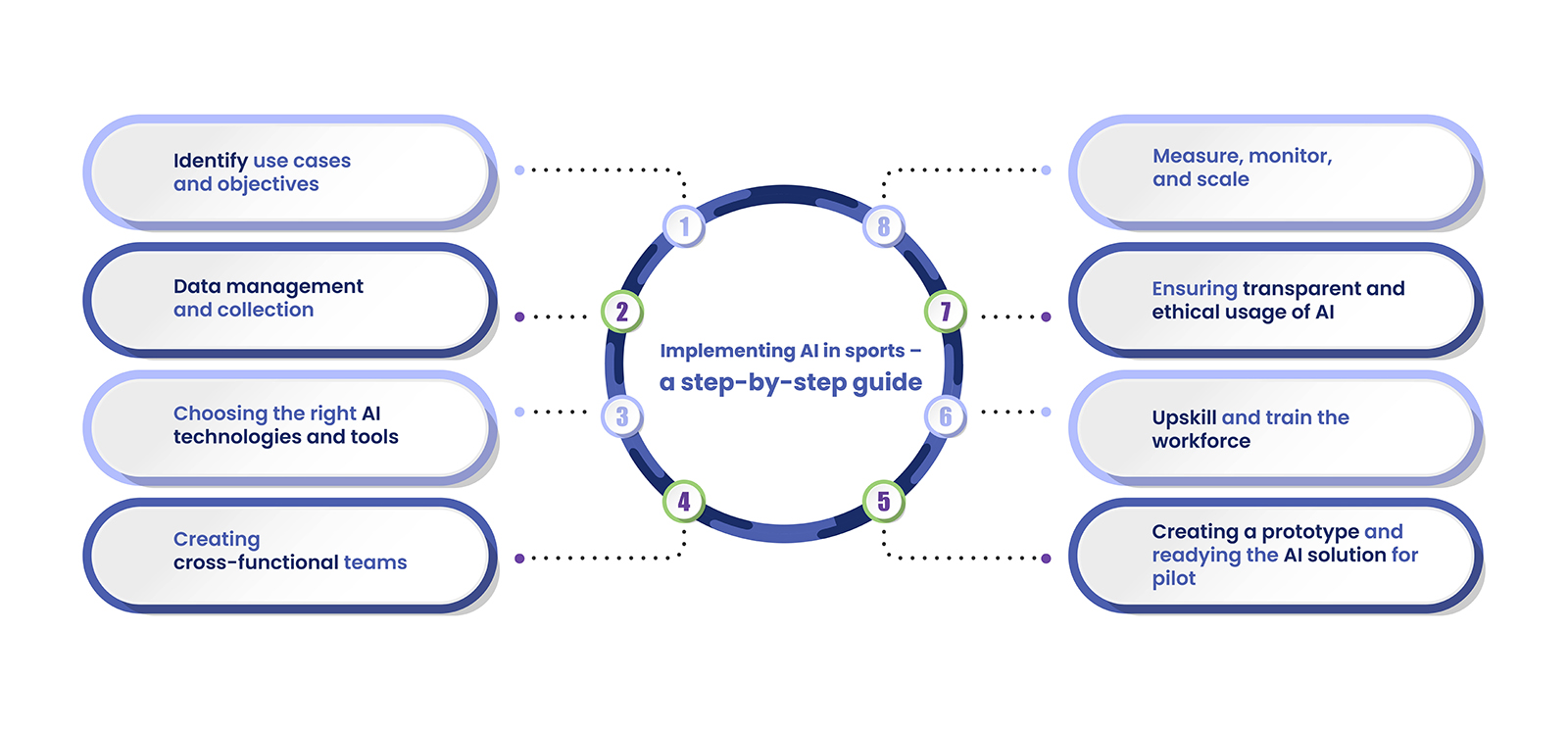
Implementing AI in sports – a step-by-step guide
Integrating AI in sports is transforming how organizations, leagues, and teams engage fans, perform, and strategize. But successful adoption of AI is not as simple as it may seem. Deployment of an algorithm is an entirely structured process that involves strategic vision, cross-functional collaboration, and data readiness.
Below, Proquantic Software USA presents a step-by-step guide that intends to walk you through the crucial details of effective integration of AI in sports organizations, along with the best practices that ensure long-term success and measurable results.
Identify use cases and objectives
Each and every successful integration of AI in sports begins with having clarity in purpose. The entrepreneurs or the users need to define the problem first, for which they need the AI solution, and how it should align with the business goals. For many organizations, this means improving fan engagement and optimizing ticket sales. For the others, it is about analyzing the performance of players or predicting injuries even before they occur.
Having a clear objective assures that the users or entrepreneurs achieve measurable outcomes and avoid fragmented adoption. For example, Football Club Barcelona uses AI to analyze match videos for their training sessions. This helps the coaches to make a more informed decision about the fitness of the players and their performance. Such targeted utility of AI in sports assures that the investments are properly translated into tangible results instead of experimental exercises.
Data management and collection
AI systems grow with abundant and accurate data, and the sports industry generates massive volumes of such data daily, right from fan analytics, cameras, and wearable devices. For making the most of AI in sports, this data has to be categorized, structured, and made accessible through a centralized platform. Faltered data management can cripple this flow and damage even the most advanced AI initiatives.
Cloud-based solutions can aid in processing and aggregating massive datasets in real-time. Moreover, maintaining data integrity through ensuring privacy, correct labelling, and filtering the duplicates is crucial. Once the pipelines of data are established successfully, teams can effectively train AI models that provide optimized strategies, reliable predictions, and tailored experiences for fans at scale.
Choosing the right AI technologies and tools
Choosing of the right tech stack determines the efficiency of the strategy of AI in sports. There are numerous AI frameworks and platforms available out there, right from OpenAI APIs for predictive insights to TensorFlow for deep learning. Sports businesses have to decide whether they must build customized solutions or leverage the readily available AI products that can quickly integrate.
For instance, NBA teams leverage Machine Learning and Computer Vision models for tracking player movements and generating heat maps that evolve with the growth of sports data and diversification of goals.
Creating cross-functional teams
Integration of AI is never never a technical initiative, but rather, it's an organizational transformation. The most efficient implementation of AI in sports includes the collaboration between sports analysts, coaches, and data scientists. This cross-functional team ensures that the AI recommendations are practical and aligned with the realities of sports.
For example, data scientists can easily determine player fatigue with the help of biometrics, while the coaches interpret the data for adjusting the intensity of the training. Such synergy between machine intelligence and human expertise enables faster and smarter decision-making across all sports management levels.
Creating a prototype and readying the AI solution for pilot
Before rolling out the solution out at full scale, organizations must test their models of AI in sports through controlled pilot initiatives. Such prototypes enable the team to evaluate the performance, gather feedback, and fine-tune the algorithms for improved accuracy. It is a safer environment for measuring the impact of the system's effect on the KPIs like fan engagement, ticket sales, and win rates.
Pilot efforts assist in the identification of unforeseen challenges, such as underperforming algorithms or data incompatibility, before committing to bigger investments. Successful pilots create confidence among stakeholders and build internal case studies that justify the upscaling of the AI deployments across diverse areas of the organization.
Upskill and train the workforce
Human capability stays central to the success of AI. For harnessing the true potential of AI in sports, it is compulsory for organizations to train and upskill their internal workforce for accurate data interpretation on data-driven insights. Upskilling operational teams, analysts, and coaches ensures that the AI is not viewed as a replacement but as an enhancement of their roles.
Hands-on practice, certification programs, and workshops with the AI dashboards enable bridging the gap between actionable decisions and complex algorithms. When employees are able to determine how AI helps them, the adoption rate accelerates and the resistance decreases, which results in a seamless transition of operations.
Ensuring transparent and ethical usage of AI
AI in sports is unparalleledly powerful, and with its great power comes its greater responsibility of operating within the ethical codes of boundaries. Privacy protection for athletes, fairness of player evaluation, and transparency of data usage are non-negotiable aspects. Bias or misuse in the AI models can affect credibility as well as create distrust among fans and players alike.
Implementing transparent data governance policies, following regional privacy regulations like GDPR, and anonymizing critical information ensures responsible usage of AI. Ethical AI deployment creates long-term trust, which makes AI a robust enabler of progress instead of controversy.
Measure, monitor, and scale
Once deployed, the AI systems need consistent monitoring to stay relevant. The sports world is dynamic, where strategies evolve, the audience changes its behavior, and new players join in every day. Frequent and consistent retraining of the AI models with updated data keeps the insights meaningful and accurate.
Performance metrics like engagement growth, operational savings, and predictive accuracy must be reviewed in every quarter. Successful pilot efforts can be easily scaled across all divisions, right from broadcast analytics to merchandising. Such a continuous feedback loop assures that the AI in sports stays as an evolving and living asset instead of a one-time project.
The best practices for the successful integration of AI in sports
Integration of AI in sports is never a one-time technological upgrade, but a long-term transformation. This upgradereshapes how organizations decide, think, and perform. For unlocking the full potential, sports enterprises, franchises, and teams have to compulsorily adopt a strategic approach that balances practicality with innovation. Successful integration not only depends on how sophisticated the algorithms are, but also on how effectively they are embedded into the culture, decision-making process, and workflows of the organization.
The key to the best practice is beginning with a clear expectation of the ROI. Before the implementation of any AI-powered tool, the sports businesses must define success. Is the goal about improving scouting accuracy or increasing fan engagement? Or is it reducing the risks of injury? Setting measurable targets assures direction and accountability for business leaders and data scientists alike. Without properly defined metrics, AI investments will easily turn into unfocused experiments that fail to justify the costs.
Cross-functional collaboration is also crucial. AI models alone are never going to fill stadiums or win championships, but people will do. Successful sports businesses and organizations must bring together business strategists, IT specialists, coaches, and analysts to align their insights. For example, while an algorithm may detect player fatigue, a coach can translate the data into training adjustments or actionable rest. Such synergy between AI-powered insights and human intuition is where the true competitive advantage remains.
Another important aspect of best practices is ethical responsibility and transparency. The AI systems have to operate, mandatorily on trustworthy data. Stakeholders, fans, and players must have the idea on how their information is being leveraged by the companies and apps. Flawed performance or bias in the recruitment algorithms not only tarnishes reputations but also affects careers. By promoting algorithmic fairness and establishing robust data governance, organizations have to build long-term credibility and ensure responsible usage of AI in sports.
Consistent improvement and scalability are also important. The sports industry, being a dynamic environment, fan expectations, player stats, and competitive landscape keep changing. AI models must be retrained on a regular basis with updated information to stay relevant and accurate. Beginning with small pilot projects enables organizations to minimize risks, learn faster, and scale what works across the numerous teams or divisions.
The very core of successful AI integration in a business begins with investing in the people. Training the company's to decipher and interpret AI insights and make informed decisions, truly empowers the organization to strive for growth. AI adoption becomes a seamless process when executives, managers, and athletes understand AI as the ultimate enabler instead of a disruptor.mless process.
In the end, integration of AI in sports is never about replacing human expertise, but completely about amplifying it. The most forward-thinking sports outfits view AI as their strategic assistants, which future-proofs their competitive edge, enhances performance, and fuels better decisions.
What we can expect in the future of AI in sports
AI has already amplified the competitiveness by a grand margin. With effective algorithms and sensors, AI has all in hand for the spectators, franchise owners, advertisers, sports companies, and game strategists. With such huge scopes for implementations, sports businesses and organizations are all likely to invest in AI development services for developing sports applications. This convergence of AI and sports is significantly redefining industry standards as well as driving innovation across the sector.
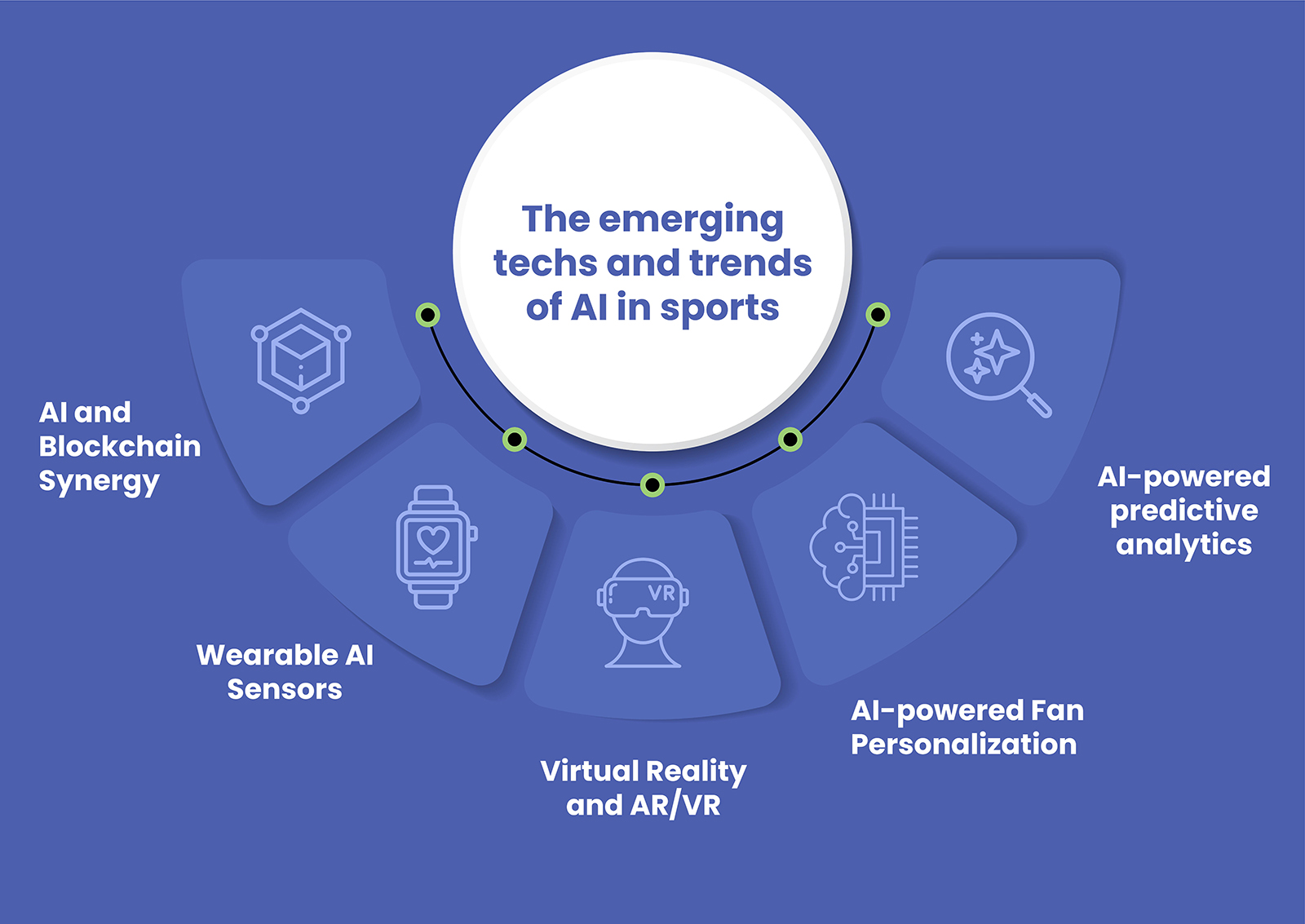
The emerging techs and trends of AI in sports
The sports industry is all set to embrace the digital evolution, powered by AI in sports. Emerging technologies are now enabling real-time, personalized, and predictive insights that were only imagination even ten years ago. Let's have a detailed glimpse at the techs and trends of AI in sports that we can expect in the future.
- AI and Blockchain synergy – The predictive intelligence of AI combined with the transparency of Blockchain will redefine event ticketing processes, athlete tokenization, and sports contracts. This will ensure both efficiency and security across all parts of the sports operations.
- Wearable AI sensors – Data-rich and miniaturized wearables will traverse beyond tracking fitness. These smart attachments will provide coaches with data on the players' biochemical compositions, optimize nutrition, monitor the stress levels, and act as the digital twin of every athlete that evolves with time.
- Virtual Reality and AR/VR – The future will witness AI merging with AR and VR for creating live viewing experiences and virtual training environments. Fans will soon watch games from the front rows virtually or even interact with the AI avatars of their favorite players.
- AI-powered fan personalization – Fan experience is gradually becoming immersive. By using real-time behavior analytics, sports platforms are now able to deliver personalized content, right from merchandising recommendations to highlight reels, which align with the preferences of the fans/ Such evolution is already evident in the NBA's utilization of AI-generated personalized clips of the games for its application users.
- AI-powered predictive analytics – Advanced AI models will soon be able to forecast player performance, injury probabilities, and even game outcomes with unparalleled accuracy. For example, companies like Zone 7 are already using the capabilities of Machine Learning for preventing injuries, predicting player fatigue, and facilitating football clubs to cut injury rates by a whopping 30%, as per a study by SportsPro Media 2024.
Such technologies, when blended, will not only improve fan experience and athlete performance but will also open new streams of revenue-earning and data-driven business models for the sports organizations.
How AI in sports is going to redefine the industry
The effect of AI in sports traverses far beyond analytics of games; it is shaping the ecosystem of the industry. Let's take a closer look:
Smart operations and sustainability – AI are even transforming stadium operations. AI-powered energy management systems are gradually optimizing power consumption, crowd management, waste control, and reducing both environmental impact and costs. Smart stadiums won't just host events, but they will act as smart ecosystems.
Enhanced fan engagement – AI is going to bring the fans closer to the game than ever before. Whether it is virtual commentators powered by generative AI or interactive live chats during the matches, or even the fantasy leagues, engagement will become more continuous and hyper-personalized.
Monetized through data – Today, the data economy is booming in sports. Organizations that understand how to harness AI for viewership trends, purchasing behavior, and interpreting fan sentiment will dominate sponsorships and marketing. AI-powered sponsorship analytics and personalized advertising will turn out to be the new gold standard for maximizing commercial ROI.
AI-powered sports medicine – The area of sports medicine, too, will be revolutionized by the AI-enabled diagnostics that can predict injuries even before they take place. Real-time data from the wearable sensors will enable quick intervention, which will extend athletic careers and reduce player downtime.
Next-generation talent scouting and recruitment – The traditional talent scouting process is being reshaped by the ability of AI to assess millions of potential players around the world. Models based on Machine Learning can today evaluate psychological, physical, and technical traits for identifying hidden talent at the earliest stages, which levels the playing field for smaller clubs.
Smarter strategies of game – AI is already assessing millions of data points from opponent tactics to player movements, offering coaches unprecedentedly useful insights. In the future, AI assistants can provide real-time tactical recommendations in the middle of the match, enabling the teams to pivot quicker than ever before.
Looking ahead
The future of AI in sports will not be about about replacing human skills but elevating them. As the algorithms turn out to be more contextual or intuitive, they will soon be empowering fans to connect deeper, coaches to think better, and athletes to perform better.
In the coming ten years, we can likely see AI functioning as the invisible core of the entire global sports frontier, right from sustainable fan operations, immersive fan ecosystems, health optimization, and talent identification. The sports organizations that embrace such transformation today will not only be able to adapt but will also define the new age of business innovation and athletic excellence.
In essence. AI will not only change how games will be played, but also how they will be experienced and remembered.

Sports app development, simplified by Proquantic
Building an AI-powered sports application requires the right blend of innovation and domain expertise, along with scalability, and this is where partnering up with a professional AI app developer stands out as an option. The professional AI app development companies, with their years of experience with AI in sports as well as enterprise-grade application development, enable sports organizations, startups, and even athletes to turn ideas into smart digital ecosystems that deliver real value.
Building AI-powered sports applications often requires multidisciplinary expertise, including AI engineers, UX designers, cloud specialists, and ERP integration experts. Businesses frequently rely on staff augmentation for ERP support teams to integrate sports platforms with enterprise systems, while workforce augmentation for service teams helps maintain customer support, technical operations, and post-launch application management.
Here's how Proquantic simplifies the sports app building process:
Flexible resourcing – With our IT staff augmentation services, businesses can quickly scale AI engineers, mobile developers, DevOps specialists, and ERP professionals. Our approach also supports staff augmentation for ERP support teams and workforce augmentation for service teams, helping organizations maintain development momentum and post-launch operations.
Customized development expertise – With our custom mobile app development services, we engineer scalable, cross-platform applications that are optimized for real-time performance.
Seamless user experience – We design engaging user interfaces for administrators, fans, and athletes to communicate effortlessly.
AI-based functionalities – We skillfully integrate personalization, performance tracking, and predictive analytics into sports applications for data-powered decision-making.
From fan engagement platforms to AI coaching tools, Proquantic enables users to harness the true power of AI in sports for innovation that turns out to be victorious both on and off the field.
Signing off
The integration of AI in sports is all set to bring a groundbreaking shift in how sports organizations operate, fans engage, and athletes perform. From AI-powered fan personalization to real-time performance, games today and tomorrow will be based on innovation. Insight and data. As the sports businesses welcome this evolution, they are not just adopting technology but also rewriting the rules and experience of competition. Having a trusted and experienced tech partner like Proquantic Software USA empowers sports organizations to reap the full potential of AI into measurable success by connecting more global audiences, creating stronger teams, and driving smarter decisions.
Frequently Asked Question About AI in Sports
How is AI used in sports today?
AI in sports is used for strategic decision-making, fan engagement, injury prevention and performance analysis by processing the massive data sets in real-time. It helps the athletes as well as teams to gain a competitive edge through gaining actionable insights.
How does AI improve player performance?
Through predictive analytics and wearable sensors, AI in sports tracks the training efficiency, fatigue, and movement of players. This facilitates intelligent workload management and personalized coaching.
What are the benefits of AI in enhancing player performance?
AI streamlines operations like sponsorship analytics, marketing, and ticketing. It enables sports organizations to enhance fan experiences and make data-powered decisions.
Will AI replace human coaching professionals in sports?
Never! AI in sports complements human expertise. It offers predictive models and data insights, but the coaching officials would still be the authority in making situational, emotional, and strategic decisions off and on the field.