


AI ROI is no longer just a speculative notion—it has become a boardroom imperative. As businesses worldwide continue to invest in Artificial Intelligence (AI) innovations, the question is no longer whether AI should be adopted, but how these investments will deliver measurable business value. According to Snowflake's 2026 survey, nearly 92% of early adopters have reported positive returns from AI initiatives, with an average return of $1.41 for every $1 invested. Meanwhile, a recent study found that nearly 90% of CFOs are seeing positive ROI from generative AI within months of deployment.
Developing an effective AI ROI strategy is now a business priority for organizations investing in artificial intelligence. Whether the objective is reducing operational costs, improving customer experiences, or accelerating innovation, every AI initiative should be backed by a measurable framework for tracking the return on investment of AI. Businesses that combine strategic planning with continuous AI ROI optimization consistently achieve stronger long-term business outcomes.
However, the landscape remains dynamic. When businesses fail to measure AI ROI proactively, investments risk becoming costly experiments without accountability. By aligning AI initiatives with clear operational, financial, and strategic objectives, organizations can move beyond the hype and turn AI into a sustainable competitive advantage.
AI ROI Strategy: How to Maximize the Return on Investment of AI
A successful AI implementation goes beyond deploying advanced technologies—it requires a well-defined strategy that aligns AI initiatives with measurable business objectives. Organizations that achieve sustainable results treat AI as a long-term business investment rather than a standalone technology project. Every successful AI ROI strategy begins with clearly defined business objectives that connect AI initiatives to revenue growth, operational efficiency, cost reduction, productivity improvements, and enhanced customer experiences. Establishing measurable KPIs before implementation provides a baseline for evaluating progress and ensures that AI investments contribute directly to organizational goals.
Another critical factor is prioritizing AI use cases that deliver the greatest business impact. Rather than attempting enterprise-wide deployment from the outset, organizations should identify areas where AI can quickly generate measurable value. High-impact applications such as AI-powered customer support, software development, predictive analytics, intelligent document processing, and workflow automation often provide faster returns while building confidence across the organization. Organizations that focus on high-impact use cases generally achieve a better return on investment of AI because they can demonstrate tangible business outcomes before expanding AI initiatives to other departments.
Measuring success should also be an ongoing process instead of a one-time evaluation. AI models evolve over time, business priorities change, and market conditions shift, making continuous performance monitoring essential. Continuous measurement is one of the most important aspects of AI ROI optimization. Organizations should monitor financial and operational KPIs through centralized dashboards, conduct quarterly performance reviews, gather user feedback, and refine AI models based on real-world performance. This iterative approach helps businesses identify opportunities for improvement while ensuring AI investments continue delivering measurable value as they scale.
Finally, enterprises should resist the temptation to roll out AI across the entire organization before validating its effectiveness. Launching small pilot projects enables teams to assess technical feasibility, measure ROI, identify adoption challenges, and optimize workflows with minimal risk. Once clear business outcomes are established, organizations can confidently scale AI initiatives across departments while maintaining governance, data quality, and performance standards. This phased approach minimizes implementation risks, strengthens stakeholder confidence, and creates a repeatable framework for maximizing long-term AI returns.
In 2026 and beyond, businesses that combine strategic planning, continuous optimization, and data-driven decision-making will be best positioned to maximize the value of their AI investments. A structured AI ROI strategy not only improves operational performance but also enables organizations to realize a stronger and more sustainable return on investment of AI as artificial intelligence becomes increasingly central to business growth.
Significance of AI ROI for modern enterprises
In 2026, AI ROI is continuously redefining how modern enterprises measure success. Artificial Intelligence has transcended beyond experimentation, and it is now the backbone of digital transformation. But the real question is not how advanced your AI is but how much value it is delivering to the business.
Driving digital transformation and business value
The AI-powered ecosystems are reshaping industries by:
- Automating the repetitive workflows for freeing the human capital for strategic work.
- Unlocking new streams of revenue through AI-based innovation and personalization.
- Optimizing decision-making with predictive analytics that improve speed and accuracy.
When the AI ROI is getting properly tracked, it enables leaders to identify the investments that fuel growth and discard the ones that drain resources.
Stakeholder confidence and leadership buy-in
Without any clear glimpse into ROI, the leadership enthusiasm quickly fades. Investors and executives require proof that AI is not just an upgrade for their business operation but also a steady enabler of profits.
Measuring AI ROI:
- Reflects on the accountability of every AI-powered initiative.
- Strengthens collaboration between businesses and technical teams.
- Creates long-term funding confidence through winning board-level trust.
Employee adoption and change management
When there’s zero human alignment, even the smartest AI fails miserably. Successful organizations:
- Integrate AI into the existing workflows instead of replacing them.
- Boost AI literacy across teams for reducing resistance.
- Celebrate early wins for building belief and momentum.
At the very core of it, AI ROI is more than just a number – it's a reflection of how effectively the vision, people, and technology can work together harmoniously. For the enterprises that aim to thrive in 2026, AI is the currency of sustainable digital progress.
How to Measure the Return on Investment of AI
In today's era of AI, measuring AI RPI has become an amalgamation of precision and art. Unlike traditional investments, returns from AI projects are multi-layered and span innovation velocity, customer satisfaction, process efficiency, and cost savings. For capturing the full picture, enterprises have to evaluate both intangible and tangible aspects of the impact.
Soft ROI vs hard ROI in AI investments
Hard ROI focuses on quantifiable and direct outcomes:
- Operational efficiency via improved accuracy and reduced downtime.
- Revenue gains from data-powered personalization.
- Cost reduction through predictive maintenance and automation.
Soft ROI, on the other hand, deals with indirect, but powerful benefits like:
- Stronger brand loyalty and customer experience.
- Enhanced decision-making confidence with AI insights.
- Enhanced employee satisfaction with reduced workload.
While the hard ROI reflects short-term profitability, the soft ROI generates sustained transformation, which should never be ignored.
Long-term vs short-term AI ROI
Organizations too often misjudge success by looking through the immediate payoffs. Short-term AI ROI reflects early wins like logistics optimization or task automation, but long-term ROI reflects the true potential of AI, like new product innovation, business model evolution, and predictive capabilities. Partnering with AI strategy consulting experts realize this long-term value and become better prepared for the future.
A Gartner report in 2026 found that the companies that evaluate both long-term and short-term AI outcomes get up to 2.6 times higher return on all investments in Artificial Intelligence, compared to the enterprises that only track short-term metrics.
The most common challenges in AI ROI measurement
Alongside the growing maturity, there are severe obstacles that businesses experience in measuring AI ROI, such as:
- Overemphasizing technology while ignoring cultural readiness and user adoption.
- Lack of baseline metrics, which makes it harder to compare the pre- and post—AI outcomes.
- Data fragmentation that leads to inaccurate tracking of performance.
For effectively measuring AI ROI, enterprises require a holistic model that integrates qualitative business value with financial KPIs. The most successful organizations treat ROI as a living metric, evolving side-by-side with AI maturity, instead of a one-time calculation.
The key metrics of AI ROI success
To maximize the AI ROI truly, organizations have to ground their evaluation in carefully chosen metrics. Such metrics broadly fall into qualitative and quantitative dimensions, and together, they provide a lens into not only the change but also the value that was created and sustained.
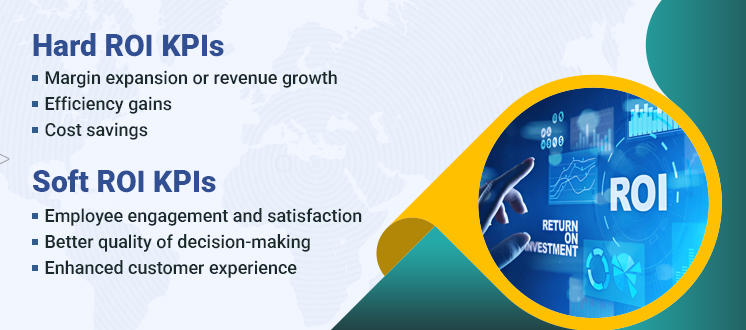
Hard ROI KPIs
Hard metrics are easy to quantify and are often persuasive with the stakeholders. The key measures are:
- Margin expansion or revenue growth – Spiked sales attributed directly to AI, for example, upselling, predictive recommendations, and new product lines.
- Efficiency gains – Measures like time saved per employee, cycle time reduction, and throughput increase.
- Cost savings – Dollars saved from downtime or lower maintenance, reduced errors, and reduced labor.
Such hard metrics anchor the AI ROI in solid business outcomes.
Soft ROI KPIs
The soft KPIs underline less obvious but equally important returns, like:
- Employee engagement and satisfaction – AI, which relieves employees from mundane work, can boost morale and retention.
- Better quality of decision-making – More confidence, quicker insights, and fewer missteps in analytics output.
- Enhanced customer experience - Higher customer lifetime value, quicker support resolution times, reduced churn, and enhanced NPS.
Often, the soft metrics act as leading indicators, the early signs that AI is reshaping operations and cultures in the most positive way.
The industry benchmarks for AI ROI in 2026
While the benchmarks differ by sector, some of the emerging norms help in guiding expectations. For instance, in the generative AI contexts, adopters are reportedly experiencing $3.71 returns for every $1 invested. Another insight from the marketing-focused AI initiatives shows that companies dedicatedly to investing in AI report nearly 20% improvements in sales figures.
However, there are multiple initiatives that are still not enough. Many sources report that nearly 42% of companies scrap a majority of their AI projects due to zero measurable returns or failures in adoption.
Such benchmarks are as crucial as guardrails, but they too need to be tailored to strategic contexts, maturity, and domain. A mid-sized retailer's AI ROI differs from that of a FinTech company, so the key here is to set realistic targets and consistently calibrate against the real performance.
Combining soft and hard KPIs alongside understanding how typical benchmarks apply to your sector will give your organization clarity about what success really looks like and the most robust way to track AI ROI over time.
AI ROI Strategy: Proven Strategies to Maximize AI Returns
Maximizing the AI ROI in 2026 needs more than just the deployment of advanced AI algorithms. It needs an integrated and strategic approach that connects people, processes, and technology. Enterprises that treat AI as a business enabler and not just as a technical tool achieve measurable results consistently. Here's a glimpse at how business can amplify their ROI effectively:
Align AI with priorities and business goals
AI initiatives offer the greatest returns when they are directly incorporated with strategic objectives. Without clear alignment, projects often turn out to be expensive experiments, fetching a limited measurable impact. Effective alignment strategies include
- Integrating AI and AI cloud integration into the existing workflows instead of creating separate systems, to ensure seamless operational impact.
- Prioritizing initiatives based on feasibility and impact, and avoiding technology adoption solely for novelty.
- Mapping AI projects to KPIs like customer satisfaction, process efficiency, and revenue growth so that ROI can be accurately measured.
- Identifying high-value opportunities where AI can bring in tangible benefits like driving customer personalization, reducing operational costs, and optimizing supply chains.
Correct alignment assures AI investments to produce real outcomes alongside ensuring seamless operational impact.
Ensuring robust governance and data quality
High-quality data is the core of any successful AI initiative. Without it, even the most advanced model will produce misleading or inaccurate results that undermine ROI. Organizations must:
- Encourage a data-powered culture where the teams know the importance of quality data that maximizes AI ROI.
- Regularly validate AI outcomes and compare them with business results for adjusting the model and detecting anomalies proactively.
- Implement policies of data governance for managing access, reducing biases, and ensuring compliance, which, otherwise, can skew AI predictions.
- Maintaining accurate, structured, and clean data sets and updating them continuously to reflect the changing conditions of business.
Robust data governance spikes trust in the AI outputs and ensures that the performance enhancements translate into measurable operational and financial benefits.
Leveraging iterative scaling and pilot projects
Deploying AI at scale often becomes a wasted investment. Pilot programs enable organizations to safely experiment, quantify returns before adoption across the enterprise, and refine models. The most important steps include:
- Launching small-scale pilot projects for testing AI in real scenarios to measure both user adoption and quantitative outcomes.
- Collecting feedback and improving workflows and models iteratively before broad scaling.
- Documenting lessons learned for reducing risks in future deployments.
- Leveraging pilot results to demonstrate ROI to executives and stakeholders, which facilitates a broader investment in AI efforts.
Iterative scaling assures measurable and predictable outcomes to prevent large-scale failures, which can erode AI ROI.
Creating cross-functional AI teams
AI success depends on collaboration across operational, technical, and business teams. This siloed approach reduces ROI and hinders the ability for a streamlined and seamless adoption.
To avoid this, organizations must:
- Streamline communication between business units and technical teams for aligning outcomes and expectations.
- Secure executive sponsorship for monitoring ROI against strategic objectives, allocating resources, and providing oversight.
- Assign trainers and change managers to ensure employee readiness and seamless adoption.
- Engage data scientists and engineers to create efficient and robust models and data pipelines.
- Include business analysts to break down strategies into actionable AI requisites.
An overview of AI ROI in application development
As the enterprises continue aligning their business goals with AI to strengthen data governance, there is one domain where the results are becoming more prominent with time, and that is application development. In the year 2026, AI is reshaping the way digital products are created, tested, and enhanced by delivering stronger customer experiences, higher quality, and faster cycles. By integrating intelligence throughout the pipeline of development, companies are able to directly boost AI ROI through measurable cost savings and time.
Quicker cycles of development with automation
Traditional pipelines of development quite often struggle with manual tasks that are repetitive in nature, like documentation, debugging, and code generation. AI automates a lot of these processes, enabling the teams to create and deploy applications in record time.
- Planning predictive sprints leverages AI to forecast workloads, optimize team allocation, and minimize the release timelines.
- Automated documentation powered by NLP models ensures that every feature or module stays updated and reduces technical debt.
- AI-powered coding tools like Tabnine and GitHub Copilot enable developers to write accurate code, up to 55% quicker, and accelerate the delivery without hampering the quality.
The time savings contribute directly to achieving a better AI ROI and enabling organizations to capture market opportunities quickly and launch products faster.
Reduced cost through automation testing and bug detection
Historically, software testing is resource-heavy and consumes nearly 30% to 40% of the entire development costs. AI-powered automation is transforming the arena heavily.
- AI-powered testing tools can automatically execute, generate, and validate test cases and drastically reduce error rates and human efforts.
- Predictive analytics determines system vulnerabilities or potential bugs before the deployment phase, reducing the costs of post-launch maintenance.
- Consistent and proactive monitoring, powered by Machine Learning, determines performance issues in real-time, which improves customer satisfaction and uptime.
By reducing downtime and the cost of rework, AI-based debugging and testing significantly enhance AI ROI across the entire lifecycle of development.
Driving customer value with AI-based innovation
Beyond cost and speed, the real strength of AI in app development is in personalization and innovation.
- Vision and voice AI are enabling the intuitive experiences of apps that align well with how users are naturally interacting with technology.
- Chatbots and recommendation models build personalized user journeys, driving retention and engagement.
- AI analytics engines interpret the user behavior for designing features that anticipate the customer's needs.
Such customer-focused abilities transform every app into a dynamically evolving product that delivers value continuously, as an essence of long-term AI ROI.
AI, in essence, has turned into a silent architect behind modern app ecosystems. By speeding up the cycles, personalizing user experiences, and cutting testing costs, it transforms every development hour into measurable value for the business. For the enterprises in 2026, the path of maximizing AI ROI is proactively run through AI-powered, intelligent application development.
AI ROI optimization in the content supply chain
Another crucial domain where AI's impact is becoming more prominent, significantly, is the content supply chain or CSC. For organizations that are managing massive volumes of digital assets, from product data to marketing materials, AI ROI optimization within the content supply chain is turning into a strategic priority. In 2026, success is not just defined through task automation, but also about integrating AI holistically to foster cultural readiness and striking a balance between creativity and efficiency.
A holistic approach to AI integration
Organizations often wrongly treat Artificial Intelligence as a singular tool, instead o an enabler. This fragmented approach leads to creation of data silos, dilutes ROI, and makes workflows inconsistent. A holistic AI integration strategy of the CSC ensures efficiency across the content lifecycle and end-to-end visibility, right from the phases of ideation to distribution.
- Content scoring and predictive analytics enable teams to prioritize assets that will perform the best, based on channel behavior and audience insights.
- AI-powered metadata management and content tagging accelerate localization efforts and enhance discoverability, which saves teams hundreds of hours every month.
- By connecting digital assessment management, analytics tools, and content management systems through AI, companies can streamline the content flow, compliance management, and version control.
Such system-wide optimization drives measurable efficiency gains and ensures that every investment in AI compounds into a higher ROI.
The role played by change management in the success of ROI
AI transformation is as much about the people, just like technology. Structured change management and leadership buy-in are vital for ensuring teams understand the reasons behind AI adoption. Without such an alignment, even the most advanced tools risk underperforming.
- Iterative feedback loops between user and leadership foster measurable progress against AI ROI goals and accountability.
- Upskilling programs facilitate operational and creative teams to collaborate effectively with AI systems instead of feeling replaced by them.
- Transparent communication about AI's expected outcomes and purpose builds trust and reduces employee resistance.
When the team feels equipped and included, adoption accelerates and transforms a potential point of friction into innovation and an operational gain multiplier.
Creative freedom and risk management
Balance between creativity and automation is a commonly misunderstood aspect of AI in CSC. AI enhances consistency and speed, but excessive reliance on it can deter content's originality. This, in the long-run degrades customer engagement and brand authenticity.
- Customizable AI models enable creative teams to preserve brand narrative, emotion, tone, and fine-tune generative outputs, while still leveraging the scalability of AI.
- Model audits and bias detection enable organizations to maintain ethical standards of content generation as well as regulatory compliance.
- Human-in-the-loop governance assures that the creative oversight remains intact, especially in areas of high impact like campaign ideation or branding.
By maintaining the balance, businesses can safeguard their brand trust and voice while reaping the efficiency benefits from AI.
In essence, optimization of AI ROI within CSC is all about convergence, where the technology, creativity, and process work harmoniously. When the integration is holistic, creative risk is managed smartly, change is people-first, and businesses are able to unlock the full potential of AI, not just as a catalyst for strategic growth but also as a cost-saving mechanism.
AI ROI Optimization Best Practices
After aligning the business goals with AI investments, organizations must focus on the discipline of execution, which is the bridge between measurable performance and AI potential. The organizations that consistently achieve higher ROI in 2026 are not the ones that only deploy AI but also continuously refine it through human collaboration, adaptation, and learning.
Learning from the user data
Data acts as the fuel for various AI systems but learning from user data is what transforms the AI from being functional to a truly strategic addition. Today's AI models thrive on the feedback loops, interaction patterns, and behavioral insights that reflect the dynamic of the real world.
- By analyzing the points of user friction, organizations can predict needs before they even arise, which drives up both retention rates and customer satisfaction.
- AI models that learn from performance metrics, error rates, and system logs help in improving productivity and reducing redundancies.
- AI systems that are trained in real-time engagement metrics adapt faster and deliver recommendations or content that align well with the evolving needs of the consumer.
A McKinsey study finds that businesses that use user-centric AI models experience up to 30% more ROI on the investment for AI as compared to those who still rely on static and one-time models. This proves that the dynamic learning is more than a feature – it's a differentiator.
Feedback loops and iterative implementation
Achieving a higher AI ROI is never a one-time milestone for companies, but it's a continuous calibration. Successful enterprises adopt the iterative AI implementation, where each phase informs the next phase, turning feedback into functional upgrades.
- Transparent dashboards that track the performance of AI against ROI targets enable teams to maintain momentum and accountability.
- Consistent evaluation from managers, developers, and end-users ensures that the AI remains well-aligned with both expectations and goals.
- Beginning with small AI pilots, evaluating the results with well-defined KPIs and scaling gradually based on the success metrics is a great way to initiate.
This iterative model not only ensures that the ROI curve trends upward with every implementation cycle but also prevents large-scale deployment risks.
Human expertise in balancing automation
AI carries expertise in pattern recognition and data processing. But its real value emerges with the augmentattion of human intelligence, rather than replacing it. The ability to strike the optimal level between human expertise and automation is the key to the sustenance of a long-term AI ROI.
- Collaborative decision-making compiles human intuition with algorithmic precision, which leads to a more impactful and nuanced business outcome.
- Adaptive task allocation enables humans to focus on high-value and strategic activities while the AI handles analytical or repetitive tasks.
- HITL or Human in the Loop framework ensures that the ethical creativity, oversight, and emotional judgement stay intact.
Ensuring transparent and ethical AI
In 2026, AI ROI is no longer gauged by only efficiency or revenue, but also by trust. Transparent AI systems that express decision-making processes build stakeholder confidence and create brand credibility.
- Communicate AI outcomes openly to stakeholders for consistent alignment.
- Consistent AI audits identify data drift, bias, and ethical blind spots.
- Implement the explainable AI or XAI frameworks for ensuring decisions are understandable or traceable.
Ethical AI practices not only mitigate the reputational risks of the company but also make businesses more sustainable in the long run.
Organizational readiness and consistent upskilling
Even the smartest AI models fail when the human teams are not prepared to use them effectively. Investing in AI literacy and consistent learning aids in maintaining workflows and scalability.
- Leverage performance-based learning programs that align well with the evolving AI frameworks and tools.
- Encourage cross-functional collaboration between creative teams, data scientists, and business analysts for maximizing innovation.
- Consistent AI awareness sessions ensure that all departments can determine how AI influences their workflows.
In short, AI ROI maximization needs a culture of ethical deployment, iteration, and learning. When businesses evolve continuously alongside their AI systems, and not merely implement them. With this, ROI turns into a dynamic metric that compounds with every human decision enhanced and every insight gained.
AI ROI Optimization Best Practices for 2026
As Artificial Intelligence continues to mature, organizations are shifting their focus from simple implementation to sustainable value creation. In 2026, successful enterprises are not just deploying AI solutions—they are continuously refining them to maximize business impact. Effective AI ROI optimization requires a combination of technological innovation, operational discipline, and strategic oversight. By embracing emerging trends while maintaining strong governance practices, businesses can significantly improve the return on investment of AI.
Leveraging AI Agents for Greater Automation
AI agents are rapidly transforming how organizations execute complex workflows. Unlike traditional automation tools, modern AI agents can reason, make decisions, and complete multi-step tasks with minimal human intervention. From customer support and sales operations to software development and supply chain management, AI agents are helping businesses reduce operational costs while improving productivity. As agentic AI becomes more capable, it will play a central role in every forward-looking AI ROI strategy by enabling organizations to scale operations efficiently without proportionally increasing resources.
Embracing Multimodal AI Capabilities
Modern AI systems are no longer limited to processing text alone. Multimodal AI can analyze and generate insights from text, images, audio, video, and structured business data simultaneously. This capability enables richer customer experiences, faster decision-making, and more accurate predictions. Organizations that integrate multimodal AI into their operations can unlock new revenue opportunities while enhancing operational efficiency, making it a powerful driver of long-term AI ROI.
Strengthening AI Governance and Compliance
As AI adoption expands, governance becomes increasingly important. Poorly governed AI systems can introduce risks related to data privacy, regulatory compliance, bias, and security. Organizations should establish clear governance frameworks that define accountability, data management policies, model validation procedures, and ethical AI standards. Strong governance not only reduces business risk but also improves stakeholder confidence, creating a more sustainable foundation for maximizing the return on investment of AI.
Investing in AI Observability and LLM Monitoring
AI performance cannot be optimized if it is not properly measured. AI observability platforms provide visibility into model performance, prediction quality, usage patterns, and operational health. Similarly, Large Language Model (LLM) monitoring helps organizations identify hallucinations, performance degradation, prompt vulnerabilities, and cost inefficiencies before they affect business outcomes.
By continuously monitoring AI systems, organizations can:
- Detect model drift early.
- Improve output quality and reliability.
- Reduce operational risks.
- Maintain compliance standards.
- Optimize resource utilization.
This level of visibility is becoming a core component of modern AI ROI optimization strategies.
Optimizing Costs Through Smart Model Selection
Many organizations assume that larger AI models automatically deliver better business outcomes. However, the most expensive model is not always the most cost-effective. Businesses should evaluate models based on performance requirements, scalability, inference costs, and business objectives. In many scenarios, smaller specialized models can deliver similar results at a fraction of the cost.
Strategic model selection allows organizations to balance performance and expenditure, ensuring AI investments generate measurable value while avoiding unnecessary operational expenses. This approach is becoming a critical pillar of every successful AI ROI strategy in 2026.
Maintaining Human Oversight for Sustainable Growth
Despite advances in automation, human expertise remains essential for maximizing AI value. Human oversight ensures ethical decision-making, quality control, regulatory compliance, and alignment with business goals. Human-in-the-Loop (HITL) frameworks help organizations combine AI efficiency with human judgment, reducing risks while improving overall outcomes.
Organizations that balance automation with human expertise consistently achieve stronger business results because they maintain trust, accountability, and adaptability. As AI systems become increasingly autonomous, human oversight will remain a crucial factor in protecting and enhancing the long-term return on investment of AI.
In 2026 and beyond, organizations that combine AI agents, multimodal intelligence, governance frameworks, observability practices, cost optimization strategies, and human oversight will be best positioned to achieve sustainable growth. These best practices not only improve operational efficiency but also create a scalable framework for continuous AI ROI optimization, ensuring AI investments deliver measurable business value for years to come.
Trends to impact the AI ROI in 2026 and beyond
As the enterprises mature in their journey of AI adoption, the definition of AI ROI is dynamically evolving beyond efficiency gains or traditional cost. In 2026, it is about long-term competitive advantage, adaptability, and resilience. Shifting business paradigms and emerging technologies are reshaping how organizations optimize, deploy, and measure AI.
Agentic workflows and AI agents
AI agents' ability for goal-focused execution, decision making, and reasoning with minimal human input is a striking trasformative development. Such agentic workflows are gradually replacing static automation with context-aware and dynamic intelligence.
- Digital agents and AI copilots can now manage end-to-end business processes, right from optimizing supply chain routes in real-time to handling customer service tickets.
- Adaptive collaboration between numerous AI agents facilitates self-improving workflows and reduces inefficiencies.
- As per a study by Gartner, by the year 2027, more than 40% of the enterprise operations will be managed autonomously by the AI agents, which will potentially double AI ROI compared to the current benchmarks.
This transition enables organizations to scale operations with fluidity and quickly respond to dynamic market changes, improving the ROI with sustained agility.
AI in product innovation, marketing, and cybersecurity
The role of AI is expanding across the core functions of the enterprise, with each unlocking distinct AI opportunities.
- The AI-powered threat detection systems neutralize and predict attacks actively. Autonomous response mechanism has the ability to reduce the breach-related losses by up to 80%, which directly translates into enhanced AI ROI as well as risk-edited profitability.
- Hyper-personalized campaigns powered by generative AI as well as predictive analytics are reducing ad wastage and increasing engagement rates. Such data-driven creativity assures ROI extends beyond the conversions and includes the lifetime value of the customer.
- AI-powered simulation platforms and design tools drastically reduce the cycles of prototyping, cutting down the cost of R&D alongside accelerating time-to-market.
Evolving the AI models and shifts in ROI measurements
As AI systems are turning more autonomous, the traditional metrics of ROI, like productivity or cost savings, can no longer tell the full story. Organizations are now focusing on the multi-dimensional ROI models that capture sustainability, adaptability, and impact on ecosystems.
- Track how quickly the AI models can self-optimize over time.
- Evaluate how AI-driven systems are maintaining operations during disruptions.
- Measuring the contribution of AI to reducing carbon footprints and energy efficiency.
AI ROI in the coming years, will be defined not just through financial gains, but also by how autonomously, sustainably, and intelligently the organizations can evolve with the technology.
Optimize your AI ROI with a reliable AI developer
Maximizing the AI ROI needs more than just deployment of algorithms; it demands specialized execution, scalability, and strategy. That is where experienced partners like Proquantic make a tangible difference. With years of experience in engineering AI software development, Proquantic empowers enterprises to transform their AI investments into measurable business outcomes.
Here is how working with our professional AI developers can be beneficial for your organization:
-
Years of technical expertise – Proquantic’s seasoned engineers, data scientists, and AI architects provide scalable, compliant, and high-performing personalized AI solutions across the industries.
-
Greater confidence with reduced risks – Extensive delivery experience aids in mitigating performance risks, integration hurdles, and data biases for ROI-focused outcomes.
-
Consistent support and innovation – Iterative scaling, automation, and predictive analytics keep the AI systems evolving with dynamic business goals.
-
Robust data integrity and governance – Transparent workflows, secure architecture, and robust data governance make the very core of a sustainable AI ROI.
-
Resource flexibility and scalability – The staff augmentation model enables organizations to scale teams effortlessly and match project budgets and needs.
-
Quicker time-to-value – Reusable modules and proven AI frameworks speed up the delivery and enable quicker ROI without sacrificing innovation or creativity.

Conclusion
Sustaining AI ROI in 2026 and the years ahead requires a clear roadmap that is built on human collaboration, iterative scaling, ethical governance, and measurable goals. Businesses have to prioritize data quality and align their core objectives with AI, monitor the soft and hard KPIs to ensure a lasting impact. An AI-vision, ready for the future, traverses beyond the concept of automation and also focuses on strategic reinvention, continuous learning, and adaptability.
Partnering with reliable and experienced AI software development teams like Proquantic Software USA enables businesses to transform intelligent business innovation into business value for the long term and AI investments into time-tested competitive advantage.
FAQs About AI ROI
What is AI ROI? What is its importance?
AI ROI measures the value businesses get from AI investments, versus what they put in. It is crucial as it changes AI into a strategic and accountable investment from a speculative expense.
How quickly can businesses witness AI ROI?
Short-term wins begin to appear from 6 to 12 months through efficiency gains or automation. Long-term ROI gains may take 1 to 3 years as AI scales and begins to compound value.
What metrics must businesses use to measure AI ROI?
Businesses must leverage Hard KPIs as well as Soft KPIs for capturing the full value of AI ROI.
What are the most common challenges in realizing AI ROI?
Unclear baselines, lack of governance, poor model adoption and data silos often undermine the AI ROI reflections and create delays on capturing true values.
How does scaling the AI projects affect AI ROI?
Scaling successful pilots ensures gains in marginal compound but scaling without feedback loops and governance can erode the AI ROI rather than amplifying it.