


Don’t find customers for your products, find products for your customers – Seth Godin.
From the excerpt above, it's crystal clear that organizations like yours must stay ahead of competitors to become pioneers in the industry, and B2B Ecommerce is not an exception. Companies used to rely on offline marketing efforts for boosting B2B sales, but those days are now gone—pen, paper, and corded telephone lines have been transformed digitally.
Traditional B2B organizations are steering towards digital channels, and according to a Gartner study, by the end of 2025, nearly 80% of B2B sales interactions will take place through ecommerce platforms.
To help modern businesses navigate this newly transformed landscape of B2B Ecommerce sales, we have created this guide to help them comprehend the essentials. This guide covers potent marketing strategies, common misconceptions, emerging trends, and fundamentals of B2B Ecommerce's role in today's enterprises.
A successful B2B ecommerce development strategy goes beyond building an online storefront. It involves creating scalable B2B ecommerce solutions that streamline procurement, automate order management, integrate with ERP and CRM systems, and deliver personalized buying experiences. By investing in the right B2B ecommerce platforms, businesses can improve operational efficiency, expand their digital reach, and meet the growing expectations of modern B2B buyers.
Importance of B2B Ecommerce
ecommerce platforms are more than just digital storefronts—they are powerful tools that help streamline sales and procurements, reduce overhead costs, and boost efficiency through automation of traditional manual tasks—which, in general, are handled by human representatives.
By integrating B2B Ecommerce, organizations are no longer limited to a particular area. They will have access to a vast network of suppliers and potential leads, helping businesses expand their reach and grow beyond the general boundaries.
B2B Ecommerce is strengthened by robust ecommerce platforms that act as the core of modern business transactions. They are loaded with features like:
- Seamless integrational capabilities with business systems like CRM, ERP, HRMS, etc.
- Bulk order processing
- Custom-centric and customer-specific pricing
- Detailed product catalogues
By properly leveraging these capabilities, businesses can decrease operational costs and deliver better customer experience.
The different kinds of B2B Ecommerce models
B2B Ecommerce is rapidly transforming businesses, with digital channels accounting for 30% of the B2B sector's revenue in 2024. With more companies adapting to the digital ecosystem, choosing the best-suited B2B Ecommerce model can significantly streamline operations, boost revenue, and improve efficiency.
Each B2B Ecommerce model serves various business needs, such as simplifying bulk purchases, enhancing supply chain efficiency, reaching end customers, etc.
Let's look at some of the conventional B2B models and explore how they work:
Business-to-business-to-consumer (B2B2C)
The B2B2C model enables businesses to sell services or products to companies, which then sell the same to consumers. This approach uproots intermediaries and empowers brands to reach end customers efficiently.
For instance, food delivery companies partner with restaurants and deliver food to end consumers without having restaurants set up their own delivery infrastructure. Custom mobile app development services plays a key role in enabling such seamless interactions between businesses and end users. Also, financial services like Afterpay or Klarna enable retailers to provide a buy-now-pay-later option directly on ecommerce websites, which enhances the shopping experience.
This entire model bridges the gap between consumers and businesses, empowering wholesalers and manufacturers to widen their reach and maintain better control over pricing and branding.
Wholesale
Wholesale B2B Commerce involves businesses purchasing goods in bulk at nominal prices from manufacturers and then reselling them to retailers. This creates the B2B Ecommerce model between retailers and wholesalers and is popular across many industries.
Reputable companies like Uline specialize in office supplies and shipping. Alibaba is a global marketplace for bulk purchases. The platform buys products from manufacturers and sells them to retailers, exemplifying wholesale B2B Ecommerce.
The wholesale ecommerce platforms offer integration with inventory setups, bulk order management, and volume-based discounts, enabling businesses to scale efficiently by reducing operational costs.
Manufacturer
The job of a manufacturer is to produce the goods at a large scale and then sell them to wholesalers, distributors, and other manufacturers. This B2B model is ideal for the consumer goods, automotive, and electronics industries.
For example, Intel, the world's pioneering semiconductor chip manufacturer, sold its products to leading computer manufacturers to integrate the chips into consumer products. Manufacturers, too, benefit from ecommerce as they can track direct orders, create production schedules, and personalize pricing, which further streamlines the procurement process.
As manufacturers adopt ecommerce, they can also enhance their connections with suppliers, automating order fulfillment and reducing production errors.
Distributor
Distributors act as the intermediaries between buyers and manufacturers, handling logistics activities like marketing, shipping, and packaging. They are crucial in ensuring the products reach businesses efficiently and seamlessly.
A popular example is Grainger, a renowned distributor that supplies operation and maintenance products to various companies across many industries. Ecommerce platforms enable distributors to offer improved customer service, flexible shipping options, and real-time stock updates.
By leveraging B2B Ecommerce, distributors can improve the transparency of the supply chain, reduce delivery times, and more effectively manage bulk orders, which leads to enhanced customer satisfaction.
Marketplaces to D2B (Direct-to-Business)
The D2B business model involves suppliers, brands, and manufacturers selling directly to D2B businesses without the interference of intermediaries like distributors or wholesalers.
B2B marketplaces like Alibaba or Amazon provide a solid platform where sellers can easily list their products and make it easier for businesses to procure various items from a single place.
Both the marketplace and D2B models bring advantages, like access to a broader audience without the complexity of the traditional distribution channels.
E-procurement and procurement platforms
Procurement is crucial for B2B businesses that involve sourcing goods and services directly from suppliers. E-procurement platforms digitalize the entire process and offer tools for improved spend tracking, workflow automation, and supplier management.
The platforms enable businesses to gain better control over purchasing decisions, increase efficiency, and reduce costs. For example, Enterprise Application Development, such as e-procurement software, can integrate easily with an ERP system to provide real-time data insights, enabling businesses to make smart purchasing decisions and maintain the right inventory levels.
Selecting the best B2B model entirely depends on the business's operational requirements, target audience, and goals. Whether you are a distributor who wants to streamline logistics or a wholesaler who wants to amplify your business reach, B2B Ecommerce will help you stay ahead in today's dynamic digital economy.
The crucial stages of B2B navigation and how to navigate them
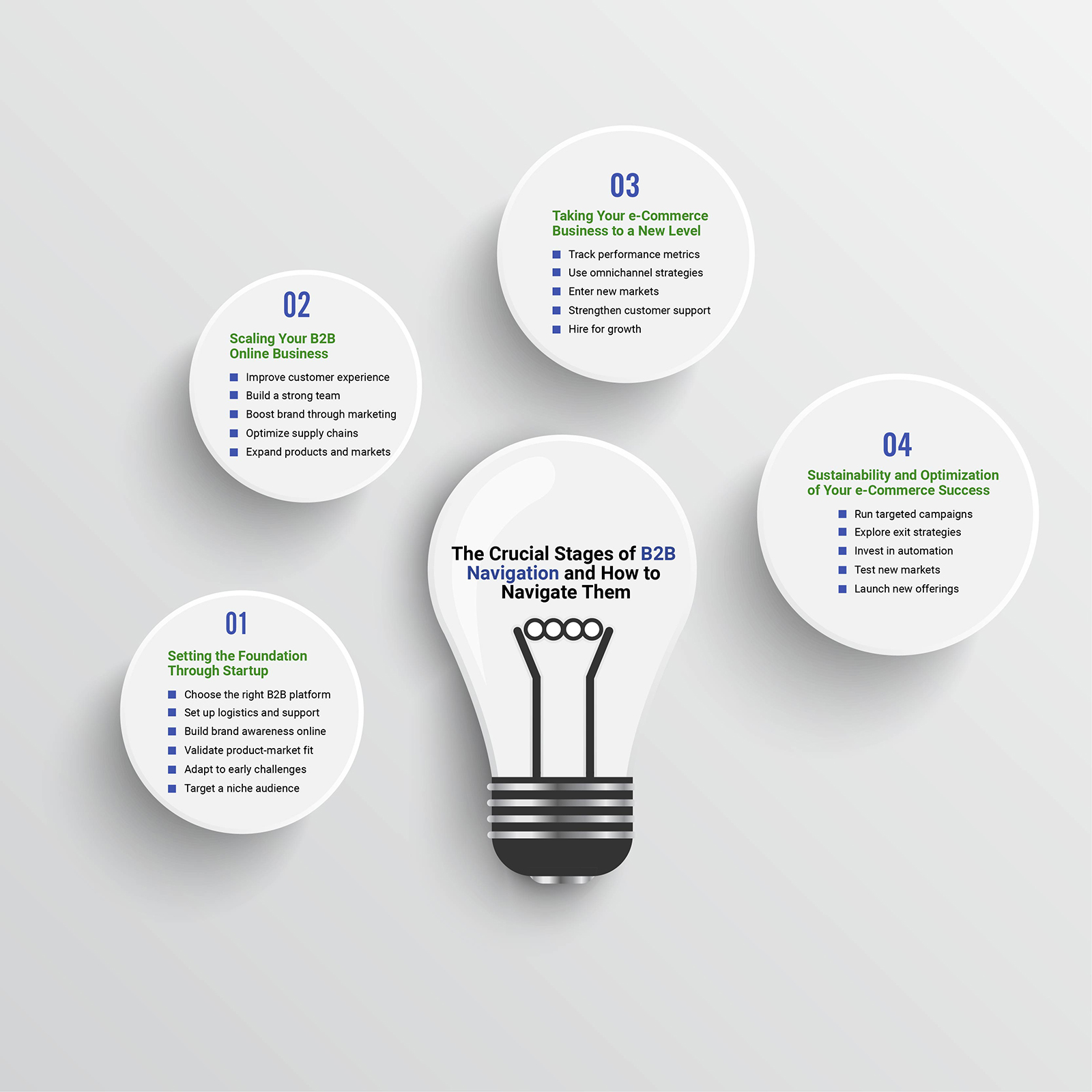
Setting up a successful navigation does not occur overnight. It is dynamic and goes through various transformational stages. Whether you are looking to scale or just a startup, having a clear understanding of the phases will enable you to make informed decisions and help you build a business for the long term.
Here’s a detailed take:
Phase 1 – setting the foundation through startup
During the startup stage, with the commencement of your B2B journey, your idea or vision takes the shape of reality through market testing and obtaining more customers. It is a significant phase where entrepreneurs like you establish the groundwork for consistent future growth through validation of your business idea, fine-tuning your product to meet market demand, and understanding customer needs.
At this stage, choosing the right B2B Ecommerce platform for your business is crucial because it will provide the infrastructure required to scale effectively. Here's a detailed look:
- Selecting the right ecommerce platform—A customized B2B Ecommerce platform can give your business the tools needed to manage bulk orders, seamlessly integrate with your business management software, and personalize pricing.
- Operational setup – Set up efficient logistics, customer support, and order fulfillment processes.
- Brand positioning – Create brand awareness through potent content strategies and an effective digital marketing plan to establish credibility.
- Customer acquisition – Initiate by targeting a niche audience and expand gradually.
- Market validation – Ensure that your services or products can solve every real problem and deliver value to the target audience.
Challenges are inevitable at this stage because your business might struggle with pricing uncertainties, slow sales, and even figuring out the right messaging for attracting the right consumers. However, selecting the right platform and staying flexible to market feedback will definitely enable you to overcome them.
Once you start getting the traction expected, then you enter
Phase 2 – scaling your B2B online business
The growth stage is where things start taking shape—sales become more in-line and organized. New customers will discover your brands and your operations will expand. This phase is about scaling the business, reinvesting in potent strategies, and optimizing operations.
To succeed, focus on:
- Improving customer experience – Invest in delivering more efficient and personalized solutions for retaining customers and increasing loyalty.
- Create a strong, dedicated team—Hire the best talents and key personnel across your customer support, operations, and sales departments to manage the growing demand.
- Strengthen your brand position—Use targeted B2B marketing strategies like account-based marketing, SEO, and content marketing to boost visibility.
- Optimize your supply chains—Integrate your ecommerce platform with logistics providers, warehouses, and suppliers to enhance speed and efficiency in order fulfillment.
- Boosting market reach – diversify your product or service offerings, reach untapped customer clusters, and enter new markets.
At this stage, if your business is agile and driven by data, you can overcome any challenge. Revisit your operation processes, improve your customer engagement quality, and keep investing in adopting new technology to achieve sustained success for your business.
This brings us to our next
Phase 3 – taking your ecommerce business to a new level
At this stage, you can experience rapid business growth with increased sales and a steady cash inflow, and you are gradually moving towards the break-even point. At this point, you can scale your operations, diversify your sales channels, and enter new markets to maintain momentum.
Here, you should focus on:
- Maintaining consistent growth – Track all key performance metrics for optimizing processes and sustaining business expansion.
- Enhancing market strategy – Take an omnichannel approach to providing an engaging and seamless customer experience.
- Expanding to new markets – Explore new areas and industries to increase your customer base and amplify your revenue streams.
- Building strong support for customer support — Ensuring customer satisfaction with reliable solutions will help you gain and retain more of the target audience.
- Hiring skilled talents – Recruiting the right professionals to support your business growth with operational efficiency.
Expansion, too, comes with its fair share of challenges. With competition becoming tougher, enterprises need to make strategic investments and intelligent decisions to stay ahead. Whether you are optimizing your B2B Ecommerce platform, logistics, or scaling your team, resourceful allocation is crucial.
Once you have touched all the miles of this stage, you will reach the next
Phase 4 – Sustainability and optimization of your ecommerce success
The maturity stage, or phase 4, is a crucial milestone in your B2B Ecommerce enterprise's journey toward growth and success. Your operations run seamlessly, cash flow is predictable, and sales are stable, as expected. The market presence of your business is strengthened, and your business is placed for long-term sustainability. The key focus areas in this stage are:
- Expansion of market efforts — amplifying brand visibility with targeted campaigns will sustain your business growth and improve customer engagement.
- Considering exit strategies — Evaluating options like leadership transitions, acquisitions, or mergers prepares your business for the unpredictable future.
- Investment in new technology – Using advanced ecommerce solutions and automation to optimize efficiency and customer experience.
- Testing new markets – Explore untapped opportunities for increasing market share and diversifying revenue streams.
- Expansion of product offerings — The Introduction of new services or products to meet the growing needs of customers and stay competitive.
At this stage, entrepreneurs like you should focus on impressing and attracting new customers and maximizing profitability. Your business understands the pulse of the market, allowing you to refine strategies that ensure success in the long term. As your business transforms into a strong system, you will be able to explore new opportunities for expansion while maintaining operational excellence.
B2B Ecommerce - strategies for growth
Implementing potent B2B Ecommerce marketing strategies will assist your business in attracting new customers, driving sustainable growth, and retaining existing customers. We have mentioned a few of them below:
- Educate your customers to engage them with relevant information and keep their trust in you.
- Guide your existing customers through your transition journey from offline to online with support and clear communication.
- Technology improves customer service quality. Embrace and adopt the right tools and new technology to reduce manual effort, provide more personalized support, and retain customers.
- Using digital channels like e-mail, social media, and Google Ads will attract new customers and retain the old ones.
- In B2B Ecommerce, the key to success is personalization for creating meaningful connections with your audience, addressing their issues, and meeting their needs with unique concepts, products, and services.
The Future of B2B Ecommerce
A study conducted by McKinsey and Company found that B2B Ecommerce is an incredibly effective sales channel. Grandview Research forecasted that the value of this market will reach $57.6 trillion by the year 2030, and the USA alone will see an annual growth rate of 10.7%.
A BigCommerce Report suggests that over 90% of global B2B buyers expect a convenient and user-friendly shopping experience on B2C sites.
A Statista survey revealed that one in every four US B2B companies has already integrated AI technologies in their ecommerce operations, and this ratio is soon expected to be more on the side of AI adoption to stay aligned with the economy's inclination towards AI-powered solutions.
Trends of B2B Ecommerce to Look for in 2025
In the current year, B2B Ecommerce will continue to evolve rapidly, with an increasing number of customers expecting ethical business practices, cutting-edge technology, and seamless experiences. Embracing the trends mentioned below will enable ecommerce businesses to stay ahead of the competition and amplify their capabilities to heighten the demands of modern business buyers. Take a look:
- AI-powered personalization — As AI becomes more sophisticated, adopting it will empower the business to deliver highly personalized support, pricing, and product recommendations. With real-time data analysis, AI will help businesses respond to customer needs quickly and boost customer satisfaction.
- Progressive web apps — Progressive web apps, or PWAs, provide a seamless shopping experience. They also provide an app-like experience without the requirement of downloading. They adapt to various devices, load quickly, and provide a unified, seamless, and efficient buying journey across mobile and desktop devices.
- Rise of mobile commerce – In 2023, 72% of global ecommerce sales were made through mobile devices, and this number is expected to increase to nearly 88% by 2027. Entrepreneurs have to ensure that their ecommerce websites and apps load fast, have an intuitive layout and enable the business to capture the growing audience with reduced rate of cart abandonment.
- Advanced data analytics — Data analytics tools will give entrepreneurs better insights into market trends and customer behavior. The tech will turn raw data into actionable strategies that will enable business owners to refine their marketing efforts, respond to quickly shifting demands, and improve product lines.
- Ethical and sustainable ecommerce — Customers are increasingly looking into brands that prioritize ethical sourcing and sustainability. By showcasing your company's commitment to transparent supply chains and eco-friendly products or services, you can appeal to socially conscious buyers and help strengthen brand loyalty.
How to Choose the Right B2B Ecommerce Platform
Selecting the right B2B ecommerce platform is one of the most important decisions for any business planning its digital transformation. The ideal platform should support bulk ordering, customer-specific pricing, ERP and CRM integrations, advanced analytics, secure payment gateways, and scalable architecture. Businesses should also consider customization capabilities, mobile responsiveness, multi-store management, API support, and long-term scalability. Whether you're planning a new B2B ecommerce development project or upgrading an existing system, choosing the right platform lays the foundation for sustainable growth and operational efficiency.
Some popular B2B Ecommerce platforms
Adobe Commerce (Magento)
Adobe Commerce (formerly Magento) is one of the most powerful B2B ecommerce platforms for medium and large enterprises. It offers advanced features such as customer-specific pricing, bulk ordering, custom catalogs, and seamless integration with ERP and CRM systems. Its extensive customization capabilities make it a popular choice for businesses with complex ecommerce requirements.
Shift4Shop
Shift4Shop is a cloud-based B2B ecommerce platform designed to help businesses launch and manage online stores with ease. It includes built-in SEO tools, inventory management, secure payment processing, and mobile-friendly storefronts. The platform is well-suited for small and mid-sized businesses looking for an affordable and scalable ecommerce solution.
Salesforce Commerce Cloud
Salesforce Commerce Cloud is a leading B2B ecommerce solution that enables businesses to deliver personalized buying experiences across multiple digital channels. It leverages AI-driven insights, automation, and seamless integration with Salesforce CRM to improve customer engagement and streamline sales processes. The platform is ideal for enterprises focused on scalability and digital transformation.
SAP Commerce Cloud
SAP Commerce Cloud is an enterprise-grade B2B ecommerce platform built for organizations with complex sales processes and global operations. It supports omnichannel commerce, advanced product management, personalized customer experiences, and deep integration with SAP ERP solutions. Businesses can use the platform to automate operations and deliver consistent experiences across all customer touchpoints.
Why Businesses Need Custom B2B Ecommerce Development
While off-the-shelf software works for many organizations, growing enterprises often require custom B2B ecommerce development to support unique workflows, pricing structures, approval processes, supplier integrations, and customer portals. A customized B2B ecommerce solution provides greater flexibility, scalability, and seamless integration with existing business systems, helping organizations deliver better customer experiences while improving operational efficiency.
Conclusion
From startups to established enterprises, B2B Ecommerce has become a must-have channel for businesses at every stage of development. A B2B Ecommerce platform is needed to create this channel and address B2B challenges like delivering a top-tier customer experience by supporting AI-driven product recommendations, integrating advanced analytics, and handling bulk orders. We hope that through this blog, readers and entrepreneurs like you will get a clear view of what to do and expect while determining the role of B2B Ecommerce for their business.