


According to Fortune Business Insights, the global blockchain technology market is projected to grow from USD 47.96 billion in 2026 to USD 577.36 billion by 2034, at a CAGR of 36.5%. This growth reflects the increasing adoption of blockchain across payments, smart contracts, supply-chain management, digital identity, and other enterprise use cases.
The expansion of blockchain applications development shows that the technology is moving beyond cryptocurrency. Businesses are adopting blockchain to improve transparency, strengthen security, automate workflows, and create trusted digital ecosystems.
These market trends demonstrate the growing role of custom blockchain application development in mainstream business. For organizations considering blockchain adoption, 2026 is an opportunity to explore measurable benefits such as secure data sharing, smart-contract automation, transparent transactions, and decentralized digital services.
#cta12
Businesses’ reliance on Blockchain app development
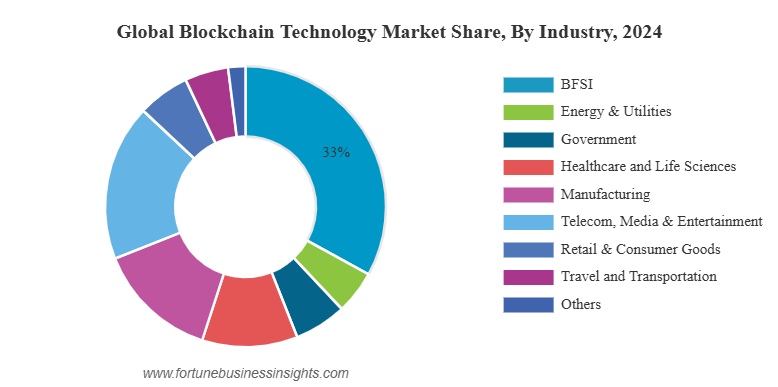
The current business era is plagued with operational inefficiencies, data breaches and fraud which are detrimental to your companies’ sustainability and credibility. According to Fortune Business Insights, the growing importance of blockchain technology has influenced all major industries from BFSI to healthcare and from government to retail.
Trust and transparency have become critical for companies working on complex data management, streamlining sensitive and critical transactions, operating across multiple stakeholders and the like.
Have you ever wondered how much time your team spends reconciling data and records? Also have you thought how many mediators you need to pass through to verify vital information. It is even more concerning to imagine what will happen even if one of those fails to process the right details. You need to manage your operations in the most secure and transparent manner. Else you will experience risk and uncertainty in all aspects-legally, financially and in terms of reputation.
This is the reality which your businesses are going through. And during this critical juncture what you need is Blockchain app development. Blockchain is not meant for cryptos only. In fact, this is an immersive technology which is drastically transforming how your businesses are operating or how they will perform in the coming time.
From automating smart contracts to storaging tamper-proof data and from verifying real time transactions to keeping records in a decentralized manner, blockchain apps are empowering businesses in ways which the traditional techniques can’t even think of.
Now let’s see how lack of Blockchain based applications can affect your brand.
Why Businesses Are Building Blockchain Apps in 2026
If you wish to equip your business with the right set of productive elements, blockchain apps currently are the best solutions you can have. The absence of this advanced platform can tarnish the image and authority of your business process. Go through the following points to have a better insight on how blockchain app development is beneficial.
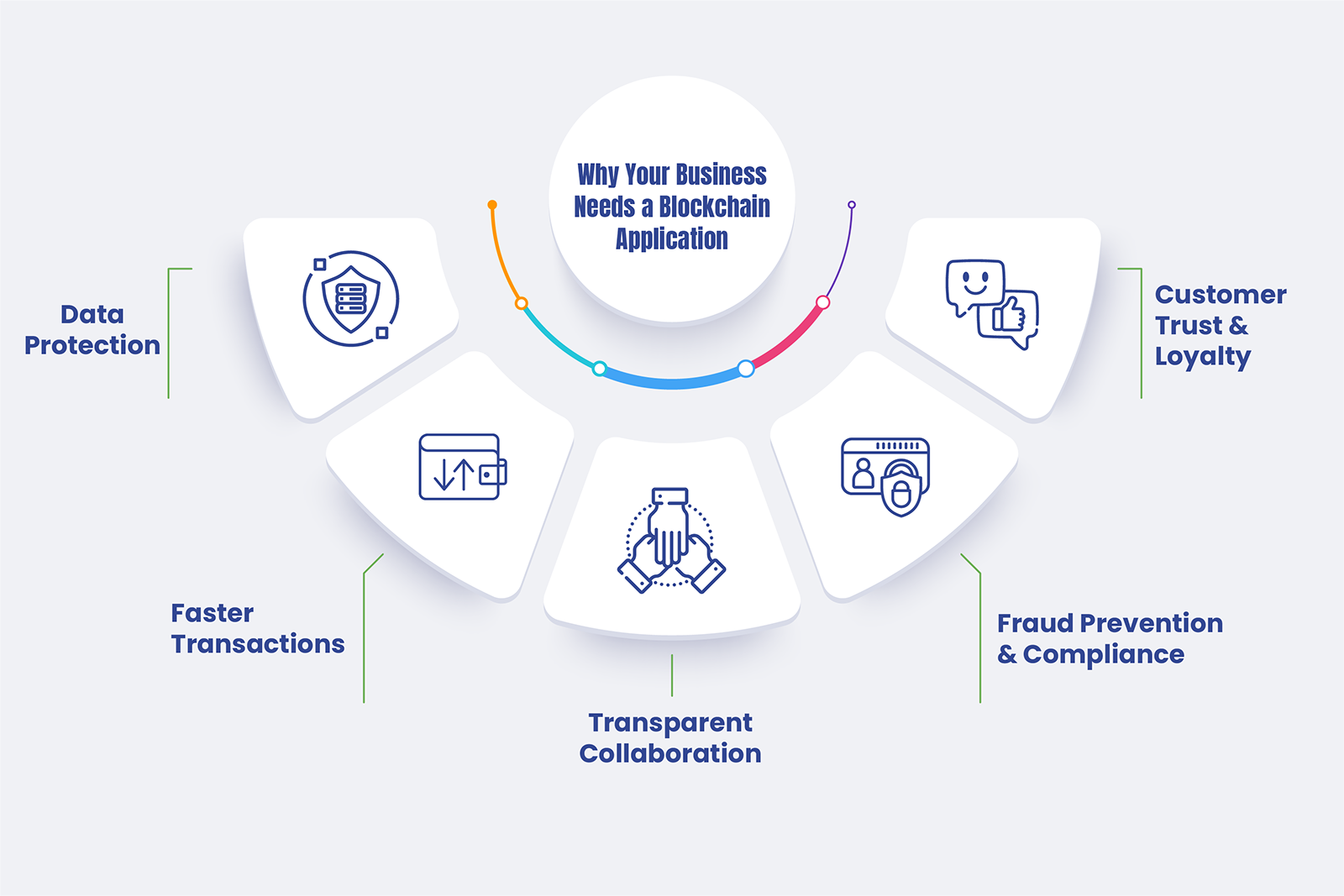
- Data breach or unauthorized access: If you use conventional databases, they may be prone to hacking or tampering. On the other hand, using a blockchain’s ledger which cannot be tampered with you can really protect your data from getting altered. Furthermore, you can also restrict unauthorized users from accessing your business facts and figures. Hence you can understand how absence of Blockchain technology can land your business into complex situations. Blockchain app development and its advantages can protect your data and information to ensure seamless communication and purpose driven results.
- Financial delays in settlement and approval processes: Third party intermediaries are involved in traditional methods. They perform manual checks which can reduce the transaction process. But with Blockchain you can automate the entire ecosystem via smart contracts which can clear the settlements instantly and reduce the operational costs. Thus, absence of Blockchain results in maximizing expenses and process delays which can hamper customer satisfaction and loyalty.
- Limited transparency across stakeholders: In the majority of business networks, what happens is each party keeps its own records. This often creates confusion and lack of trust. But with the adoption of Blockchain, stakeholders can have a single source to avail records which improves accountability and collaboration. Thus, you can see how without Blockchain your stakeholders will lack communication and responsibilities.
- Fraud risk and compliance issues: Conventional methods are getting redundant to verify transactions and keep them secure. This has made it easier for the fraudsters to violate compliance through repeated attacks. But again, with Blockchain you can simplify audit and reduce fraud risk due to its immutable and traceable history. Here also, absence of Blockchain apps will make your business vulnerable towards compliance and risks.
- Lack of confidence and trust: Customers today are more concerned about integrity, privacy and security. But traditional systems often fail to ensure data protection and maintain the proposed trust. But using Blockchain you can have its secured and verifiable processes to reinforce your customers’ trust and confidence. Thus, absence of Blockchain can hamper your customers’ engagement and retention.
So, once you have an idea about the utility of Blockchain apps, let us understand what Blockchain is and what Blockchain apps are.
Blockchain technology – the concept
Blockchain technology is defined as a decentralized digital ledger technology which is used to record transactions in a secure and transparent manner across multiple systems. While on one hand, traditional databases store data in a central server, Blockchain technology on the other hand, uses a network of computers to spread identical copies of the data. In the process, the new transactions are added as a block and each block is in connection with the previous one. This entire addition and linking is done in such a way so that they cannot be manipulated or tampered with.
Blockchain apps for business – an overview
Also known as decentralized apps, Blockchain apps are developed on Blockchain technology. This implies that these applications function on a ledger system which is distributed. This mechanism stores data on multiple nodes and in linked blocks. Also, it uses smart contracts to execute transactions. Decentralized applications by nature are free from ownership and hence are transparent and secure.
Custom blockchain application development enables businesses to build solutions around their specific operational needs, whether that involves secure document verification, supply-chain tracking, digital identity, tokenization, payments, or automated agreements. Unlike generic software, these applications can be designed around the required network, security controls, integrations, and compliance requirements.
Functionality of Blockchain app development in business
Blockchain apps are getting prominent and popular due to various reasons. The following section will help you to have better insights.
Prime features of Blockchain applications
Decentralization: Here there is no central authority and the Blockchain apps use peer to peer networks to function. This process provides more control to the users and leaves no scope to fail.
Secure data: Blockchain records all the actions and the transactions securely making the apps tamper-proof. This enhances the credibility of your business and attracts customers looking for trust and integrity.
Integration of smart contracts: Blockchain apps reduce manual intervention. Through smart contracts, it utilizes self-executing codes that automate business logic. Hence there is little, or no middlemen involved to create delays in the system.
Now let us know about the performance of Blockchain applications.
This section deals with the utilities of Blockchain apps and why you should consider them to enable your business to achieve excellence. Let’s begin with:
Decentralization: While on one hand, the traditional apps are centralized, Blockchain applications on the other hand are decentralized. This means that while the former ones run on company’s servers, the latter ones use a network of computers. For blockchain apps there is no single authority that controls the data. On the network everyone avails the same version of information.
This means that even if you do not have belief in the brand, you can still blindly trust the system it follows. Due to its transparent and secure nature, you can protect your process and data.
Smart Contracts: Smart Contracts are like digital agreements used by Blockchain applications. When specific conditions are met, these contracts execute themselves automatically. Thus, blockchain app development facilitates your transactions and prevents it from any sort of data breaches.
For instance, when you pay for your service, it automatically gets verified through these contracts for final delivery. As there are no middlemen, hence no delays in between. Hence you can see the results faster with little glitches and no disappointments.
Secure and safe data: When you complete any action using a Blockchain app it gets stored or recorded permanently in the secure ledger. For example, when you sign-in, buy, sell or submit any vital information here, it gets added to the system for good and cannot be altered.
Thus, it protects your valuable and vital records from getting tampered with. It becomes your digital vault which restricts any sort of unauthorized access or entries.
Use of tokens: Blockchain apps mostly come with digital tokens of their own. These can be used to earn rewards, make purchases, cast votes, gain access to new features and lots more.
Apart from being a user, in this ecosystem you are also a participant. This empowers you to experience innovation in new ways.
Indispensable Events in Blockchain Technology
This section throws light on technologies that form the foundation of blockchain to boost technological transformation.
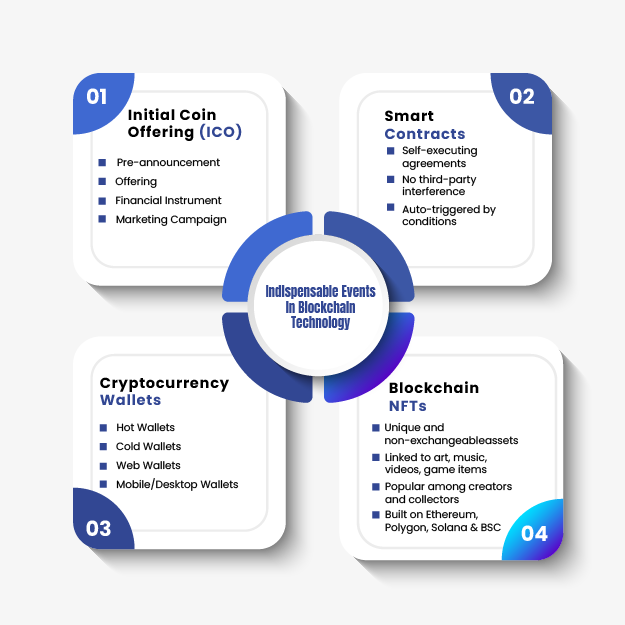
Initial Coin Offering (ICO): This is a business model focused on fundraising objectives. ICO is suitable for enterprises or startups having a blockchain component in their business process.
Let’s see how it works:
Pre-announcement: As the first stage, the preparation begins here. During this stage, the websites of the companies where investors are likely to visit frequently are being equipped with white papers, containing the details of the project along with the marketing campaigns.
Offering: Here the terms and conditions of the contracts drafted are shared with the potential investors.
The Financial Instrument: Here the investors are offered crypto coins in return for their capital.
Marketing Campaign: Marketing campaigns are created keeping in mind the purpose driven results in accordance with business output. It continues for a month and mainly attracts and engages audiences pertaining to small institutions and investors.
Smart Contracts: Just after the ICO, Smart Contracts are the next in prominence for businesses driven by Blockchain app development technology.
Smart Contracts on Blockchain are as good as physical contracts as the involved parties cannot breach them. Here both need to deposit an amount in a separate deed which can only become effective once the conditions mentioned in the contracts are met.
Cryptocurrency wallets: By cryptocurrency wallet we mean a digital tool where cryptographic keys are stored and managed securely. This helps companies or users to manage, send and receive Ethereum, Bitcoins or tokens associated with specific enterprise Blockchain applications.
This secured digital vault is empowered with identity authentication and plays a key role in facilitating communication with the economy of the Blockchain.
Some popular types of crypto wallets include
Hot wallets: Trust wallet and Meta Musk are popular examples of this category. These wallets are purposeful for everyday transactions.
Cold wallets: Trezor and Ledger are popular examples and best suited for secure and long-term storage.
Web wallets: Binance and Coinbase are noteworthy examples. These online wallets are provided by exchanges for beginners. Hence, they are convenient as well.
Mobile/desktop wallets: From the name itself it is evident that these wallets can be accessed via your phone/computers. Hence, they are accessible on the go.
Businesses planning trading or digital-asset platforms may also require cryptocurrency exchange development services. These services can include secure user onboarding, KYC and AML workflows, wallet integration, order-management capabilities, liquidity connectivity, transaction monitoring, and security controls designed for the applicable market and regulatory requirements.
Blockchain NFTs: Better known as Non-Fungible Tokens, NFTs are valuable components of Blockchain. In 2026, NFTs continue to support use cases involving verifiable ownership, digital collectibles, gaming assets, membership access, ticketing, and tokenized digital experiences. Contrary to cryptocurrencies where each one is same, NFTs have individual value which is different from one another. Hence the latter cannot be exchanged with one another.
Non-fungible tokens can relate to anything such as videos, music, artwork, items in online games etc. As they are exclusive in nature, people like collectors, artists, gamers and businessmen are often attracted towards those assets. Another aspect behind owning or selling NFTs is that everyone wants to sell or buy those which are unique and actually stand out in the crowd.
NFTs today are not only restricted to Ethereum network. In fact, these are developed on other popular Blockchains like Polygon, Solana and Binance Smart Chain. Using these platforms, businesses and creators can invest in Blockchain technologies to make digital experiences flexible and immersive via smart contracts.
Why You Should Invest in Blockchain App Development
With Blockchain apps you can transform your business processes, create new revenue opportunities and boost security. Listed below are some prime benefits of Blockchain app development for your enterprises.
Strengthened security: This is a vital element which keeps your data protected and prevents malicious attacks. By using decentralized and encrypted networks, Blockchain equips your information and data to become resistant to unauthorized alterations.
Improved transparency: This is no less vital in enhancing your brand value. Availing Blockchain in your business, you can record all transactions and make those visible to authorized candidates. As a result, it reinforces trust among partners, customers, regulators and others.
Reduced operational expenses: This is another noted advantage of Blockchain app development. Businesses across industries often face obstacles when they lack automation in their workflow process. But with Blockchain based applications you can automate processes and tasks via smart contracts. This significantly reduces your administrative costs along with the expenses involved in settlement and verification processes.
Speedy transactions: To process transactions, conventional methods take longer duration. To minimize this gap your business badly needs Blockchain app development. From enabling real time processing to eliminating 3rd party delays, this technology empowers your businesses to process transactions faster and with improved accuracy, convenience and efficiency.
Blockchain Applications Development: A Step-by-Step Guide
Before building blockchain apps, identify the real-world problems the product will solve, such as smart-contract automation, digital identity verification, secure payments, asset tokenization, or supply-chain tracking. Some key questions you can showcase are:
- What problems can we solve?
- How does Blockchain eliminate the obstacles of traditional solutions?
- Who are our targeted stakeholders and users?
Choosing the Right Platform for Blockchain App Development
Depending upon your business privacy, cost and scalability, you need to opt for the right protocol that serves your requirements.
Popular platforms you can consider are:
- Ethereum: This is the most used platform and is equipped with smart contract support.
- Polygon: This platform is compatible with Ethereum and is also cheaper and faster.
- Solana: With this platform you will experience great speed at low cost.
- Binance Smart Chain: This platform is also fast and comes with cost-effective attributes.
Selecting tools and app architecture
Effective blockchain software development services combine the right network, smart-contract architecture, wallet integrations, frontend experience, backend APIs, testing approach, and security controls. Choosing these elements early helps teams build scalable applications and avoid costly changes later in the development lifecycle.
You need to empower your blockchain app development strategies with suitable elements and use powerful development tools to ensure its best performance. These are:
Integral Elements:
- Integration of wallets like MetaMask
- Integration of smart contracts
- Using backend APIs for establishing business logic
Development tools you require are:
- Blockchain integration libraries like Ether.js or Web3.js
- Use of development frameworks such as Truffle and Hardhat
- Solidity, Ethereum based smart contract language
Smart Contract Development
Smart contracts are to be written keeping in mind the foundation of your business. This defines your rules, logic and data on the Blockchain.
Some best practices to be observed here are:
- Maintaining security standards such as Open Zeppelin libraries
- Keeping them effective and outcome-oriented
- Using periodic testing to simulate behavior
- Thorough Testing
As Blockchain apps cannot be changed once deployed, they need to be tested minutely. Before mainnet deployment, test the application on appropriate current testnets, such as Devnet for Solana, Amoy for Polygon, and Sepolia for Ethereum. You need to conduct testing for the following:
- To ascertain accuracy of business logic
- To identify vulnerabilities
- Connecting and building frontend
To communicate properly with Blockchain you need to develop a user-friendly interface. This can enable your users to connect their wallets, sign-in and communicate purposefully with smart contracts.
Some popular frontend stacks:
- Vue or React (for UI)
- Blockchain SDKs like Web3.js, Ether.js
- Wallet-connect tools like WalletConnect and Web3Modal
Security audit
You need to have a professional audit of your apps and smart contracts before the final launch.
Here you need to watch out for:
- Wallet manipulation or frontend injection
- Flaws in the logic
- Re-entrancy attacks
- Deployment to Mainnet
Once you are done with testing and auditing, you can now deploy the smart contracts within the live Blockchain network.
Main requirements here are:
- Utilization of Deployment Scripts like Hardhat, Truffle etc.
- Mainnet wallet such as MetaMask
Tech stack for Blockchain app development
Backend and frontend technologies form the backbone of Blockchain app development. Popular front-end frameworks such as Next.js and React.js are extensively used because of their performance and flexibility advantages. Both contribute to making dynamic user interfaces while Vue.js enables developing light weight UIs. Bootstrap or Tailwind CSS facilitates the styling aspect which boosts your UI development.
For seamless Blockchain interactions, developers prefer using libraries such as Ethers.js or Web3.js to link frontend and smart contracts. Similarly, tools such as Wallet Connect, Web3Modal or the MetaMask SDK sre applied to link crypto wallets in a hassle-free manner.
Now talking about the backend technologies, Express.js and Node.js are utilized to deal with Blockchain based event driven logic. To emphasize enterprise grade APIs, NestJS can be considered as a structured option. Effective databases like PostgreSQL and MongoDB are used to contain logs, information and metadata.
By integrating solutions such as Filecoin or IPFS with document heavy applications or NFTs, you can tackle the decentralized file storage. Through GraphQL you can deal with the query aspect of the Blockchain data by using Graph tool. This helps in reinforcing usability and performance. To support your backend infrastructure, services like Infura, Firebase, AWS or Alchemy are preferred to deal with app hosting, node access and authentication.
Blockchain use cases across industries
Blockchain has already been widely adopted by plenty of companies to undergo a sea change in their process development and productive capabilities. The following example will make things easy for you to understand.
From healthcare and financial services to real estate and supply chains, custom blockchain application development helps organizations create secure, transparent, and automated workflows. The following examples show how blockchain solutions can address industry-specific challenges.
Healthcare
Guardtime, an IT company, has embraced Blockchain app development technology in its process to manage and streamline patient data/records. On full utilization of this measure, it can ensure that the medical records are in safe hands and free from any unauthorized access. Also, it saves time as the process of updating patient data has become automated.
Noteworthy Benefits:
- Providing patients with Blockchain based health identity
- Enabling hospitals and labs share records securely
- Maintaining logs of all records to enable verified access
- Allowing patients to revoke or give permissions to access their data
- Properly tracking by whom and when the data has been accessed
- Connecting the wearable health information to patient records safely
Fintech
JP Morgan Chase, a reputed name in the banking domain uses Onyx, a Blockchain oriented platform to reshape the banking infrastructure. For example, this blockchain app development advantage enables JP Morgan to tackle settlements and real time payments by using JPM Coin.
This entire process has minimized the need for intermediaries, improved cross-border transactions, reduced costs and eliminated delays to ensure customer satisfaction and loyalty.
Noteworthy Benefits:
- Managing and storing cryptocurrencies securely
- Automated processing of loans and insurances
- Detecting suspicious activities via automated checks
- Enabling direct lending between users in a secure manner
- Keeping user transaction logs secured on blockchain
- Makes transactions tamper proof
- Facilitates smooth conversions between crypto and normal currencies
Real Estate
To tokenize assets, Red Swan CRE, a commercial real estate marketplace from the US is using Blockchain software development technology. By collaborating with developers and property owners this brand is converting commercial buildings worthy of high value into digital tokens on the Blockchain. This makes it easy for global investment and also facilitates fractional ownership.
Noteworthy Benefits:
- To make investment easy it segregates property ownership into digital tokens
- Its records of legal history and property ownership are non-changeable
- Validates identities of both through digital KYC tools
- Completes transfers after payments via smart contracts
- Creates seamless process for international process to buy and manage properties
- Helps in the exchange or resale of real estate tokens
- Puts in proof of date to establish the authenticity of legal property documents
Manufacturing and Supply Chain
Walmart, one of the biggest US brands in the retail domain has adopted an advanced blockchain app development technique to transform its supply chain and food safety tracking. In close coordination with its suppliers, this brand through Blockchain focuses on preventing foodborne illness, identifying contaminated items and improving trust via verified product history.
Noteworthy Benefits
- Recording the history of products at every stage-from raw material to final delivery
- Maintaining data consisting verified suppliers
- Storing compliance certificates and inspection reports in an immutable manner
- Linking scanners and sensors to live Blockchain records
- Uses Blockchain authenticated QR codes to tag products
- Automates the process of supplier payment after delivery
- Tracks food and medicine which are sensitive to temperature
- Records and detects mismanagement during transportation
Conclusion
At Proquantic, we provide blockchain software development services that help businesses turn decentralized ideas into secure, scalable products. Whether you need a custom NFT marketplace, supply-chain platform, DeFi solution, or cryptocurrency exchange development services, our team can support your product strategy, architecture, development, testing, and deployment.
In 2026, building blockchain apps can help businesses improve transparency, security, automation, and operational efficiency. With the right approach to blockchain applications development, organizations can reduce manual complexity, strengthen trust across stakeholders, and create future-ready digital services.
Ready to explore custom blockchain application development for your business? Contact Proquantic to discuss your requirements.
Frequently Asked Questions:
What is blockchain in simple terms?
Answer: Blockchain app development is a detailed process of making applications that function on a blockchain. Also known as decentralized apps, they cannot be tampered with as they run on distributed networks. Being secure and transparent in nature, today’s businesses across industries are adopting it massively to transform their processes and achieve excellence.
What is the purpose of blockchain technology in business?
Answer: Blockchain technology has become instrumental for present-day businesses to stay adaptable and futuristic. From verifying and tracking transactions to eliminating errors and frauds and from automating processes to making transactions tamper proof, blockchain apps perform multiple functions to empower your business and ensure consistent growth. This makes blockchain app development apt for business transformation and profitability.
How does blockchain leverage AI for businesses?
Answer: Blockchain and AI are complementary to each other in automating business processes and minimizing complexities. Blockchain app development involves AI elements to improve security measures, automate smart contracts, enhance risk management, optimize supply chain and lots more. This saves time and improves productivity to ensure customer satisfaction and loyalty.
What security measures are to be adopted for blockchain wallet app development?
Answer: There are plenty of security measures you can adopt while building a secure blockchain wallet app. From applying robust encryption protocols like AES-256 to using secure key storage methods and from implementing stringent login protection measures to adding effective authentication instructions you can make your blockchain wallet app development purposeful and exclusive.
What is the future of blockchain technology?
Answer: Blockchain technology has huge prospects of becoming more popular and prominent in the coming time. Due to its immersive features and functionalities companies are adopting it widely to boost productivity and stay innovative. Blockchain app development not only enhances your brand credibility but also empowers you to improve your abilities and become profitable.