


The U.S.'s real estate market is projected to reach $155.60 trillion by 2029, growing at 3.31% of CAGR. To keep pace with this growth, integrating the right technology into realty apps enables buyers, sellers, and agents to connect seamlessly. Zillow, founded in 2006, remains the benchmark real estate app, consistently reimagines property search and transaction with data, automation, and immersive digital experiences.
Today, consumers expect beyond static listings, instant valuations, interactive tours, seamless scheduling, and even mortgage pre-approvals on a single app. For startups and established enterprises that want to develop Zillow-like apps, choosing appropriate tech integration can yield positive outcomes.
The success of these real estate companies highly depends on integrating the right mix of technologies. From AI-driven pricing engines to spatial computing tours and embedded finance, the future of property listing platforms depends on several aspects.
This blog explores the core strengths and features that make Zillow stand out in the real estate market in the U.S. Keep reading to explore some must-have property technology (PropTech) integrations to shape housing search platforms in 2025.
Why Zillow sets the standard for real estate tech apps?
Zillow is a U.S.-based tech real estate marketplace company that helps people connect with reliable professionals for renting, selling, and buying homes. According to Nasdaq, the traffic through Zillow’s websites and mobile apps was up by 5% during Q2. Some data also suggests that more than 243 million unique users visit the pages monthly.
Many companies that aim to create similar real estate apps often consider following the footsteps of Zillow. Below are the benefits that help realty marketplace firms thrive in the competitive market with the help of PropTech application development.
Optimized marketing
Developing a real estate app helps businesses showcase their properties with exceptional visuals, recommendations, and virtual tours. Implementing the right optimization strategies helps enhance marketing efforts, which improves performance of the app and yield better results.
To acquire more customers and achieve business goals, you need features like location-based property suggestions, push notifications, and personalized alerts. Realty apps like Zillow use these aspects to reach more buyers and increase return on investment (ROI).
Higher revenue
Homeowners or businesses often search for better properties in their desired locations and within a specific budget. Real estate apps allow buyers to quickly discover the options available, streamlining tour scheduling, making advance payments, and converting sooner.
Realty software development is a proven and effective way to find better leads and close more deals. This increases the revenue for estate agencies and help them establish as reputable names for property-related matters.
Enhanced loyalty
Zillow’s well-designed app is what keeps their users engaged through a variety of property search features. Moreover, saved searches, personalized housing matches, and easy interfaces to connect with the agents offer great transparency and convenience.
Creating similar applications for realty enterprises can acquire more loyal and long-term clients, depending on your services for future transactions.
Automation integration
Integrating artificial intelligence (AI) into the app is the reason behind the success of Zillow as a realty marketplace firm. Automation helps the platform to estimate housing values through predictive pricing models. Buyers often rely on these real estate apps for intelligent property recommendation systems, helping them speed up their search.
Realty marketplace platforms also utilize big data analytics and machine learning (ML) algorithms to improve user experience. These technologies make buying, selling, renting, and financing easier for housing platform users. They can browse a wide range of properties from different geographic locations across the U.S.
Moreover, with features like AI chatbots, enterprises can remain connected with users 24/7. Including an automation agent in the app helps addressing all queries through real-time conversations with human touch.
Cost saving
Property marketplace firms often reduce administrative costs through automation. They achieve this by integrating features within the app that minimize manual tasks. Automating processes like customer support and property listing updates reduces human error and also lower operational and advertising expenses.
Many enterprises and startups also improve profitability with PropTech apps by leveraging AI to handle business-related tasks. This includes lead qualification, customer engagement, document management, and data analysis.
How does technology impact real estate app development?
Those firms that develops their PropTech apps take inspirations from Zillow or other popular platforms like Redfin and Trulia. Do you know what makes these real estate applications outstanding, setting industry standards for future PropTech app developers?
Let’s discuss what’s Zillow chooses different to shape realty businesses across the U.S.
1. Uses a widely recognized AVM that keeps learning
Zestimate is an automated valuation model (AVM) that keep users engaged to the real estate app. The underlying reasons include its visibility, consistent updates, and transparency about accuracy ranges.
For on-market homes, Zillow reports a nationwide median error under 2%. It is a powerful trust signal for shoppers deciding what to tour next. For off-market properties, the error is higher, but still informative at scale.
You don’t have to match the Zestimate overnight while creating an application for your realty business. Try to build an AVM that ingests standardized property data, updates rapidly when listings status flips, and exposes explainability. Ensuring clear feature contributions helps build trust with both app users and regulators.
2. AI-powered listings that go beyond photos
Zillow’s “Showcase” and related experiences blend high-resolution images, room-organized photo streams, interactive floor plans, and 3D tours into a single, AI-assisted listing. This feature allows buyers build strong mental models of layout and flow before they ever book a home tour. That reduces wasted tours and improves lead quality for real estate agents.
Computer Vision (CV) and 3D pipelines are essential components to create perfect housing marketplace applications. These are core technologies to conversion because they collapse the gap between browsing and conviction.
CV is a branch of AI that allows computers to observe and interpret visual data from videos and images of properties. The pipelines then convert raw 3D data into formats suitable for websites and apps, allowing users to view the property details on different devices.
3. Immersive viewing that meets the moment
With Zillow Immerse for Apple Vision Pro, the real estate app explores spatial computing as a mainstream touring channel. Interactive floor plans, 3D walkthroughs, and richer depth enable users to have a panoramic view of properties.
Spatial UX won’t replace mobile. But supporting spatial scenes, which is now easier with platform APIs, increases differentiation, press surface area, and remote-buyer confidence.
Earlier, the buyers relied on mobile devices to evaluate two-dimensional pictures of new homes. With Zillow Immerse, they can visit every room and inspect the space, from the ceiling to floor. The experience is like walking down the hallways and see every detail through the floor plan generated by AI.
4. Tour scheduling and pipeline efficiency
Zillow acquired ShowingTime and now uses ShowingTime+ to coordinate showing schedules, offers, and related property listing services. Using a clean touring stack often help realty businesses generate high-intent event data and with multiple listing services (MLS).
Integrating these technologies help reduce the effort of brokers, buyers, and sellers. ShowTime simplifies showing requests, activity tracking, and feedback on projects. Buyers can use it for driving directions, upcoming housing tours, and connecting with realtors.
Real-estate apps integrating ShowTime enhances user experience through listing presentation, room-by-room photo organization, interactive floor plans, and high-resolution images.
5. Embedded finance signals and rate context
Zillow surfaces daily mortgage rate context and offer financing services through Zillow Home Loans. Finance visibility matters for many people because they pick home tours depending on the affordability of properties.
Embedding finance in realty software includes features like pre-qual, rate quotes, and monthly-payment calculations. Including these aspects in your app can change the behavior of target buyers. Through this tech integration, businesses usually guide users toward homes they can easily purchase.
Tech integrations for your next-gen real estate apps
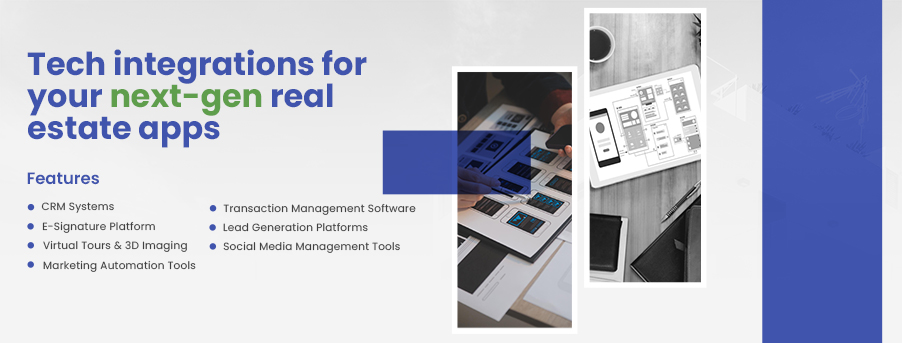
When building a modern real estate app, you need the latest tech stack to elevate user experiences. Below are some essential tech integrations shaping next-generation property apps.
1. Customer relationship management (CRM) systems
Client relationships define long-term success in real estate business across the U.S. Integrating CRM into the application helps with lead generation, follow-ups, and identification of interested clients. Without a structured CRM, enterprises can miss out growth opportunities and weaken client engagement.
Why CRM integration matters:
- Lead management: These systems are necessary to track, nurture, and convert leads effectively.
- Automation: They automate repetitive tasks, including reminders and follow-ups with users.
- Integration: CRMs connect smoothly with marketing, transaction, and communication tools, which help businesses align with their goals.
- Analytics: Includes tech stacks that deliver actionable insights to refine performance and sales strategies.
Popular CRM options:
- Follow Up Boss: It is a user-friendly CRM tailored for real estate agents with powerful lead management and automation features.
- Salesforce: It is a customizable, scalable, and AI-powered analytics tool.
- Lofty CRM: Businesses use it for lead generation with advanced workflow automation.
- Wise Agent: It is a real estate CRM to track transaction and contact management.
Selecting the right CRM ensures smoother business operations. To customize integrations, hire a developer with experience in real estate software development in the U.S.
2. Electronic signature platforms
When more people visit your real estate platform to buy or sell properties, the speed of operation really matters. Paper-based document handling can frustrate clients and make them choose other realty apps embedding e-signature. Integrating this technology on home buying platforms accelerate transactions while ensuring compliance.
Benefits of electronic signature integration:
- Secure and legally binding: Every document remains legally valid and encrypted with e-signature platforms.
- Device flexibility: Clients can sign in from phones, tablets, or laptops anytime to access their profiles on real estate application.
- Audit trails: The feature of detailed logs helps track every interaction, timestamp, and device address.
Leading solutions:
- DocuSign: Widely adopted with strong compliance features.
- HelloSign: User-friendly with simple integrations.
Electronic signatures reduce delays, improve client satisfaction, and support fully remote transactions.
3. Virtual tour and 3D imaging tools
Modern buyers expect exceptional digital experiences before in-person property visits. Virtual tour and 3D imaging integrations allow meeting this demand of users.
Why 3D imaging and virtual tours are important?
- Increased user engagement: Buyers explore homes remotely with higher interest due to high-quality photos and videos and floor plans on a single platform.
- Influence buying decisions: Properties with 3D touring options attract more serious inquiries and buyers.
- Transparency: Integrating these immersive tools allow clients see layouts, flows, and space before the actual home tour.
Top platforms:
- Matterport: It creates detailed and interactive 3D property models.
- Zillow 3D Home: It is a technology used by realtors for quick uploading property pictures and creating virtual tours using a mobile device or 360° camera.
- CloudPano: It provides 360-degree tours with multimedia hotspots.
- EyeSpy360: It enables 360-degree home tours with live chat support.
Real estate apps integrate these tools for marketing properties and delivering memorable experiences to buyers. You can hire developers with expertise in AR and 3D technologies to integrate these features in your realty app.
4. Marketing automation tools
Agents and brokerages manage multiple marketing channels on a regular basis. Marketing automation platforms in real estate applications can simplify workflows while maintaining personalized communication.
Core benefits of marketing automation:
- Efficiency: It saves your considerable time on creating separate email campaigns and social posting activities.
- Consistency: Real estate enterprises can use this integration to maintain a steady brand presence without manual effort.
- Lead nurturing: Marketing automation allows realtors find suitable prospects during buying cycles.
- Scalability: This tech integration enables realty platforms to handle large client bases while keeping them engaged.
Notable tools:
- ActiveCampaign: It combines CRM, automation, and marketing in one platform.
- HubSpot: It provides integrated tools for email marketing, social media management, and performance analytics within its CRM.
- Zapier: It automates workflows by connecting different platforms.
Real estate apps integrating automation allow teams to scale with minimal overhead. This integration enhances client engagement, builds efficiency into marketing operations, and boost sales.
5. Transaction management software
Around 76% of property transactions in the U.S. involves strict compliance with anti-money laundering (AML) requirements of the Bank Secrecy Act (BSA). - Source
Every transaction within realty enterprises involves multiple parties, documents, and deadlines. Missing details or mismanagement of transaction can result in derailing closings and damaging reputations. Transaction management software addresses this complexity, which is why it is embedded in home search apps.
Why integrate transaction management software?
- Centralized management: Store, organize, and share transaction documents securely.
- Compliance tracking: Monitor deadlines, disclosures, and regulatory requirements.
- Collaboration: Agents, clients, and vendors access shared progress timelines.
Top solutions:
- Dotloop: Combines e-signatures, storage, and transaction workflows.
- SkySlope: Tracks compliance and deadlines in real time.
- TransactionDesk: Provides electronic forms and cloud-based management.
- Brokermint: Adds commission and accounting tracking.
Transaction management integration reduces manual errors, ensures compliance, and simplifies collaboration across stakeholders.
6. Lead generation platforms
Consistent lead flow helps real estate businesses sustain in the competitive market. Manual lead generation campaigns don’t always give desired outcomes or convert clients. This is when integrating technology-driven lead generation tools ensures predictable outcomes.
Advantages of lead generation integration:
- Predictive Analytics: AI identifies homeowners who are likely to sell their properties soon.
- Targeted Outreach: Tech integration for lead generation campaigns reaches high-intent prospects directly.
- Automation: Automated lead generation in real estate software facilitates continuous engagement to nurture potential clients at scale.
- Pipeline Health: Maintain a constant supply of qualified prospects.
Notable platforms:
- Market Leader: Exclusive leads with websites and automated campaigns.
- SmartZip: Predicts seller likelihood using analytics.
- Offrs: Uses AI to identify potential sellers early.
- Ylopo: Drives leads through dynamic ads on social and search channels.
Lead generation tools integrated into realty apps create self-sustaining business models for both startups and enterprises.
7. Social media management tools
A strong digital presence is essential for home buying and selling apps, which also influences brand credibility. Social media integration keep agents consistent and visible in competitive markets. These tools are essential for realty business apps to boost lead generation, engage customers, and streamline communication.
Why integrate social media integration tools?
- Scheduling: Plan property-related posts across social media platforms without manual updates.
- Engagement tracking: The integration allows realty businesses analyze client interactions and campaign performance.
- Cross-channel management: If you want to manage multiple accounts in one dashboard to increase your reach to potential home buyers, these tools help.
- Efficiency: Marketers can reduce time spent managing digital channels manually by embedding social media management technology in property marketplace apps.
Prominent tools:
- Sprout Social: Robust scheduling and engagement metrics.
- Sprinklr: Enterprise-level platform with AI analytics.
- Metricool: Supports diverse channels with analytics.
- Meta Business Suite: Optimized for Facebook and Instagram.
With integrated social media management, real estate apps support ongoing client engagement and brand growth.
Layered integrations for real estate app development, powered by custom mobile app development software, can simplify processes and enhance customer trust. Startups and enterprises that embed these technologies can confidently build property platforms ready for buyers and sellers.

| App Complexity | Core Features | Advanced Features | Estimated Build Cost (USD) | Typical Timeline | Typical Team | Ongoing Monthly (Cloud/SDKs) |
| Basic MVP App | User registration; property listing; search filters; contact agent; Google Maps integration; push notifications | Limited property images; email alerts; favorites & wishlist | $50,000 – $90,000 | 10 – 16 weeks | 1 PM, 1–2 Mobile Devs, 1 Backend Dev, 1 QA | $100 – $400 |
| Mid-Level App | Enhanced listings with videos; mortgage calculator; chatbot for inquiries; CRM integration; advanced search filters | AI-driven recommendations; virtual property tours; in-app messaging | $90,000 – $160,000 | 16 – 28 weeks | 1 PM, 2–3 Mobile Devs, 2 Backend Devs, 1–2 QA, 1 Designer | $300 – $900 |
| Enterprise Level App | Custom property marketplace; blockchain transactions; 3D & AR property tours; IoT-based smart home integration | Machine-learning property valuation; voice search; personalized user dashboards | $160,000 – $350,000+ | 28 – 48 weeks | 1 PM, 3–4 Mobile Devs, 3–4 Backend Devs, 2 QA, 1–2 Designers, 1 DevOps | $800 – $3,000+ |
Conclusion
PropTech plays an important role in evolving real estate market in the U.S. Realty marketplace platforms bridge the gap between buyers and sellers and connect them with trusted realtors. Zillow integrate several technologies to deliver an efficient and streamlined real estate experience. The platform’s online presence and large user base provide housing enterprises the growth they need to remain competitive.
Looking for a software development agency in the U.S that combine latest technologies to create Zillow-like apps? Proquantic specializes in creating AI-powered real estate solutions to help businesses become more visible and grow their client base. Reach out to our software developers to discuss your app development needs today.
Frequently Asked Questions on PropTech in Real Estate
What is the scope for PropTech in real estate industry?
PropTech sector is projected to expand rapidly, with market size expected to reach USD 88.37 billion by 2032. Technologies like AI, IoT, and data-driven solutions support this growth, optimizing transactions, valuations, and property management.
Sustainability tools and green building technologies are also influencing adoption. PropTech improves transparency, efficiency, and customer experience while supporting smart city and infrastructure developments on a global scale.
How much is the development cost of a real estate app?
Building a real estate app in 2025 can cost between $40,000 and $150,000. The cost usually depends on features, complexity, and the location of your custom app developers.
If you want to create a basic app with listings and search functions, it is relatively affordable. However, building advanced property apps, using AI, AR/VR, and third-party integrations, can be more expensive.
Moreover, your choice of platform, such as iOS, Android, or cross-platform, and post-launch maintenance also affect expenses. Businesses should allocate 15 to 25% of initial investment annually for ongoing support, updates, and security features.
How does a modern real estate application generate revenue?
Real estate apps use diverse monetization strategies to sustain growth across the U.S. They charge agents and brokers through premium listings, commission-based leads, or subscription tiers.
Advertising revenue also plays a significant role, as realty apps allow businesses to promote mortgage, insurance, or moving services. Furthermore, transaction fees from in-app payments and affiliate partnerships also offers revenue opportunities to businesses.
What are the latest trends in real estate tech?
Real estate technology is advancing with innovations that improve both efficiency and user experience.
Artificial Intelligence (AI): It powers valuation models and predictive analytics.
Machine Learning (ML): It enables personalized recommendations. IoT and smart automation streamline energy use and tenant comfort.
Virtual and Augmented Reality (VR/AR): These technologies provide immersive property tours and 3D walkthroughs. Digital twins replicate buildings for predictive maintenance and planning.
Blockchain: This technology supports secure transactions, tokenization, and fractional ownership, creating new financing models. These innovations collectively redefine how properties are bought, sold, and managed.
What new PropTech innovations are shaping real estate?
Emerging PropTech trends are setting the standard of real estate applications.
- Digital twins: This technology simulate buildings for accurate planning.
- Edge computing: It improves data processing for smart properties.
- Voice-enabled controls: They allow smooth tenant interactions.
- Smart city integrations: These align property management with broader infrastructure networks.
Sustainability-driven technologies are also gaining traction, optimizing energy usage and reducing operating costs. Collectively, these trends enhance tenant experiences, reduce inefficiencies, and help property owners maximize value.
Why do realtors use CRM system today?
Customer Relationship Management (CRM) is a real estate software that enables agents and brokers to centralize client and property-related data. It simplifies lead management, automates follow-ups, and organizes contacts for better decision-making.
Realtors benefit from real-time performance insights that reduces inefficiencies and ensures timely communication with buyers and sellers.
CRMs also improve deal tracking by providing pipeline visibility. With the integration of automation with analytics, CRMs enable agents to covert faster while maintaining long-term customer relationships.
Also read How AI in automotive industry is reinventing future transportation.