


In today’s hyperconnected digital environment, businesses are no longer limited to traditional software or on-premises servers. Cloud app development enables enterprises to use remote infrastructure to build scalable, cost-efficient, and agile applications that users can access securely from anywhere.
A cloud application is software that runs on cloud infrastructure rather than solely on a local device or on-premises server. Cloud-based software development is therefore a strategic approach to building, deploying, and scaling applications with greater flexibility and reduced infrastructure overhead. It is in fact a strategic move, more than just being a technological one.
The global cloud computing market is valued at USD 1.106 trillion in 2026 and is projected to reach nearly USD 5.947 trillion by 2035, expanding at a CAGR of 20.61% from 2026 to 2035.
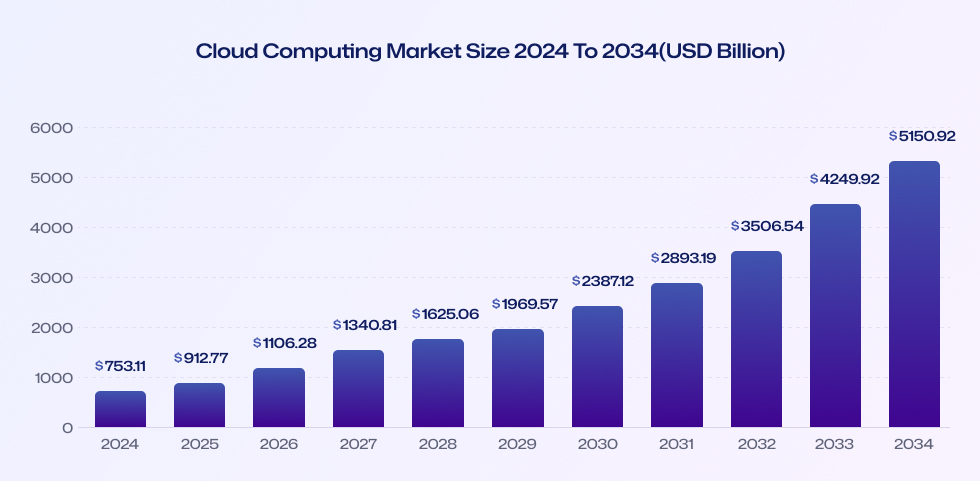
With the increasing competition and skyrocketing expectations, companies across all industry verticals are stably transitioning to clouds which are, eventually, ensuring seamless UX, reducing infrastructure overhead and boosting performance.
In this write-up today, we will be exploring the crucial benefits of cloud-based application development, explain its related costs and break down its processes of development so that, by the end of this blog, you are empowered to make well-informed decisions for your next big project.
Businesses are choosing to migrate into cloud – here’s why
Cloud computing is revolutionizing the entire business landscape by addressing critical issues like performance and data storage for almost 70% of digital workspaces. Nearly 94% of the companies are functioning with cloud computing integrated into their operations, which makes cloud-based application development a vital aspect for creating applications that enhance productivity, elevate customer experiences and streamline workflows.
In 2026, cloud app development is helping organizations launch digital products faster while improving reliability, collaboration, and scalability. By adopting the right cloud architecture, businesses can support changing user demands without making large upfront investments in physical infrastructure.
Web applications that function on cloud platforms are completely different from the applications that run on-premises. A cloud-based infrastructure provides various services as well as options for developing a high-available and scalable application that caters to the global audience.
It gives unlimited opportunities to an application for scaling and matching with business requirements. For reaping the benefits from cloud platforms, applications have to be built by using options and services that are provided by cloud infrastructure.
The different types of cloud-based solutions for enterprises
Cloud computing technologies include different types of services as well as resources like storage, data servers, databases, etc. and each of these are run by a third-party. Third parties authorize their infrastructure on a paid or free basis along with the computer resources. In a nutshell, users can avail these services, space and resources without the worry of infrastructure maintenance.
Generally, there are mainly four types of cloud deployment that are available for businesses, viz:
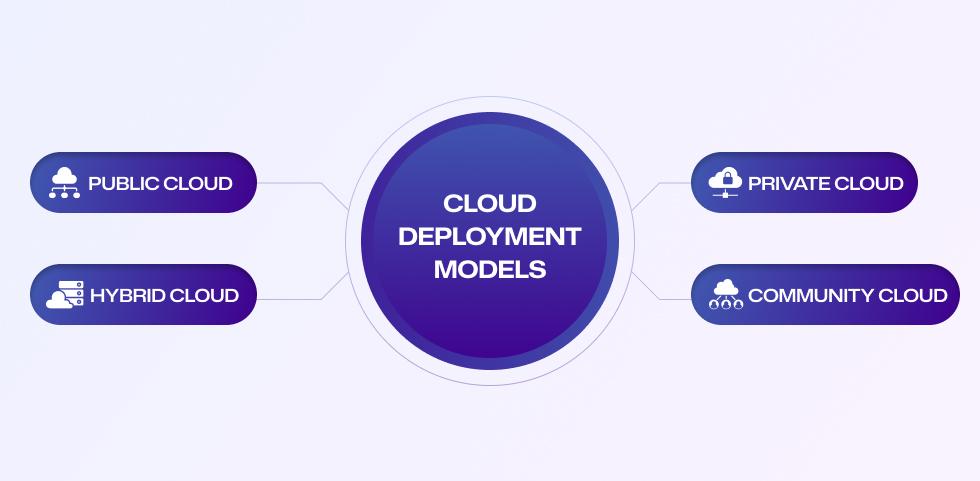
Community Cloud – The deployment of this cloud-based application development solution type is similar to private cloud, to be discussed ahead. But the point of difference in between them is that the data sharing takes place between two organizations. For example, a government of any country consists of various departments internally which need the same resources and infrastructure and at this place the community cloud comes in place.
Hybrid Cloud – Hybrid cloud app development Hybrid in cloud app development is leveraged in both private and public. Here data is distributed among third-party apps and on-devices along with additional variants for optimization and deployment.
Public Cloud – Data in the public cloud resource is accessible only through authorized devices. Public clouds usually provide flexibility and optimal price with data processing.
Private Cloud – The functionality of private cloud system is to provide a secured space to data, web and applications. Private cloud service is utilized by a single company without any public access.
These cloud deployment solutions can be leveraged for different applications services. 4
Crucial characteristics of cloud-based applications
Cloud-based application development solutions are characterized with flexibility and scalability which enable them to easily adapt and align with the changes. The applications also offer internet-powered access which implies that the users can access applications from anyplace with internet connection.
The multi-tenancy characteristic enables various users to share a single infrastructure, which reduces cost. Cloud apps also offer continuous updates, maintenance and cost-efficiency that are frequently managed by the cloud provider.
Here’s a more detailed breakdown on each of the aforementioned characteristics:
- Flexibility and scalability – Cloud apps have the ability to quickly scale up or down, entirely based on demand. These apps can adapt to the dynamic user needs and workloads. This kind of flexibility enables the organization to reduce costs and optimize resource utilization.
- Multi-tenancy – Multiple users are able to share the common underlying infrastructure within a cloud environment, with their own isolated application instances. This feature of ability of sharing the resources can lead to optimized resource utilization and cost-efficiency.
- Cost-efficiency – Cloud applications decrease the requirement for companies to invest in their own software or hardware because these resources are managed by the providing authorities of the cloud. This characteristic eliminates the upfront and ongoing maintenance cost that are associated with on-premises expenses.
- Inter-based access – Cloud applications are accessible through the internet, and they eliminate the need for users to be connected physically to a specific device. This accessibility features facilitates collaboration and remote work.
- Continuous maintenance and updates – Cloud providers are dependent on the updates of cloud infrastructure and applications and ongoing maintenance. This feature ensures that that the applications are running seamlessly, and the users are also getting the advantage from latest security patches and features.
Types of cloud application development services
Generally, cloud computing is of 4 types, viz:
- IaaS or Infrastructure as a Service
- PaaS or Platform as a Service
- SaaS or Software as a Service
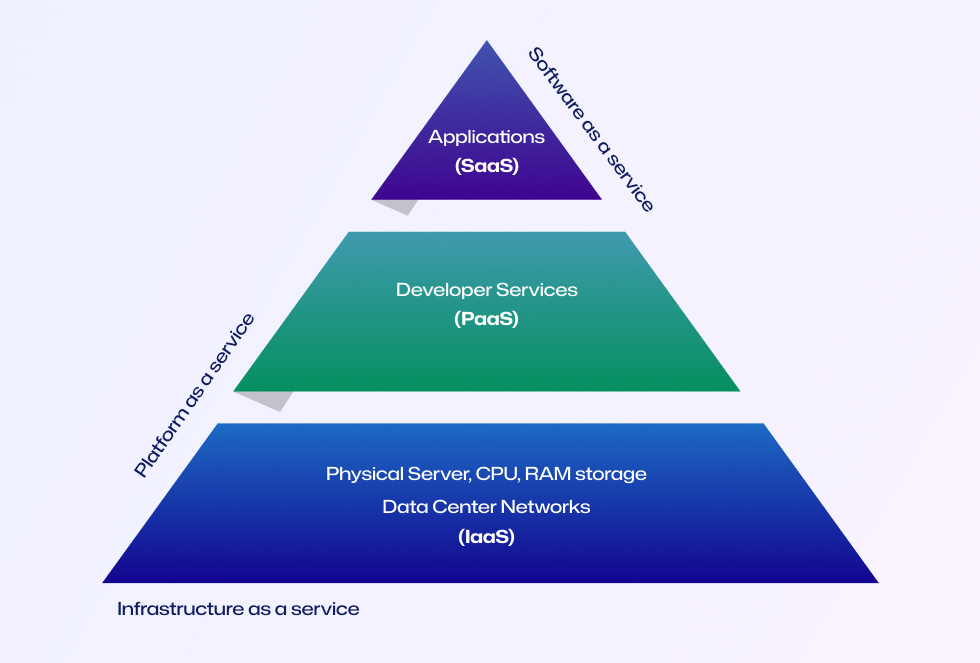
Let’s dive deeper into the crucial aspects of each of these cloud computing types to understand their functionality better:
IaaS or Infrastructure as a Service
Infrastructure as a Service or IaaS is an important aspect in cloud computing which provides networking over internet on demand, storage and key computing resources. The crucial aspects include features facilitating automation of administrative tasks, flexibility, cost-efficiency and scalability.
IaaS enables businesses to concentrate on the core operations alongside reducing the responsibility of managing the infrastructure within.
The crucial aspects of IaaS are discussed below:
- Security – IaaS providers include many security measures that protect the infrastructure resources as well as data from threats and unauthorized access.
- Reliability – IaaS platforms are built for reliability and feature like failure mechanisms and data redundancy ensure high availability.
- Focus on the core business – With IaaS, businesses have the ability to offload their infrastructure management to their providers which enables them to focus on the core activities of business.
- Data backup and disaster recovery – A lot of IaaS providers provide robust data backup and disaster recovery features that ensure data protection and business continuity.
- Automation – IaaS providers, frequently automate the administrative tasks like maintenance and provisioning which free-up the IT teams so that the latter can concentrate on strategic initiatives.
- Flexibility – IaaS provides flexibility of experimenting with various configurations and technologies without needing assistance of any physical hardware. This facilitates experimentation and rapid innovation.
- Cost-efficiency – By using the model of pay-as-you-go, IaaS reduced capital expenditure because the business only has to pay for resources that are used.
- Scalability – IaaS empowers businesses for quickly scaling down or up as per the need of infrastructure resources. This ensures that the business has the capacity of handling the fluctuating demands.
PaaS or Platform as a Service
In cloud computing, Platform as a Software or PaaS is marked by emphasis on application development as well as deployment without needing the management of underlying infrastructure. The crucial aspects include offering complete environment of complete development and deployment, which will be able to offer numerous tools for development, facilitating flexible access for the teams and seamless scalability.
PaaS also focuses on rapid development and deployment of apps, streamlined process of development and cost-effectiveness.
The crucial aspects of PaaS are discussed below:
- Collaboration – PaaS platforms comprise of features that support team collaboration to further boost the developers to work on projects together.
- Focus on application development – PaaS frees up the developers from the critical responsibility of managing infrastructure, enabling them to focus in deploying and building applications.
- Security – PaaS providers invest a lot of time and resources behind strengthening the security measures for protecting the applications and platforms developed on it.
- Automated updates – PaaS providers manage the maintenance of internal infrastructure to ensure that the platforms are always up to date.
- Flexible access – PaaS empowers the developers to use tools and shared services from any location, just with the help of internet – facilitating remote collaboration.
- Easy scalability – PaaS platforms are conceptualized to be horizontally scalable, which allows resources to be adjusted dynamically as per demand.
- Faster time to market – By providing necessary tools with a pre-configured environment, PaaS speeds up the process of application development process, eventually leading to faster time to market.
- Cost-effectiveness – PaaS reduces the cost of infrastructure management by enabling the developers to focus on development of application, rather than maintenance of the infrastructure.
- Flexibility and scalability – PaaS offers range of tools like IDE or integrated development environment, debugging utilities and version control systems that simplify the process of development.
- Complete developmental environment – PaaS offers a comprehensive ecosystem for deploying, testing and building applications that include services, frameworks and development tools.
SaaS or Software as a Service
SaaS in cloud computing revolves around security features, scalability, accessibility and cost-effectiveness. It offers a subscription-powered model and eliminates the need for infrastructure cost, allowing the users to scale their usage based on the needs. Cloud accessibility and automatic updates are its key benefits alongside providing a user-friendly experience and simplified IT management.
The crucial aspects of SaaS are discussed below:
- Integration – SaaS applications often provide integration with other SaaS tools which allows a seamless flow of data across all business functions.
- Automatic updates – SaaS providers maintain and update the software that ensure the users to always have the latest version.
- Access control and data encryption – SaaS providers implement access control and data encryption as strong mechanisms for protecting the sensitive data.
- Provider responsibility – SaaS providers invest dedicatedly in security measures for protecting the application and data.
- On-demand scalability – SaaS provides seamless scaling down or up that empowers the business to adapt to the change of usage needs.
- Cloud accessibility – SaaS applications are distributed over the internet so that the users can access them from any device as well as location with internet connections.
- Reduced It overhead – SaaS providers manage infrastructure maintenance, support and software updates which reduces the burden on the in-house IT staff.
- Subscription model – SaaS providers charge through a subscription model which eliminates large chunk of investments in software and hardware investments.
FaaS or Function as a Service
Functions as a Service in cloud computing is an important element for developer focus, scalability and cost efficiency. FaaS enables developers for deploying units of code to the cloud or deploying individual functions that are executed in response to specific events or triggers without needing the management of server infrastructure. The key aspects include efficient resource utilization, increased scalability, and reduced operational cost.
The crucial aspects of FaaS are discussed below:
- Scalability functions are leveraged independently which allows for efficient application scaling and optimal utilization of resources.
- This assures that the applications can handle without the requisition of manual intervention which eventually leads to improved reliability and performance.
- FaaS platforms automatically scale functions down or up that are based on demand.
- Organizations only pay for the functional times that actively run and not the idle periods.
- FaaS eliminates the requirement to provision and maintain n an idle infrastructure which leads to crucial cost savings, especially for dynamic workloads.
- FaaS operates on a model of pay-per-use which means that the company only pays for resources that are consumed by functions.
Cloud-based application development solutions are leveraged in our daily lives
These examples show how cloud app development supports scalable products across file sharing, customer relationship management, video streaming, collaboration, and communication. The same principles can be applied to custom business applications and cloud-based mobile platforms. Keep reading below:
Dropbox
- A cloud-based application development solution is a hub of file syncing, storage and sharing service. It enables the user for storing files online, access them from any device, collaborate on the documents within a secured environment, all remotely.
- Here’s a glimpse at its important features:
- Provides users with virtual storage space for uploading, storing and downloading files.
- Files are automatically synced across all devices ensuring that the users can access them from anywhere.
- Dropbox empowers users for sharing their folders and files seamlessly through collaborator invitation and link generation.
- Has various versions of files, which allows the users to revert to the previous versions if and when needed.
- Users can access the document offline without worry as the edits and changes made are available automatically when online.
- Employs various security measures like user data protection and encryption.
- Integrates with various applications and platforms like Slack, Google apps and Microsoft Office.
Salesforce
A cloud-based customer relationship management platform – to access which the users need internet instead of individual servers or computers. This enables the users to manage marketing campaigns, sales operations and customer data – all from a centralized location that is accessible from any place.
Here’s a glimpse at its important features:
- Salesforce is accessed from web browsers or mobile applications, which eliminates the requirement for updates and physical installations.
- All business and customer data processed are stored in a central unit which is a secured cloud system, ensuring accessibility and consistency for the authorized users.
- Salesforce’s cloud infrastructure enables businesses to seamlessly scale their CRM capabilities down or up as and when needed, aligning with the rapid changing and growth requirements.
- The cloud-based aspects of Salesforce facilitate communication and collaboration among various teams within the company by providing a shared platform for communication and data access.
- Businesses can decrease the costs related to IT personnel, software licenses and hardware by outsourcing the infrastructure management to Salesforce.
Netflix
Netflix too is a cloud-based application development solution that leverages the AWS or Amazon Web Services as its infrastructure. It carries out its storage and computing needs entirely on the AWS platform including video transcoding, recommendations engine, analytics, databases, etc. This enables Netflix to reduce costs, improve customer service experience and scale its services.
Here’s a glimpse at its important features:
- Uses a hybrid cloud approach that combines need for a public cloud (AWS) for various functions like customer data storage and private cloud for web hosting.
- Netflix leverages AWS services like Amazon RDS for databases, CloudFront for content delivery, S3 for storage and EC2 for computing.
- AWS’s ecosystem allows the platform to rapidly adapt to the changes that are in demand or in trend for expanding their global service and presence.
- Through AWS, Netflix has successfully reduced operational costs by paying for resources that it uses – this eliminated their need for own data centres.
- Cloud computing facilitates Netflix for providing personalized recommendations, improve the overall streaming experience and reduce buffering.
- Netflix leverages cloud services like Amazon Kinesis for processing data in real-time. This enables them to monitor their user behaviour, make data-powered decisions and detect any anomalies or issues.
- The global infrastructure of Netflix enables the platform to offer its services to a vast pool of audience for improved satisfaction and better accessibility.
- Netflix uses cloud computing model for its business; it introduces new features and rapidly adapts to the dynamic market changes.
Google Workspace
Google Workspace is a cloud-powered app – it is hosted as well as accessed through internet, instead of individual devices. The set-up enables the users to access productivity tools, emails and documents from anywhere in the world with just an internet connection. This infrastructure eliminates the need for local software installations.
Here’s a glimpse at its important features:
- Enables the users to access workspace apps like sheets, docs and Gmail through web browsers.
- Workspace apps do not require any individual computers or installations. Users can seamlessly access them from the cloud.
- Provides data, document and files storage that is accessible from any device.
- Sheets and Docs empower multiple users to work on documents in real-time, simultaneously, facilitating real-time collaboration.
- Workspace is designed to scale for meeting requisites of various organizations which ensures performance and reliability.
- Can integrate with various other Google services as well as third-party applications enhancing its functionality.
Zoom
Zoom is a cloud-based application development solution that is primarily used for holding web meetings, audio conferencing and video conferencing. It enables the users to record and store meetings in the cloud for accessing and sharing later. Zoom leverages a cloud-powered infrastructure for its core functionalities that include video storage and transmission.
Here’s a glimpse at its important features:
- Zoom meetings and recorded videos are stored in clous that enables the users for remotely accessing them from anywhere and at any time.
- Users can get hold of Zoom recordings through any device like smartphones, tablets and computers, as long as there is internet connection.
- Zoom provides web applications that allow the users to join webinars and meetings without the need for installing and downloading desktop application.
- A cloud-based platform, Zoom is conceptualized for handling large numbers of meetings and users simultaneously and ensures reliable performance.
- Zoom holds a hybrid cloud architecture which means that it can be used with an on-premises resource – providing flexibility for organizations.
- Zoom offers a cloud-powered phone system called Zoom Phone that offers features like secure communications, global phone coverage and integration with meetings.
- Zoom enables its users to record meetings and store them in clouds for accessing and sharing them later.
- Zoom can also be integrated with transcription tools for converting the video sessions into text files for enhancing productivity.
Benefits of Cloud-based application development solutions for Business
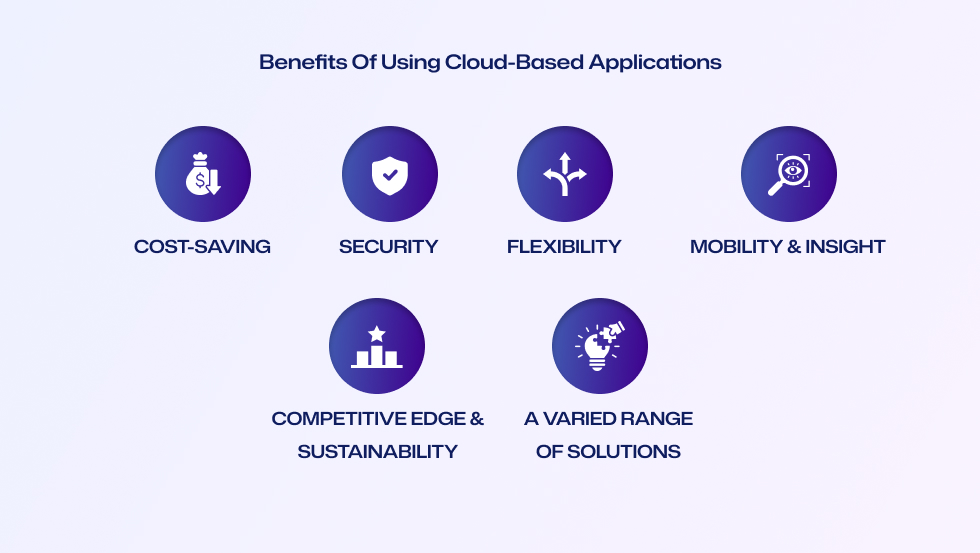
Cloud-powered applications provide a lot of benefits for businesses that include better collaboration, improved accessibility, increased agility and cost savings. The benefits also include disaster recovery capabilities, data security and scalability.
Here’s a detailed look at the benefits:
Reduced cost of infrastructure
Cloud solutions uproot the necessity businesses investments in maintaining data centres and physical servers.
Pay-as-you-go model
Businesses can only pay for the resources that they use which reduces operational expenses.
Lowering costs of IT staffing
Cloud-powered applications frequently need less dedicated IT staff for support and maintenance.
Increased scalability
Cloud applications can be scaled down or up quickly as per the dynamic business demands.
Increased accessibility
Cloud-based business applications can be accessed from anywhere. The users have to have only an internet connection which allows collaboration and remote work.
Increased flexibility
Businesses can select from different clouds services and models of deployment for aligning with their specific needs.
Better security measures
Cloud providers heavily invest in setting up a strong security infrastructure which includes access control and data encryption.
Disaster recovery
Cloud-powered applications offer robust disaster recovery solutions which ensure businesses of continuity during unexpected events.
Automatic updates
Cloud providers manage software maintenance and updates automatically which reduces stress of IT teams.
Access to information
Cloud-based application development solutions centralize data and provide quick access to authorized users of information which improves decision-making.
Better communication
Cloud platforms often integrate many communication tools like video conferencing, instant messaging, etc, that facilitates seamless communication.
Real-time collaboration
Cloud applications enable the teams to work together on projects and documents, all in real-time, regardless of the location.
Better customer service
Cloud-based support systems and CRM improve customer service that provides access to customer information and facilitates rapid resolution of issue.
Better data analytics
Cloud platform comes with tools for businesses intelligence and data analytics that empower businesses to gain accurate insights of data.
Quick time to market
Cloud platforms enable rapid application deployment and development that allows the business to conceptualize new services and products to market them faster.
Cloud Application Development Process
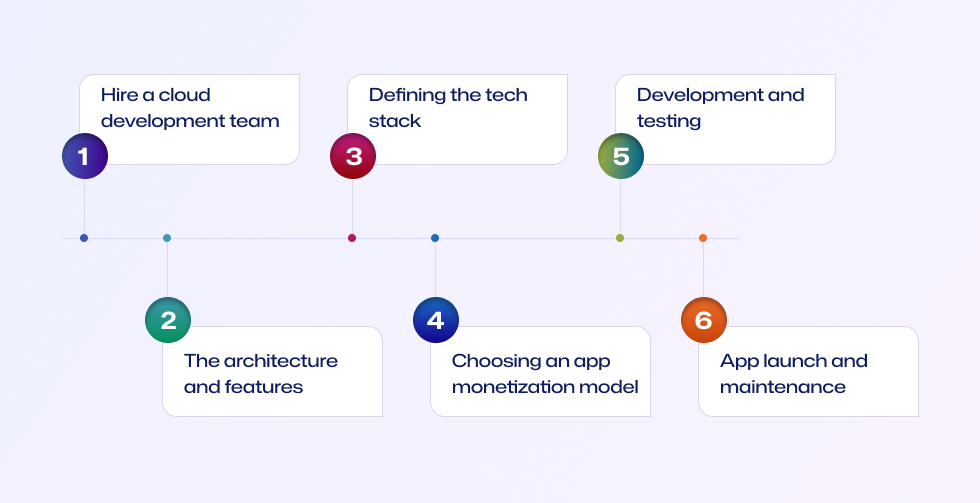
A successful cloud-based software development process begins with clear business requirements, cloud architecture planning, security design, and a scalable deployment strategy. Whether the product is a web platform, enterprise system, or mobile solution, each stage should align with performance, compliance, and long-term growth requirements.
Developing a potent cloud application needs careful planning and experience. Keep scrolling below to know the steps with which you or your development team can craft an effective cloud application that meets the needs of your target audience.
Market research and conceptualization
Brainstorming is the very first step into generating the basic idea of building a cloud application that captivates the target market. Once you are well aware of the potential concepts of the application, market research next will identify your idea’s viability.
At this phase, business owners can evaluate the user needs, competition, potential customer base and evaluate the market size to get an idea of what the target audience wants or needs. Interact with potential users, refine your ideas and align them with the market needs for increasing the app’s chances of success.
Planning and designing
The planning and designing stage are crucial for the development of cloud applications that run seamlessly and meet the user’s needs when they are launched. This process involves germinating ideas into detailed specifics, creating user journeys and wireframing, consideration of the needed features and mapping out the user interface.
For businesses planning cloud-based mobile app development, this stage should also define device requirements, offline functionality, API integrations, data synchronization, and security controls. Early planning helps ensure the mobile experience remains fast, reliable, and scalable as the user base grows.
At this phase, it is crucial to consider ensuring the accessibility, security and scalability of the requirements, aligned with vision and meeting the needs of the target market.
Testing and development
The development phase includes leveraging the specifications as well as designs and turning concepts into working applications, Experienced developers make use of the right tools, software development kits and programming languages. Quality assurance too is an important step for quality assurance and figure out any errors that may cause issues to identify and fix bugs before the app is launched in the market.
Hire a Cloud Development Team
When it comes to hiring a team of cloud application developers, enterprises have three main options, viz, outsourcing an experienced software and cloud applications development company, building an in-house team or hiring a freelancer. Presenting a comparative table on the scopes of all three:
| Management and transparency parameters | Hiring in-house | Hiring freelancers | Hiring a cloud application development company |
| Control and oversight | High | low | High |
| Communication | Direct | variable | high |
| Cost | High | variable | variable |
| Scalability | Moderate | variable | high |
| Duration of project | Long-term | short-term | contractual |
| Innovation and expertise | Tailored to company needs | Task-oriented | Access to diverse expertise |
| Cultural alignment | In-house | variable | high |
| Risk management | Direct | moderate | high |
| Time zone consideration | Local | variable | anytime |
Given the parameters mentioned above, it is clear that hiring a professional cloud application development company is the most viable option for enterprises who lack the right infrastructure or resources for cloud-based application development.
Choose the Right Tech Stack
Choosing the correct tech stack depends on ample factors like safety concerns, types and numbers of integration, requirements of scalability and project scope. For instance, for seamless scalability and easy maintenance of cloud solutions, Python-based development stack is ideal. On the other hand, for testing ideas and building projects that require rapid visualization, Ruby on Rails is preferred as it facilitates seamless collaboration among the cloud software developers.
Honestly, there is barely any common size to fit all as each team selects based on the available resources and expertise. Explore below, the most popular tech stack options that are commonly leveraged for cloud-based application development:
| Frontend | Tailwind CSS, Materialize, Bootstrap, Vue.js, Angular, React |
| Orchestration and containers | Amazon ECS, OpenShift, Kubernetes, Docker |
| Frameworks | Vue.js, React, Angular, Ruby on Rails, .NETCore, Express.js, Flask, Django, Spring Boot |
| Databases | Firebase Realtime Database, Firestone, Cosmos DB, Amazon RDS, MongoDB, PostgreSQL, MySQL |
| Programming languages | TypeScript, PHP, Go, .NET, Ruby, .Node.js, Python, Java |
App Monetization Model
App monetization refers to the strategies that are leveraged for generating revenue from an app that is deployed on cloud. This includes number of features like premium features, subscriptions, in-app purchases and in-app advertisements.
App monetization is a critical aspect of app development lifecycle which helps in the offset development costs and generate profits.
App monetization models involve certain considerations like integration, cost optimization, security and scalability.
To choose the right model, the developers consider factors like user engagement, target audience and purpose of the app. To find the most appropriate approach for an effective app, it is crucial to experiment with various models first as certain types of models might be better suited for specific apps or user demographics.
Post-Launch Maintenance and Optimization
With the constantly evolving market and shift of user needs, new technologies emerge and hence, cloud applications too need post-launch optimization and maintenance. The key areas here are:
Updating technology as frameworks, libraries and technology stacks used in the applications receive new updates.
Adjustment of scalability based on the growth of application and traffic fluctuation.
Performance optimization for ensuring that the applications remain scalable and responsive with evolving demands.
Security patches and updates for safeguarding the user data against the evolving threats.
The Best Practices for Cloud-based application development
Best practices in cloud-based application development services include monitoring, access control, encryption, robust security measures, DevOps, serverless computing containerization, utilization of microservices, adopting microservices architecture, API-first approach, implementing CI/CD pipelines, ensuring observability and real-time monitoring.
Here are the details:
Microservices architecture – Breaking down applications into independent and smaller services for fault isolation, scalability and easier maintenance.
Containerization – Using technologies like Docker for packaging the applications and their dependencies for ensuring consistency across various cloud environments.
DevOps practices – Implementing the CI/CD pipelines, integrating testing and monitoring for seamless deployment and development, automating deployment and implementing CI/CD pipelines.
Serverless computing – Leveraging serverless platforms for certain tasks and specific functions to reduce the operational overhead which allows the developers to put their focus on code.
Data security – Implementing compliance measures, access control and data encryption for protecting sensitive data.
Analytics and monitoring – Leveraging tools for providing valuable insights, security threats, user behavior and tracking performance.
Scalability – Design applications for scaling down or up based on the load balancing, using of auto-scaling features and demands.
Performance optimization – Consideration of distributed databases, utilization of caches and optimization of codes for enhancing the application’s responsiveness and speed.
Cost management – Monitoring consumption of resources and optimizing allocation of the same for controlling costs.
Compliance – Adherence to compliance requisites and industry regulations.
API design – Designing APIs for seamless integration and communication with other services.
Cloud-native development – Consideration of the use of cloud-native technologies as well as platforms for creating resilient and scalable applications.
Security – Securing the data at transit and at rest by using encryption, implementing strong access controls for restricting access to sensitive data and ensuring compliance with industry standards and relevant regulations.
API-first approach – Prioritization of well-defined design principles like ease of adoption and RESTful architecture of consistency.
CI/CD pipelines – In cloud-based application development services, implementation of CI/CD pipelines include automation of entire process of software delivery through a series of automated steps, right from production to code commit.
Ensuring observability and real-time monitoring – For ensuring observability and real-time monitoring, developers must concentrate on analyzing and collecting data, improving observability setup and automating the monitoring.
Challenges in cloud app development
Cloud application development faces stringent hurdles that include managing costs and resources, portability and interoperability service design complexity, app security and data privacy, etc.
Maintaining the security of applications as well as sensitive data is important given the fact that designing flexible and scalable services are complex as well.
To ensure that the applications can work seamlessly along with other systems and can be systematically moved from one cloud platform to another, is another significant challenge. Organizations, additionally, must go through the compliance requisites and regulatory frameworks and manage effectively the resource and cost consumption of cloud applications.
Let’s have a detailed look at the challenges:
Data privacy and application security
- Data breaches – Cloud apps are most vulnerable when it comes to data breach due to its misconfigurations, insecure APIs and shared infrastructure.
- IAM or inadequate identity access management – Proper management of user permission and accessibility is significant because weak controls lead to unauthorized breaches.
- Insecure APIs – Securely implementing and designing APIs is crucial for preventing vulnerabilities as well as unpermitted access.
- Cyberattacks – Cloud applications are vulnerable to malware attacks, DDoS, DoS.
- Compliance – Meeting the regulatory challenges like HIPAA or GDPR, involving implementation of standard security and data privacy, pose as a significant challenge.
Complexity in service design
- Microservices – As microservices offer their benefits, they also bring in complexity in adequate management of interactions and multiple services.
- Flexibility – Ensuring that the applications can be adapted to evolving technologies and changing market needs, can be challenging.
- Scalability – Conceptualization and development of applications that can be scaled down or up requires careful management of resource and is immensely complex.
- Portability and interoperability
- Data portability – The ability of moving data between on-premises and cloud is challenging during disaster recovery and flexibility.
- Standardization – Assuring the cloud application’s capability to work seamlessly with various systems and platforms need strict adherence to industry standards.
- Vendor lock-in – Organizations who become dependent on specific cloud provider make it challenging to migrate to or integrate with on-premises framework.
Regulatory and compliance issues
- Regulatory frameworks – Navigating through various regulatory frameworks across various industries like healthcare and finance can add to complexity.
- Compliance and audit – Maintaining of compliance with audit and regulation requirements need accurate documentation and robust security controls.
- Data residency – Ensuring data storage and processing within the correct geographic region as required by regulations is challenging.
Managing resources and cost
- Predictable costs – Controlling of unpredictable cloud costs to avoid overspending is a huge challenge.
- Resource management – Effective management of cloud resources include network, storage and services is crucial for cost and performance.
- Cost optimization – Optimization of resource utilization along with cloud management costs a fortune and it makes profitability challenging.
Real-world use cases and innovations
From just being convenient storage solutions, cloud-based application development solutions have transformed into the core machinery or engine behind today’s digital transformation. Today, these applications power up intelligent services, create agile infrastructures for various industries and fuel real-time analytics.
Let’s have a look at how cloud-based application development solutions are transforming economies with strategic use cases and real-world innovations.
Google Cloud Edge x McDonald’s
Focus of innovation: Cloud-based data analytics + Edge Computing
Google Cloud partnered with McDonald’s for modernizing its customer service and experience with the power of EDGE computing. The idea behind it was simple – bringing the data source (read restaurants) closer to cloud computing.
Highlights:
- With the deployment of EDGE devices at the restaurants, McDonald’s could process inventory data and customer orders without the need to route everything from centralized cloud servers.
- The cloud-powered AI models enabled predicting anticipation of customer demand for specific menus based on time and location and machine failures.
- Based on trending items, time of the day and weather, the digital manus could be changed dynamically through cloud-hosted Machine Learning models.
The synergy between Google Cloud and McDonald’s aims at improving the operation speed with reduced latency – both of which are necessary in high-speed service sectors.
SaaS-Powered Route Planning for Fleet Management
Focus of innovation: SaaS-powered cloud native solutions for streamlining and empowering logistics
Logistics and fleet management companies are adopting, increasingly, SaaS-powered route-optimization tools which leverage real-time weather forecasts, usage patterns and traffic data that are streamed via cloud APIs for designing efficient routes.
Companies like Fleet Complete and Verizon Connect provide cloud-native tools for route optimization that integrate well with cloud-based dashboards, vehicle telemetry and GPS.
Highlights:
- Real-time updates on fuel efficiency, delivery delays and road closures for dynamic rerouting.
- Cloud-powered analytics enable businesses to reduce and track operational costs, idle time and fuel consumption for reducing costs.
- SaaS platforms are designed for handling fleets of various sizes – right from multinational carriers to small delivery firms – empowering the businesses with scalable architecture.
SaaS cloud-based application development solutions democratize access to AI-powered tools in logistics that enable SMEs into streamlining their transport and delivery systems.
Multi-platform solutions for video conferences
Focus of innovation: Cloud-powered real-time communication platforms
The need for scalable and seamless communication tools increased after 2020, which pushed the emergence and popularity of platforms like Google Meet, Microsoft Teams and Zoom that redefined video conferencing using cloud-based application development solution architecture.
Highlights:
- Users can jump from web to mobile to desktop confidently as all data like transcripts, meeting history and chat logs are synced and stored in the cloud.
- By leveraging the multi-region cloud availability zones, the platforms ensure high availability and low latency across all continents.
- Advance CCPA and GDPR compliance with secured management of identity are seamlessly integrated into the cloud infrastructure.
Cloud-powered RTC platforms are crucial tools of collaboration that offer seamless interoperability with various devices with high security and low latency.
AI-powered cloud-based application development solutions by tech giants
Focus of innovation: AIaaS or AI as a service vis public cloud platform
Google GCP, Microsoft Azure and Amazon AWS are the forefront players who intend to deliver Artificial Intelligence and Machine Learning capabilities via cloud platforms and APIs, enabling the developers in architecting intelligent applications at scale.
Examples:
- Google Vertex AI is an end-to-end platform that deploys scalable Machine Learning Solutions, manages training models and data.
- By leveraging Amazon SageMaker, developers can manage, train and deploy Machine Learning models on the cloud entirely.
- Azure Cognitive Services provide APIs for sentiment analysis, facial recognition and language understanding.
Cloud democratizes the usage of AI through offering computing infrastructure and pre-built tools that were, once accessible to the tech giants, but now made available to mid-sized businesses and startups alike.
Cost of building cloud-based application development solutions
The cost of cloud-based software development depends on the application’s architecture, user volume, integrations, cloud provider, security requirements, and ongoing maintenance needs. For cloud-based mobile app development, teams should also account for mobile APIs, cross-platform frameworks, testing across devices, and app-store deployment requirements
Here are the details:
Cost of infrastructure
At the heart of any cloud-based application development, lies infrastructure. Whether it is Google Cloud Platform, Microsoft Azure or Amazon Web Services, the choice of the service provider influences costs significantly. These service providers, tight from storage, computing resources to databases, the selection is based on the app’s requisites with varying costs.
Here’s a breakdown:
- Storage – Costs for strong data inside cloud like Azure Blob Storage or Amazon S3, can range between several Dollars and few cents per gigabytes per month.
- Databases – Costs of databases like MongoDB, PostgreSQL and MySQL can be between fee (in some special or unique circumstances) and several hundred Dollars every month, depending on their size.
- Server instances – The cost of server instances depend on types of factors like containers, virtual machines and size factors like memory and CPU. Even the tiniest application might be within the price range of $10 and $100 every month.
- Cloud Service Providers – This cost is variable significantly as it depends on the providers like Google Cloud, Azure and AWS. Right from a medium to small-sized application, costs may vary between $10,000 to $100.
Development technologies and tools
The technologies and tools that are leveraged during cloud-based application development, also add to the costing variance. The more advanced technology is used, the software and applications will function smarter and better, refining the user experience. But this refinement makes the development process more expensive. Of course, opting for open-source solutions can lower costs, but it might make integration harder.
Here’s a breakdown:
- Libraries and frameworks – The costs of leveraging libraries and development frameworks vary. As mentioned earlier, open-source solutions can be free, but some are associated with costs for commercial support or usage.
- Licensing fees – Licensing fees, if they are associated with any kind costs like libraries or frameworks, can shoot the development expenses up.
Ongoing maintenance
Ongoing maintenance is a crucial part of cloud application lifecycle. Regular security patches, bug fixes and updates are crucial factors that ensure the application’s optimal performance. Since maintenance costs are perpetual, their recurring expenses must be factored into the overall budget.
Here’s a breakdown:
- Personnel expenses – Personnel expenses for ongoing enhancements and support vary widely depending on location and team size. This could range between $10 to $10,000 every month.
- Monitoring tools – Right from free to hundreds of Dollars every month, the monitoring tools vary in cost.
- Regular updates – Cost of regular or frequent updates depend on the application complexity. This may range between a few hundred to a few thousand Dollars every month for small to medium-scale applications.
Security measures
Implementation of security compliance, protocols and encryption along with industry standards impacts significantly on the overall expenses. But safeguarding of sensitive data along with the building of user trust are important investments.
Here’s a breakdown:
- Certifications and compliances – Cost of compliance certifications like GDPR and HIPAA vary immensely depending on application size and requirements. This can range between tens of thousands to a few thousand Dollars every month.
- Firewalls – Cost of firewalls also vary depending on the complexity and type of software and hardware. A basic firewall may be included in cost of infrastructure, while advanced firewall costs up to several thousand Dollars annually.
- SSL certificates – Cost of SSL certificates range between free to several hundred Dollars every year for advanced certificates.
Lastly, we can say that creation of a cloud-based application development solution may cost somewhere between $30,000 to $160,000. The final price, however, depends on the complexity of the applications and their features. For simpler projects the cost may vary around $20,000 but for large-scale projects, it may shoot up to the aforementioned $160,000 figure, especially when they are custom business applications or extensive cloud migration solutions. For enterprise-grade applications, the cost margin can surpass the million-Dollar mark.
Kindly note that these figures are indicative and based on the market research findings by Proquantic Software USA. Actual cost may vary depending on the chosen cloud service provider, features or complexity of the project.
Hidden cost in cloud-based application development solutions
Hidden costs in cloud-based application development projects often grow out of unexpected changes for services like third-party integration and data egress. They also occur from inefficient deployments and mismanaged resources.
To understand these expenses and implementing strategies for mitigating them is important for achieving cost efficiency and optimization of cloud spend.
Cloud App Development Trends for 2026 and Beyond
The future of cloud app development in 2026 will be shaped by generative AI, serverless computing, edge processing, cloud-native security, and increasingly intelligent automation. These technologies are making cloud-based software development more efficient while enabling businesses to deliver faster, more personalized digital experiences.
The crucial trends driving this evolution are:
Integration with generative AI
- Code generation - AI Software Development Services are increasingly leveraging generative AI models to assist developers in suggesting functions, generating code snippets, significantly accelerating development time and designing applications.
- Personalized experiences – Cloud applications leverage generative AI to customize the user experiences and interfaces based on customer usage patterns and preferences.
- Automated testing – AI can be leveraged in generating test scenarios, test cases and improving the quality of software testing.
AI chips in cloud computing
- EDGE computing – AI chips are increasingly being integrated into EDGE devices which brings in the AI capabilities closer to the data sources in real-time for reducing latency.
- Optimized performance – Specialized AI are being designed for specific project needs and workloads to accelerate speeds of processors and improve the efficiency of computationally heavy tasks like deep learning and Machine Learning.
Consistent growth in remote collaboration tools
- Virtual collaboration environments – Platforms which enhance the physical workspaces, allow for more collaborative and interactive remote work which are still gaining traction.
- Asynchronous communication – Tools which facilitate communication without any dependency of every participant to be online at the same time, like Slack and asynchronous video conferencing, are becoming necessary for vast and distributed teams.
Rise of serverless computing
- Cost-efficiency – By paying for only computed time used, serverless framework can significantly reduce expenditures especially for the apps with variable usage patterns.
- Scalability – Serverless functions enable developers to focus on the core business logics without the worry of managing infrastructure – which enables even scalability in meeting the dynamic demands.
These trends blend to create a more scalable and efficient as well as flexible environment for cloud-based application development to:
- Improve collaboration between geographically distributed teams
- Improve performance of applications
- Facilitate faster cycles of development
Proquantic Software – your partner for futuristic cloud-based application development solutions
At Proquantic Software, our cloud-based application development processes go beyond the code – we conceptualize solutions that are customized, tailored and built resilient to meet the demands of real-world. Whether you are modernizing legacy systems or building from the ground up, our Custom Software Development Services ensure long-term sustainability, optimal performance and seamless integration.
Proquantic supports businesses with end-to-end cloud-based software development, from architecture planning and cloud migration to secure application delivery and ongoing optimization. Our team also delivers cloud-based mobile app development solutions that connect users, data, and business systems through scalable cloud infrastructure.
With deep focus on infrastructure efficiency, compliance and industry alignment, we empower the businesses to leverage cloud as their strategic advantage - beyond just a technical upgrade.
Here’s how we can do that for you too:
End-to-end cloud development services
From conceptualization to deployment and beyond, we deliver comprehensive cloud-based application development solutions as our team excel at:
- Supporting hybrid and multi-cloud strategies for meeting diverse operational needs
- Integrating real-time data processing, DevOps Consulting Services and third-party APIs
- Migrating the legacy systems to the cloud ecosystems seamlessly
- Conceptualizing the cloud-based applications with availability and high-performance
Scalable infrastructure design
One of the best advantages of our cloud-based application development solutions is scalability and topping that, we assure you to grow. We:
- Leverage platforms like GCP, Azure, AWS for elastic expansion of cloud
- Build high-availability and disaster recovery system essential for business continuity
- Transform the cost-performance ratio with dynamic allocation of resources
- Conceptualizing containerized environments and microservices for modular scaling
Compliance and security expertise
Cloud development is never possible or complete without breach-proof security and at Proquantic Software, we consider it as a cornerstone of our services through:
- Application of secure-by-design principles that vary from the 1st line of code itself
- Conducting frequent real-time monitoring, audits and penetration testing
- Ensuring PIC-DSS, HIPAA and GDPR and regional data law compliance
- Implementation of role-based access controls and enterprise-grade encryption
Industry-centric cloud solutions
Proquantic custom-builds cloud architectures and align them with the demands of each sector. Whether your business is in logistics, e-Commerce, healthcare or finance, our talented team of engineers can deliver industry-aligned Custom Enterprise Software Development
solutions that:
- Assure of rapid deployment with minimum effect on the existing workflows
- Incorporate Big data layers, Blockchain Software Development Services, IoT and AI for industry-driven intelligence
- Enabling custom integrations for patient monitoring systems, CRMs and ERPs
- Address domain-specific performance benchmarks and regulations
Conclusion
Cloud app development offers businesses a scalable and efficient alternative to traditional application development. In 2026, cloud platforms help organizations improve flexibility, reduce infrastructure overhead, strengthen security, and deliver reliable digital experiences across web and mobile channels.
With careful planning and the right cloud platform, cloud-based software development can help businesses build, deploy, and evolve secure applications that support long-term growth. Whether you need an enterprise platform or cloud-based mobile app development, Proquantic Software USA can help you create a tailored cloud solution for your business.
Frequently Asked Questions (FAQs)
What are the main types of cloud applications?
Cloud applications can be broadly categorized into SaaS (Software as a Services), PaaS (Platform as a Services), IaaS (Infrastructure as a Services) and FaaS (Function as a Services)
How secure is cloud-based application development?
Cloud-based application development is secured due to factors like:
- Regular patching and updates
- Security features
- Cloud providers’ expertise
How long does it take to develop a cloud app?
The time needed to develop a cloud application varies depending on the size and complexity of the application. It may range from weeks to many months due to the factors like development team size, prototyping and requirement analysis.
Is cloud app development suitable for startups in 2026?
Yes. Cloud app development is well suited to startups because it offers flexibility, lower upfront infrastructure costs, faster deployment, and the ability to scale as demand grows. Startups can use cloud-based software development to launch MVPs quickly, while cloud-based mobile app development enables them to reach users across devices without building extensive on-premises infrastructure.
What is the difference between SaaS, PaaS, and IaaS?
The key differences between SaaS, IaaS and PaaS lie in their responsibility of service models and level of control. Here’s a basic glimpse:
IaaS – The cloud provider manage infrastructure and customers build, deploy and manage the applications and operating systems.
PaaS – The cloud provider manager infrastructure but developers are responsible for managing, building and deploying applications.
SaaS – The cloud provider manages entire stack of applications, that include updates, infrastructure and software.