


Nearly every new startup aspires to scale rapidly and achieve sustainable growth following its launch. However, the journey to thrive in the competitive market while dealing with various financial priorities is challenging. Striking a perfect balance between performance and cost strategies is vital during the evolution of startups.
According to a Tracxn report, the United States is home to more than 1.2 million startups, making it the world’s largest hub for innovation. Among them, over 213,000 companies have collectively raised $7.74 trillion in funding. Yet, the real measure of their success isn’t the capital they’ve secured, but how wisely they balance spending with performance for sustainable growth.
For founders, executives, and investors, achieving growth while maintaining financial discipline is the ultimate balancing act. In this blog, you’ll discover how to build scalable cost frameworks that appeal to investors, secure funding, and maximize ROI at every stage of your startup journey.
The Major Growth Stages of a Startup
Business lifecycle comprises a series of predictable stages, which help entrepreneurs set their priorities and make better financial decisions. Most importantly, each stage demands different growth strategies to help your company stand out and navigate challenges. To understand the cost strategies involved in each startup stage, let’s discuss them first.
-
Ideation & validation: Problem evaluation and solution
Start by framing the problem precisely and testing whether it truly exists for a defined user segment. Conduct focused customer interviews, micro-surveys, and rapid landing-page experiments to measure interest, behavior, and willingness to pay.
For startups balancing cost and performance, early validation reduces wasted professional effort and keeps burning low while proving demand. During this stage, companies track simple conversion signals and qualitative feedback to decide which product to build next.
-
MVP development: Create a minimum viable product
Developing a minimal viable product (MVP) is a common practice where startups build the smallest product to demonstrate core value. They do this to reach real users and capture actionable feedback on their products. However, emerging companies prioritize must-have features during product development that deliver measurable outcomes by removing non-essential ones.
Instrument analytics, error monitoring, and automated tests are essential from the very beginning, so that quality does not degrade while you iterate. Through modular architecture and feature flags, firms can successfully develop and launch MVPs safely.
Offshore companies often help startups lower development costs. However, they require clear acceptance criteria, frequent demos, and tight backlog discipline to reduce or protect time-to-market and maintain performance.
-
Growth & scaling: Expand customer base and infrastructure
Startups enter this stage once they achieve product-market fit and are ready to increase their user or customer base. Their focus shifts from experimentation to building predictable outcomes through customer acquisition, retention, and infrastructure optimization.
Companies invest in marketing channels that consistently attract the right users while strengthening operations to handle ongoing demand. They evolve systems, from basic setups to scalable architectures, that support higher traffic, transactions, and data loads without compromising speed or reliability.
Financial planning also matures, emphasizing efficient capital allocation and sustainable growth metrics. This is when startups transition from being product-centric to becoming process-driven organizations, which is capable of serving larger markets and maintaining long-term performance.
-
Expansion & maturity: Sustaining growth through diversity
During the final evolution stage, startups evolve into established businesses that mostly focus on sustaining growth and achieving long-term stability. You can witness a shift from rapid scaling to diversification, expanding product lines, entering new markets, or exploring strategic business partnerships.
Many tech firms refine their operations, strengthen governance, and adopt data-driven decision-making to ensure cross-team collaboration and efficiency. Financial discipline and balancing innovative investments with profitability and risk management take the center stage here.
Some established startups focus on brand reputation, customer loyalty, and compliance to earn and maintain trust in the competitive market. This is the phase where a fast-moving startup transforms into a resilient enterprise. Companies can expect steady revenue, operational excellence, and adaptability amid changing market dynamics and emerging technological shifts during this stage.

Types of Costs Involved in a New Startup Launch
Startup costs depend widely on the type, industry, location, and operational scale of businesses. Every startup incurs a mix of one-time and recurring expenses that shape its financial foundation, which can be anywhere between $50,000 and $500,000. Understanding these costs helps founders estimate their funding needs and manage cash flow effectively from day one. Here’s a breakdown of the major categories of startup costs.
Examples of One-Time Costs for Startups
Below are the one-time costs companies typically incur when starting a new business.
-
Business formation and registration:
Establishing a legal business entity requires fees for business registration, filling all business incorporation documents, and handling important licenses or permits. These costs also depend on the structure, such as an LLC, sole proprietorship, or corporation, which impacts liability, taxation, and compliance. Registering your business in the US can cost between $200 and $1,000.
-
Professional services:
At the startup stage, businesses need professional support from lawyers, accountants, and consultants. Legal experts assist your business with contracts, compliance, and intellectual property, while accountants help set up financial systems, tax structures, and recording processes. Opting for professional services means an investment in the range of $150 to $450+ per hour for individual projects and various stages of a startup.
-
Branding and marketing materials:
A strong brand identity is critical during a startup launch. However, the primary costs here include logo design, brand guidelines, business cards, brochures, and initial website setup.
Preparing early marketing materials in both digital and print formats can also help attract first customers and establish your firm's credibility. Expect the charges for basic packages to be between $1,000 and $5,000. In comparison, the costs can be $11,000 to $70,000 for comprehensive business campaigns.
-
Equipment and supplies:
Depending on the business type, startups may need essential tools such as computers, office furniture, manufacturing equipment, or inventory. For product-based ventures, raw materials and packaging supplies also form a significant portion of these upfront expenses.
Companies during their early stage often spend between $27 and $32 per employee per month. In case of additional requirements like initial inventory and specialized equipment, this expense can become thousands of dollars.
-
Technology:
Modern startups rely heavily on digital tools for operations. On average, startups spend between $40,000 and $200,000 on technology development during the initial stage.
Technology expenses usually include purchasing or subscribing to software, communication systems, cybersecurity tools, and point-of-sale (POS) systems. Even cloud-based platforms for project management and collaboration come under this category. Sometimes, the ongoing IT expenses can also be added to this cost, which can be between $500 and $5,000+ per month.
-
Market research:
Before launching, conducting thorough market research helps founders understand customer behavior, pricing expectations, and competitive positioning. Research costs can include surveys, focus groups, in-depth interviews, and questionnaires.
You can utilize data analysis tools and hire a specialized agency to interpret insights for different stages of a startup. The investment required for data analytics services is around $1,000–$10,000 per month. Whereas opting for an enterprise IT consulting company can help you explore various aspects, including market research, startup costs, technology, and upgrades.
Recurring Costs for Emerging Businesses
Alongside one-time costs, startups also have some repeat expenses as discussed below.
-
Rent and utilities:
Ongoing operational costs often start with office or retail space rent. This includes monthly payments for electricity, water, gas, internet, and phone services. These are expenses that are essential for maintaining daily business operations.
Depending on the office size and location, a startup may need to invest $1,000 to $5,000+ to rent the space. You can also add $200 to $1,000 to utilities every month to this cost.
-
Salaries and wages:
Employee compensation is one of the largest recurring costs for startups. This includes not only base salaries but also benefits, bonuses, and payroll taxes. Competitive pay structures are vital for attracting and retaining skilled talent.
For example, if you are in the software development business, hiring an expert developer means paying an average of $144,000 yearly. Working with offshore developers in this case can be more cost-effective, provided you approach a reliable agency like Proquantic.
Read more about offshore software development and the cost estimation for US businesses here!
-
Marketing and advertising:
Startups prepare an exclusive budget for continuous marketing efforts, which helps them maintain visibility and attract customers. The expenditure includes costs for social media campaigns, online ads, content creation, influencer collaborations, and public relations initiatives. Early-stage business owners often invest $5,000 to $10,000 in advertising and marketing materials.
-
Insurance:
Comprehensive business insurance protects startups from potential risks. This can include general liability coverage, property insurance, workers’ compensation, and professional liability insurance. Each of these options provides a safety net against unexpected financial losses. In the US, emerging companies pay $500 to several thousand dollars annually for insurance, which is likely to increase with advanced stages of a startup.
-
Taxes:
Every startup must account for multiple types of taxes, comprising income tax, sales tax, payroll tax, and property tax. Planning tax obligations ensure compliance, which is necessary for firms to avoid penalties that could disrupt operations.
Taxes are usually calculated on the basis of location, structure, and payroll of a business. Sometimes, it can be a certain percentage of the profit for that financial year.
-
Loan payments:
If a startup is funded through business loans or lines of credit, regular loan repayments become a fixed recurring cost. Interest payments and principal installments are often factored into monthly financial planning.
For U.S. startups, loan payment costs depend on the Annual Percentage Rate (APR), reflecting both interest and fees, and offering a complete picture of borrowing expenses.
-
Maintenance and repairs:
Businesses require periodic maintenance for equipment, facilities, and technology systems. Keeping everything in working order prevents startup owners from avoiding costly breakdowns and ensure uninterrupted operations.
On average, firms may need to invest approximately $50,000 for repairs and maintenance work.
-
Inventory:
Product-based startups consistently restock their inventories to meet customer demand. This leads to fluctuating costs based on sales volume, supply chain changes, and seasonal variations in market activity.
There can be an additional inventory expenditure of $1,000 to $100,000+ for a startup, depending on the business scale and model.
-
Professional fees:
Some US firms often continue using professional services even after the market launches. They spend money on accountants to handle tax filings, lawyers to manage contracts, and consultants to advise on business scaling strategies. All these aspects contribute to ongoing operational expenses, ranging from $300 to $5,000+ per year.
-
Travel expenses:
Many startups incur travel costs for events like client meetings, trade shows, or business development. These include transportation, accommodation, meals, and event registrations. For startups expanding into new markets, the overall expenses can often reach between $1,400 and $1,800 per trip.
Office supplies:
Day-to-day office operations rely on basic supplies, including stationery, printer ink, cleaning materials, and packaging items. These expenses compound over time and can become a bigger investment for an emerging business. Sometimes, investing $100 to $300 per month can also become a draining expense for an early-stage startup.
Training and development:
As the business grows, continuous employee training ensures skill enhancement and operational efficiency. These expenses include professional courses, workshops, and certifications to keep the team updated with evolving industry trends.
According to a report from Training Magazine, most companies allocate around 13% of their business budget to learning technologies and tools. Meanwhile, small enterprises typically spend approximately $1,071 on training and development. This expense continues to rise as technology needs expand and skill requirements grow within a startup.
Common Cost Mistakes Across Startup Stages
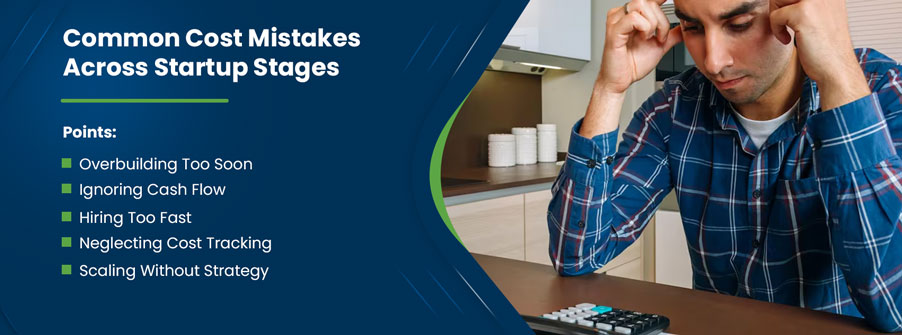
Emerging firms often face challenges calculating the precise cost, which puts them under a financial burden. Let’s discuss what causes budget misallocations during different stages of a startup.
-
Overbuilding Too Soon
Founders often spend heavily when adding features, even before customers approve of their demand. Overbuilding inflates development costs, lengthens time-to-market, and hides whether the core idea actually solves the problems of users.
Modern MVP practice favors rapid validation and iterative releases. However, expensive integrations and “nice-to-have” features can easily wait until metrics justify them. It is recommended to build products with features that can be beneficial for customers.
-
Ignoring Cash Flow
Running out of cash remains one of the leading causes of startup failure. Treating cash flow as secondary to growth often results in missed payroll, halted product development, and emergency fundraising under unfavorable terms.
Companies often closely track key metrics such as gross and net burn rates, monthly runway, and the timing of receivables versus payables to mitigate risks. They can take the help of market research to forecast multiple runway scenarios and identify potential shortfalls early. Strong cash flow management empowers teams to make strategic decisions proactively rather than react to financial crises.
-
Hiring Too Fast
Adding headcount before clearly defining roles and performance expectations increases fixed costs and heightens the risk of employee turnover. Rapid hiring can also dilute company culture, overwhelm onboarding processes, and reduce overall productivity while increasing operational overhead.
To avoid this problem, companies should prioritize hiring for critical and clearly measurable roles. They must leverage specialized contractors for project-based or short-term needs, ensuring resources align with milestones and growth goals without adding unnecessary long-term payroll burden.
-
Neglecting Cost Tracking
Many startups lack cost visibility across SaaS subscriptions, infrastructure, and vendor agreements. In-house teams often oversubscribe tools, miss pricing efficiencies, and misattribute spending to products or channels due to a lack of accurate tracking tools.
Several companies use automated tools to track recurring spending and unused subscriptions. Real-time cost dashboards help founders course-correct before small leaks become critical drains on the runway.
-
Scaling Without Strategy
Scaling before operational repeatability invites amplified problems: customer support breakdowns, inconsistent product quality, and exploding costs. Growth must follow validated processes, reliable metrics, and infrastructure that handle increased load.
A strategic scale plan ties hires, marketing, and tech spending to unit economics and customer retention targets. Otherwise, rapid expansion converts manageable costs into unsustainable fixed obligations and can accelerate failure rather than deliver durable growth.
How Proquantic Balances Cost and Performance for Startups?
Reducing costs while improving performance is essential for early-stage startup success. Missteps that lead to budget misallocations can be corrected with the right strategic partner. Here’s how our approach helps maximize savings while strengthening operational performance during the stages of a startup.
We help businesses identify key features and develop custom software, including MVP. This is necessary to avoid overspending while filtering out non-essential features.
Many startups operate smoothly only when they have dedicated office spaces. However, if you want to reduce expenditure on rent and utilities, hiring our offshore teams can benefit your business.
Full-time hires for every role can result in financial loss for your firm. Partnering with us can provide you with access to global talent for your projects without hiring them permanently.
Instead of costly software or marketing strategies, you can simply hire IT professionals from a leading outsourcing agency in the US.
You can trust us to design your custom website, develop mobile apps, and handle legal requirements for offshore hiring. Our services can bring startup costs down while giving a competitive edge with artificial intelligence, cloud technology, enterprise application development, DevOps consulting, and more.
Conclusion
Having realistic expectations on startup costs and performance can help you achieve successful outcomes. However, having an outsourcing partner can keep strategies aligned to your business goals and maximize ROI.
Proquantic’s seasoned team specializes in MVP development and staff augmentation services. We are ready to help you balance performance and cost throughout your startup journey. Schedule a call to discuss your needs with us and receive every help to establish your emerging business.
FAQs on Stages of a Startup
How should startups adjust costs as they grow?
Startups, during the initial stage, focus heavily on minimizing expenses through smart, lean tactics. They typically begin with a small core team and limited infrastructure to speed up planning and product delivery. Many tech startups also hire offshore developers or IT engineers for initial builds. This is a cost-efficient approach that allows in-house teams to concentrate on core strategy and growth tasks.
As the company gains traction during the seed or early growth stage, the budget should gradually expand to include stronger product oversight, customer support, and operational reliability. When scaling, founders should prioritize spending on operations, global talent acquisition, and monitoring tools to ensure sustainable performance.
For US-based startups, it’s crucial to set quarterly goals to realign budgets with evolving growth priorities.
At what stage does performance outweigh cost savings?
Startups focus on cost-efficient marketing and customer acquisition during the initial stage to validate their ideas and gain early traction. However, once you achieve consistent user growth, retention, and steady revenue, shift focus to performance and product quality. Slow releases, instability, or recurring bugs can impact customer experience and business credibility at this point.
To maintain reliability and scale efficiently, startups should consider hiring dedicated offshore teams instead of freelancers or short-term contractors. This approach ensures better control, accountability, and long-term collaboration. Moreover, performance-based investments should target core product improvements to enhance customer satisfaction, scalability, and sustainable growth.
How to balance performance upgrades without inflating costs?
To strike the right balance between performance and cost, start by identifying the key performance metrics for your business, such as page load time under 2 seconds, server response time under 200 milliseconds, and error rate under 1% for core transactions.
Next, prioritize upgrades that directly impact those metrics. For less critical modules, you can leverage offshore engineers to keep costs down. However, core architecture, reliability, and monitoring should remain in-house, so your team retains control and accountability.
Many U.S. firms migrating to cloud infrastructures report ~20% annual cost savings on infrastructure alone. Also, downtime can cost SMEs up to $100,000 per hour for sites while working with 100 employees or even fewer. By prioritizing the right upgrades and leveraging offshore talent smartly, you avoid inflated cost structures while improving the reliability and growth potential of your product.
Can I grow my startup fast without overspending?
Yes, startups can grow fast without overspending by being strategic about what to offshore and what to retain in-house. In the early stage, outsource repetitive development, testing, and non-core operations to offshore teams while keeping customer-facing engineering, product design, and decision-making internal.
Automate workflows, review SaaS subscriptions, and negotiate multi-year vendor deals to reduce recurring costs. As you scale, combine offshore execution with strong in-house oversight to maintain quality and accountability.
Avoid cutting corners in areas like UX, data security, or infrastructure reliability, where performance directly drives growth. Smart cost management is about efficiency, not shortcuts. Every dollar saved should strengthen your business, helping you operate longer, improve performance, and extend your runway before the next funding round.
Do offshore developers help startups scale affordably?
Yes, partnering with offshore development teams can help startups scale efficiently without exceeding their budgets. The key is to collaborate with a reliable IT staff augmentation company that ensures skilled talent, clear communication, and secure operations.
For U.S. startups, offshore development can reduce engineering costs by 50% to 70% compared to hiring onshore teams. This cost advantage allows early-stage companies to allocate resources toward core business growth, product innovation, and market expansion while maintaining quality and delivery speed.
Early-stage startups can significantly reduce hiring costs by working with offshore professionals to build non-core features or early product prototypes. However, successful scaling requires strong process governance, overlapping time zones for collaboration, and clear, consistent communication between distributed teams.
As a best practice, companies should keep core development, user-facing features, and final product oversight in-house. This ensures better quality control, faster decision-making, and alignment with the company’s long-term vision while leveraging offshore teams for cost efficiency and execution speed.
How do investors measure ROI across startup stages?
During the growth stages, investors focus on the cost efficiency of a startup. They might inquire about some vital details like how long your startup can operate with current funds, the burn rate or spending speed, and how much progress you’ve made toward key milestones. These indicators show whether the existing team can achieve results with limited resources.
As startups grow, the focus shifts to sustainable performance. Investors look for signs of long-term viability, such as customer retention, healthy unit economics, and a scalable infrastructure that can support more users without major cost spikes.
For US companies using offshore engineering teams, stakeholders also examine whether lower development costs have affected product quality or delivery speed. They look for measurable value from every dollar spent, which often includes parameters like fewer bugs, faster release cycles, and higher customer conversion rates.
What matters most is alignment between the cost strategy and the performance metrics of a business. If you can demonstrate that your cost savings directly support scalability, reliability, and user satisfaction, you’ll earn investor confidence.
Recent reports show that offshoring with proper governance, including clear processes, communication, and quality control, can reduce development costs by up to 50% while maintaining strong performance outcomes. This balance of efficiency and accountability is exactly what investors look for at every stage of startup growth.