


US businesses lose over $75 billion annually due to poor customer service, yet many issues are preventable. According to Microsoft, 80% of dissatisfied customers would stay with better service, and 86% of buyers are willing to pay more for a superior experience.
Whether you are looking for your startup or enterprise to thrive in the competitive market, poor customer relationships can slow down your business. Off-the-shelf customer relationship management (CRM) software offers fast setup, basic features, and lower upfront cost. They come with ready-made templates, unnecessary features, and might limit scalability, integration, and flexibility for evolving business needs.
However, tailored solutions can help your company handle customers better and build a good reputation in the market. The CRM market is booming, with over 700 G2 listings and billions in projected growth.
This blog provides valuable insights into the cost of custom CRM development and discusses how businesses benefit from a commercial enterprise environment. Find out how going beyond off-the-shelf solutions helps you manage customer interactions better and make informed decisions.
Create a scalable CRM that improves customer experience and drives growth.
CRM Development Market Status and Trends in 2026
The CRM development market is witnessing rapid evolution as enterprises prioritize personalized customer experiences and operational efficiency. According to Fortune Business Insights, the global CRM market size will reach USD 262.74 billion by 2032 at a CAGR of 12.8%.
Modern CRM solutions are no longer limited to basic contact management. You can use the software now to integrate advanced analytics, automation, and AI-driven insights to streamline business operations. For US enterprises and startups, a custom CRM development cost evaluation is a strategic move to thrive in the competitive market.
Generative AI (GenAI) is a key driver reshaping the software development market. AI-powered CRMs transform customer engagement through human-like interactions, providing real-time support, and generating personalized recommendations. Moreover, integration of virtual assistants and chatbots enable businesses to efficiently handle inquiries, anticipate customer needs, and deliver smart solutions across multiple channels.
Alongside enhancing predictive capabilities, GenAI identifies patterns, trends, and growth opportunities that traditional analytics might miss. This empowers tech and non-tech firms to optimize sales, marketing, and customer retention strategies, thereby increasing ROI.
The rising adoption of cloud-based CRMs, mobile accessibility, and integration with third-party tools is also fueling demand for tailored solutions. US enterprises and startups increasingly recognize that off-the-shelf solutions may fall short in addressing unique workflows and company goals.
Custom CRM development is now a strategic necessity for businesses to achieve operational excellence, deepen customer relationships, and stay ahead in a competitive, data-driven market.
Which Factors Drive Custom CRM Development Cost?
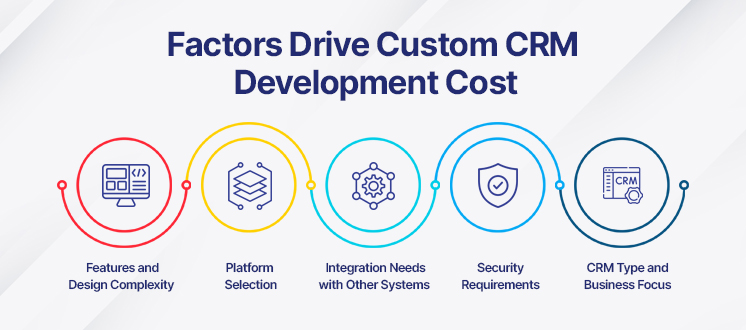
The expenses for tailored CRM software can widely vary due to certain factors. If you are thinking about the cost factors, here’s a complete breakdown.
1. Features and Design Complexity
Several features are integrated into CRM software. Sometimes, having too many features significantly contributes to the development cost. The expenses usually vary depending on the types of features you want in your customer relationship management product.
For example, if you want only a simple design and basic features, the cost can be less compared to that of complex and advanced interfaces. On average, the cost can range between $25,000 and $70,000+, which entirely depends on the scope of your CRM project.
Here is a detailed breakdown of average pricing based on functionality and interface sophistication:
| Feature & Complexity | Details | Average CRM Development Cost Range |
| Basic Features | Contact management, task tracking | $30,000 – $50,000+ |
| Advanced Features | AI-driven analytics, workflow automation, third-party integrations, | $50,000 – $70,000+ |
| Simple Design | Minimalist interface, mobile-friendly layout, intuitive navigation | $25,000 – $45,000+ |
| Complex Design | Custom UI components, responsive design, enhanced interactivity | $35,000 – $50,000+ |
These details represent average market estimates for US firms developing CRM projects. However, the actual costs may vary based on technology stack, team expertise, and project timeline. Contact our CRM developers at Proquantic to understand pricing depending on design complexity and features.
2. Platform Selection for the App Development
The selection of the development platform is one of the key factors that determines the cost to build CRM software. Whether you want apps for mobile or your business website, here’s an estimate of the cost.
- Mobile-based:
When it comes to creating an application from scratch for mobile devices, it can cost between $40,000 and $120,000. For US enterprises and startups, building native apps even involves separate builds, increasing the overall development expenditure further.
Custom CRM development costs can often include several other factors, which include regular updates for performance standards and OS requirements. From UI design to conducting various tests across iOS or Android platforms, there can be additional expenses for mobile app development. Don’t keep guessing the cost of mobile app development when you can read about the right estimates here!
- Web-based:
Web-based app development allows users to access applications through any modern browser across devices. However, factors such as feature complexity, development team rates, third-party integrations, and scalability requirements significantly impact the overall project cost.
The costs can be in the range of $25,000 to $150,000+, depending on the dashboard designs, integrations, and website architecture. You may need to spend $10,000 to $30,000 to create entry-level web apps with basic core features. Expect this cost to be between $30,000 and $100,000 when you select moderately complex app development.
Moreover, when you add advanced features and functionality to enterprise-grade software solutions, expenses can reach $100,000–$250,000+.
- Web & Mobile:
Developing applications for web and mobile platforms can cost between $60,000 and $200,000+. If you are wondering what contributes to this expense, keep scrolling below to find out!
The price usually comprises the overall expenses toward responsive web design and a shared backend for Android and iOS devices. Moreover, it includes the cost of integrating features, testing interfaces, and optimizing for smooth operation across different platforms.
In many enterprise-grade apps, including artificial intelligence (AI), advanced tools, and multi-system integrations can increase the development budget. This cross-platform approach helps many tech startups and organizations maintain consistency with product delivery, save time, and easily acquire users through mobile and website without maintaining separate codebases.
3. Integration Needs with Other Systems
Some businesses often require integrating customer relationship management software with other tools. When integrating third-party APIs, ERP systems, or email marketing software, expect the custom CRM development cost to be higher than usual.
Choosing the right integrations for client management solutions can enhance operational efficiency and data synchronization in enterprises. However, your choice of integration is responsible for the final pricing of CRM software.
The development cost is between $5,000 and $15,000+ when you integrate basic email marketing tools or other simple integrations. If your business demands integration of multiple APIs or an ERP system, the cost can rise to $15,000 – $30,000+.
4. Security and Compliance Requirements
Making apps compliant with legal and security standards significantly increases CRM development costs for many US firms. Moreover, meeting HIPAA, SOC 2, or PCI DSS standards often increases project budgets by 20% to 60%. Some expenses also depend on data sensitivity and system complexity.
Achieving SOC 2 compliance alone can cost $30,000 to $150,000 for audits, documentation, and remediation. For healthcare CRMs, HIPAA compliance adds $20,000 to $80,000 in security setup and testing.
These expenses cover encryption, access control, secure hosting, and continuous monitoring. Though costly upfront, investing in strong compliance frameworks helps companies avoid breaches, protect customer trust, and prevent fines that can exceed $1.5 million per violation.
5. CRM Type and Business Focus
The expenditure for client management software also depends on the type. Let’s discuss the average costs as discussed below:
- Operational CRM: This category of relationship management software makes it easy for organizations to streamline a wide range of operations. You can build these CRMs to manage leads, navigate sales and marketing, and automate repetitive tasks. Operational client interaction systems can help establish strong relationships, increase productivity, and reduce time-to-market. The expenses can be anywhere between $50,000 and $85,000+ for US companies.
- Analytical CRM: These interaction systems are designed to evaluate customer insights and data analytics with advanced integration and reporting features. Expect the analytical custom CRM development cost to be between $65,000 and $80,000+.
- Strategic CRM: This type of client relationship management software can keep your customers engaged for the long term. Strategic CRM combines predictive analytics, data insights, and tailored engagement strategies to improve customer loyalty, retention, and overall lifetime value. The cost of developing this software is in the $80,000–$100,000+ range.
CRM Development Types and What They Cost Businesses
Once you get a clear picture of the custom CRM development cost, implementing it for your business becomes smoother. If you are not sure which client relationship management software your firm needs, here are some common picks.
-
Ready-Made CRM Solutions
Enterprises and startups can easily implement these types of customer management systems to streamline their business operations. Ready-made solutions include pre-designed platforms that allow businesses to quickly set up interaction systems to engage customers.
Building these CRMs is beneficial for small startups that want to streamline customer service, sales, and marketing efforts. The monthly subscription charges for users can range between $25 and $300, which varies according to CRM features and membership plans.
Some common examples of these pre-built client relationship management systems include HubSpot, Salesforce, and Zoho. -
Customized Off-the-Shelf CRM
Tailored CRM software can easily fit the workflow of a specific firm. It comprises a ready-made client management platform with custom integrations. These off-the-shelf CRMs with customized features are suitable for mid-sized businesses that need flexible systems for customer engagement.
If your company integrates more advanced modules into the existing CRM design, it can add more to the overall costs. Many tech enterprises in the US spend around $25,000 to $60,000 on CRMs to align them to business goals. However, the expenses can rise further, adding $50,000–$150,000+ for initial development and $5,000–$20,000+ for annual maintenance. -
Fully Custom CRM Development
Prebuilt CRM platforms are not always adequate to match the unique features, integration requirements, and company workflow. Creating fully customized client interaction software can overcome the limitations of off-the-shelf systems.
The process of developing a tailored solution involves finding a reliable app development company to define clear objectives for the CRM. From initial design through final deployment and quality assurance, and even when applying the latest updates, all phases incur additional expenses.
To gain a long-term competitive edge, acquire complete control, and optimize customer experience, many firms opt for this solution. In terms of custom CRM development cost, companies spend between $70,000 and $200,000+. This expense can vary depending on the compliance needs, integrations, and features included in the fully custom customer interaction system.
Feature-Wise Custom CRM Development Cost Explained
It is recommended to schedule a consultation with our CRM developers for a project estimation. This can provide clarity on the type and features you want in your customer management software. Below is the price breakdown of some must-have features in your client interaction system.
- Efficient Lead Management
Tech companies utilize this feature to track and organize potential clients or users throughout the sales cycle. With a custom CRM system, you can easily identify, nurture, and assign leads, which increases conversion rates for your business.
Some effective tools that developers integrate during the integration process include custom segmentation, automated follow-ups, and lead scoring. Adding a lead management feature can cost between $3,000 and $8,000+. It allows US companies to streamline sales efforts and maximize resources to nurture prospects. - Real-Time Sales Pipeline Monitoring
This feature gives teams instant insights into deal progress and performance across every stage of CRM development. With live updates, drag-and-drop features, and automated alerts, sales reps can prioritize high-value opportunities and reduce bottlenecks.
This functionality helps managers make faster, data-driven decisions while improving team coordination. Custom CRM systems with real-time tracking empower businesses to forecast revenue more accurately and optimize strategies for higher conversion and profitability. Expect the cost of including sales pipeline monitoring to be in the range of $4,000 to $10,000+. - Smart Contact Management Tools
These tools organize customer data, communication history, and engagement records in a centralized location. They help teams personalize outreach, strengthen relationships, and improve user retention.
Integration of smart contact management systems with email, calendars, and social platforms ensures smooth coordination across departments. It simplifies data access, supports automation, and enables targeted campaigns that drive meaningful customer interactions.
Implementing this feature can cost between $2,500 and $6,000+. Having these tools enhances both sales performance and customer satisfaction in any CRM solution. - Comprehensive Activities Tracking System
A comprehensive system for tracking activities ensures complete access to meetings, calls, tasks, and follow-ups linked to every client. It helps sales and support teams stay organized with automated reminders, visual dashboards, and detailed productivity insights.
US firms can analyze time management, identify missed opportunities, and align efforts by incorporating a task tracking system. This feature can cost from $3,000 to $7,000+, adds accountability and structure to business operations, making CRM platforms more effective and results-oriented for growing organizations. - Advanced Reporting and Analytics
Advanced reporting and analytics transform raw CRM data into clear, actionable insights for better decision-making. With customizable dashboards, KPI tracking, and predictive analytics, businesses can uncover trends, forecast performance, and measure success in real time.
Visual reports simplify complex data and support agile strategy development. The integration of advanced analytics can increase your firm's custom CRM development cost by $5,000 to $12,000+. However, with reporting and analytics tools, organizations stay competitive and responsive to changing customer behaviors and market dynamics. - Robust Security and Protection Functionality
This must-have feature enable safeguarding customer information and business data from cyber threats. Features such as data encryption, role-based access control, and multi-factor authentication strengthen system reliability. You can get all the integrations with an investment of $4,000 to $10,000+ toward security enhancement strategies.
Compliance with standards like GDPR ensures transparency and trust. Regular security updates and monitoring help prevent breaches and unauthorized access. Implementing these features in custom CRM systems fosters long-term data integrity and protects organizational credibility in today’s digital business landscape.
What Will a Custom CRM Development Cost You in 2026?
Organizations often choose custom CRM software for scalability, credibility, flexibility, and other benefits. If you want a similar strategic choice for your business, estimate the development cost through the following details.
-
Average pricing range for CRM systems
Custom CRM development cost typically starts at $15,000, even if you build a minimal viable product (MVP). Mid-market solutions range between $25,000 and $120,000, offering more advanced features and integrations. For large-scale enterprise systems, costs often exceed $125,000–$200,000+, depending on complexity, customization level, and third-party integrations. -
Team composition and development costs
In 2026, developer hourly rates continue to vary widely by region. Offshore teams generally charge $20–$50/hour, developers in Eastern Europe average $40–$80/hour, while teams in the US or Western Europe can command $80–$200/hour based on expertise and project demands. -
Regional pricing and outsourcing benefits
Outsourcing CRM projects can yield substantial savings. Hiring developers from India or the Asia-Pacific region costs around $15,000–$30,000, $30,000–$60,000 in Eastern Europe, and $60,000–$150,000+ in the U.S. or Canada, showcasing the financial advantage of offshore collaboration.
CRM Development Cost Guide by Project Type
The cost can depend on the CRM software development category. Below is an estimation of potential expenditure on the categories of client interaction systems.
-
Operational CRMs
Developing an operational CRM costs between $25,000 and $60,000, covering sales automation, lead tracking, and workflow management. Around 20% of the budget goes to UI/UX design, 15% integrations, and another 15–20% toward testing and support. This is when costs automatically rise with added automation and multi-user functionality. -
Analytical CRMs
Analytical CRMs range from $40,000–$150,000+, driven by data analytics and visualization tools. Around 30% of costs go to building analytics engines, 25% to dashboards, and 15% to API integrations. Predictive modules and AI-driven insights may increase expenses, while maintenance adds another 15–20% yearly. -
Strategic CRMs
Strategic CRMs cost between $75,000 and $200,000+, depending on integration depth and analytics complexity. Nearly 40% of the budget supports multi-department modules, 20% covers requirement mapping, and 15 to 20% goes to ERP or HRM integrations. Additional expenses arise from compliance, forecasting tools, and advanced data security features. -
Fully Custom CRMs
A fully custom CRM typically costs between $100,000 and $700,000+, with 50% spent on backend and frontend development. About 15% covers design and architecture, 25% goes to integrations and mobile features, and the rest supports deployment, testing, and maintenance for scalability and long-term performance.
Hidden Pricing Strategies in Custom CRM Development
When developing a custom CRM, pricing nuances like incremental add-ons, feature tiers, and licensing models are often overlooked. Hidden pricing can include extra fees for additional modules, per-user licenses, or “premium” integrations.
-
Ongoing Maintenance and System Updates
Beyond the initial build, the hidden cost of maintenance and updates continues to get added each year. Usually, ongoing maintenance expenses range from 15–20% of the initial custom CRM development cost annually. For example, if your CRM development cost is $100,000, you may need to spend $15,000–$20,000 per year for support, patches, and applying upgrades. -
Staff Training and Smooth Onboarding
After launch, training staff and onboarding new users are frequent hidden expenses. Costs such as training sessions, documentation, onboarding freshers, and adoption management can range from $2,000 to $10,000+, depending on system size and user count. -
Compliance Checks and Security Boosts
Custom CRM systems rarely include full compliance and advanced security in the base cost. Budgeting must include expenses for role-based access, encryption, audits, and regulatory compliance reviews. These can easily add $10,000–$50,000 to the existing software development budget. For example, security efforts may raise costs by 20–50% of base development.
How to Estimate the Cost of Custom CRM Development?
For custom CRM development in 2026, typical budgets continue to begin, typical budgets begin from $15,000 for very basic systems. Most mid-sized projects range between $25,000 and $120,000. Enterprise-grade software solutions can even exceed $200,000, depending on complexity, integrations, and compliance.
-
Comparing Rough and Detailed Estimates
A rough estimate provides an initial idea about the development cost, often spanning $30,000 to $150,000+. This approach is more useful for early budgeting and approval from stakeholders.
On the other hand, a detailed estimate analyzes costs by modules, integrations, and development hours, thereby narrowing accuracy to ±10 to 15%. This approach helps businesses plan resources precisely and avoid hidden expenses during full-scale CRM development. -
Discovery and Documentation Essentials
The discovery phase lays the foundation for accurate custom CRM development cost estimation. Businesses typically spend $2,500 to $15,000+ on discovery and documentation, depending on the project’s complexity, feature list, and team location.
Offshore development partners often complete this phase in 2–4 weeks. However, U.S.-based or in-house teams may take longer due to deeper workshops, stakeholder interviews, and compliance reviews.
Case Study: CRM Development Cost Breakdown at Proquantic
At Proquantic, our structured approach ensures predictable costs, faster delivery, and measurable ROI for every CRM project. We assist businesses in planning CRM development budgets with transparency and precision. Our strategies are designed to meet the customer relationship management needs of all clients.
-
Rough Estimation Process
The initial expenditure can range from $40,000 to $70,000 for an MVP product. We set the prices based on project scope, CRM complexity, and core modules. -
Detailed Estimation Approach
When factoring advanced analytics, workflow automation, and third-party integrations, costs rise to $80,000–$150,000 depending on team size and delivery timeline.
Average Cost Breakdown Example
-
Design & UI/UX: $10,000–$20,000
-
Backend Development: $25,000–$60,000
-
Integrations & APIs: $15,000–$30,000
-
QA & Deployment: $5,000–$15,000
Approach our CRM developers for complete cost breakdown of the development project.
Future Trends in Custom CRM Development Cost
In 2026, the cost of custom CRM development continues to be shaped by emerging technologies such as AI, automation, cloud computing, and intelligent workflow orchestration. According to a report from Grand View Research, the global AI for customer service market size will reach USD 83,854.9 million by 2033, growing at a 23.2% CAGR.
Businesses now choose adaptive and AI-driven ecosystems, which evolve with user behavior and market trends. This also indicates that CRM development budgets are no longer limited to core development and integration. As intelligent technologies reshape business workflows, pricing now depends on how deeply AI, automation, and cross-platform capabilities are embedded.
Impact of AI, Automation, and Cloud on CRM Pricing
Here’s how each emerging trend influences the custom CRM development cost.
-
Artificial Intelligence and Machine Learning:
AI and ML capabilities like predictive scoring, sentiment tracking, and personalized recommendations can raise software development costs by 20 to 40%. Businesses must invest in data pipelines, model training, and GPU infrastructure. Continuous AI monitoring, fine-tuning, and inference add recurring cloud expenses ranging from $1,000 to $5,000 monthly, depending on data volume and model usage. -
Workflow Automation and RevOps Intelligence:
Adding automation logic, analytics dashboards, and API-based workflows can increase development cost by 15 to 25%. However, these features cut operational overhead by automating lead assignments, task creation, and reporting. The return often offsets setup costs within a year through improved productivity. -
Cloud Infrastructure and Scalability:
CRM development using cloud computing solutions is an effective way to reduce infrastructure costs. However, there could be additional expenses if you consider storage and recurring subscriptions to utilize cloud platforms. Many companies develop customer relationship management software on Azure, AWS, and Google Cloud. Depending on your choice of infrastructure, expect to add between $15,000 and $40,000 to your development budget annually. Some SaaS businesses even opt for a pay-as-you-go (PAYG) cloud computing model, using resources on a per-use basis. For more insights into cloud models right for your US firm, contact a reputable development agency.
Key Shifts in CRM Development Budget Planning
-
Each added integration or intelligent workflow increases design effort, testing time, and overall project cost.
-
For U.S. companies, seat-based models can significantly increase monthly costs as sales, marketing, and support teams expand.
-
Connecting a CRM platform to complex integrations, like marketing automation tools, HR, or ERP, can increase total development budgets by 25 to 40%.
-
Cloud CRMs cut upfront costs and speed deployment, while on-premises systems need servers, maintenance, and IT staff, raising long-term ownership expenses.
-
Fully custom CRMs offer tailored features but cost more to build and maintain, while lightly customized off-the-shelf solutions stay more budget-friendly for mid-sized U.S. businesses.
Conclusion
Customer relationship management tools are not just a technological revolution for companies. They offer a more strategic way to ensure smart collaboration with stakeholders and improve client experience.
Whether you are an emerging startup or an established SaaS enterprise, building your own client interaction system can drive measurable outcomes and strengthen relationships with clients. However, find a trusted agency to inquire about every aspect of custom CRM development cost to select the right platform and integrations.
Proquantic is a offshore software development company that specializes in developing CRM systems. We help businesses of all sizes and from different domains, like IT, healthcare, hospitality and travel, logistics, and e-commerce. Schedule a call to get a rough or detailed estimate on the development costs of your custom CRM.
FAQs on Custom CRM Development Cost
1. How much does custom CRM development cost?
The cost of custom CRM development in the US depends on complexity, features, and the expertise of developers. The cost can be between $30,000 and $50,000 for basic solutions, which is ideal for small firms. Whereas mid-sized businesses can get complex integrations through a development cost of $75,000 to $150,000.
For large enterprises, CRMs with advanced features, mobile apps, AI integration, and third-party system connections can cost around $250,000. Costs also depend on whether the development is handled in-house, outsourced locally, or offshore.
Beyond development, companies also consider ongoing maintenance, upgrades, and support to get a realistic picture of the total investment required.
2. What drives the cost of custom CRM development?
Several factors influence the cost of building a custom CRM in the U.S. First, feature complexity matters: advanced automation, analytics, AI, and custom dashboards require more development hours.
Moreover, platform selection also affects pricing. In most cases, developing web-only CRMs is cheaper than adding mobile apps for iOS and Android. Integration of ERP systems, payment gateways, or third-party tools adds complexity and cost.
Security and compliance requirements, especially in regulated industries like healthcare or finance, increase both development and testing costs. Finally, team location and expertise impact pricing, as U.S.-based developers typically charge more than offshore teams.
3. Is custom CRM cheaper than ready-made tools?
Custom CRMs usually have higher upfront costs than off-the-shelf solutions like Salesforce or HubSpot, which charge monthly subscription fees. However, custom CRMs can be more cost-effective long-term because they eliminate recurring licensing fees, reduce dependence on multiple third-party apps, and can be tailored to specific business workflows.
A custom CRM also allows for unique features that may improve efficiency, sales tracking, and customer experience, ultimately boosting ROI. Businesses need to weigh the initial investment against potential long-term savings and benefits. In many cases, the tailored fit and control of a custom CRM outweigh the lower upfront cost of ready-made tools.
4. Do outsourcing rates impact CRM pricing?
Yes, outsourcing rates are a major factor in CRM development costs. In the US, hiring local developers can cost $100–$200 per hour, which significantly increases overall project expenses.
Outsourcing software development services to Eastern European or South Asian companies may reduce hourly rates to $25–$75. However, businesses should consider time zone differences, communication challenges, and quality assurance when calculating custom CRM development costs. While lower rates can reduce upfront costs, project management and coordination may require additional resources.
Ultimately, choosing the right outsourcing model balances cost savings with project quality, timelines, and long-term maintenance. Strategic outsourcing can make custom CRM more affordable without sacrificing essential functionality or security.
5. Can open-source tools reduce CRM development costs?
Open-source CRM platforms like SuiteCRM, Odoo, and ERPNext can help U.S. businesses reduce development costs because they eliminate licensing fees and provide pre-built functionality. These tools can be customized to meet specific business needs, reducing the time and cost associated with building features from scratch.
Open-source solutions still require skilled developers for implementation, customization, integration, and ongoing support. Moreover, businesses must account for hosting, security updates, and staff training. While open-source CRMs lower initial costs, companies should consider the total cost of ownership to ensure that long-term maintenance and scalability align with business objectives.
6. What are the recurring costs for custom CRMs?
Recurring costs for U.S. businesses using custom CRMs include hosting, maintenance, support, training, and third-party integrations. Cloud hosting typically costs $1,000–$10,000 annually, depending on traffic and storage needs.
Maintenance and technical support, including bug fixes, security updates, and feature improvements, can range from $5,000 to $20,000 per year. Training employees to use the CRM effectively is another ongoing expense.
Some integrated tools, such as email automation, analytics, or payment gateways, may charge additional subscription fees. Companies should plan these recurring costs to ensure the CRM remains reliable, secure, and fully functional over time.