


The demand for integrating e-wallets into businesses is rapidly growing among start-ups and established enterprises.
In 2026, digital wallets account for 56% of global eCommerce transaction value and 33% of in-store spending, demonstrating their growing role in how consumers pay.
E-wallet apps have become an integral part of people's daily lives worldwide. If you're considering building a mobile wallet or estimating its overall cost, read on!
In the US, eWallet app development costs can typically range anywhere between $30,000 and $300,000. However, several other developmental factors also decide the ultimate budget for developing a digital payment application. Besides, there are ways to reduce the cost of developing the app, which can benefit businesses.
Want to understand the key factors that determine the e-wallet app development cost in 2026? This guide explains mobile-wallet design, security, features, compliance requirements, and the cost of digital wallet app development for businesses.
What Is Ewallet App Development?
E-wallets are mobile-based digital payment systems that replace the need to carry traditional or physical wallets. With this contactless payment platform, users can successfully initiate transactions with a business or service provider.
Individuals who want a convenient billing method most often use e-wallet apps. This platform allows linking debit, credit, or loyalty cards and bank accounts to streamline online shopping, fund transfers, and secure payment experience.
With eWallet app development, businesses can streamline digital payments. They allow buyers to store their cards or bank-related details within the FinTech app for smooth transactions. This eliminates the need for entering financial information repeatedly on different payment platforms.
Ewallet app development involves designing and building secure applications that let users store payment methods, make purchases, transfer funds, pay bills, and manage financial activity through a smartphone or other connected device.
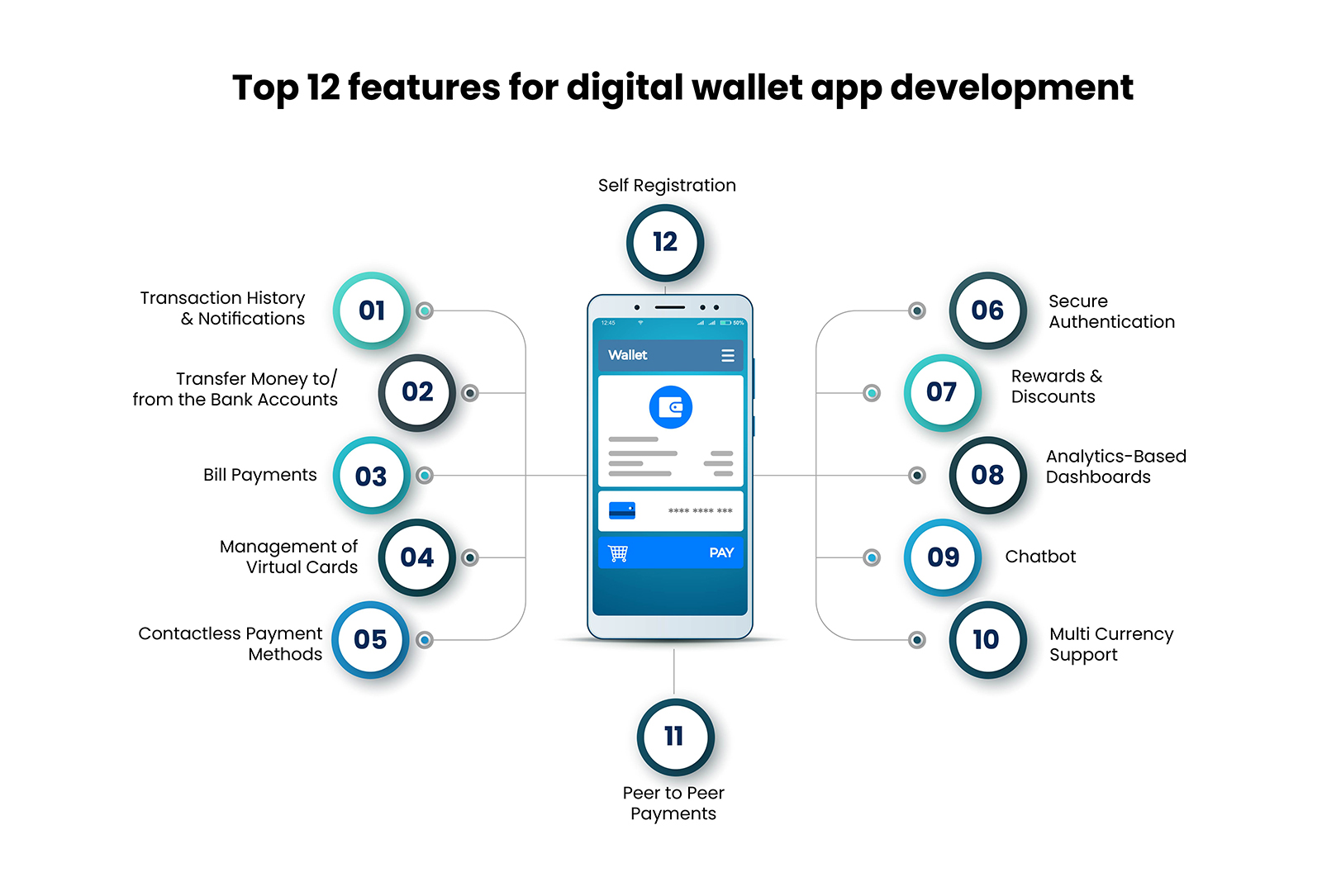
Top 12 features for digital wallet app development
The final pricing of a digital payment system depends on many things, including the features available on the platform. Let’s discuss the topmost aspects of an e-wallet app development one by one.
1. Transaction history and notifications
A well-developed eWallet app allows users to track past purchases and payments through a history of transactions. If there are financial activities going on in individual accounts, the platform should generate real-time notifications to alert them.
Many businesses now invest in e-wallet development that provides several notification options for transactional details in their users' accounts. This includes emails, push notifications, and SMS.
One of the best features that makes these virtual payment methods user-friendly is the provision to customize app notification settings. It gives them the freedom to choose the types of trigger alerts for transactions and the method of delivery.
2. Transfer money to/from the bank accounts
Most digital payment apps allow transferring money between bank accounts and mobile wallets. For businesses that handle financial transactions with clients, vendors, or stakeholders, especially across borders, they rely on multi-currency support.
Developers utilize secure APIs to ensure a smooth payment experience for users. These interfaces are commonly used by banking partners or payment gateways, which allow users to add funds to their e-wallets or transfer money back to their bank accounts safely.
3. Bill payments
When paying bills for electricity, water, gas, property taxes, or even subscriptions, most payees rely on eWallets. Digital payment platforms allow you to schedule or instantly pay these utility bills through secure integrations with supported merchants and service providers.
These partnerships often decide the cost of digital wallet app development. The prices can be even higher if it include advanced billing features or real-time reconciliation.
4. Management of virtual cards
Modern digital wallets allow users to securely link and manage debit and credit cards, reducing the need to carry physical cards. These wallets often support tokenized virtual cards that are stored securely, in compliance with standards like PCI DSS (Payment Card Industry Data Security Standard).
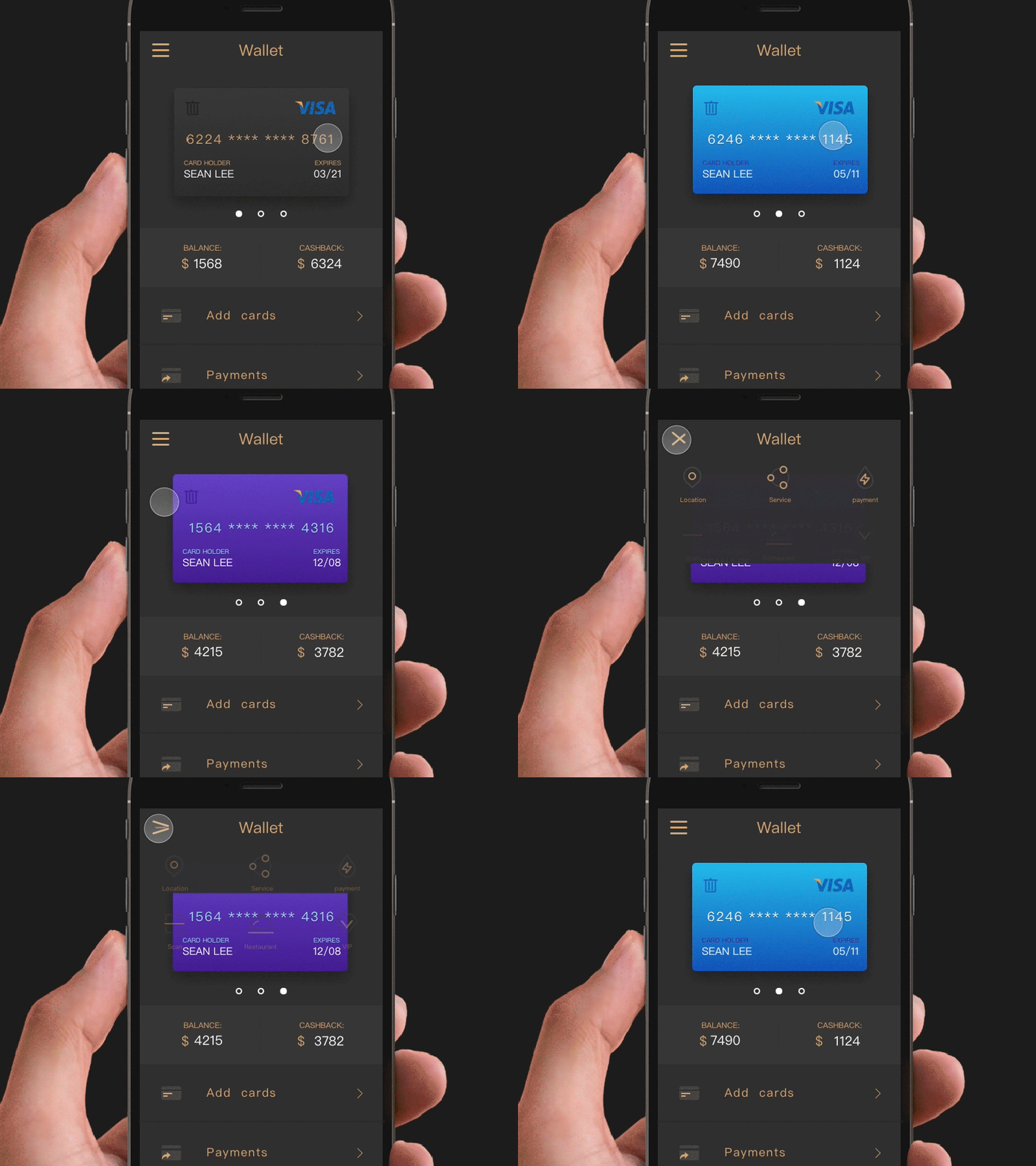
Developers implement robust encryption and authentication protocols to ensure card data remains protected. Advanced wallet apps also enable users to view transactions, set limits, and quickly add or remove linked cards with just a few taps. The ability to manage virtual cards seamlessly, including one-click card linking or removal, is a key feature that can influence the overall expenses of eWallet app development. Modern mobile wallet app development often includes QR-code and NFC payment capabilities, allowing users to complete fast, contactless transactions at retail locations, within apps, and through supported online checkout experiences. Most retail chains across the US now use NFC and QR codes to collect payments from their buyers. If you are interested in making the transactions contactless, a digital wallet allows for integrating these modern technologies.
To cater to businesses seeking fast, secure, and convenient transactions, these aspects need to be considered for eWallet app development. The ultimate cost of developing and integrating QR code functionality in a digital wallet app is influenced by several factors.
Basic scanning interfaces are less expensive than QR codes that are dynamically generated. Moreover, the development platform, like iOS, Android, or both, and the location of the digital wallet app development company also impact the pricing of the digital payment app.
6. Secure authentication
When developing a FinTech app, security is the most important concern. Your mobile payment solution should have proper authentication procedures for users to ensure secure transactions.
Facial recognition, PIN generation, two-factor authentication, and fingerprint verification are some of the necessary aspects to ensure that only registered or authentic users get to use the mobile payment system. You can take the assistance of an expert developer to integrate modern biometric authentication when carrying out digital wallet app development.
7. Self-registration
One of the most effective ways to drive user adoption of a digital wallet app is by enabling self-registration with minimal disruption. Try developing an app that offer a quick and user-friendly onboarding experience to achieve higher engagement and broader adoption.
For successful registration, the app must be available on both Android and iOS platforms. Once installed, users are asked to complete a Know Your Customer (KYC) process by submitting digital copies of their identification documents. The onboarding flow often includes OTP verification, creating login credentials, and linking bank accounts or cards.
Implementing a secure and seamless self-registration process significantly impacts the development cost and complexity of the eWallet app development platform.
8. Rewards and discounts
Loyalty points, cashback, and promotional discounts on transactions can enhance user engagement and retention in mobile wallet apps. Including these features influence regular usage and create a unique identity for your app in a competitive market.
Business owners who want to develop an e-wallet platform often collaborate with experienced IT partners for proper execution. Discussing goals regarding digital wallet app development helps them identify interesting features to include within. You can also promote the eWallet through rewards programs, discounts, and referral systems, depending on your business model and user base.
9. Analytics-based dashboards
A fully featured eWallet app shows various details through a multi-feature dashboard. The information present on the digital payment system includes upcoming bills, scheduled payments, and spending habits of the user.
From tracking expenses to managing the budget better, developers can incorporate a user-centric dashboard during the digital wallet app development.
10. Chatbot
Customers who rely on virtual payment apps often have genuine queries during or after making online transactions. Including a chatbot in the FinTech payment platform can clear up many of their confusions, including detailed instructions on how to use the app.
This approach of integrating AI technology in a mobile payment solution incurs extra development costs. The pricing of eWallet app development may increase further if additional features, such as voice search, are included.
11. Multi-currency support
Some eWallet platforms are made for users from different parts of the world. If your objective is to attract global customers and encourage them to make transactions, make sure your app supports multiple currencies.
Incorporating a multi-currency feature in the digital wallet can make it more popular among International users. This inclusion can even give an extra edge to the business over other payment apps serving only local customers or within the U.S.
12. Peer-to-peer (P2P) payments
Virtual wallet apps work most efficiently when making payments to individuals in the contact lists of the users. A platform that facilitates P2P payment allows sending and receiving money directly. This means splitting bills among friends or making instant payments for a shared business venture becomes easy and quick with this peer-to-peer integration.
Including this feature is possible only with a high-performing e-wallet. Following a proper digital wallet app development process is necessary for these payment platforms to work perfectly. It’s best to hire a reputable IT vendor who specializes in reshaping traditional transactional systems with eWallet apps.
E-Wallet App Development Cost Breakdown in the U.S. (2026)
The final e-wallet app development cost depends on the selected features, compliance requirements, payment-provider integrations, platforms, security architecture, and ongoing maintenance needs. The estimates below should be treated as indicative ranges, as every wallet project requires individual scoping.
The estimated cost of e-wallet app development is discussed here, which may vary based on the features incorporated into the payment platform.
| Feature | Focus | Estimated Cost (USD) |
| Transaction History and Notifications | Track past transactions, send push/email or SMS notifications, and customizable notification settings. | $8,000 – $12,000 |
| Transfer Money to/from Bank Accounts | Enable secure API integration for bank and wallet transfers; support multi-currency if required. | $15,000 – $20,000 |
| Bill Payments | Schedule or initiate payments to utilities or services via third-party aggregator integration. | $8,000 – $12,000 |
| Management of Virtual Cards | Support for tokenized virtual cards, card linking/unlinking, transaction overview. | $10,000 – $15,000 |
| Contactless Payments Method | Support for QR code (basic/dynamic) and NFC payments depending on platform and hardware. | $4,000 – $8,000 |
| Secure Authentication | Two-factor authentication, facial recognition, biometric logins, and PIN protection. | $8,000 – $15,000 |
| Self-Registration | Onboarding via OTP, document upload, and KYC verification (Android/iOS platforms). | $5,000 – $8,000 |
| Rewards and Discounts | Implement loyalty programs, cashback offers, referral codes, and custom business incentives. | $10,000 – $15,000 |
| Analytics-Based Dashboards | Spend tracking, budget management, and visual dashboards for user financial insights. | $8,000 – $12,000 |
| Chatbot | AI-powered customer support bot with basic Q&A; optional voice search feature. | $5,000 – $8,000 |
| Multi-Currency Support | Currency conversion, international wallet support, and FX rate integration. | $12,000 – $18,000 |
| Peer-to-Peer (P2P) Payments | Instant money transfers to/from contacts, bill splitting, secure messaging (optional). | $10,000 – $15,000 |
How to create a digital wallet: a step-by-step guide
If you want to build a secure digital payment system for your business, below are the steps that are involved in the eWallet app development process.
A successful digital wallet app development project starts with a clear product strategy, strong security planning, regulatory awareness, and a user-focused payment experience. The following steps help businesses move from an idea to a scalable wallet platform.
Define your product goal
Your journey toward a digital wallet begins by identifying the purpose behind developing it. Some common motivations behind building an eWallet app include peer-to-peer money transfers, payments to merchants, and crypto storage. However, you must compare use cases, target audience, and main functionalities before developing an app.
Discuss with a professional if there is any need to integrate banking APIs or support QR code payments. A clear product vision lays the groundwork for all design and decisions regarding eWallet app development.
Design an intuitive interface
Digital wallet app development focuses on the appearance and working of the platform. Incorporating an interface that is easy to navigate builds user's trust and ensure satisfaction. Remember, the payees expect minimal steps when checking balances, transferring money, or paying bills.
Most modern-day app developers incorporate intuitive elements, such as drag-and-drop features, swipe actions, or fingerprint-based access. They focus on exceptional design to reduce friction and help prevent churn. You should also avoid complex interfaces in your app design to reduce abandoned transactions and lost users.
Implement security measures
Users need to feel that their funds and data remain protected when using mobile wallet. That’s why embedding multi-layered security protocols is essential for these businesses when developing the digital payment app.
Biometric authentication, end-to-end encryption, and tokenization are usually implemented to ensure secure transactions. Moreover, the apps comply with industry regulations to retain user confidence.
Develop the digital app
The ewallet app development phase begins after the product strategy, security requirements, integrations, and design elements have been defined. Moreover, collaborating with a developer at this stage can help to build the app’s backend and frontend.
Developers use APIs to enable payment processing, bank account linking, and push notifications. However, the choice of technology stack depends on your timeline, budget, and expectations from your digital wallet app development.
Test and deploy your app to the market
Quality assurance is necessary before making your app publicly available. Perform tests across various devices and operating systems to check the app's usability, functionality, and security.
Address issues like low connectivity or simultaneous transactions to prevent real-time problems with the digital wallet. Your app can be launched on Google Play and Apple’s App Store once it is customized for users.
Upgrade and maintenance
Launching your e-wallet is just the stepping stone for your business before it is launched in the market. Regular updates are essential for your digital payment system to stay competitive and relevant. Moreover, it is advised to track user behavior and feedback to consistently improve a business's digital payment system.
Bug fixing, loading speed optimization, and introducing new features are essential while developing the app. Continuous maintenance also ensures your digital wallet remains compatible with OS updates and deal with emerging threats, while meeting user expectations.
Technology stack in eWallet app development
A secure mobile wallet app development project requires a technology stack that supports identity verification, payment processing, data security, notifications, analytics, and reliable cloud infrastructure. The table below represents some of the technologies commonly used in eWallet app development processes.
| Category | Tech Stack |
| Phone Verification | Nexmo |
| Frontend | Angular, CSS, JavaScript, and HTML5 |
| Database | HBase, Cassandra, and MongoDB |
| For cloud environment | Salesforce, Google Cloud, AWS, and Azure |
| For push notifications | Push.IO, Amazon SNS, Twilio, Urban Airship |
| For real-time analytics | Hadoop, Apache, and Spark |
| For QR codes | ZBar Code reader |
Security compliances for digital wallet app development
To build a legally sound digital wallet app, follow the security regulations and data protection laws specific to your region. For example, in the United States, e-wallet providers must comply with a mix of state and federal laws that govern the collection, storage, and processing of financial data.
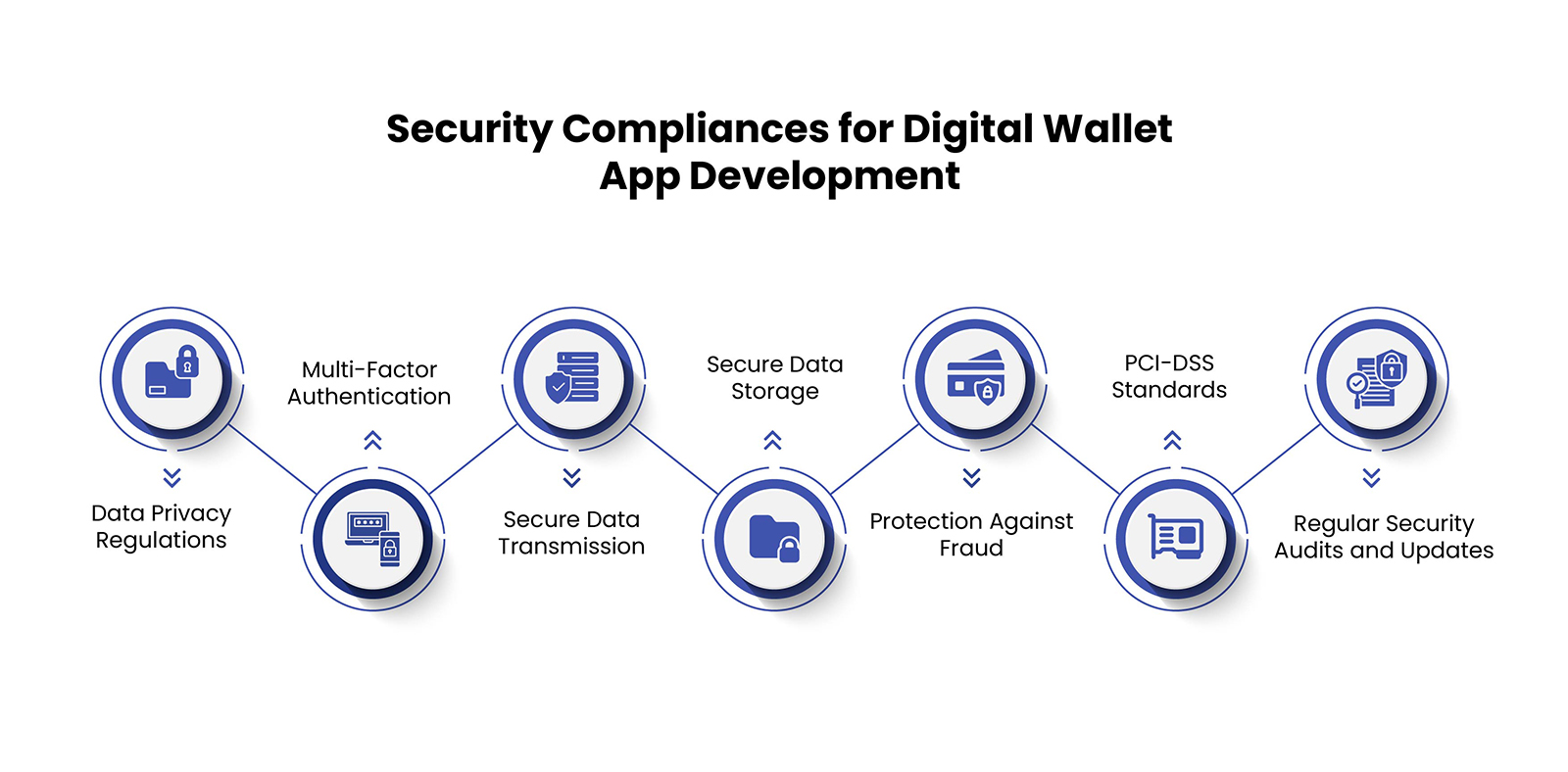
Here's the compliance you need to follow during eWallet app development:
1. Data privacy regulations
Your app must comply with widely accepted privacy laws, such as the California Consumer Privacy Act (CCPA) in the US. These laws ensure transparency with how user data is being collected, used, and shared.
2. Multi-factor authentication
To add an extra layer of security, implement multi-factor authentication. This could involve a combination of face recognition, fingerprint scanning, one-time passwords, and PINs. Such features are commonly expected and help verify user identity beyond just a password, especially on iOS devices.
3. Secure data transmission
Data security is essential, regardless of whether it's being transferred or is at rest. All communication between your app and backend servers needs proper encryption. You are advised to use secure protocols like SSL (Secure Sockets Layer), TLS (Transport Layer Security), or VPNs to prevent data leaks during transmission. This ensures that sensitive information, like login credentials or transaction details, stays protected.
4. Secure data storage
Use hashing techniques for encryption to protect your financial details stored in the app. This ensures that the data is unreadable without proper decryption keys during a security breach.
5. Protection against fraud
Your app should be smart enough to catch suspicious behavior or fraudulent activities. Features like real-time transaction monitoring, IP tracking, and alerts can prevent fraud and unauthorized access.
6. PCI-DSS standards
If your wallet app handles credit or debit card payments, check its compliance with the Payment Card Industry Data Security Standard (PCI-DSS). This helps to process the data of the cardholder securely.
7. Regular security audits and updates
Cyber threats evolve constantly. This is why you must focus on making your app immune to these attempts. The best practice is conducting routine security audits to identify vulnerabilities, applying patches, and keeping your system up to date. Staying alert during and after eWallet app development can prevent security breaches.
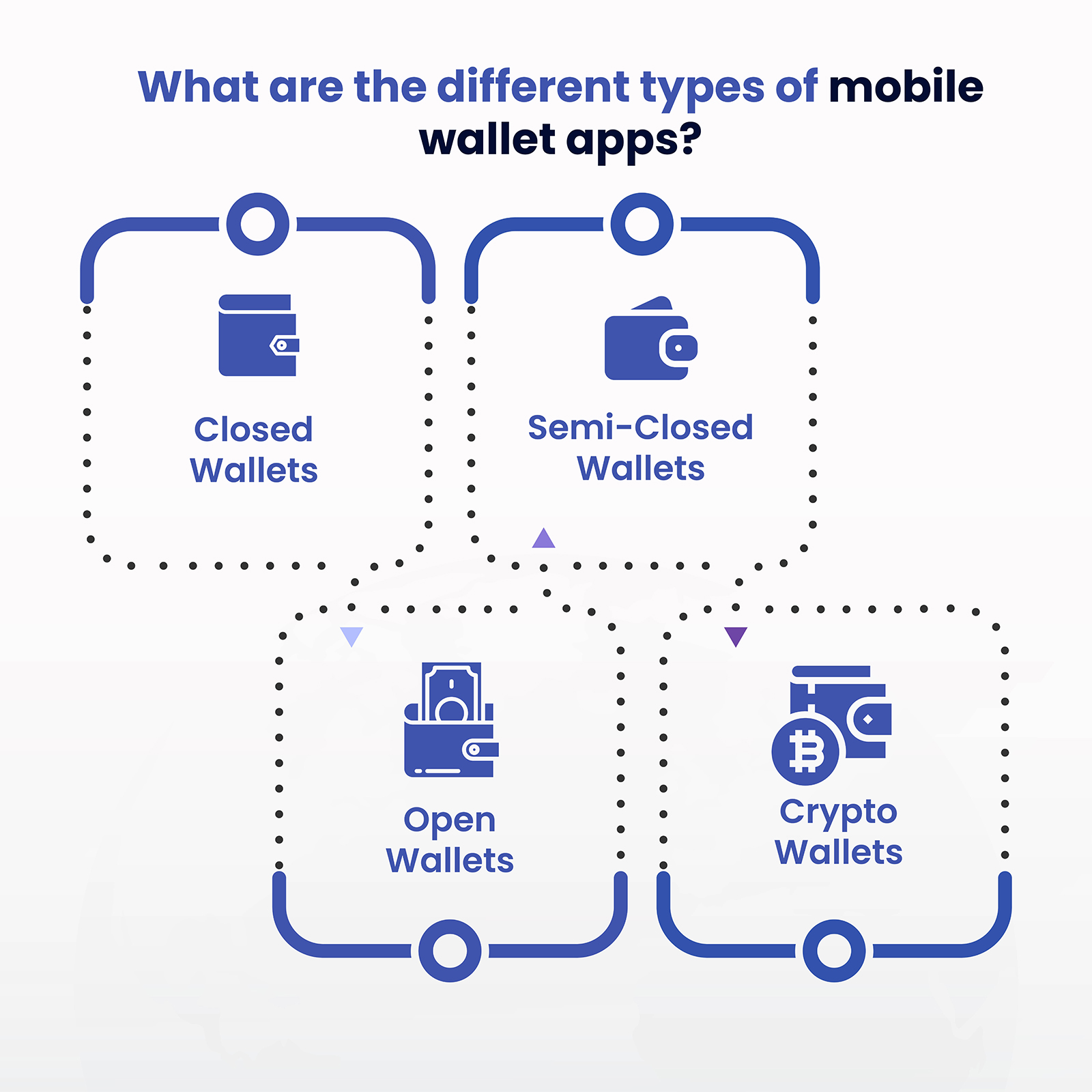
What are the different types of mobile wallet apps?
When it comes to digital wallet app development for a business, you can select from the following categories.
Closed wallets
These wallets are issued by individual companies, like Amazon or Starbucks, for purchases only within their own ecosystem. Users preload funds and can only spend within that merchant’s platform. Funds can’t be withdrawn or transferred elsewhere.
Semi‑closed wallets
Issued by providers who have agreements with select merchants, these wallets let users store money for use at partnered online and offline outlets. They don’t support cash withdrawals to bank accounts or sending to non‑network users.
Open wallets
Offered by banks or licensed institutions, open wallets allow storing, peer-to-peer transfers, merchant payments, and ATM cash withdrawals. They link to bank accounts, support wide merchant acceptance, and are regulated similarly to traditional bank accounts.
Crypto wallets
Designed for managing digital currencies, crypto wallets store public or private keys for assets like Bitcoin or Ethereum. They come as hot wallets, which are online, convenient but less secure, and cold wallets, which are offline, hardware or paper, and offer greater security.
Most popular examples of digital wallet apps
Many e-commerce companies are opting for contactless payment methods to manage financial transactions with ease. If you need a digital wallet system for your reputable enterprise or new startup, try developing one that aligns with the business. Below are some popular platforms that have increased their user base with digital wallet app development.
Apple Pay
Launched in 2014, Apple Pay is an NFC-based mobile wallet available on iPhone, Apple Watch, iPad, and Mac. It securely stores payment cards using tokenization, authenticates with Face ID or Touch ID, and enables in‑person, in‑app, and online transactions while preserving user privacy.
Estimated to acquire 659 million customers worldwide, Apple Pay has approximately 63.9 million users across the US alone. If you want to build an app like Apple’s digital payment system, it could cost between $40,000 and $150,000+, or even more.
Google Pay
This mobile payment app has been rebranded as the Google Wallet platform. It supports NFC tap‑to‑pay, QR, peer-to-peer transfers, bill payments, loyalty integration, encryption, tokenization, and biometric or PIN authentication across Android and iOS.
Launched in 2015, Google Pay has around 250 million global users. According to many reports, 57 million Americans are estimated to join this digital payment platform by 2028.
The development cost for apps like Google Wallet can range between $100,000 and $300,000, depending on several factors.
PayPal
PayPal is a global digital-wallet and online-payment platform with 439 million active consumer and merchant accounts as of December 2025, the latest full-year figure reported by the company. PayPal supports secure peer-to-peer transfers, in-app and online purchases. You can also use it for QR code and POS payments, multi-currency handling, crypto options, buyer protection, and One‑Touch checkout.
Many e-commerce businesses around the world prefer this app development model to offer quick and reliable payment options. On average, you may need a budget of $150,000 to $300,000 for a similar kind of digital wallet app development.
Embark on your eWallet app development journey with Proquantic US
Careful evaluation of business goals and target users are needed for banking and FinTech app development. With a reliable e-wallet developer from an established company, you can get all the necessary features while keeping the eWallet compliant with the security standards.
Proquantic supports end-to-end digital wallet app development, from product strategy and UX design to secure payment integrations, KYC workflows, testing, deployment, and post-launch maintenance. We help businesses build wallet solutions that balance convenience, compliance, and scalability.
We are a leading destination for custom mobile app development services, helping businesses reach more users and generate maximum ROI. With 240+ successfully delivered projects, Proquantic Software remains a top choice for 100+ innovators worldwide.
If you are looking for digital wallet app development in the U.S. for your company, schedule a call with our team. We can help your business reach global customers through a mobile payment system created by top 3% app developers in the industry. Reach out to us and discuss FinTech solutions and the cost involved for eCommerce, education, finance, healthcare, and more.
Frequently Asked Questions About E-Wallet App Development Cost
Can I develop an e‑wallet app, and what is the cost?
User registration, KYC verification, secure payment integration, encryption, multi‑factor authentication, and tracking real‑time transactions are essential features of eWallet app development. You can use modern APIs, cloud infrastructure, and cross‑platform frameworks to create a scalable, reliable app that works smoothly on various devices.
Schedule a call with our experienced mobile app developers to create your digital payment platform. We can evaluate your business needs and guide more about the features and tech stacks needed for customizing the app, along with the development cost.
What challenges can I face with digital wallet app development?
You might encounter certain challenges, from ensuring secure encryption to fraud detection and MFA. There can be issues while meeting diverse regulations (KYC/AML), crafting a user-friendly interface, and the app's compatibility across devices. It’s best to consult our developers for integrating payment gateways, scalable infrastructure, and designs persuading users to trust the payment platform.
Is a digital payment wallet safe?
Yes, digital wallets are safe if there is encryption, tokenization, and multi‑factor authentication. However, loss of device, phishing, malware, public Wi-Fi risks, and inconsistent bank protocols can pose certain risks. Strong passwords, biometric locks, transaction alerts, and user vigilance can help keep a safe digital environment.
How to generate revenue for my business using an e‑wallet?
You can make money through e‑wallets in the form of transaction fees, interchange fees, and interest on stored balances. Don't forget the profit you can earn from premium or subscription services and in‑app purchases.
You can also make your business financially strong through referral partnerships and value‑added services, which include analytics, loans, insurance, or merchant offers tailored to users.
What is the e-wallet app development cost in 2026?
The e-wallet app development cost in 2026 depends on the features, platforms, payment integrations, compliance requirements, security architecture, and development-team location. A basic wallet may require a smaller budget, while enterprise-grade platforms with KYC, multi-currency support, analytics, and advanced fraud prevention require a larger investment.
What is included in ewallet app development?
Ewallet app development can include user onboarding, KYC verification, bank-account linking, payment processing, virtual-card management, transaction history, authentication, QR or NFC payments, rewards, analytics, and peer-to-peer transfers.
What are the key stages of digital wallet app development?
Digital wallet app development typically includes product discovery, UI/UX design, compliance planning, security architecture, backend and frontend development, API integration, quality testing, deployment, and ongoing maintenance.
Why is security important in mobile wallet app development?
Security is essential in mobile wallet app development because these apps handle personal and financial data. Encryption, tokenization, multi-factor authentication, secure APIs, transaction monitoring, PCI DSS compliance, and regular security audits help protect users and build trust.