


In 2025, we can see that the majority of companies, suffering from the lack of the right talent, are hitting a wall. A recent report puts the IT staff augmentation market at the approximate value of $383.5 billion this year, and by 2035, it is expected to reach $1.2 trillion. Despite this massive growth, there are many organizations that are still struggling, as 68% of the CTOs of the country opine that they cannot figure out the right skills quickly enough. Nearly 70% of the firms report finishing the digital projects much later due to delays from recruiting, training, or even running out of budget.
At this point, IT staff augmentation service turns out to be the real game-changer. With this option, the entrepreneurs are able to tap into the external and flexible talents, who can fill the talent gaps immediately, facilitating scalability, avoiding high costs, and reducing the lag time of recruiting full-time hires.
In this informative session today, Proquantic Software USA will highlight top models of IT staff augmentation service that enable entrepreneurs to choose to solve their toughest challenges in accelerating delivery and talent bottlenecks and keeping projects on track.
IT staff augmentation service – definition and importance
Staff augmentation service refers to the strategic hiring of external professionals on a contractual basis, for the purpose of filling the skill gaps of an organization. Contrary to the traditional hiring model, the service enables businesses to gain full control of their projects through onboarding specialized talents. In today’s digital economy, the model gas gained widespread recognition for maintaining competitiveness and agility. Whether it is scaling teams, accelerating product launches, or managing the seasonal workloads, the staff augmentation service enables businesses to respond to the quickly changing markets almost instantly.
It enables the organizations to ensure consistent delivery of the project, boost project delivery, and optimize costs without any long-term hiring commitments.
Why is staff augmentation service spiking in demand
The growing talent shortage across the globe and the rise of remote working and its significant growth have spiked the demand for staff augmentation services. Companies today prefer flexible solutions for their workforce, which provide immediate access to the skilled professional without an extended recruitment cycle pr geographical limitations.

Staff augmentation service – core concept and how it works
Staff augmentation service enables companies to extend the capabilities of their in-house teams with the help of external professionals on a project or temporary basis. Such experts integrate seamlessly into the existing workflows, enabling businesses to maintain control over operations, accelerate project delivery, and bridge the talent gap without any full-time employment.
At its very core, staff augmentation service is all about scalability and agility. Businesses can quickly get access to a talented pool of professionals, right from designers to developers, when needed. The model ensures quick adaptability to the project demands, letting the teams contract or expand resources without disrupting quality or productivity.
Unlike traditional hiring, staff augmentation services rule out the lengthy process of recruitment, employee retention challenges, and onboarding costs. Companies can save nearly 40% of the operational costs while gaining niche expertise quickly. The result? Optimized utilization of budget, faster project completion, and streamlined workflows.
Staff augmentation service in action- real-world examples
Suppose you are growing a FinTech startup in the USA and preparing to launch a mobile banking application. You are also facing a challenge in finding the right experienced developers for the job in the local market. So, you partner with a reliable and experienced provider of staff augmentation service, which enables you to quickly onboard remote cybersecurity and onboarding experts. As a result, you get to accelerate the speed of your product completion and launch without any compromise of control or quality.
A documented example that we can set here involves Accenture, which scaled digital service delivery with external teams of engineers across various client accounts. This approach amplified their capability for quick expansion by cutting out lengthy cycles of recruitment.
Another real-world case is IBM, which leverages offshore staff augmentation services to bolster its project teams. By partnering with the external staffing vendors from the Philippines, India, and more, it expanded its technical ability while controlling the costs.
Such examples showcase how the IT staff augmentation service acts not only as a stopgap but also as an aspect of strategic growth. In both these cases, the augmented talent blended into the existing workflows and adhered to the standards and protocols of the enterprises, which allowed the latter to scale with flexibility.
The different types of staff augmentation models
As businesses continue to expand worldwide, technology evolves as well, which spikes the demand for a flexible workforce for the quick delivery of solutions. Staff augmentation service has successfully emerged as a robust approach for companies that strive for quick scaling, maintaining productivity, and gaining access to specialized skills. Each of the models, detailed below, offers unique advantages depending on the business goals, complexity, and project duration.
Read below the top 13 types of staff augmentation services which organizations can consider in 2025 and beyond.
The traditional model
This is the most widely leveraged model, which focuses on hiring external professionals on a contractual basis to fill a talent gap temporarily in the workforce of an organization. The specialists typically work on-premises and seamlessly integrate with the internal teams. Businesses rely on the model for projects that need specific domain expertise and hands-on collaboration.
For instance, a retail chain may temporarily hire data analysts for the peak sales season to optimize inventory management. Traditional staff augmentation service provides flexibility for scaling staff without the long-term hiring commitment or employee benefits costs.
Offshore staff augmentation
The offshore staff augmentation service includes hiring professionals from different countries. The labor costs in this model generally remain at the lower side, but the technical expertise is exceptional. This model is immensely popular among companies from the UAE, USA, and UK, and they collaborate mainly with the teams in Eastern Europe, the Philippines, India, and more. Offshore augmentation service enables access to a vast global talent pool, alongside reducing the operational costs by nearly 60%. It is ideal for long-term support and development of projects where consistent collaboration and scalability are crucial elements.
Nearshore/onshore staff augmentation
Near-shore or onshore staff augmentation refers to the hiring of experts in nearby regions or within the same country. Such a model reduces challenges like time zone or cultural differences, enabling quicker decision-making and smoother communication. For instance, a company based in Dubai may choose to work with development teams based in Egypt or Jordan, maintaining a similar culture as well as working hours. Offshore models can be slightly costlier, and hence, nearshore or onshore staff augmentation service provides better legal compliance, improved collaboration, and higher convenience.
Remote staff augmentation
In the post-pandemic global business ecosystem, remote staff augmentation has turned out to be the new standard. It enables organizations to seamlessly integrate remote experts within the core teams, regardless of any geographical limitations. Such models ensure round-the-clock productivity, boost innovation, and enhance diversity. Businesses using remote staff augmentation services benefit from access to rare skill sets, cost efficiency, and flexible scheduling, especially in fields like AI development, cloud computing, and cybersecurity.
Agile staff augmentation
Agile staff augmentation service combines the principles of flexible staffing with Agile methodology. Companies can hire professionals who can seamlessly blend cross-functional collaboration, quick iteration cycles, and sprint-based workflows. The model suits organizations that are focused on fast-paced and continuous software development. For instance, a FinTech firm can rapidly recruit QA engineers or scrum masters to enhance the velocity of the Agile teams. Agile staff augmentation enhances scalability as well as ensures the teams remain adaptable throughout the lifecycle of the project.
Resource augmentation
Resource augmentation, closely related to staff augmentation service, emphasizes supplementing the existing teams with extra manpower instead of filling the skill gaps. It is often used when the projects need an extra workforce to meet tight deadlines. For example, an IT company may recruit an additional five developers through resource augmentation services to ensure on-time delivery of software. The model concentrates on reducing burnout and enhancing the team productivity of the permanent employees.
Temporary staff augmentation
Temporary staff augmentation fulfills short-term staffing needs like sudden project spikes, seasonal workloads, or covering the leaves of employees. Such professionals are hired for months or weeks until the stabilization of demand. Businesses in events management, retail, and logistics frequently leverage temporary staff augmentation services to maintain an uninterrupted operational flow without any permanent hiring. Such a model enables organizations to operate lean and stay financially efficient during the dynamic demand cycles.
Project-based staff augmentation
Project-based staff augmentation is a highly targeted model that is designed for time-bound and specific projects. When the project concludes, the role of augmented staff ends. It is crucially valuable for SMEs and tech startups that work on Minimum Viable Product or MVP development or infrastructure migration. For instance, a healthcare startup may hire a team of augmented developers for a six-month mobile application project. This approach assures access to the top-tier professionals while maintaining focus and cost predictability.
Long-term staff augmentation
Long-term staff augmentation service caters to organizations that have ongoing large-scale projects, requiring sustained external support. Unlike the project-based models, such professionals work with companies for many years, often turning out to be integral parts of the internal teams. The model suits organizations that manage continuous product evolution or extensive digital transformation. It provides deep institutional knowledge, continuity, and stability without the need for permanent hiring or administrative complexities.
Specialized staff augmentation
Specialized staff augmentation service specializes in hiring niche experts for regulated or intensely technical industries like cybersecurity, data science, Blockchain, or Artificial Intelligence. Professionals bring in specialized knowledge that is difficult to find through standard hiring. For instance, a financial institution can use specialized staff augmentation for hiring data security specialists for the purpose of compliance audit. The model boosts the credibility of the project, ensures adherence to regulations, and improves innovation.
Master vendor staff augmentation
Under this, a single vendor is hired to manage all the staffing needs for a company, including coordination with secondary vendors or multiple subcontractors. Such a centralized model simplifies management, provides better pricing control, and ensures quality consistency. Government agencies and large enterprises prefer such an approach to avoid administrative chaos. A master vendor staff augmentation service provider standardizes performance tracking and onboarding processes for all the augmented staff.
Gig platform staff augmentation
The rise of the gig economy has created a way for the gig platform staff augmentation, where companies, by using online platforms like Freelancer, Upwork, or Toptal, source professionals. Such an on-demand model is great for organizations that seek rapid access to independent contractors for short-term or specialized tasks. Gig-based staff augmentation services provide unmatched cost flexibility and speed, although they need a stronger oversight of project management for ensuring consistency and quality.
On-demand staff augmentation
On-demand staff augmentation is a modern and dynamic model that empowers businesses to hire skilled professionals quickly for evolving or urgent project needs. With these platforms, companies onboard the vetted talents in just a matter of days, significantly reducing the hiring cycles. For example, a SaaS company may bring in a DevOps engineer in the middle of the project for troubleshooting the development challenges whenever they occur. An on-demand staff augmentation service provides unmatched responsiveness, enabling organizations to adapt seamlessly to market shifts in real-time.
Which is the right model for your business?
Depending on your project goals, operational needs, and budget, you can select the right staff augmentation service model.
- For streamlined management – Master vendor model
- For flexibility and agility – On-demand staff augmentation or Agile staff augmentation
- For cost optimization – Remote or offshore staff augmentation service
- For long-term innovation – Long-term or specialized staff augmentation service models
Proquantic says – Choose a hybrid model that combines the best of multiple approaches to enjoy the best balance of scalability, cost, and control.
Staff augmentation service – business model explained
The business model of staff augmentation service revolves around providing skilled professionals to organizations on an on-demand, flexible basis. Unlike the traditional model of employment, staff augmentation enables organizations to dynamically scale their workforce. Service providers maintain a pool of pre-vetted QA engineers, project managers, designers, developers, etc., and deploy them based on the project or client demand. The client retains full control over the execution of the project, while the provider of staff augmentation service manages payroll, compliance, and recruitment. Such a model ensures agility, cost optimization, and quicker onboarding in response to the shifting requirements of the project.
Here's how staff augmentation service fits within outsourcing
Staff augmentation service functions as a subset of outsourcing, but with greater control and transparency. In traditional outsourcing, a project is entirely handed over to the third-party manager who is supposed to oversee end-to-end delivery. On the contrary, staff augmentation embeds external professionals directly into the in-house team of the clients. Such a hybrid approach enables organizations to outsource talent instead of tasks, facilitating consistent communication, cultural alignment, and collaboration, alongside leveraging the expertise of the external professionals.
Key differences from managed consulting and services
While the managed services transfer the entire responsibility of an IT function or the entire project to an external provider, the staff augmentation service keeps the client responsible for decision-making and management. The external staff work under the direction of the client, focusing entirely on the execution. Meanwhile, consulting services deliver, primarily, strategic planning or advisory services instead of operational manpower.
Hence, staff augmentation services bridge the gap by providing quick access to top talent, ready to hire in just days, unlike managed service providers, who execute independently, or consultants, who guide.
A detailed glimpse into managed services vs Augmentation services
Managed services and staff augmentation services both enable organizations to efficiently scale, but they differ in scope, responsibility, and control. While the staff augmentation offers skilled professionals working under the supervision of the clients, managed services provide the full ownership of the project to the vendor, a model that is ideal for businesses that seek end-to-end management instead of direct team integration.
| Aspects | Managed Service | Staff Augmentation Service |
| Scope | Covers IT function management or a complete project | Provides skilled professionals to the extended internal teams |
| Responsibilities | The vendor takes the entire responsibility for project delivery and execution | Clients have control over outcomes, supervision, and tasks |
| Control | Limited client control: the vendor manages the team independently | High client control on team management and daily operations |
| Cost Structure | Subscription-based or fixed pricing for complete service packages | Pay for the augmented staff, based on hours or duration of the project |
| Flexibility | Moderate flexibility; governed by SLAs | Highly flexible; teams can be scaled down or up as needed |
| Ideal For | Businesses that seek full-service outsourcing to reduce the burden of management | Businesses that need specialized or temporary talent for particular projects |
Consulting vs staff augmentation service
While both consulting and staff augmentation services aim at strengthening business operations, they differ in their roles to a significant extent. Consulting focuses on strategic advisory services, while the staff augmentation service focuses on execution. In essence, consultants guide people on what they (should) do, whereas professionals help organizations to get that done, making both complementary in driving business transformation.
Execution vs advisory roles – explained
| Differential Aspects |
|
|
Choosing the right staff augmentation service provider – a comprehensive ‘how to’
Selecting the most suitable staff augmentation service provider is great for ensuring long-term collaboration, cost-efficiency, and project success. An ideal partner must offer a blend of proven expertise, operational flexibility, and security compliance to help businesses scale seamlessly, while maintaining control over deliverables and quality.
Evaluating the essentials
While choosing a staff augmentation service provider, businesses must prioritize the expertise during the process. Assess the experience across the industry, the diversity of the talent pool, and the technology in which they specialize. Ask for their case studies or share success stories that reflect on their measurable results.
Security, next, is also a major concern of consideration, which ensures that the providers adhere to global data protection regulations like HIPAA, ISO 27001, or GDPR, depending on the industry. A credible partner will carry a strong framework of NDAs, governance, or compliance protocols in place for safeguarding sensitive information.
Lastly, assess flexibility. The top providers enable you to scale the team down or up rapidly without any contractual or financial constraints. They must support both hybrid and remote models of engagement, offering agile solutions for staffing that adapt to the dynamic needs of the projects.
What you must ask the providers
Your search for the right staff augmentation service provider will end once you get satisfying answers to:
- What’s your policy on project scaling and contract flexibility?
- How do you manage time-zone differences and communication?
- What measures are in place for ensuring IP protection and data security?
- What technologies and industries do you specialize in?
- How do you onboard and vet talent?
Benefits of staff augmentation service for business
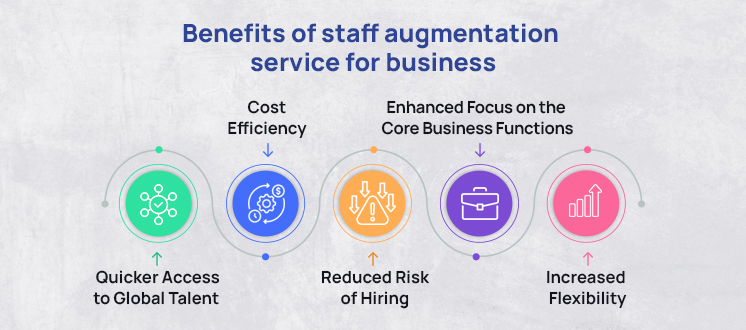
Staff augmentation service today has become a preferred strategy for organizations to move quickly, maintain cost control, and innovate continuously. Beyond bridging skill gaps, the model provides unmatched agility, which enables businesses to create resilient teams that quickly adapt to the dynamic market demands.
Quicker access to global talent
One of the biggest and the most significant benefits of staff augmentation service is the capability of tapping into the global network of skilled professionals. Businesses can instantly access the top-tier cybersecurity experts, designers, data scientists, and developers without any lengthy cycles of recruitment. Providers maintain a pre-screened pool of talent, ensuring that the right experts are deployed within days, enabling the companies to speed up the project delivery and maintain momentum in high-pressure environments.
Scalability and cost efficiency
Staff augmentation provides a cost-efficient model where organizations pay only for the time and skills they use. There is no requirement for investing in infrastructure, employee benefits, or long-term contracts. The model allows organizations to scale teams down or up, based on the workload of the project. Businesses often report saving nearly 30% to 50% in operational costs alongside maintaining consistent quality and output.
Time to market and reduced risks of hiring
Traditional recruitment may take months or even weeks, which delays the execution of the project. Staff augmentation service removes this barrier by offering pre-vetted professionals who can be integrated immediately. This accelerates time-to-market and minimizes risks in hiring as the providers ensure role-based expertise before the placement happens.
Enhanced focus on the core business functions
When businesses choose to hire external specialists for operational tasks or technical tasks, their internal teams are able to focus more on customer engagement, strategy, and innovation. Delegating execution-focused roles like backend development, design, or testing for augmented teams can ensure internal resources stay dedicated to the business’s innovation and growth, instead of repetitive or administrative tasks.
Reduced overhead and increased flexibility
Staff augmentation service provides businesses with the ability to remain agile in uncertain markets. Need additional data analysts for a seasonal campaign? Or do you require developers for a product launch? Organizations can bring them instantly, just as easily as releasing them at the end of the project. This model minimizes the overhead expenses related to full-time hiring, including employees' salaries and workspace.
By integrating staff augmentation service into the operational models, businesses can gain expertise, efficiency, and flexibility, which empowers them to stay future-ready, competitive, and ready in a globalized business environment.
The challenges of staff augmentation service and how to overcome them
Staff augmentation service provides flexibility and access to global talent, but it also has its own share of challenges. The most widespread issues include communication barriers within hybrid teams, data security vulnerabilities, and productivity alignment. However, with an active management backed by the right strategies, such risks can be effectively minimized, which allows the organizations to benefit fully from the advantages of the models.
Let’s look at the details:
Alignment of productivity
One of the most crucial and frequent concerns of staff augmentation is maintaining consistent productivity between augmented and in-house teams. As the external professionals belong from various time zones or work environments, aligning them with the internal processes can be a huge challenge for the business. Without proper process of onboarding, performance tracking, and clarity on their roles, productivity can take a drastic dip.
Here's how to overcome the challenge:
- Schedule regular feedback loops and check-ins to ensure accountability and alignment.
- Leverage collaboration platforms like Slack, Asana, or Jira for streamlining the daily workflows.
- Conduct streamlined onboarding sessions to familiarize the augmented staff with company expectations, communication channels, and company tools.
- Establish clear indicators of KPIs and performance metrics right before the initiation of the project
Augmented teams can achieve similar, or in some cases, higher productivity levels than the in-house teams when managed well.
Challenges of data security
Engaging external specialists introduces intellectual property and data privacy risks. Remote contractors or developers may handle the sensitive data of the business, client information, or source code, and without any stringent control, this can put organizations at risk of compliance violations and security breaches.
Here's how to overcome the challenge:
- Conduct regular data-handling activities and security audits
- Leverage project management tools as well as VPN-encrypted channels
- Restrict access based on project or role requirements
- Implements access control policies and NDAs for all the augmented employees
- Partner only with the staff augmentation service providers who adhere to SOC2, GDPR, or HIPAA compliance
By enforcing such robust protocols of cybersecurity, businesses can ensure that the augmented teams work within the same framework of security as the in-house staff.
Communication and cultural challenges
Staff augmentation service facilitates a strong collaboration and communication, and cultural differences can impact the efficiency of the workflow. Misunderstandings about communication styles, time zones, and work ethics lead to friction, reduced time cohesion, and delayed responses.
Here's how to overcome the challenge:
- Use video collaboration and conferencing tools for building trust and maintaining transparency
- Schedule overlapping hours of work to facilitate real-time collaboration
- Build an inclusive culture of work by integrating the augmented professionals into daily celebrations and meetings
- Prioritize cultural compatibility at the time of selection itself. Choose providers who provide cross-cultural and multi-lingual training
When the organization nurtures cross-cultural alignment, distributed teams can seamlessly perform, often bringing in innovative approaches to problem-solving and fresh perspectives.
Some other challenges include:
- Gaps in knowledge transfer – When the augmented staff leave for the day, critical knowledge of the project might be lost. Organizations must ensure thorough documentation and establish clear handover protocols.
- Dependency on the external providers – Over-dependency on a single provider of staff augmentation solution may lead to disruption in operation when there's a change in contract. Organizations must maintain small in-house backup teams or diversify vendors to overcome the challenge.
By anticipating such challenges and applying structured governance, organizations can leverage staff augmentation services fully, alongside maintaining consistent performance, security, and control across all teams.
Staff augmentation service – what to expect ahead
The future of staff augmentation service is continuously being redefined by hybrid working models, automation, and Artificial Intelligence. As the businesses demand specialized expertise and greater agility, staff augmentation will gradually evolve into a data-driven and smarter solution that supports dynamic integration of workforce, rapid scalability, and on-demand hiring across borders.
Let’s have a look at the details:
Automation and AI in team building
AI is transforming how companies identify, onboard, and vet the augmented professionals. Rather than relying on manual screenings, the AI-powered algorithms can match candidates for the projects that are based on experience, skill, and even team compatibility.
Automation, too, is improving workforce planning by allocating resources as per the assessed insights on project needs. For example, companies that leverage AI-powered staff augmentation services can monitor performance metrics, streamline communication, and automate skill assessments consistently.
The key benefits include:
- Seamless integration with the in-house teams through AI-powered onboarding tools
- Improved quality of recruitment via behavioral insights and predictive analytics
- Reduced the time of hiring through automated candidate matching
By the year 2026, automation and AI will make staff augmentation service a significant strategy, which will enable businesses to create and optimize teams regardless of geography.
The rise of on-demand and hybrid staffing
The global workforce is increasingly becoming hybrid, blending on-demand, remote, and in-office professionals. Staff augmentation service will play a central role in connecting this model by offering the organizations immense flexibility to scale down or up based on demand, without any long-term commitments.
Such evolution will witness the rise of an on-demand staffing ecosystem, where the skilled professionals will be sourced from global talent clouds within hours. Companies will adopt agile strategies for the workforce, combining project-specific and flexible experts.
As the hybrid work gets a stronger foothold in the vast landscape of corporate, staff augmentation services will turn out to be the backbone of scalable and future-ready operations.
Choose Proquantic for your staff augmentation service needs
When you choose to partner with Proquantic Software USA, you give your business access to a top-notch network of IT experts, developers, designers, and more who have the right skill set, experience, and, most importantly, the ability to integrate seamlessly into your company projects.
With the IT staff augmentation service, tailored to scale as per industry, Proquantic Software USA empowers organizations to move cost-effectively, smarter, and quicker.
Take a look at the benefits:
- Global presence with offices in the UAE, the UK, and the USA
- Flexible models of hiring for both long and short-term projects
- Expertise across retail, healthcare, EdTech, and FinTech domains
- Two-week trial period for you to assess compatibility
- Access to senior developers who have 8+years of industry experience
Conclusion
Staff augmentation service will stay as a strategic pillar of the business that empowers it to reduce costs, scale quickly, and get access to specialized talents. As hybrid models and AI continue to redefine global operations, companies will be embracing flexible team models that will lead the change. Partnering with reliable staff augmentation service providers like Proquantic Software USA will ensure that businesses become future-ready, stay agile, and consistently upgrade with the right talent for meeting the dynamic demands of the project.
FAQ (Frequently Asked Questions)
ChatGPT said:
What are the different staff augmentation service models in 2025?
Businesses can select from the 13 staff augmentation service models that include on-demand, project-based, agile, remote, nearshore, offshore, traditional, etc., that offer scalability and agility for every type of project and for every operational scale.
Is staff augmentation better than hiring full-time employees?
Staff augmentation provides on-demand access to skilled professionals without any long-term commitments. This reduces hiring costs and recruitment time, alongside maintaining the agility of the project.
What are some of the the benefits of staff augmentation service?
Staff augmentation service provides quicker talent acquisition, scalability, and cost efficiency, which reduces hiring risks along with enhanced flexibility for meeting the business needs.
Which model is best for startups and enterprises?
Startups benefit the most from remote augmentation and on-demand models, whereas enterprises prefer long-term or agile staff augmentation services for stability and scalability.
What risks come with staff augmentation, and how can they be avoided?
Some of the most widespread challeges include communication barriers, security challenges, and productivity misalignments, which are mitigated through consistent performance reviews, data compliance protocols, and a transparent onboarding process.