


Imagine you want to bake a cake, and while taking out the ingredients one by one from the cupboard, you realize the kitchen is out of eggs. The next thing you do is take out your mobile app and order a pack of eggs, along with other pantry essentials. Grocery delivery is considered to be the largest of all online delivery segments, currently expanding to reach a value of $456.6 billion worldwide. It’s no longer a convenience, but an infrastructure. The emergence of such apps has risen significantly post-COVID, indicating the rising trend of grocery delivery app development.
Build a scalable grocery delivery app with expert support
Why people love grocery delivery apps
In cities and suburbs, grocery delivery apps act as the 24/7 provider of fresh milk, fish, veggies, and household essentials for many people. Such applications facilitate quick and convenient delivery of groceries, saving a lot of time for the customers, who do not have to stand in the queue for payments anymore.
And as a company, your investment in grocery delivery app development will turn these challenges into a golden opportunity.
With the right application, businesses can win loyal customers and grow their revenue without any extra headaches. In this guide today, we will be highlighting how grocery delivery app development can transform your business at every step.
Grocery delivery app development – beginning with the basics
Grocery delivery app development is the process of creating digital platforms that connect consumers with grocery stores.
It's a web or mobile app that allows users to browse, add to cart, order, pay, and get groceries delivered to their homes.
More than just coding, when apps like these are fully developed, it consists of 3 main parts:
- A customer app – In this part, the shoppers search for products, add items to the cart, and place their orders.
- Store admin panel – System for the grocery owners to monitor stocks, manage orders, and track sales.
- Delivery panel – Delivery drivers get route details, order notifications, and eventually complete deliveries.
The goal of such apps is to make the entire process of online grocery shopping efficient, secure, and convenient for everyone, right from the shopper to the store admin.
Did you know?
Nearly 54% of the US consumers use grocery delivery services regularly
Grocery delivery app is transformative for businesses – here’s why
The world has become fast-paced, and people have become busier. The time and patience of standing in long queues to drive to the nearest grocery store isn't possible all the time. For business, such apps can prove to be transformative. Here's how:
- Provides expanded reach and offers more revenue – Digital platforms function beyond the geographical barriers, enabling the local stores to serve wider audiences as well as tap into the new customer segments.
- Heightens customer experience – Features like AI-powered recommendations, real-time tracking, varied payment options, and easy ordering options boost convenience significantly, driving loyalty and higher retention rates.
- Boosts operational efficiency – Apps automate order processing, inventory management, and delivery routing, which optimizes staff performance and reduces manual errors.
- Facilitates data-driven decision-making – Businesses get actionable insights into popular products, inventory turnover, and buying patterns, which enables targeted marketing campaigns and better stock management.
- Direct marketing channels – Personalized promotions and push notifications allow businesses to directly connect with users, fostering brand loyalty and increasing customer engagement.
Features to be included in every grocery delivery app development project
Let's have a look at some of the most essential features to be included in a grocery delivery app development project:
Features for the customer app
- Real-time cart and inventory – Display the stock status in real-time and enable cart item editing.
- Easy profile registration – Address management, phone number verification, social media login.
- Live tracking – GPS-powered tracking for viewing the delivery staff's location from the storehouse to the doorstep.
- Advanced filtering and search – Ability to search for products by brand, category, voice search, and other filters for availability and price.
- Multiple payment gateways – Quick, easy, and safe integration of COD, digital wallets, credit or debit cards, etc.
- Reviews and ratings – Allow the customers to rate the app, products, and delivery personnel.
- History and reorder – Ability to view the past orders and reorder frequently purchased items quickly.
- Schedule deliveries – Enable the users to choose time slots preferred by the customers.
Features for partner app
- In-app communication – Calling or chat facility for interacting with customers.
- Earning tracking – Dashboard for weekly and daily earnings, as well as commission management.
- Route optimization – GPS navigation for insights into the fastest route for reaching the delivery location.
- Order management – Notifications or alerts for new order requests with picking-up and dropping-off facilities.
Features for vendor app and admin panel
- Push notifications – Sending updates on discounts, offers, and order status.
- Payout and commission management – Managing revenue sharing between vendors and platforms.
- Reporting and analytics – Insights into popular items, sales data, and customer behavior.
- Product management and inventory – managing variations, product listings, stock, and price levels in real-time.
Today’s ‘trending’ grocery delivery app development features
- Sustainability options – Offering eco-friendly carbon offset options and packaging.
- Hyperlocal functionality – Enabling quicker delivery from nearby storehouses.
- AI-based recommendations – Personalized product suggestions for increasing sales.
A step-by-step guide on a grocery delivery app development project
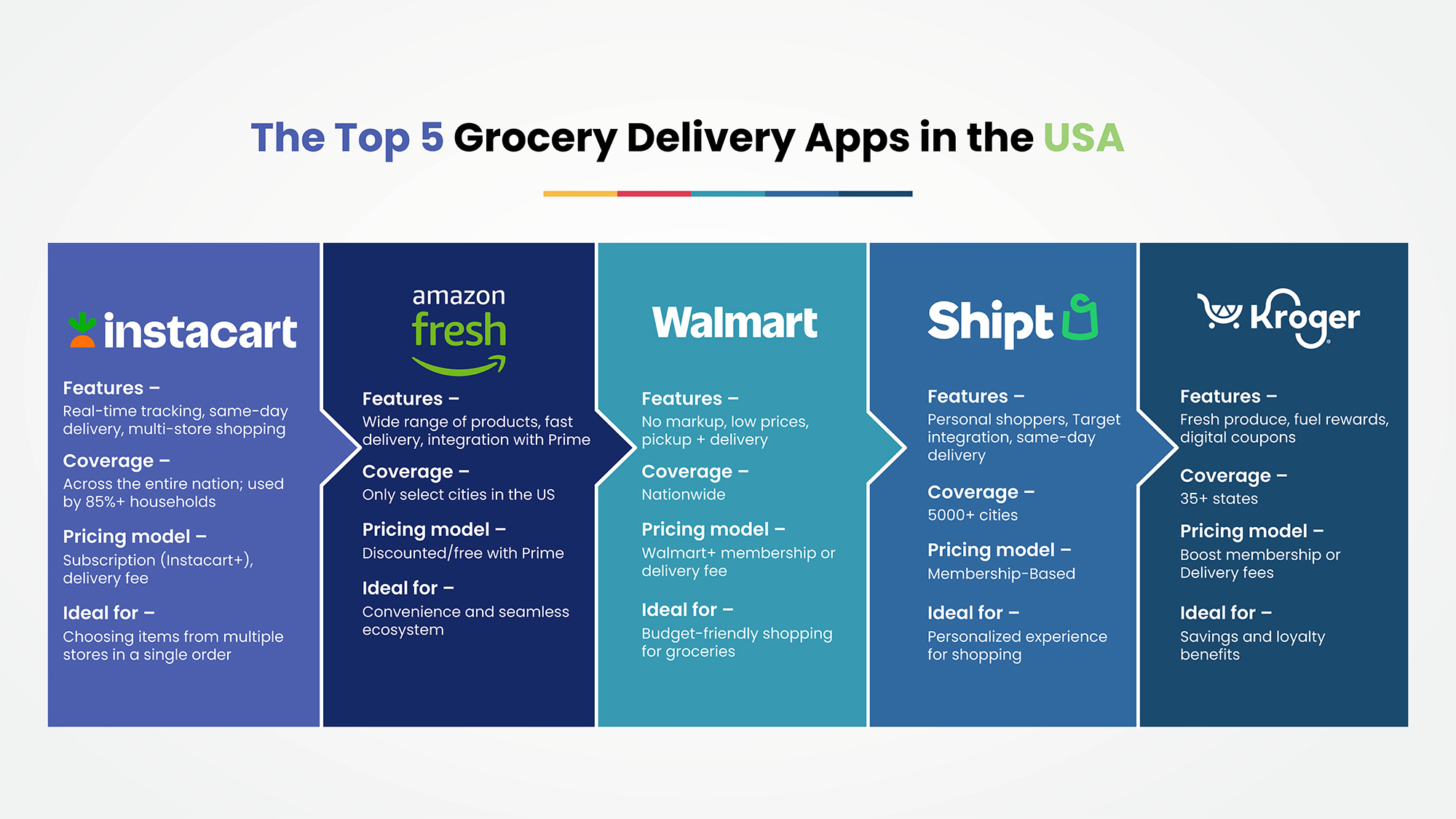
A successfully built grocery delivery app development product is a multi-dimensional project, which blends seamless user experience and complex logistics. To create a powerful platform like Walmart, FreshDirect, Shipt, Amazon Fresh, or Instacart, one must synchronize the four distinct interfaces, which are:
- Admin panel
- Delivery partner app
- Merchant/store app
- Customer app
Here's a comprehensive step-by-step guide to the development process
Conducting market research followed by the selection of a business model
Writing the first line of code comes second; defining your niche must be first! Begin with:
Identification of the audience
Who is your target audience? Budget-conscious families who plan weekly restock or a busy urban population who need hyperlocal deliveries in minutes?
Selection of the right model
- On-demand delivery model – A very popular model in the market. By owning an on-demand grocery delivery app, users can order groceries whenever needed, and they will be delivered in just minutes or hours.
Example – Instacart.
Pros – Quick delivery, convenient shopping at any time, no need for physical store hopping.
Cons: High delivery fees, limited delivery slots. - Subscription-based model – Users pay a monthly or yearly fee to get free deliveries and various offers. Example – Amazon Fresh.
Pros – Predictable shipping cost, cheaper or free delivery.
Cons: Limited to the app's service areas, an upfront payment is needed when not ordered frequently. - Marketplace model – In this model, grocery apps play the role of middlemen. It connects the users with local supermarkets or grocery stores. This app does not manage actual groceries but helps users shop from numerous stores.
Example – Shipt, Instacart.
Pros – Multiple options of products and stores, flexible shopping options.
Challenges – Delivery can be slow during the busy hours; prices vary between stores. - Store-owned model – In this model, the grocery store operates and owns the delivery app. The store manages nearly everything, from grocery items to delivery processes.
Example – Walmart grocery.
Pros – Lower prices due to the absence of middlemen, direct relationship with the stores.
Cons – Delivery might be restricted to specific areas, limited to only the store's products - Business-to-Business or B2B model – This model focuses on delivering the groceries to businesses and not individual customers. Such apps connect hotels, restaurants, and other businesses that need bulk deliveries.
Example – FoodMaven
Pros – Cheaper for bulk orders, helps businesses to quickly get groceries.
Cons: Limited to only a few business customers, not for individual customers.
Prototyping and UI/UX
In the grocery business, conversion takes place through ease of use. When a user cannot find ‘free-range eggs’ within three seconds, they will leave immediately.
- High-fidelity mock-ups – Leverage tools like Adobe XD or Figma for designing the true vision of the interface, focusing on appetizing imagery, clean layouts, and clear call-to-action.
- Wireframe – Create the core framework of the app for mapping out the user journey, from landing page to checkout.
- Information architecture – organize hundreds of SKUs or Stock Keeping Units into subcategories and intuitive categories.
Choosing the right technical stack
Your chosen tech stack will determine the app’s future scalability and performance.
- Cloud infrastructure – Google Cloud or Amazon Web Services offer the crucial auto-scaling capabilities that handle traffic spikes during holiday sales.
- Database – MongoDB or PostgreSQL is leveraged to handle order histories, user profiles, and complex inventories.
- API and backend – Python or Node.js are great for managing real-time data processing.
- Mobile development – React Native, or Flutter, are the popular industry standards for cross-platform grocery delivery app development projects, which allow businesses to launch on both Android and iOS by using a single codebase.
API integration and core feature development
This phase is like the engine room where the developers build crucial functionalities:
- Push notifications – Leverage Firebase Cloud Messaging for alerting users about delays, order confirmations, or discounts.
- Secure payments – Integrate Braintree, Stripe, or any other local gateways for supporting digital wallets, credit cards, and Buy Now, Pay Later options.
- Real-time tracking – Integrate Google Maps API, which is critical for allowing the customers to monitor their progress of deliveries and also for the drivers to find the best routes.
- Advanced filters and search – implementing Elasticsearch allows users to find products even when there are Typos.
The four-pillar synchronization
The development team must ensure that all modules (Admin panel, Delivery partner app, Merchant/Store app, Customer app) communicate with each other in real-time.
- Customer app – cart management, browse, and order tracking.
- Store app – Receiving orders, inventory management, and marking the 'out of stock' items.
- Delivery app – Navigation, accepting delivery requests, and proof-of-delivery through Photo or OTP.
- Admin panel – A web-based dashboard for the business owners to run marketing campaigns, manage disputes, and monitor revenues.
Rigorous QA
Grocery apps involve real-time logistics and financial transactions, so bugs can prove to be expensive.
- UAT or User Acceptance Testing – Real-world situations where testers can function as drivers and customers for finding friction points.
- Unit testing – testing the individual components.
- Security audit – Ensuring that the user data, as well as payment information, is compliant with standards like GDPR and fully encrypted.
Maintenance, marketing, and deployment
Once the application is polished, it is then submitted to the Google Play Store or Apple App Store.
- Feedback loop – After launch, monitor the app analytics to locate the drop-off points of the users and release bi-weekly updates to enhance the app experience.
- Launch strategy – Offer ‘refer a friend’ or ‘first order free’ incentives for building a significant user base initially.
The top 5 grocery delivery apps in the USA
Grocery delivery app development - how much does it cost?
In the United States, professional grocery delivery app development in 2026 is a significant investment, which typically ranges from $40,000 to $500,000 or even more. For an app development team based in the US, the hourly rate for hiring a senior developer currently ranges between $100 to $250 per hour, driving the total project cost significantly higher than the offshore alternatives.
Estimated cost as per app complexity
The entire budget is primarily fixed by whether you are creating a simple tool for a single store or a multi-vendor marketplace like Instacart. Here are the details:
- Building MVP: $40,000 - $100,000
Timeline – 12 weeks to 24 weeks
Focus – Most important features for a small city or single location. The MVP includes a simple product catalog, basic user login, standard payment processing, and a shopping cart. - Middle-level app: $100,000 to $250,000
Timeline – 6 months to 9 months
Focus – Ideal for regional chains. Features to be included at this level are push notifications, real-time order tracking, basic loyalty programs, and advanced search filters. - Enterprise-grade platforms: $300,000 to $500,000+
Timeline – 9 months to 18 months
Focus – Ideal for businesses' operations across multi-city or national-scale, like Amazon Fresh or Walmart. The grocery delivery all-in-one development solution features AR-product views, AI-powered recommendations, hyper-optimized route algorithms, and complex multi-vendor management.
Estimated cost as per core components
Building a grocery delivery app needs four distinct interfaces, viz, Admin Dashboard, Vendor/Store app. Partner app, Customer app. Let’s look at the cost details:
- UX and design
Custom branding - $15,000 - $60,000
Standard templates - $5,000 - $10,000
Interactive/premium – UX - $30,000 - $60,000
Why it is important – In the crowded marketplace, a crucial portion of the user retention rate is dependent on an intuitive interface.
- Backend infrastructure and architecture
Enterprise architecture - $80,000 - $100,000 (microservices for multi-vendor support and unlimited scaling)
Moderate infrastructure - $25,000 - $60,000 (real-time updates, scalable APIs)
Simple setup - $5,000 - $25,000 (basic CRUD databases and operations)
- AI integration and advanced features
Voice ordering capabilities - $10,000 - $20,000
AI personalized recommendations - $8,000 - $20,000
Augmented Reality Previews - $15,000 - $30,000
Smart Route optimization - $15,000 - $35,000
- Third-party costs
Communication services (Firebase/Twilio) - $2,000 - $6,000 for the setup; recurring fees may be applied for every message.
Payment gateways (PayPal/Stripe) - $3,000 - $10,000 for integration, along with ~2.9% + $0.30 for every transaction.
Mapping services (Mapbox/Google Maps) - $2,000 - $5,000 for integration, with recurring usage fees (~$2-$17 per 1,000 requests).
Ongoing and hidden operational expenses
Launch of the app is only the beginning of the budget cycle. Founders often overlook such recurring costs:
- Customer acquisition and marketing – Acquiring users in the competitive markets like the US averages between $15 - $25 per hour. The initial campaigns often need $50,000 to $200,000 for the basic, city-level traction.
- Compliance and legal – US-specific regulations like food handling permits, CCPA/GDPR cost from $5,000 to $25,000 at the initial stage.
- Cloud hosting (Azure/AWS) – Costs rise with traffic, typically ranging from $500 to $5,000 every month.
- Yearly maintenance – Typically 15% to 25% of the original cost of development (for example, $15,000 - $25,000 for a $100k application).
Grocery delivery app development – steps to optimize the cost
Engineering a grocery delivery application in the highly competitive, high-cost US market needs a balance between fiscal responsibility and feature richness. With the US developer rates ranging from $100 to $250, an unoptimized project can prove to be overbudget, sometimes even spiraling into a seven-figure expense.
For bringing a competitive product into the market without traces of overspending, founders have to shift from the mindset of 'building with everything' to a more modular and strategic approach. Here is a comprehensive presentation on the steps to optimize the cost of a grocery delivery app development project.
Let’s have a look at the steps:
The strategy for Minimum Viable Product
The most efficient way of optimizing the cost is by limiting the initial scope. A lot of founders fail by trying to engineer a solution that will beat the already popular apps from day 1. In this attempt, they include costly features like 'global multi-vendor support, voice ordering, and complex AI.
The right way to do it is:
- Give importance to the core utility - Your MVP only needs these three things:
A secure checkout
A searchable product list
A basic delivery tracking system - Defer the premium feature for the growth phase – Skip the high-cost additions like drone delivery integration, Augmented Reality integration for fruit ripeness, and AI-driven personal shoppers. Such features can be added in the next version(s) once you have a consistent and steady revenue-earning stream.
- Impact on cost – An MVP typically costs between $40,000 and $100,000, whereas the full-featured launch can cross $300,000.
Leverage the cross-platform frameworks
Historically, companies have had to engineer two apps separately for two operating systems, iOS and Android, based on Swift and Kotlin, respectively. This doubled the cost of development, naturally claiming more hours for the process.
Instead, today’s businesses can:
- Leverage React Native or Flutter frameworks for enabling the developers to write a single codebase that runs on both the iOS and Android platforms.
- Efficiency gains – Companies will need only a single development team instead of two platform-dedicated teams. Maintenance expenses are halved as well because the bugs only require to be fixed in one place.
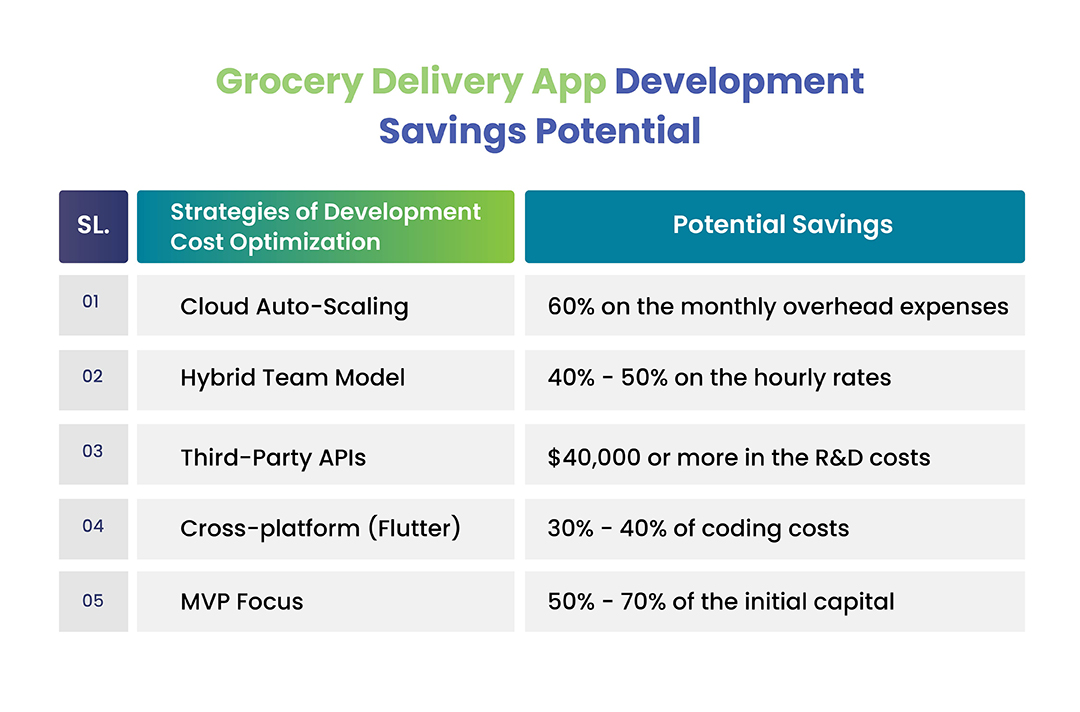
- Impact on cost – Using cross-platform frameworks for grocery delivery app development can decrease the total development hours by nearly 45%.
Leverage the ready-made integrations and third-party APIs
Engineering every internal system right from scratch, like a private payment gateway or custom map engine, is unnecessary and expensive. Here’s a list of the integrations:
- Payments – Integrate Braintree, PayPal, or Stripe. These are pre-certified for PCI compliance, saving you months of technical and legal groundwork.
- Geolocation – Leverage Mapbox or Google Maps for real-time route optimization and tracking.
- Communication – Integrate Twilio for SMS or Firebase for enabling push notifications.
- Impact on cost – Integrating an API may cost $2,000 - $5,000, whereas engineering a proprietary equivalent may cost $50,000 or more.
Optimize UI/UX design process
Scope-creep happens during the design phase. A good-looking app is no doubt important, but non-standard patterns of navigation and complex animations increase the coding time.
- Prototyping – Leverage tools like Figma for creating a high-fidelity and clickable prototype before writing a single code line. Figma takes only a few minutes to fix a design flaw, while fixing the same in coding takes days.
- Leverage design systems – Rather than designing every screen from a blank canvas, leverage the Human Interface guidelines by Apple or Material Design (Google).
- Impact on cost – Streamlined design can save nearly $25,000 in the front-end development hours.
Adopt offshore model
As you are targeting the US market, employing a 100% US-based team can be an expensive call. On the contrary, 100% offshore team can lead to quality issues and communication barriers.
Here’s what you can do:
- Keep your lead architect or product manager in the US for ensuring that the quality standards and business logic standards align with the local market. Then, outsource the heavy lifting (testing and coding) across regions like Latin America or Eastern Europe, where the rates fall between $40 - $70 per hour.
- Impact on cost – This can decrease the ‘burn rate’ by nearly 50% alongside maintain quality oversight.
Implement DevOps and automated testing
A lot of founders skip the QA part to save money upfront, but later, they pay double when bug fixing becomes critical in a live environment. Here's what to do:
- Continuous integration (CI/CD) – Automation of deployment processes reduces the manual labor that is required for pushing updates to the App Store.
- Automated QA – Investing in the automated scripts for testing core functions like adding items into the cart, which will ensure that new updates will not hamper any new feature.
- Impact on cost – decreases the maintenance costs for the long term by preventing 'technical debt' that can claim up to 20% of the budget after launch.
Select a scalable cloud infrastructure
Never over-provision your servers. In case you have 100 users, you must not be paying for the server capacity that can handle 100,000. Instead, you can go for:
- Serverless architecture – By using Google Cloud Functions or AWS Lambda enables your infrastructure to automatically scale. You will have to pay only the exact amount for the power used.
- Impact on cost – Reduces the monthly hosting fees, right from thousands to just a few hundred at the very early growth phase.
Consider the white – label solutions for quick entry
In case you are a small local chain or single grocery store, you may not require a customized app at all. You can opt for:
- SaaS platforms – Companies like Uppernic or Logic-Soft provide off-the-shelf grocery applications that you can brand with your logo.
- Impact on cost – These have a low setup fee of $5000 - $15,000 along with a subscription, which is more affordable than a $100,000 custom built product.
Grocery delivery app development savings potential
Why working with an offshore team can be beneficial
Partnering with an offshore grocery delivery app development team can prove to be a strategic advantage for modern businesses. Offshore collaboration enables companies to rule out limitations of local hiring and get access to a pool of highly skilled developers who bring in innovation and diverse expertise for the project.
One of the most crucial benefits of hiring an offshore team is gaining cost-efficiency without compromising on the quality. Offshore teams function from regions with lower cost of operations, enabling businesses to save nearly 50%, as compared to in-house hiring, while still getting access to the top-tier talent.
Also, companies save big time as there are no overheads involved, in relation to infrastructure, recruitments, or employee management, making the budget more flexible and predictable.
Scalability and speed are crucial advantages. Offshore teams can be hired quickly, in a matter of days, for example, eliminating the prolonged recruitment cycles. Such agility enables businesses to scale resources as per their needs or project requirements, ensuring quicker time-to-market and efficient handling of the dynamic workloads.
Hiring an offshore development team gives a business quick access to specialized skills. It opens doors to areas like cloud computing, AI, modern app frameworks, and more. Talents with such skills may be expensive or scarce to be found locally. This ensures that the app is created by using best practices and the latest technologies, improving both future scalability and performance.
Finally, offshore partnerships offer continuous productivity and flexibility. With distributed or time-zone-aligned teams, businesses can accelerate project delivery and achieve 24/7 development cycles, while maintaining transparency and control.
Combined with dedicated support and engagement models, offshore development models become a robust enabler of efficiency, innovation, and sustained growth.
Why choose Proquantic Software as your app development partner
Equip your business with scalability, technical excellence, and market-focused innovation with Proquantic Software. Our expertise in customer mobile app development ensures that every solution is engineered to handle the unique challenges of grocery platforms like multi-vendor management, real-time inventory, and seamless order tracking.
By harnessing the power of modern technologies like advanced analytics, cloud computing, and AI, our team will optimize operations and personalize user experience so that you stay competitive in the dynamic on-demand ecosystem.
Beyond development, Proquantic Software is focused on creating future-ready applications that effortlessly scale with business growth. Our cloud native approach assures consistent performance even when there is peak demand, while the cross-platform capabilities decrease time-to-market as well as development costs.
Right from secure payment gateways to intuitive UI/UX integrations, we offer end-to-end support that transforms a simple grocery app into a powerful digital commerce platform.
Here's why you should hire us for a grocery delivery app development project:
- Proven experience in on-demand and e-Commerce app ecosystems
- Strong focus on retention, experience, and conversion optimization
- Cost-efficient development without any compromise on quality
- Seamless API integrations for logistics, payments, and inventory management
- Quicker time-to-market with cross-platform and agile development solutions
- Integration of AI-powered features like demand forecasting and recommendations
- Expertise in creating high-performance and scalable grocery delivery applications
Conclusion
Businesses which invest in scalable technologies, right features and cost-optimized approach in their grocery delivery app development projects, will emerge as clear winners in the future for long-term success. By focusing on the operational efficiency, user experience and innovation, businesses engineer powerful platforms which drive growth, stay competitive and enhance loyalty in the evolving digital landscape of grocery delivery.
Frequently Asked Questions (FAQs)
What is the cost of building a grocery delivery app?
A grocery delivery app development solution can typically range between $15,000 and $150,000 or more, depending on features and complexity. A basic MVP ranges between $8,000 - $25,000 while the advanced and feature-rich platforms may exceed $100,000. The major cost factors include developer location, platform (iOS/Android), app features (payments and tracking), UI/UX design complexity, etc.
How to create a grocery delivery app development solution?
Creating a grocery delivery application development includes secure payments, product catalogs, order management, and live tracking. One can build this by using no-code platforms like AppMySuite or Glide for speed or via custom development for advanced features.
Is it profitable to invest in grocery delivery app development?
Food delivery applications find it difficult to earn a profit as they operate on slim margins, regardless of the high revenue. While market leaders like Amazon Fresh or Instacart have grown enough revenue, they frequently experience net losses due to the promotional discounts and high operating costs.
Profitability varies, with some platforms struggling to break even and others achieving minor success.
What are the technologies used for building a grocery delivery app?
The most common technologies include backend technologies like Node.js, mobile frameworks like React Native and databases like MongoDB.
Why should businesses hire professional grocery delivery app development companies for an app-building project?
A professional grocery delivery app development company ensures expert knowledge of market trends, timely delivery, and high-quality app engineering that are crucial for a successful project.
What is the average timeline for building a grocery delivery app development project?
The timeline for building a grocery delivery app development solution depends on complexity. On average, it takes around 12 to 20 weeks, involving stages like UI/UX design, requirement analysis, testing, development, and deployment.