


Work is no longer about cubicles, rigid desks, or fixed schedules. Nowadays, businesses evolve into a dynamic and borderless ecosystem, giving rise to remote and hybrid workplace models.
From startups in Silicon Valley to global enterprises spanning continents, organizations consistently redefine their business operations and work culture. They integrate the latest technologies to meet the expectations of a workforce that demands flexibility, transparency, and digital-first collaboration.
According to the American Community Survey, remote work once surged to 17.9% from 5.7% pre-pandemic (COVID-19). This shift was mostly the driving force behind organizations to implement modern software solutions like Human Resource Management Systems (HRMS). The primary purpose behind such enterprise software development was to track attendance, time, performance, communication, engagement levels, and more among remote staff hired through staff augmentation in the US.
As more companies continue to adopt remote and hybrid work models, they increasingly invest in custom HRMS software and custom HRMS solutions to streamline workforce management, improve compliance, and enhance employee engagement across distributed teams.
Do you know why companies worldwide prefer HRMS software over traditional management systems for operations across borders? This blog covers everything you need to know about HRMS software development in the US to manage hybrid and remote work arrangements.
How HR Software Supports Remote Teams
Understanding how HR software supports remote teams is essential for organizations managing distributed workforces. A modern custom HRMS solution centralizes payroll, attendance, onboarding, performance management, compliance, communication, and employee engagement into a single platform. These capabilities help businesses improve productivity, maintain transparency, and support long-term workforce growth.
Traditional HRMS: Why does it fall short in remote work
Standard or traditional HRMS is paper-based and uses manual methods. They started gaining popularity in an era where people physically clocked in and managers supervised the performance and productivity by walking across the office floor.
Managing attendance, recruitment, payroll, and other activities is straightforward with this traditional HR management system. Moreover, legal compliance is limited to only one country’s laws, making the process less complicated for startups and enterprises.
Classic HRMS worked fine when organizations were centralized. However, in today’s borderless economy, where teams may span 12 time zones and 20 jurisdictions, they collapse under pressure.
Let’s break down where these outdated systems fail, especially in large and complex workplaces:
1. Time zone chaos
Imagine a software engineer in California collaborating with a QA tester in Poland and a project manager in India. While one begins the day, the other is about to end their work shift. Standard HRMS tools, designed for single location teams, face several challenges to handle asynchronous contributions.
Performance reviews are often conducted without considering the late-night efforts of employees due to the time zone mismatch. Scheduling meetings also becomes a nightmare of endless email chains for the business founders or even the staff working remotely.
Deadlines often slip because some systems assume synchronous working hours. In short, employees become invisible if their productivity doesn’t align with the company’s time zone.
2. Compliance complexity
Payroll and labor compliance are complex matters that require careful assessment and implementation. The rules vary drastically across borders. A policy perfectly legal in Texas may result in lawsuits in Germany or hefty fines in Brazil. This is when traditional HRMS tools, which are built for domestic operations, cannot keep pace with evolving, localized regulations.
Do you know how this compliance complexity of the HR management system could impact your business? The common consequences that arise are delayed salaries, legal disputes, or worse regulatory crackdowns damaging both finances and brand reputation. For e-commerce businesses in the US or even global organizations, this risk is simply intolerable.
3. Limited employee engagement tools
In remote work, employee engagement isn’t about Friday pizza parties or office perks. It’s about constant transparency, digital first communication, and recognition to align with business goals.
Most legacy HRMS platforms are built as transaction engines. They focus on leave approvals, payroll slips, and compliance reports instead of fostering a trust-based employee-employer connection. The shortcomings of these traditional HR management systems often leave offshore engineers or software developers feeling isolated, undervalued, and culturally detached.
4. Poor scalability
Startups may begin with a team of 20, but if they succeed, that number can grow to 200 within months. Global enterprises may acquire new branches overnight. Standard HRMS platforms, bound by rigid frameworks, simply cannot adapt quickly.
Reconfiguring workflows often means additional expenses. Besides, in many cases, businesses are forced to migrate to entirely new systems, creating disruption when growth is most critical.
For enterprises managing global talent, these limitations create bottlenecks. For startups scaling rapidly, they can become growth killers. Either way, companies need something better that is designed for the distributed realities of modern work.
How is custom HRMS software shaping global enterprises?
According to Grand View Research, it is estimated that the global HR software market will reach USD 16.43 billion by 2023. Overall, the growth is projected at a 12.2% CAGR.
A custom HRMS software platform allows organizations to build workflows that match their unique business processes instead of adapting to the limitations of off-the-shelf HR tools. This flexibility is particularly valuable for global companies managing remote and hybrid employees.
These statistics highlight the growing demand for custom HRMS development among organizations of all sizes with remote and hybrid arrangements.
Do you know why cross-border businesses are shifting toward customized HRMS application development? Keep scrolling below to explore more about integrating artificial intelligence (AI) into cloud-based HR management software.
HRMS software: An overview
HRMS software is a digital solution that automates, streamlines, and centralizes HR processes. It includes a wide range of functions, which makes it easy for global firms to hire and manage offshore candidates. Like traditional HRMS, this tool helps enterprises and startups with performance tracking, recruitment, payroll, managing benefits, and employee engagement.
This modern cloud-based software utilizes AI technology to make data-driven decisions for worldwide companies. Using this system enables businesses to enhance employee experience through various exclusive features.
The inclusion of HRMS software reduces human errors and eliminates the need to perform tasks manually. For startup or enterprise owners, HR management apps can give real-time insights into their workplace trends.
Why do enterprises prefer custom-built HRMS software?
A custom HRMS solution gives organizations complete control over features, integrations, compliance requirements, and employee experiences, making it a better long-term investment than generic HR management platforms.
Below are the reasons why global companies or startups preferring to build HR management applications.
Tailored flexibility
A U.S. startup may focus on rapid onboarding and agility, while a multinational in healthcare may prioritize strict compliance. Customizing HRMS systems is possible as per the organizational needs. Founders, managers, or HR professionals can include specific features in the HR management system to speed up processes.
Future proof scalability
Custom HRMS platforms are modular. You can add new features, such as analytics or region-specific compliance, without replacing the entire system. This means businesses can scale globally without breaking their digital backbone or changing HR management algorithms.
Embedded compliance
From GDPR to HIPAA to region specific tax laws, regulations are evolving daily. Custom HRMS allows compliance frameworks to be hard coded and auto updated. Embedding these features reduces legal risks and ensures payroll remains smooth across jurisdictions.
Deep integrations
Unlike standard HR management tools, custom HRMS application development connects with collaboration platforms like Slack, Teams, or Jira, as well as accounting and AI driven analytics. This creates a holistic digital ecosystem for both managers and employees.
Enhanced employee experience
HRMS prioritizes more than transactions when you integrate this tool into your workplace management. The dashboards highlight progress, wellness modules encourage healthy habits, and recognition tools celebrate achievements. Including this software creates a positive digital HR experience, which directly improves retention of hybrid, remote, or offshore employees acquired through staff augmentation services.
Adopting custom HRMS isn’t just about technology for global firms. Investing in HR management systems is about creating a sustainable people first business model in a digital first world.
Key features of a custom HRMS for remote teams
One of the biggest advantages of Custom HRMS for Remote workforces is the ability to combine automation, compliance, collaboration, and performance management within a single platform. These features help organizations efficiently manage distributed teams while maintaining productivity and employee engagement.
A modern Human Resource Management System (HRMS) does far more than just calculate payroll or store employee records. For remote first organizations, it becomes the digital nervous system that keeps operations aligned, employees engaged, and compliance risks under control.
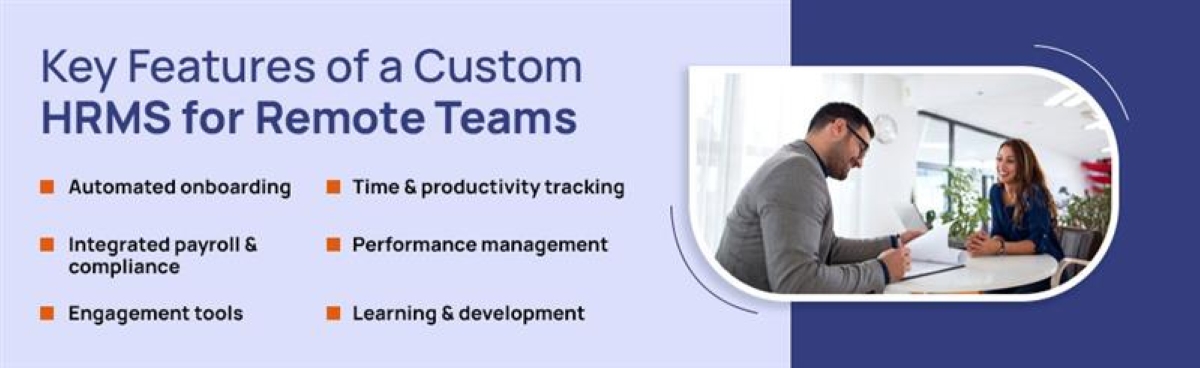
In distributed environments, where physical oversight is limited, an HRMS must deliver both structure and flexibility. Below are the core features global firms prioritizing when building or adopting a custom HRMS designed for remote teams.
-
Automated onboarding
Remote hiring or IT staff augmentation often stretches across multiple countries, and each new employee faces different compliance rules, document requirements, and cultural onboarding challenges. A robust HRMS automates these steps by generating region specific documentation, verifying compliance, and even integrating e signature tools for quick turnaround. Instead of HR teams spending hours chasing paperwork, the system provides a seamless experience for new hires.
Additionally, customized onboarding portals can deliver branded training modules, company culture videos, and policy overviews, ensuring employees feel connected to the organization from day one. For example, a remote developer in Brazil or a designer in Germany should receive the same consistent onboarding experience while still meeting local regulations. This consistency builds trust and accelerates productivity.
-
Time & productivity tracking
Managing productivity across time zones can be a nightmare without accurate tools. Platforms like Trutimer and similar trackers simplify this by removing manual timesheets and replacing them with automated logging. HR managers and team leaders gain real time visibility into how projects progress, while employees no longer feel micromanaged.
Advanced systems also allow organizations to track billable hours for clients, ensure compliance with local labor laws, and analyze productivity trends across regions. For remote first teams, this data is invaluable in balancing workloads, preventing burnout, and recognizing high performers who might otherwise go unnoticed.
-
Integrated payroll & compliance
Perhaps the most complex challenge for global teams is ensuring employees are paid fairly, on time, and in compliance with local tax regulations. A custom HRMS with multi-currency and multi law payroll automation removes the administrative headache by automatically calculating salaries, tax withholdings, and benefits contributions.
For example, paying a software engineer in Canada requires adherence to Canadian tax law, while compensating a consultant in India involves different withholding rules.
With an integrated HRMS, these complexities are handled automatically, reducing errors and protecting the company from costly legal disputes. More importantly, it reassures employees that no matter where they work, they can trust the organization to get payroll right every time.
-
Performance management
Remote employees can sometimes feel invisible, especially when recognition and promotions are tied to in office visibility. Performance management modules solve this by creating transparent dashboards that measure contribution objectively. Continuous feedback loops, goal tracking, and regular check-ins keep employees engaged and motivated.
Instead of annual performance reviews that often miss the mark, modern HRMS platforms enable real time performance discussions, aligning employee growth with company objectives. Leaders can identify top talent early, while employees benefit from clarity about expectations and recognition for achievements. This fairness builds loyalty, especially in remote environments where turnover can be high.
-
Engagement tools
One of the biggest risks in remote work is employee disengagement. Without watercooler conversations or in person celebrations, it’s easy for workers to feel isolated. Engagement tools built into an HRMS tackle this challenge head on. Features like peer-to-peer recognition platforms, regular pulse surveys, and wellness tracking keep employees connected to the organizational culture.
For example, recognition badges, public shout outs, or gamified reward systems can significantly improve morale. Wellness integrations such as stress check ins, meditation app tie ins, or health tracking demonstrate that the organization values not just output but also employee well-being. By combining recognition with feedback, HRMS platforms transform remote work from a solitary activity into a collaborative experience.
-
Learning & development
Remote employees want more than a paycheck; they want career growth and skill building opportunities. An HRMS with integrated training modules and upskilling pathways ensures employees remain competitive and motivated.
For instance, a sales executive in Singapore might have access to leadership courses, while a developer in Eastern Europe could complete cloud certification programs all within the same HRMS platform.
Goal tracking features link these learning opportunities to career advancement and organizational needs. This ensures that employees don’t just consume training content but apply it toward measurable objectives. Ultimately, a strong learning and development framework helps companies retain top talent, reduce turnover, and build future ready teams.
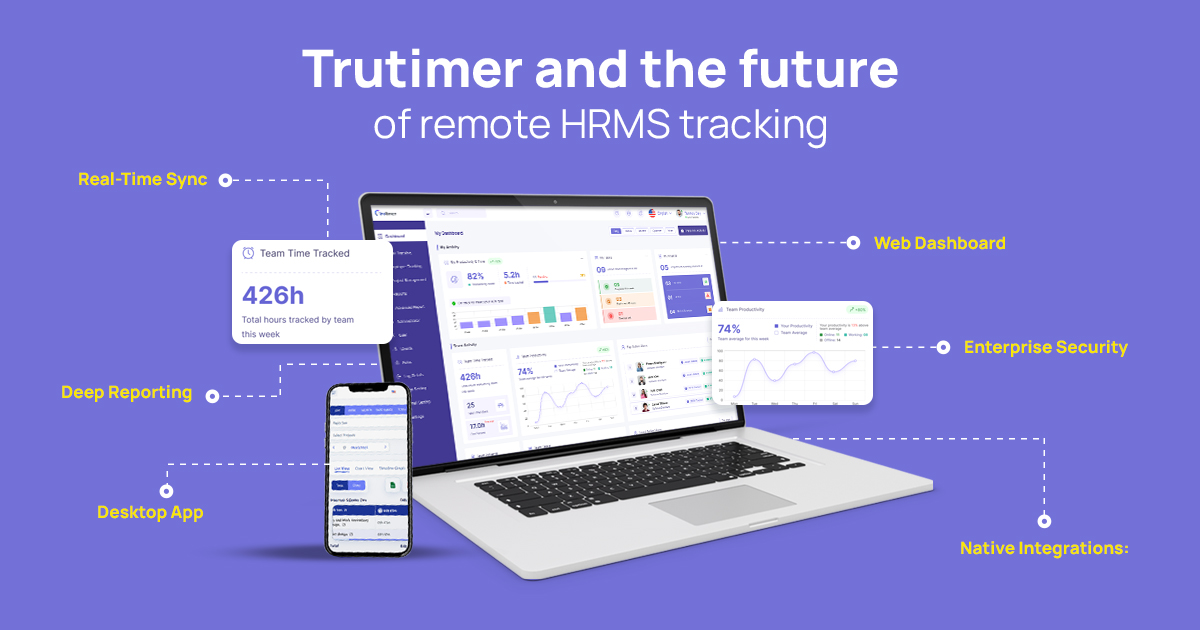
Trutimer and the future of remote HRMS tracking
What is Trutimer?
Trutimer is a web and desktop time-tracking and productivity platform built for today’s distributed workforce. It goes beyond simple timesheets by providing verifiable proof of work, capturing hours, activities, and outcomes with complete transparency. This digital tracking system is designed by Proquantic, a software services company experienced in offshore development and staff augmentation in the US. Trutimer helps businesses ensure accountability across teams, projects, and vendors, whether local, remote, or hybrid.
Who uses this time-tracking app?
Trutimer is trusted across departments like:
- Sales
- Marketing
- Product
- QA
- R&D
- Engineering
If you bill clients, manage vendors, or track internal utilization, Trutimer delivers clarity that is impossible to deliver with spreadsheets and manual logs.
What are the core features of Trutimer?
- Web Dashboard: Instant visibility for managers, finance, and clients
- Desktop App: Lightweight tracker for Windows and Mac devices
- Real-Time Sync: SignalR-powered accuracy with resilient API persistence
- Deep Reporting: List, chart, and timeline views with Excel/PDF exports
- Native Integrations: Jira, Azure DevOps, Redmine, and Trutimer Projects
- Enterprise Security: Machine fingerprinting, client certificates, encrypted payloads
How Trutimer transforms HRMS tracking?
HR teams often struggle to track performance and utilization in remote models. Trutimer integrates with HRMS processes, helping organizations:
- Align tracking with payroll and performance management
- Evaluate the productivity of remote and hybrid employees
- Optimize workforce with data-backed insights
Trutimer is shaping the future of HRMS tracking by combining productivity insights with enterprise security. It empowers businesses to build trust, improve efficiency, and scale confidently in a borderless workplace. With Trutimer, managing remote teams is a competitive advantage for US companies.
Together with a custom HRMS solution, Trutimer provides organizations with accurate workforce visibility, automated reporting, and data-driven decision-making for remote and hybrid teams.
How do automated timesheets help workforce management?
Do you know that automated timesheets are effective in enhancing the accuracy and efficiency of time tracking apps? Whether you need to record work hours of remote employees or evaluate the attendance for salary calculations, cloud-based time tracking ensures accurate results.
Global time tracking
Digital timesheets are beneficial for staff who work remotely, on-site, or from various locations worldwide. It helps employers record employee hours without relying on manual input.
Businesses often integrate AI-powered time sheets during HRMS software development to streamline various tasks.
Payroll management
Companies often hire custom enterprise software developers to integrate automated timesheets with payroll systems. This integration simplifies transferring recorded log hours to payroll software.
AI-powered time-tracking apps like Trutimer allow HR professionals to ensure that all staff get accurate payments. Implementing this tool avoid discrepancies between employees and the hiring teams
Mobile accessibility
This is an exclusive feature that enterprises or HR professionals can explore with automated timesheet systems. It allows remote employees to use their mobile devices to log their work hours. The feature helps in-office staff who need to share their operating hours while travelling somewhere for business purposes.
Conclusion
As remote and hybrid work continue to define the future of business in 2026, investing in custom HRMS software has become essential for organizations managing distributed teams. A modern custom HRMS solution improves productivity, strengthens compliance, automates HR operations, and creates a better employee experience across global workforces.
HRMS software development offers a reliable way to redefine business strategies and workforce management across the globe. With Trutimer-powered automated time sheets and other advanced features, it can generate reports and boost productivity to help enterprises achieve long-term growth.
Do you want a dependable enterprise product development agency in the U.S? At Proquantic, we design AI-powered HR management systems to automate enterprise workflows, payroll, hiring, and employee engagement. Schedule a call today and let our developers streamline your HR-related process with custom-built HRMS software.
FAQs About Custom HRMS for Remote and Hybrid Teams
Do HRMS and ERP mean the same?
No, both HRMS and ERP serve different purposes for global enterprises. HRMS manages all HR-related resources and tasks across the employee lifecycle. This tool can simplify payroll systems and leave approval, reducing employee turnover. Through instant access to the information, HRMS software helps employees generate pay slips, request tax details, and more without needing the HR team.
Enterprise resource planning (ERP), on the other hand, is there to integrate and streamline all significant business functions into one system. Including ERP helps businesses with reduced redundancy, better data visibility, and improved efficiency. When it comes to selecting developers to work on an HRMS application, consider this classification to avoid confusion.
What factors influence HRMS software development costs?
If you want to develop an HRMS application, the cost largely depends on the location, complexity, functionality, and compliance requirements. In the U.S., the expenses of creating simple HRMS software with basic management features can be between $8,000 and $12,000.
For mid-tier software development with payroll and reporting features, the cost can be $13,000 to $20,000. However, if your enterprise needs a fully scalable, high-end HRMS software for hybrid or remote work arrangements, the basic charges could start from $25,000.
You also need to consider the labor rates and other demographic factors while developing the HR management system. Reach out to our enterprise product development team for exact pricing of HR management systems.
Can I integrate automated time tracking software in an existing HR system?
Yes, automated time tracking apps, like Trutimer, can be integrated with most HR systems. Proper integration ensures uninterrupted data flow, syncing time records with employee profiles, leave management, payroll, and other HR functions.
Many AI-powered solutions support global compliance and multi-currency payroll, which make them suitable for multinational organizations.
How HRMS timesheets track employees across different time zones?
Timesheet automation is a significant function within HRMS applications. It tracks the work hours of remote and in-office employees through digital software. Using timesheets eliminates the necessity of manual data entry and replaces it with automated real-time tracking.
This core feature enables staff in cross-border companies to log their exact hours regardless of diverse time zone or location. Timesheets use geolocation, automated timestamping, and IP-based logging to convert entries to a standardized system time. HRMS applications sync this information with global calendars to adjust payroll calculations and other work-related functions.
Does the automated time tracking feature ensure data accuracy?
Yes, AI-powered time tracking in HRMS reduces human error and eliminates maintaining employee records through manual data entry. Moreover, the feature ensures precise recording of the work hours of employees.
This accuracy is essential for multinational companies to use the data for project management, distribute tasks, payroll, and performance evaluations.
How Trutimer improves employee accountability?
Trutimer is an automated time tracking software that provides real-time insights into activities and work hours of employees. Features like project-specific time allocation, activity monitoring, and detailed reporting features help managers, business owners, and HR professionals identify productivity trends and issues if any.
Time-tracking tools allow them for timely intervention to foster a culture of responsibility among in-office, hybrid, and remote teams.