


Apple Inc.’s strong market presence and premium user base are the reasons behind the growing demand for iOS applications. For many businesses, building apps for the Apple ecosystem is no longer an optional add-on but a reliable way to retain customers, generate consistent revenue, and thrive in the competitive US market.
Although iOS powers only about 28% of global mobile devices, it generates nearly 65% of worldwide app revenue. According to a recent Grand View Research report, the global Apple Store mobile application market size is estimated to reach USD 392,423.4 million by 2030. Industries, ranging from e-commerce and healthcare to fintech and gaming, increasingly view iOS apps as a strategic investment.
Whether you are launching new products for Apple devices or looking to scale faster, expenses for developing applications remain a crucial factor. Read this comprehensive guide to understand what influences iOS app development cost, the impact of AI advancements, and strategies businesses implement to plan their budgets for custom software solutions.
What is iOS App Development?
iOS app development involves designing and deploying mobile applications for Apple devices, which include iPhones and iPads. Developers use Swift, Objective-C, or other programming languages to create applications within Xcode, Apple’s official integrated development environment.
The platform provides tools for designing user interfaces, writing code, testing features, and debugging applications. Apple maintains an integrated ecosystem where hardware, software, and services work together.
Before an application becomes available on the App Store, it must pass a strict review process that checks performance, privacy compliance, security standards, and user experience guidelines. This controlled environment helps developers deliver reliable, secure, and high-quality mobile applications across Apple devices while ensuring users receive a consistent and optimized experience.
App costs vary—get a clear estimate before you invest.
Why Do Businesses Invest in iOS App Development
For tech enterprises and startups targeting high-value users, especially in North America, developing apps for the iPhone, iPad, or other Apple devices remains a smart strategic move to grow businesses. As per a report, there are around 300,000+ games and 2.42 million apps on the App Store, indicating how iOS applications are steadily growing across industries.
Companies today choose iOS platforms that deliver strong user engagement, revenue potential, and long-term reliability. Here’s how Apple device app development can benefit your business by offering a powerful environment to launch high-quality mobile applications.
-
Access to high-value iOS users
One of the biggest advantages of developing apps for Apple products is its high-value audience. iPhone users are widely recognized for their higher spending capacity compared to users on many other platforms. They are more willing to pay for premium apps, subscriptions, and in-app purchases. For businesses, iOS app development creates excellent opportunities to generate higher revenue through digital products and services.
-
Drive engagement with loyal Apple users
Apple has built a strong reputation for quality and innovation. As a result, its users tend to remain highly loyal to the brand and its ecosystem. Once users adopt Apple devices, they often continue using Apple TV, iPhones, iPads, Macs, Apple Watch, and other relevant services for years. This loyalty translates into higher engagement rates for apps and stronger customer retention for businesses.
-
Simplified development with device consistency
Device consistency often motivates tech enterprises and emerging businesses to develop iOS applications. Unlike platforms with thousands of device variations, Apple maintains a limited number of devices with predictable screen sizes and hardware configurations. This consistency allows developers to design and test apps more efficiently.
-
Smooth, fast, and reliable app performance
Performance plays a crucial role in user satisfaction. iOS devices are known for their speed, smooth interface, and reliable performance. Apple tightly integrates its hardware and software, allowing apps to run efficiently even with complex features. For businesses, this means customers can enjoy responsive applications that load quickly and operate smoothly, resulting in better user experiences and improved brand perception.
-
Strong iOS presence in key markets
While Android leads globally in device volume, iOS dominates several high-value markets. In the United States, iPhones hold a majority share of the smartphone market. This presents a significant opportunity for businesses targeting premium users in regions with strong purchasing power.
-
Users quickly adopt latest iOS updates
Apple users tend to update their devices quickly when new operating system versions are released. This means developers can build apps using the latest technologies without worrying about compatibility issues with outdated software. Faster adoption rates make it easier to maintain apps and deliver new features efficiently.
-
Built-in security and privacy standards
Security is another reason businesses trust the iOS ecosystem. Apple enforces strict privacy policies and app review guidelines to protect users. These measures create a safer environment for both customers and businesses.
Apps that meet Apple standards gain stronger user trust and credibility. Companies planning advanced features, scalable architecture, and custom integrations often compare development approaches and security requirements to better estimate overall iOS app development costs.
-
Quicker development with easier maintenance
With fewer device variations and comprehensive development tools, building and maintaining iOS applications can be more efficient. Custom app developers focus on improving features and user experience alongside handling compatibility issues in Apple devices. Over the years, this can reduce maintenance costs and improve development efficiency.
For businesses aiming to deliver premium digital experiences, investing in iOS app development offers a strategic advantage. With a loyal audience, powerful technology, and strong revenue potential, the iOS platform provides the ideal foundation for building successful mobile applications.
iOS App Development Cost Estimation Based on Features
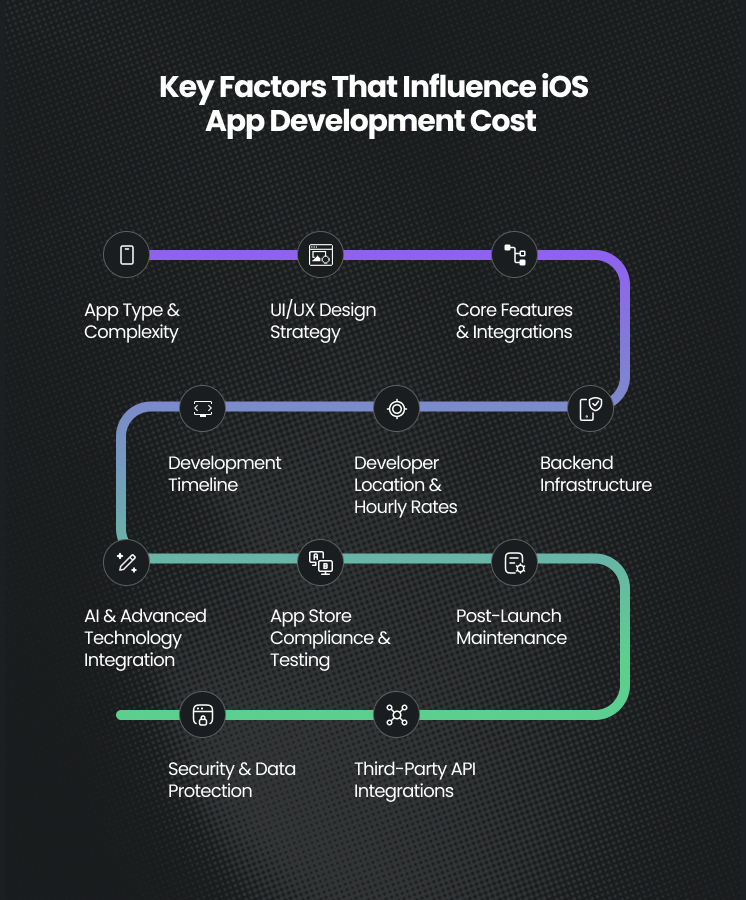
Having clarity of the factors determining the cost of iOS app development helps businesses plan realistic budgets and avoid unexpected expenses. For companies targeting Apple device users, such as the iPhone and iPad, development costs vary widely depending on the following aspects:
1. App type
The type and complexity of Apple software significantly influence the iOS app development cost. As the functionality and technical requirements increase, our developers spend more time on architecture, backend integration, and testing, thereby increasing the total project budget.
Simple apps
They include calculators, notes, and basic business information applications.
- These apps usually have minimal UI components and no complex backend infrastructure. Experts mainly focus on simple navigation and basic functionality while developing digital products for Apple devices.
- For US tech firms, the cost of developing simple iOS apps can be anywhere between $10,000 and $30,000, with development timelines of 4 to 8 weeks depending on design requirements.
Medium complexity apps
These are iOS software solutions, ranging from Booking platforms and HR portals to CRM dashboards and customer service apps.
- These applications require backend databases, APIs, user authentication, and admin dashboards. Because developers must integrate data storage, security layers, and user management systems, the development process becomes more complex.
- Typical costs for building medium-level iOS software can be between $30,000 and $80,000, with development timelines of 2 to 5 months.
Complex apps
The best examples of these Apple software solutions include e-commerce platforms, social networking apps, ride-sharing services, and real-time collaboration tools.
- They require advanced architecture, real-time data processing, payment integration, and high scalability. They also demand extensive testing and performance optimization.
- The development costs for complex iOS apps range from $80,000 to $250,000+, depending on the number of features and integrations required.
2. App design
Design strategy is an important aspect that decides how users interact with an iOS app. Apple emphasizes polished design standards, making it essential for tech firms to invest in user-friendly interfaces and smooth navigation to meet user expectations.
Basic UI design
- Design approach: Basic designs rely on standard interface components and simple layouts without heavy customization. Developers use default UI elements and limited branding adjustments to keep the interface clean and functional.
- Cost impact: Because fewer design resources and revisions are required, development teams can implement these interfaces quickly. For most business applications, basic iOS app development costs can be between $3,000 and $8,000, completed within two to three weeks.
Custom UI/UX design
- Design approach: Custom designs for user experience focus on creating a unique brand identity through tailored layouts, animations, and interactive elements. You can always approach our development team to build personalized icons, micro-interactions, and advanced navigation flows to enhance user engagement.
- Cost impact: This level of design requires specialized UI/UX expertise and additional testing to ensure performance across iPhones, Apple Watches, tvOS App, and more. As a result, custom design costs usually range from $8,000 to $25,000+, which often depends on the number of screens and design complexity.
3. Core app functions
Every feature added to an app increases development complexity and cost. Features require coding, testing, backend infrastructure, and ongoing maintenance for iOS applications.
Common features included in Apple devices and their estimated implementation costs include:
- User authentication (sign-up/login): $2,000 – $5,000
- Push notifications: $1,000 – $3,000
- Payment gateway integration: $5,000 – $10,000
- GPS location services: $3,000 – $8,000
- Chat or messaging systems: $10,000 – $25,000
When you include advanced features, like AI integration, video streaming, or real-time analytics, it can increase the iOS app development cost.
For example, an AI-powered recommendation may exceed your budget by $20,000 to $50,000, depending on data infrastructure and the complexity of algorithms. Many companies often adopt a Minimum Viable Product (MVP) strategy to cut costs while evaluating the market demand for Apple applications.
4. Development time
Sometimes, the overall timeline directly influences iOS app development cost because developers typically charge based on hours worked. In the US, experienced iOS developers can charge $100 to $200 hourly, depending on expertise and project complexity.
Estimated timelines for different types of apps include:
- Simple apps: 1–2 months
- Medium apps: 3–5 months
- Complex apps: 6–12 months or longer
Based on these app development timelines, you may have to bear the following expenses:
- Simple apps: $15,000 – $40,000
- Medium apps: $40,000 – $120,000
- Complex apps: $120,000 – $300,000+
Longer development cycles indicate additional testing of iOS apps, quality assurance, and project management costs. Businesses should plan realistic timelines to avoid rushed development and technical debt.
5. Developer location
The geographic location of the iOS app development team can significantly affect overall project costs. Labor rates vary widely across regions due to differences in market demand and living costs.
Typical hourly development rates include:
- North America: $100 – $200 per hour
- Western Europe: $70 – $150 per hour
- Eastern Europe: $40 – $80 per hour
- Asia/India: $25 – $60 per hour
Many tech companies building apps for Apple devices often seek a reliable iOS app development agency to facilitate communication and ensure compliance with regional regulations.
Some of them even adopt hybrid hiring models or IT staff augmentation services from Proquantic Software to hire offshore Apple app developers. This approach can reduce development costs by 30–50% while maintaining quality standards.
Extra Expenses that Impact iOS App Development Cost
Here are some hidden costs that tech enterprises often overlook while developing applications for iPhones, iPads, or other Apple devices.
-
Developer account fees
Apple requires a paid developer membership to publish apps on the App Store. You may need to invest about $99 per year towards the Apple Developer Program for individual or company accounts.
Businesses that need enterprise distribution may pay around $299 annually. This cost is mandatory before submitting any iOS application to the App Store, which you must add to the overall development budget.
-
Quality testing
Thorough testing ensures the application runs smoothly across different devices and iOS versions. Development teams perform functional testing, performance testing, and security checks to detect bugs early.
Testing mobile applications prevents poor user experiences and reduces the risk of negative App Store reviews. Consider $1,000 to $5,000 more to the application build expenses, depending on the software complexity.
-
Ongoing maintenance
Apps require continuous updates and performance improvements after launch. Apple regularly releases new iOS versions, and applications must remain compatible with the latest system updates.
Maintenance may include bug fixes, feature improvements, and security updates. US enterprises allocate around $2,000 to $10,000 per year for maintenance to ensure long-term stability and optimal app performance.
-
App review fixes
Apple reviews every app to ensure it follows App Store guidelines before final deployment. If the app fails to meet these requirements, the product may face rejection and require additional modifications.
Fixing compliance issues or modifying app features involves significant development efforts from experts. These revisions can increase the cost by $500 to $3,000, depending on adjustments.

How Proquantic Software Can Help with iOS App Development
With a team of trained iOS app developers and many successful projects, Proquantic Software remains a leading choice for app development services. We have a proven track record for delivering high-performance applications to drive business growth.
From FinTech to mHealth and eLearning, our products maintain the highest standards of UI/UX, security, and compliance for US companies. Our agile methods and innovations in AI & ML, backend and cloud, frameworks, and more make us a reputed iOS app development company in the US.
Conclusion
Developing iOS apps offers a strategic investment opportunity for businesses targeting premium mobile users. Tech companies can strengthen their brand presence, improve customer engagement, and support long-term digital growth in a highly competitive market with software development exclusive to Apple devices.
Partnering with our experienced app developers can ensure better planning, scalable architecture, and smooth performance. At Proquantic Software, we combine technical expertise with business insight to build reliable, high-quality iOS solutions. Whether you need a dedicated developer for a well-built app or want more insights into iOS app development cost, call us.
Frequently Asked Questions (FAQs)
1. How can I begin iOS app development today?
You need to install Xcode, which is Apple’s official development environment, to create your Apple Developer Program account. Learn programming with Swift or Objective-C, explore Apple’s iOS SDK, and start by practicing how to build simple apps. Understanding interface design, APIs, and App Store guidelines can further help you successfully launch your first functional iOS application.
If you are looking for a go-to partner for app development, especially for Apple devices, contact Proquantic Software. We provide comprehensive services to help businesses with iOS app development.
2. Can I use AI tools to reduce iOS app development costs?
Artificial Intelligence (AI) can reduce development costs by automating coding, testing, debugging, and documentation. These virtual assistants and code generators help iOS developers work faster and minimize errors.
Integrating advanced AI features, such as recommendation engines, chatbots, or predictive analytics, can increase development budgets. To save considerably on additional IT or Apple app development infrastructure, training data, and specialized tools for successful implementation, call our experts.
3. What does iOS app development cost in 2026?
Developing iOS applications in 2026 can cost anywhere between $20,000 and $200,000+, depending on complexity, design quality, and integrations. A basic MVP may cost around $20k–$60k, while feature-rich Apple software solutions can exceed $100k.
Costs increase with AI features, backend systems, security, and custom UI requirements. For the correct cost estimation of iOS app development, schedule a call with our developers.
4. Are iOS apps profitable for enterprises and startups?
Yes, iOS apps often generate higher revenue per user because Apple users spend more on subscriptions and in-app purchases. Modern businesses can drive consistent revenue from a premium audience by implementing strong security standards and adapting to a stable Apple ecosystem.
Many companies launch on iOS first to validate ideas and build profitable digital products. You can also increase profits and attract more users to your business with iOS app development services.
5. Which is cheaper to build apps, Flutter or native iOS?
Using Flutter can lower development costs when building apps for both iOS and Android because developers maintain a single codebase. However, you can always choose native development with Swift to deliver high-performance applications due to deeper Apple ecosystem integration and long-term scalability for apps designed exclusively for iOS users.
6. Do iOS apps require maintenance after App Store launch?
Yes, apps require continuous updates after launch to remain compatible with new iOS versions, fix bugs, improve performance, and add features. Businesses usually allocate 15–20% of the original development cost for annual maintenance, security updates, and infrastructure improvements to keep the application stable and competitive.
7. How long does it take to develop an iOS app?
The development timeline often depends on the app’s complexity. A basic MVP can take about 2–4 months, while a standard iOS app development project often takes anywhere between 4 and 8 months. Large, feature-rich platforms with integrations, advanced security, or AI capabilities may take 8–12 months or longer to design, build, test, and launch.
8. Can I build an iOS app on a small startup budget?
Yes, many startups implement their ideas with a Minimum Viable Product (MVP), which includes only essential features of iOS applications. This approach reduces initial costs while validating the idea of software development in the US market. Once users provide feedback and traction grows, the app can gradually scale with additional features and advanced functionality.