


In today’s phase of post-pandemic digital rush, learning takes place beyond cubicles and classrooms. The knowledge flows across screens of all sizes on various types of devices, and at the heart of this, LMS or learning management systems stand tall as the main driver. What started as a tool for online courses has gradually evolved into a powerful platform for skill-based learning, compliance management, and corporate training at scale.
For modern organizations, an LMS is no longer a luxury, but the very foundation of a future-ready workforce. Whether you are launching an edtech startup, training healthcare professionals with new protocols, or onboarding employees from overseas, the correct learning management system introduces engagement, analytics, and structure into a seamless ecosystem.
And the entire world has noticed this. The global market for learning management systems is expected to touch $45 billion by the year 2030, which will be powered by the demand for AI-powered analytics, remote upskilling, and personalized learning, and this momentum is unstoppable.
Learning management system – definition and purpose
An LMS or learning management system is a comprehensive software solution that enables educational institutions and organizations to deliver, design, and manage experiences of learning digitally. It is like the central nervous system of the modern education as well as corporate training, where the learners are engaged, courses are created, and progress is gauged in real-time.
The focal purpose of LMS solutions is streamlining the process of learning alongside maintaining scalability and flexibility. It enables the administrators to track the performance of learners, assign modules, and upload the learning materials through detailed reporting and analytics. For businesses, learning management systems simplify employee onboarding, compliance training, and skill development across global teams. In the circle of education, it supports the instructors to personalize learning journeys, host assessments, and manage digital classrooms for students of every level.
Beyond functionality, learning management systems act as a digital learning environment, which is a space that establishes connections among collaboration, communication, and content. Features like real-time feedback, gamified learning paths, discussion forms, etc, make the experience more engaging and interactive. With AI integration, the modern LMS platforms can recommend personalized content, enhance the outcomes, and predict learner behaviour with data-powered insights.
Ultimately, an LMS goes far beyond functioning as the very repository of online courses. It is a dynamic ecosystem that transforms how people connect, upskill, and learn in the knowledge-powered world to empower organizations to build a more capable, smarter, and future-ready workforce.
Learning management systems – key trends and statistics
The market for learning management systems underwent a rapid evolution back in 2024, boosted by the three dominant forces like cloud-based deployment, AI-powered personalization, and VR/AR-powered adaptive learning.
Let’s have a look at the details:
Personalization and AI
- By 2024, nearly 47% of learning management system platforms were integrated with capabilities of Artificial Intelligence, like automated feedback, intelligent recommendations, adaptive learning paths, etc.
- AI-powered personalization is identified as a top trend for 2025, with several organizations projecting more than 30% growth in the adoption of the technology within the LMS deployments.
Adaptive Learning Growth and VR/AR
- Immersive learning technologies are continuously getting implemented within the LMS ecosystem. In the past year, nearly 54% of the learning management systems reported experimental learning, improving engagement through simulation and VR/AR integrations.
- Also, adaptive learning engines that tailor content in real-time, based on the learner's performance, are embedding 45% or more of the LMS launches.
Cloud-based adoption
- Cloud-hosted learning management systems consistently dominate the strategies of deployment. Back in 2023, the segment of cloud deployment held nearly 65% of the global learning management systems’ revenue share.
- A report in 2024 showed that by this year, the global market for learning management systems is expected to grow to $27.09 billion, underlining a massive, cloud-driven expansion.
The different types of learning management systems
The market of modern learning management systems provides multiple options for deployment that suit the different needs of various organizations' levels of technical expertise, budgets, and needs. Each of these solution types carries its own advantages, making them crucial for the decision-makers to determine which model aligns the best with their infrastructure and learning goals.
Self-hosted LMS
A self-hosted LMS provides the organization's full control over their security policies, configurations, and data. They are installed on the in-house servers and often favoured by government bodies, universities, and enterprises with strict requirements of governance. While self-hosted learning management solutions facilitate deep customization, the platforms need higher upfront investments as well as ongoing maintenance. Organizations have to manage cybersecurity, scalability, and updates independently, which adds to the complexity but ensures maximum compliance flexibility and autonomy.
Cloud-powered learning management solutions
A cloud-powered LMS is accessed via the internet and hosted on the provider's server. This kind of learning management system provides reduced IT overhead, scalability, and flexibility. The solution follows a subscription model for its pricing systems (SaaS), where security, maintenance, and updates are managed by the vendor. Cloud-based LMS platforms are great for businesses that seek remote accessibility and quick deployment. They support seamless integration with HR systems, Google Workspace, facilitate automatic backups, and support real-time updates. With remote and hybrid work becoming part of the mainstream working structure, nearly 65% of organizations are now preferring cloud-based LMS solutions for their scalability and agility.
Open-source LMS platforms
Open-source learning management systems provide the best of both cloud LMS and self-hosted LMS, with cost-efficiency and flexibility. Such systems are free to download, enabling the organizations to modify the source code as required. Some great examples are Chamilo, Open edX, and Moodle. Open-source platforms are great for institutions that have robust technical teams who are capable of handling security patches, integration, and configuration. The trade-off? Licensing cost may be low, but maintenance and customization can require a lot of effort for development.
Practical Applications of Learning Management Systems
Learning management systems are versatile, and that's their biggest value. From customer training programs, classrooms, to corporate environments, the LMS platforms have revolutionized how knowledge is retained, consumed, and delivered.
Let’s explore how the various sector uses this technology for achieving measurable learning outcomes.
Training and onboarding an employee
For enterprises, LMS solutions are considered to be the backbone of modern workforce development. It simplifies employee onboarding by centralizing the skill-building resources, policies, and training materials. Automated progress tracking assessments ensure that there is consistency in learning experiences across departments and geographies. With AI-powered analytics, HR teams can easily personalize the upskilling modules and identify skill gaps to improve productivity and retention, while cutting the training costs significantly.
Academic learning for universities and schools
Educational institutes leverage learning management systems for creating interactive and flexible classrooms. LMS platforms like Blackboard, Moodle, and Canvas empower the educators to design multimedia discussions, quizzes, and lesson forums. Students benefit a lot from the real-time feedback and self-paced learning, whereas institutions gain insights into the engagement levels and academic performances. In a world of an increasingly hybrid work culture, LMS platforms connect the gaps between in-person and virtual education.
Compliance and certification training
Industries like manufacturing, finance, and healthcare depend heavily on compliance training for meeting safety and legal standards. An efficient learning management system tracks progress, renews certification, and generates reports that are audit-ready. The systems ensure that the employees stay compliant, alongside reducing the administrative workload, which turns out to be a critical benefit for the highly regulated sectors.
Partner and customer education
Companies also use the LMS platforms for training external stakeholders like end-users and distributors. The companies, by offering product knowledge courses and structured tutorials, strengthen brand loyalty, minimize support requests, and improve customer satisfaction. Partner enablement with LMS-powered training assures smoother collaboration and consistent messaging.
E-Learning programs and online courses
e-Learning and EdTech platforms heavily rely on the LMS technology for managing, hosting, and monetizing courses. Features like AI-based recommendations, progress tracking, and gamification make learning more outcome-driven and learning engaging. Whether it is hobby-based learning or professional development, LMS systems offer the right infrastructure for reaching global audiences efficiently.
How to build a Learning Management System?
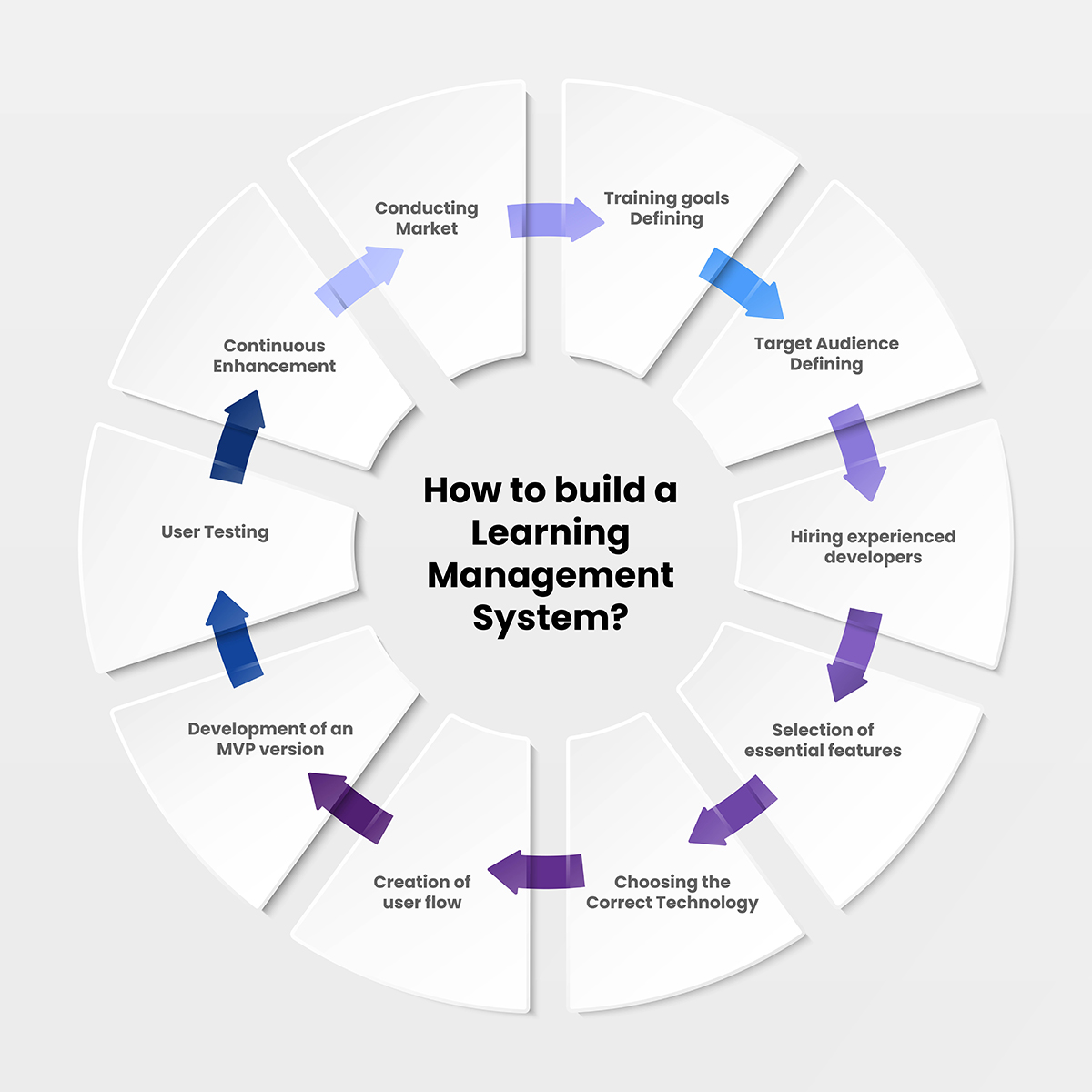
Creating a robust learning management system calls for a blend of continuous improvement, solid engineering, and user-centric design. Here's a practical roadmap that the teams can follow to move ahead from ideation to creation of a production-ready and scalable LMS platform.
Conducting user and market research
Start by understanding the competitive offerings and validating the demand before investing in development.
- Gather regulatory requirements, technical constraints, and use cases, like compliance and data residency.
- Conduct an interview with potential users like learners, instructors, and HR managers to understand the pain points and must-have capabilities.
- Identify market segments, pricing models, feature gaps, and competitors.
Define training goals and target audience
Clarify which people are going to be using the system and what outcomes are expected to be delivered to ensure alignment across the stakeholders.
- Prioritize use cases like continuous learning, certification compliance, and onboarding.
- Define KPISs, success metrics, and learning objectives like pass rates or completion rates.
- Divide the users by roles like guest, learner, instructor, and admin.
Hire an experienced development team to build an LMS
Assemble a cross-functional team of experts that covers development, design, product, and operations.
- Partner with a proven LMS development agency like Proquantic Software USA when your in-house skills are limited.
- Add a product manager for stakeholder alignment and owning the roadmap.
- Add backend and frontend engineers who are experienced in creating scalable platforms.
- Add DevOps, QA engineers, and, if needed, a data or AI engineer for personalization features.
Select the essential features of LMS.
Focus on the core functionality for building a Minimum Viable Product which delivers immediate value.
- Role-based access control, content versioning, analytics, and reporting.
- Assessment engines, enrolment flaws, user management, and content authoring.
- Integration – Conferencing/video tools, payment gateways, HRIS, SSO.
Choose the correct technology.
Select the technologies that perfectly balance developer productivity, scalability, and performance.
- Consider managed services and cloud providers like Azure, GCP, and AWS for quicker time-to-market.
- Choose from database – MySQL or PostgreSQL for relational data; object storage for media and Redis for caching.
- Backend – .NET for business logic and APIs, Ruby on Rails, Django, Node.js.
- Frontend – Vue, Angular, and React for responsive interfaces.
Create user flow and UI/UX design.
Design intuitive experiences that minimize the friction for both administrators and learners.
- Ensure accessibility, clear visual hierarchy, and mobile responsiveness.
- Prototype interactive mock-ups and wireframes, and test with representative users.
- Map user journeys through parameters like certification, registration, learning sessions, and course discovery.
Develop an MVP version.
Create a focused product that enables early cycles of feedback and proves core value.
- Maintain modular architecture and clean APIs for future extensions.
- Use feature flags for toggling experimental capabilities without any full releases.
- Run usability tests with learners and instructors and collect qualitative feedback.
Perform quality assurance and user testing.
Validate usability, performance, and functionality before scaling.
- Optimize time loads, fix critical issues, and ensure that the compliance requirements are all met.
- Run SAST/DAST performance stress tests and security scans.
- Execute tests with learners and instructors and collect qualitative feedback.
Launch optimization, support, and continue enhancing
Deploy and treat the launch as the beginning of an iteration cycle.
- Iterate on the basis of analytics by expanding integrations, AI recommendations, and adding personalization.
- Provide documentation, responsive support channels, and onboarding guides.
- Gather NPS feedback, monitor engagement metrics, and roll out with the pilot group.
Core features of Learning Management Systems
A well-built LMS or learning management system is defined by its security, scalability, and strength of its focal features, the ones that measure learning success, simplify content delivery, and shape user experience. The following elements make up the very backbone of a successful LMS, each of which is designed to ensure measurable, engaging, and effective learning outcomes.
Content and course management
At the very heart of the learning management system lies the ability to manage, create, and distribute educational content. Course management enables administrators as well as instructors to ensure learners have access to all resources and modules and efficiently organize training materials.
The key functionalities here are:
- Content scheduling and automated enrolment for a streamlined delivery.
- Version control for maintaining and updating course materials.
- Support for various content formats like xAPI, SCORM, video, audio, and text.
With dynamic content management, organizations will easily be able to adapt courses to the evolving educational standards and business goals.
User permissions and roles
A powerful LMS supports the role-based access control that ensures that each of the users, whether learner, instructor, or admin, can have appropriate access control.
The core aspects are:
- Secure authorization and authentication workflows.
- Customizable user roles that are defined with privileges.
- Administrative dashboards for managing permissions, groups, and users. This aspect ensures operational control, data security, and an organized learning hierarchy inside the system.
Certifications, tests, and assessments
Certification and testing features revolutionize a learning management system into a result-driven hub from a content hub. Such tools encourage accountability, validate the acquisition of skills, and measure learner understanding.
The essential elements are:
- Certificate generation on the completion of the course.
- Instant feedback and automated grading mechanism.
- Adaptive tests, assignments, and quizzes.
- Times assessments ensure fairness and randomized question banks.
- This aspect not only enhances engagement but also enables the organization to track learning outcomes and compliance accurately.
Performance analytics and progress tracking
Data-driven insights form the very core of the modern LMS systems. Progress tracking facilitates administrators and instructors to gauge the group and individual performances accurately.
The key capabilities are:
- AI-powered insights for personalized learning recommendations.
- Exportable reports for academic or HR review.
- Analytics for predicting learner success and identifying the knowledge gaps.
- Real-time dashboards for displaying completion rates, scores, and learner activity.
These analytics empower the decision-makers to demonstrate training ROI, improve the engagement strategies, and refine content.
Social learning and in-app collaboration
Learning thrives in an environment of collaboration. The modern LMS solutions incorporate interactive and social tools for enhancing engagement.
The collaboration features can include:
- Message boards and discussion forums for fostering peer interaction.
- Integration with communication tools like Microsoft Teams and Slack.
- Shared workspace for brainstorming and group projects.
- Real-time instruction and chat Q&A sessions.
By creating a thriving, community-oriented ecosystem of learning, organizations can facilitate continuous teamwork. Knowledge sharing and continuous improvement.
Engagement and gamification tools
Gamification has changed the concepts of e-Learning by transforming participation into motivation. Integration of game elements keeps the learners actively involved and enhances rates of retention.
- Some common tools for gamification are:
- Goal milestones and progress bars for visual motivation.
- Interactive learning paths that reward consistency.
- Achievement tracking and challenge level.
- Leaderboards, points, and badges.
- A gamified LMS solution transforms the passive participants into active learners by making the learning habit-forming and enjoyable.
Offline and mobile learning support
Accessibility is non-negotiable with learning management systems in today’s mobile-first world. Learners have to be able to access the materials anywhere and at any time, even when there is no active internet connection.
The most crucial features include:
- Push notifications for announcements, updates, and assignments.
- Sync-on-connect features that automatically update progress.
- Native mobile applications with support for offline mode.
- Responsive designs for every screen size.
Offline and mobile learning extend the appeal and reach of education as well as training beyond the usual boundaries, which ensures convenience and inclusivity for all users.
Advanced features for a Modern Learning System
As organizations evolve their strategies of digital education, a learning management system solution has to function beyond basic course delivery to offer truly modern features that elevate integration, personalization, and engagement. Below, Proquantic USA outlines the four key aspects with which modern LMS systems can distinguish themselves from others.
AI-powered personalized paths of learning
The future of learning lies in catering to the personalized needs, and that is exactly where Artificial Intelligence creates its mark within the LMS.
- AI-driven content recommendation engines analyze preferences, performance, and learner behaviour for suggesting the correct modules at the correct time.
- Skill gap identification and predictive analytics facilitate continuous learning from the gathered data for highlighting learners who may need alternative learning paths and extra support.
- Adaptive pathways and assessments that dynamically select the alternate content or adjust difficulties, based on how learners progress.
Integration of video content
Video content today is central to online learning and, hence, integrating it seamlessly into the LMS is crucial for modern learning experiences.
- Custom branding. Adaptive bitrate streaming and native video players ensure high-quality and consistent playback across the bandwidth conditions and devices.
- Video integration platforms can easily connect to Vimeo, YouTube, or an enterprise's video libraries into the interface of the LMS so that the learners do not have to leave the system.
- Enhanced video features like embedded quizzes, time-based access controls, and watermarking within playback, as well as on the viewer behaviour.
- Interactive video lessons like role-play simulations, scenario-based video, and branching paths adapt based on the responses of the learners.
Gamified experiences of learning
For sustaining learner motivation and embedding long-term retention, gamification has emerged as the must-have in a sophisticated learning management system.
- Social elements like collaborative modules, team challenges, and peer competition build community and enhance the learning community.
- Mission-based or story-based learning flows in an embedded way within the LMS solutions and turns training sessions into an interactive journey instead of a checklist.
- Achievement levels, leaderboards, points, badges, and micro-challenges keep the learners motivated and engaged to progress.
Third-party integrations
A modern LMS solution cannot operate in isolation; it has to act as an integrated aspect of the organizational ecosystem.
- CRM interactions enable course assignments that are based on product launches, lead interactions, and sales roles.
- HRIS/HRMS integrations help in automating the user enrolment, certification renewals, role changes, and alignment of the org-chart within the learning management system.
- LTI, SSO, and API support assure seamless data syncing, access, and interoperability between enterprise systems and LMS.
- Analytics dashboards that draw data across ERP, CRM, HRMS, etc, bring out a clear picture of how training can impact the outcomes in a business.
Advantages of implementing a Learning Management System
Implementation of the learning management system comes as a strategic advantage for the institutions and organizations with the aim of delivering measurable, consistent, and engaging learning experiences. Beyond simplification of training delivery, a modern learning management system transforms how the knowledge is created, retained, and managed across the organization. Here is how an LMS creates tangible value across various dimensions.
Time and cost efficiency
One of the most evident benefits of the learning management system is its capability to reduce both administrative overhead and training costs.
- Reduced instructor and travel costs – The traditional in-person training demands printed materials, travel, and instructor costs.
- Automated processes – Grading, assessments, enrolment, and tracking are automated, which reduces the manual work and reduces hours for training departments and HR.
- Content libraries that are reusable – Once the LMS is developed, the e-Learning modules can be easily reused as well as updated without any additional cost of production.
Centralized management for training
A learning management system functions as a unified hub for all activities of learning, which ensures accessibility and structured organization.
- External partners, students, and employees can easily access the training content under the single system, which improves consistency across campuses or departments.
- LMS dashboards enable administrators to monitor progress, generate accurate performance reports in real-time, and identify knowledge gaps.
- Policies, materials, and updates can be easily and instantly distributed across every user, ensuring that every user learns from the latest knowledge.
Better learner engagement
A crucial reason why organizations turn to LMS solutions is their ability to make learning more personalized and interactive.
- Personalized paths of learning – AI-powered LMS systems recommend the modules based on performance, career goals, and skill gaps, which improve outcomes and learner motivation.
- Badges, leaderboards, and rewards transform learning into a competitive and fun experience.
- Simulations, quizzes, and videos keep the learners engaged, as compared to slide decks or static PDFs.
Customizable and scalable educational delivery
Whether you train 50,000 employees or 50 employees, LMS effortlessly scales without any limitation of infrastructure.
- As the organizations grow, cloud-powered LMS solutions automatically adapt to handling more users and data without any downtime.
- Organizations can seamlessly tailor learning paths, workflows, and UIs that match their training and corporate strategy.
- LMS serves diverse teams across numerous regions with localized content.
Certification and compliance tracking
In the regulated industries like aviation, finance, or healthcare, certification tracking and compliance training are very much critical.
- LMS automatically renews and issues certification upon completion of the course.
- Administrators can seamlessly and instantly generate audit reports or compliance checks.
- Centralized content updates ensure that all compliance materials reflect the latest industry or legal requirements.
The key factors that influence LMS development cost
| Factor | Description | Impact on Cost |
| Integrations and technology stack | Tech stack: Frontend – React, Flutter Backend – Django, Node.js Database – Firebase and PostgreSQL All these influence the development time and performance. Integrations with payment systems, CRM, and HRMS affect the complexity further. | Multiple integrations and an advanced technology stack increase both maintenance and development budgets. |
| Development team structure and location | The cost is variable, depending on the geographic situation and expertise of the team. Developers in Western Europe and North America charge around $100 to $200 every hour, whereas the skilled offshore teams from Eastern Europe or Asia charge around $30-$70 every hour. | Choosing the right structure and region can reduce the overall costs of development without sacrificing quality. |
| Scalability and system complexity | Technical architecture, like scalability needs, data volume, or number of users, determines the cost of infrastructure. Enterprise-grade learning management systems need cloud scalability, role-based access, and load balancing. | Higher scalability and complexity need to increase the expenses of both maintenance and development. |
| Customization level and features | The level of personalization and core functionalities in the learning management system influence the cost significantly. Basic LMS solutions include analytics, quizzes, and course management, while the advanced ones integrate automation, gamification, and Artificial Intelligence. | More custom workflows and features lead to greater developmental costs and hours. |
The cost of developing a learning management system
The cost of developing an LMS depends on the deployment model, functionality, and scope. Whether you are building a full-scale enterprise system or a simple internal platform, determining the cost breakdown facilitates budget allocation and strategic planning.
Cost ranges of basic, advanced, and mid-level learning management systems
| LMS Type | Description | Estimated Cost | Timeline of Development |
| Advanced or enterprise-level LMS | Features multilingual support, API integrations, video conferencing, automation, and AI personalization. | $100,000-$250,000 | 8 months to 12+ months |
| Mid-level LMS | Consists of responsive design, gamification integrations, and analytics dashboards. Great for mid-sized enterprises. | $50,000-$100,000 | 5 months to 8+ months |
| Basic LMS | Carries core features like reporting, assessments, user management, and course creation. Ideal for educational institutes and small businesses. | $25,000-$50,000 | 3 months to 5+ months |
Cost comparison between off-the-shelf and custom learning management systems
| Type | Benefits | Drawbacks | Cost in approximation |
| Custom LMS | Unique and tailored design, complete data ownership, flexibility of integration, and scalability. | Longer development cycle and higher upfront investment. | $50,000 to $250,000; one-time cost of development. |
| Off-the-shelf LMS | Rapid development, lower upfront cost, proven reliability. Example – LearnUpon, TalentLMS, and Moodle. | Limited scope for customization, recurring fees for subscription, may not scale to complex models of business. | $5 to $25 for every user, per month; subscription-based. |
Build a personalized learning management system with Proquantic Software USA
We live in a world where there are hundreds of platforms offering the same one-size-fits-all solutions. In this chaos, choosing to build a tailored learning management system gives organizations and institutions a strategic edge. Unlike off-the-shelf platforms, customized learning management system solutions precisely align with the user personas, branding, workflows, and business goals, eliminating workarounds and compromises that accompany the generic platforms.
Why a personalized LMS makes sense:
- Optimized ROI – Upfront investment can be higher, but the long-term cost of the off-the-shelf solutions, regarding unused features, migration, and customization of the off-the-shelf solutions, can outweigh any savings of the initial stage.
- Future-ready and scalable – Create an enterprise-grade and modular architecture that grows with the growth of the company.
- Full control and ownership – Businesses can feature roadmap, security, integrations, and data flows without the risks of vendor lock-in.
- Aligns perfectly with the processes – Organizations do not have to adjust the processes to fit the system, as the system adapts with the company.
When it comes to building a customized learning management system, businesses need a partner that understands both learning-centric user experiences and enterprise-grade requirements. At that place, Proquantic Software USA steps in. We have years of experience in enterprise software application development and are a reliable partner for many global organizations for tailor-made digital learning solutions that can be personalized, scaled, and integrated seamlessly with the organizational landscape.
Conclusion
A properly designed learning management system is not just about delivering the courses, but also about innovation, engagement, and continuous growth. As the organizations transform and grow, a tailored LMS turns out to be the very foundation of the evolution. With the expertise of a reliable development partner like Proquantic Software USA, organizations can build a high-performance and future-ready LMS that seamlessly aligns with the business goals and delivers lasting value across the organization's learning journey.
Frequently Asked Questions (FAQs)
What is an LMS and how does it work?
A learning management system is a digital platform that empowers the organization to build, manage, and deliver educational or training content online. It functions by automating assessments, certifications, tracking learner progress, and hosting courses within a singular system.
Is an LMS suitable for any organization size?
Of course! A learning management system can be scaled for fitting into organizations of any size, right from large enterprises to startups, by tailoring user capacity, integrations, and features based on the specific needs of the training.
Can third-party tools be integrated?
Of course! The modern LMS solutions can seamlessly integrate with HRMS, CRM, payment gateways, and analytics to ensure data synchronization and a seamless learning experience.
How does an LMS support educators and learners?
A learning management system makes teaching simple with real-time analytics, content management, and automated grading while providing flexible access, progress tracking, and personalized content from anywhere and at any time.