


When assessing the reasons behind business failure, have you considered that it might stem from not hiring skilled professionals? With the technology sector evolving rapidly, enterprises are racing to upskill their workforce to keep pace with change. If upgrading the skills of your staff is not an option, outsourcing teams is the next best solution.
By 2030, the global outsourcing services market is estimated to reach US$1.11 trillion, at a 5.46% CAGR. Clearly, many companies worldwide are likely to hire more specialized professionals to focus on core IT business functions.
To keep your company competitive, hiring the top talent should be your priority. Whether your firm is in the US or elsewhere, and you need to outsource staff skilled in emerging technologies, read this blog.
Scroll below to see where to find these certified professionals and which outsourcing model to use. You will also learn whether your business needs an onshore, offshore, or nearshore hiring model to remain competitive.

Why do businesses prefer to hire a competent team?
Several reasons influence the decision to outsource specialized professionals for software development or other IT-related work. Let’s discuss them one by one:
-
Reduce expenses without Compromising Talent
If a company is determined to appoint remote or external teams through staff augmentation, the primary aim is cost efficiency. Yes, overspending on staff is often not feasible for many firms due to various reasons. These companies first identify the areas for which they need improvement and pursue an onshore, nearshore, or offshore hiring agency.
Reducing operational costs is possible with an outsourcing partner that also helps to bridge the skill gaps. Such hiring agencies recruit suitable candidates from around the globe for companies, which is crucial for today’s competitive environment.
Moreover, you can rest assured that the outsourced staff will assist you in your development projects without compromising quality. Their areas of expertise and dedication can directly impact sustainability and profitability of your business.
-
Lower Labor Expenses Smartly
As cutting costs is the primary motivation behind hiring global talent, businesses always focus on reducing labor costs. With the help of offshore hiring agencies, they acquire highly skilled engineers and developers from regions where they can work for lower wages.
US-based companies often choose India, Eastern Europe, the Philippines, or similar countries, since the hiring budget is comparatively lower. Saving money on labor allows these firms to redirect their savings to other growth initiatives, marketing efforts, or core operations.
-
Save on Infrastructure and Operations
By offshoring custom software development services, businesses can lower operational expenses while avoiding the cost of building internal IT infrastructure.
Outsourcing professionals or an entire team through an offshore hiring agency is the best decision for businesses. Enterprises and startups that don’t have adequate funds for the latest equipment, technology, and workplace often approach remote staff for development-related work.
For smooth operations and timely completion of digital products, you need offshore teams by your side. Companies acquire global talent and save overhead costs for full-time employees through staff augmentation.
Outsourcing models comparison
Enterprises consistently look for ways to optimize costs, scale faster, and stay ahead in the tech-driven market. Whether it’s software development, cloud migration, mobile app creation, or building artificial intelligence solutions, talent availability often becomes the defining factor.
Understanding the differences between Offshore vs. Onshore vs. Nearshore outsourcing helps businesses select the most effective hiring strategy based on budget, collaboration requirements, project complexity, and long-term growth objectives. While each model offers unique advantages, the right choice depends on your organization's operational priorities.
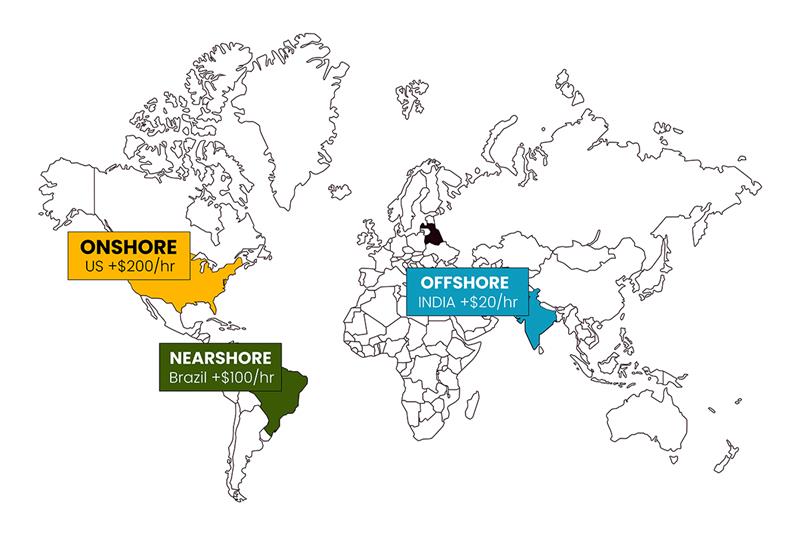
Outsourcing is not a cost-cutting practice anymore but a strategic approach to filling talent gaps and driving innovation. Companies today can choose among three outsourcing models: onshore, nearshore, and offshore. Each comes with its own advantages, but when it comes to flexibility, scalability, and cost-effectiveness, offshore IT hiring through staff augmentation stands out as the clear winner.
Let's discuss every model in detail and understand why most IT projects depend on offshore hiring in the US.
What is the onshore hiring process?
Onshore staffing solution refers to hiring professionals located in the same country as the client company. For instance, a US-based business partnering with a software development firm in California or New York is choosing an onshore model.
When evaluating offshore vs nearshore vs onshore outsourcing, onshore hiring offers the highest level of local collaboration and regulatory familiarity. However, businesses should also compare scalability, cost, and talent availability before selecting this model.
Significance of onshore software development
The key advantage of onshore outsourcing lies in proximity and familiarity. Teams share the same language, culture, and legal frameworks, making communication seamless. Onshore outsourcing is particularly useful for projects requiring high levels of collaboration, frequent in-person meetings, or an in-depth understanding of local market conditions and regulations.
-
What are the benefits of onshore talent acquisition?
- Familiarity with the local market: Local professionals understand the taxation laws, compliance rules, and labor frameworks applicable to regions.
- Smoother communication: Working in the same time zone eliminates any difficulty around scheduling tasks. Moreover, language and cultural alignment reduce miscommunication.
- Faster onboarding: Shared work practices and norms minimize project ramp-up time.
-
The downside of onshore rates
Onshore outsourcing, especially in high-cost markets like the US, is significantly more expensive. While outsourcing does save on benefits, healthcare, and infrastructure, domestic labor costs remain high.
For example, based on industry averages:
- Junior developers cost $80–120/hour
- Mid-level developers cost $110–170/hour
- Senior developers cost $150–250/hour
Such figures make onshore outsourcing impractical for many companies, particularly startups and mid-sized firms that need to balance budgets without compromising quality.
What is a nearshore hiring model?
Nearshore outsourcing involves hiring developers from a neighboring country or region. A US company outsourcing to Mexico, or a Western European company outsourcing to Poland, would be examples of nearshore collaborations.
Comparing offshore vs nearshore staffing enables organizations to balance communication, cost efficiency, and access to skilled professionals. Nearshore hiring is often preferred when overlapping working hours are essential, while offshore models typically provide broader talent pools and greater cost savings.
Nearshore outsourcing is often seen as a compromise between onshore and offshore. Rates are generally lower than domestic hiring, but cultural similarities and overlapping working hours still allow for efficient collaboration.
Benefits of nearshore development
- Proximity with cost savings: Nearshore hiring offers more control over project execution and complettion through in-person discussions.
- Time zone compatibility: Working hours often overlap, reducing delays in communication.
- Access to specialized talent: Nearshore markets may offer specific technical skills not widely available domestically.
Onshore vs. nearshore: Which is right?
Nearshore outsourcing provides financial advantages over onshore. However, it still cannot match the cost-effectiveness of offshore hiring model.
Additionally, nearshore talent pools are often smaller compared to offshore hubs in Asia or Eastern Europe. For companies aiming for scalability and access to cutting-edge expertise, offshore is usually the more strategic choice.
What is offshore talent acquisition?
Offshore outsourcing means hiring developers or engineers from distant countries. For example, an US company outsourcing to India, Vietnam, or Poland is considered offshore.
For companies comparing Offshore vs. Onshore vs. Nearshore, offshore hiring often provides the greatest flexibility, access to specialized expertise, and long-term scalability for software development and digital transformation initiatives.
This model has been around for decades, but its relevance has skyrocketed in recent years. The global shift toward remote work during the pandemic normalized distributed teams, removing the stigma around offshore collaboration. Rising inflation and economic uncertainty have further fueled the demand for affordable offshore IT talent.
Offshoring is no longer just about saving costs but about building high-performing global teams with niche expertise. Through IT staff augmentation, businesses can integrate offshore developers directly into their projects, extending in-house teams without the overhead of full-time hiring.
What are the benefits of offshore development?
Offshore outsourcing through IT staff augmentation offers advantages that extend well beyond affordability.
Significant cost savings
Offshore rates are often three to five times lower than onshore rates. For example, senior developers in Eastern Europe may charge $45–85/hour, compared to $150–250/hour in the US.
Access to a global talent pool
Offshore outsourcing models open the door to millions of skilled IT professionals worldwide. Companies can find cloud computing, AI/ML, DevOps, mobile app development, and cybersecurity specialists. These skills are often scarce in the US software development markets.
Flexibility and scalability
Offshore staff augmentation allows companies to scale teams up or down quickly, adapting to project needs without long-term commitments.
High-quality expertise
Many offshore markets emphasize Science, Technology, Engineering, and Mathematics (STEM) education and professional certifications, producing developers with world-class technical skills. Countries like Poland, Ukraine, and India consistently rank among the top outsourcing destinations for engineering excellence.
Round-the-clock productivity
You can utilize the time zone differences to increase the productivity of your business. With teams working in different regions, enterprises can maintain 24/7 development cycles, accelerating time-to-market.
Offshore software developer hiring rates
Consider the following hourly costs while hiring offshore software developers:
- Junior developers: $25–45/hour
- Mid-level developers: $35–55/hour
- Senior developers: $45–85/hour
These rates highlight why offshore outsourcing is mostly preferred for resource-intensive IT projects, especially cloud migration or AI-based development.
Offshore IT staff augmentation: Bridging global talent gaps
While traditional project outsourcing works well for one-off assignments, offshore IT staff augmentation is quickly becoming the go-to model for businesses with long-term digital transformation needs.
How does staff augmentation work?
Instead of outsourcing entire projects, companies hire offshore professionals who work as extensions of their in-house teams. These developers adapt to the client’s workflows, tools, and processes, providing greater control and transparency compared to traditional outsourcing.
Why is offshore hiring ideal for IT projects?
- Cloud development: Offshore cloud engineers help companies migrate infrastructure, optimize performance, and ensure cost efficiency.
- Artificial intelligence: intelligent, scalable AI systems.
- Mobile app development: Offshore developers bring both iOS and Android expertise at a fraction of domestic costs.
- Custom software: Offshore staff can handle full-stack development, DevOps, and QA testing while working within existing project structures.
Key advantages of offshore staff augmentation
- Seamless integration: Offshore professionals follow the same reporting structures as in-house developers.
- Reduced recruitment burden: No need to manage lengthy hiring cycles, as specialized staffing partners provide pre-vetted talent.
- Cost-effective scalability: Companies can expand teams rapidly without long-term liabilities.
- Global innovation access: Offshore experts often bring diverse problem-solving perspectives from working across industries.
Why offshore outshines onshore and nearshore?
When comparing outsourcing models side by side, the strength of offshore outsourcing becomes clear:
- Onshore offers convenience but is too costly for most IT-driven businesses.
- Nearshore reduces costs but still limits access to the deepest talent pools.
- Offshore delivers the best of both worlds, which is cost efficiency, scalability, and access to world-class expertise.
In a global economy where technology evolves rapidly, relying only on local talent can limit growth. Offshore outsourcing ensures enterprises remain agile, competitive, and future-ready.
Difference between offshore, onshore, and nearshore models
| Criteria | Onshore | Nearshore | Offshore |
| Location | Based in the same country as the client | Located in neighboring or regional countries | Based in distant countries, often across continents |
| Time Zone Compatibility | Fully aligned with local business hours | Partial to full overlap with working hours | Time difference requires planning but supports 24/7 development cycles |
| Communication | Smooth communication with no language barriers | Generally smooth with minor regional nuances | Effective when structured; English proficiency common in leading hubs |
| Cost | Highest due to US labor rates | Moderate savings with proximity benefits | Most cost-effective option for long-term or large-scale projects |
| Quality | High quality with strong local oversight | Consistent quality depending on vendor expertise | Competitive quality with experienced providers in global markets |
| Security and Compliance | Strong US legal framework and easy regulatory alignment | Good compliance depending on trade agreements | Reliable when working with vetted offshore partners |
| Language and Communication | Same native language, fluent communication | Often fluent, but may involve minor differences | Varies by region; top hubs offer fluent communication |
| Cultural Affinity | Full cultural match, shared holidays, and norms | Similar work culture with minor differences | Manageable differences; structured onboarding reduces friction |
| Talent Access | Limited to US talent pool | Access to skilled professionals in nearby countries | Access to broader, highly skilled global talent |
| Collaboration Style | Direct, in-person or real-time virtual | Real-time or near real-time virtual coordination | Asynchronous or planned sync-ups; flexibility adds efficiency |
| Project Control | High control with in-person access | Balanced control with good visibility | Strong control with defined processes and governance |
| Travel Accessibility | Easy travel and on-site coordination | Short travel time, generally convenient | Less frequent travel needed; virtual tools bridge the gap |
| Possibility of Risk | Low risk due to legal alignment and proximity | Moderate risk, manageable through contracts | Manageable with due diligence; experienced partners reduce risks |
| Best Suited For | Projects needing close collaboration, high security, and strategic control | Mid-size projects balancing cost and collaboration | Large-scale projects with cost-sensitive budgets and extended timelines |
This comparison of offshore vs nearshore vs onshore outsourcing highlights how each model differs in cost, communication, collaboration, scalability, and talent availability. Reviewing these factors helps organizations select the staffing approach that best supports their current needs and future business growth.

Which tech experts are commonly outsourced by US firms?
In this competitive era, businesses mostly rely on outsourcing new talent to build a powerful workforce. Many emerging startups and established companies hire our tech experts through staff augmentation services, espcailly for customizing opensource ERP solutions to match unque business workflows. You can either appoint professionals full-time or on a project basis to accelerate the development of software projects.
Hiring these tech specialists accelerates product delivery and shortens time-to-market, boosting business innovation and productivity. If you are thinking about building a remote team, let’s discuss what firms prefer through IT staff augmentation in the US.
Software Developer
These development specialists are mostly outsourced worldwide by global leaders. If you want to build mobile and web applications, SaaS platforms, or enterprise systems, software developers are the best choice.
According to many industry research reports, application development covers around 37% of outsourced IT functions. Even in the US, businesses opt to outsource development services to scale quickly.
AI/ML Engineer
When it comes to adding stunning features to software, experts integrate artificial intelligence (AI) and machine learning (ML). These skills are essential to reshape industries that indulge in the latest language models.
Appointing in-house professionals is not always feasible for many startups. This is the actual reason why so many firms prefer to offshore AI or ML engineers. You can depend on these tech experts to design algorithms and integrate automation in AI-driven projects.
IT Engineer
There is a growing demand for IT professionals in many tech startups, where the focus is on launching high-performance applications. Outsourcing engineers with expertise in software, network systems, computer hardware, and databases can give your company the necessary growth in the global platform.
IT engineers are responsible for handling coding, system maintenance, troubleshooting, and implementing robust security protocols. For companies delivering products related to cybersecurity, cloud computing, software development, or database management, outsourcing IT professionals is the best option to integrate their expertise.
Cloud Expert
With the growing demand for storing digital data on secure servers, there is a rise in hiring cloud engineers across the US. Businesses that want real-time collaboration and maintain an advanced cloud infrastructure usually take the help of these IT experts.
Over 90% of organizations are estimated to face IT skill shortages by 2026, mostly in the cloud sector. This talent gap is likely to drain $5.5 trillion from worldwide businesses. - Source
For companies looking for a proven and quick way to modernize and scale, they depend on offshore specialists for prompt and affordable cloud services.
Cybersecurity Specialist
With the digitization of workspaces, comes the risk of cyber threats. Skills shortage in this area of IT solutions can compromise the safety of your company’s digital assets.
According to a recent survey, cybersecurity experts are among the most outsourced professionals. From startups to reputable enterprises, you will find these specialists everywhere to perform audits and revise compliance frameworks.
Hiring these tech experts is an essential step for businesses to strengthen security protocols and protect sensitive data of the businesses and their clients.
Full-Stack Developers
Outsourcing a full-stack developer can help your firm handle both backend and frontend programming. These tech roles highly focus on continuous innovation to bring your software products to the forefront.
Instead of hiring multiple developers, companies prefer offshore staff for end-to-end development support.
Conclusion
Choosing between Offshore vs. Onshore vs. Nearshore outsourcing depends on your budget, project complexity, collaboration preferences, and growth strategy. While onshore and nearshore models offer advantages for organizations prioritizing geographical proximity, offshore hiring continues to provide the strongest combination of cost efficiency, scalability, and access to global technical talent for long-term digital transformation.
In today’s talent-driven economy, where IT skills shortages are becoming the norm, offshore outsourcing remains a competitive necessity. Companies that embrace offshore hiring are better positioned to innovate faster, operate leaner, and achieve more with their technology investments.
Are you looking for offshore software engineers or full-stack developers sourced by a reputed IT staffing agency in the US? At Proquantic, we help companies of all sizes foster long-term productivity with staff augmentation solutions. Discuss your nearshore, onshore, or offshore hiring needs with us to scale your team and gain collaboration value.
Frequently Asked Questions About Offshore vs. Onshore vs. Nearshore
What outsourcing model ensures the best communication in the US?
Onshore talent acquisition offers the smoothest communication; nearshore is close thanks to overlapping time zones and cultural alignment. Offshore hiring can match it when you add project management (PM) practices, onshore standards, and overlapping hours. Many U.S. firms adopt a hybrid model to help remote teams communicate with each other smoothly.
Which outsourcing model is most cost-effective today?
Offshore hiring is usually most cost-effective on hourly rates and scale. The estimated costs here range between $10 and $55, compared to $30 and $75 for nearshore and $80 and $170+ for onshore hiring.
Nearshore talent acquisition balances savings with easier collaboration and travel. Onshore costs more but can reduce rework for complex, ambiguous, or regulated work. However, the total cost depends on churn, oversight, and speed-to-value. Contact our IT staff augmentation specialist to choose the most affordable and impactful outsourcing model for your business.
Can offshore or nearshore talent match local hire quality?
Yes, both offshore and nearshore hiring solutions can match the local hire standards. To achieve positive outcomes, you need a reliable staffing partner in resource reinforcement like Proquantic.
We are a leading platform offering a global talent pool for startups and enterprises across the U.S. Our staff augmentation services help businesses bridge talent gaps and gain a competitive edge. You can rely on us to outsource remote AI/ML engineers, full-stack developers, and mobile app specialists to maximize outcomes.
What mistakes should I avoid in global hiring?
Avoid chasing the lowest bid, unclear project scopes, and poor discovery when outsourcing global talent. Instead, prioritize compliance, IP protection, and data residency to ensure successful product delivery.
What is the future of offshore vs. nearshore outsourcing in the US?
The nearshore outsourcing market is estimated to reach $93 billion by 2030, growing steadily due to cultural and time-zone alignment. However, the offshore outsourcing market will remain dominant, with the software development segment projected to cross $280 billion by 203. Both offshore and nearshore hiring models in the US are driven by cost savings and access to specialized IT skills.
How can I set up remote workers for long-term success?
In order to build a balanced work environment, enterprises ensure a few things to keep remote staff fully invested and deliver successful projects. Following their footsteps, you can start by ensuring they have reliable internet, a professional workspace, and the right hardware and software.
Invest in onboarding, documentation, and overlap hours while selecting engineers or developers from different countries or regions. Set KPIs, SLAs, time-tracking tools, and escalation paths for smooth business operations. Always plan knowledge transfer, backups, and potential vendor transitions to keep projects resilient and uninterrupted.