


Created for networking purposes, social media has now become a powerful tool to accelerate business growth. A significant presence across various networking platforms now helps enterprises, startups, small business owners, and even novices build their brands from scratch, improve community outreach, and adopt digital monetization.
If you own a business, consistency is the key to driving a higher level of user engagement and creating new revenue models. Social platforms not only allow businesses to form niche communities based on demographics but also help you promote your products and services rapidly.
With customized social media app development, you can leverage these advantages effectively. According to a recent report from Market Research Future, the global social networking app market size is estimated to reach USD 1041.8 billion by 2035, growing at 24.42% CAGR.
Before you can think about building your own social networking application, it’s crucial to understand the features, tech stacks, and cost breakdowns. This blog will guide you through the entire process, providing insights into the types of apps you can develop to strengthen your community on social media.
For those who are still thinking about whether to invest in online networking app development, scroll below to find out.
Launch a scalable social media app with modern features and seamless user engagement.

What is Social Media App Development?
Social media app development is an end-to-end process that allows emerging companies, established organizations, and even individuals to design, build, and launch their digital platforms. The selection of features in custom mobile app development empowers users to build professional connections, share content, and engage in real-time interactions, making it ideal for networking platforms.
From intuitive user interfaces to in-app notifications, every feature goes through several backend systems to support uninterrupted communication and content sharing at scale. If you have a unique product idea or want to bring more meaningful leads for your business, social media platforms provide the essential tools.
Adopting the best development strategies for your online networking apps help integrating artificial intelligence (AI), cloud technology, augmented reality (AR), and other cutting-edge technologies to create a more engaging and immersive environment for users.
Social Media Usage at a Glance
- Global adoption scale- 5.79 billion active users worldwide
- Adult users- 94.5% of the population engaged are 18+ years old
- Overall reach- 69.9% of the global population connected
- Internet overlap- 94.7% of internet users are on social media
- US engagement- An average of 6.5 platforms used per user
Core Features in High-Performing Social Media Apps
What you include in your application often decides the lasting impression on users, which keeps them coming back to explore remaining features. Below are some main highlights of most popular apps that drive scalability, monetization, and user retention in this tech-savvy age.
AI-powered personalized feeds
Modern social platforms integrate custom AI solutions to deliver highly relevant content experiences. Apps now adapt content based on user behavior, preferences, and interactions instead of chronological or generic feeds.
What it does:
- Evaluate user behavior patterns to recommend content
- Groups users based on interests and updates feed ranking using intelligent algorithms
- Adapts in real time with machine learning (ML) models to deliver content fast
Why it matters:
- Engage users by recommending content that matches their interests and preferences
- Helps users discover new creators, fresh content, and trending conversations
- Encourages longer browsing sessions, stronger user retention, and more loyal visitors
Short-form video & live streaming
Video content has become one of the most effective ways to capture and retain user attention on social media. To meet evolving user expectations, businesses are increasingly incorporating short-form videos and live-streaming features into their social media applications.
These formats make storytelling more engaging, encourage real-time interactions, and help create a more immersive and dynamic user experience.
Important features:
- Vertical video feeds for mobile-first content consumption experiences
- Built-in editing tools for filters, transitions, music, and quick video enhancements
- Live streaming features with real-time chat, reactions, and audience engagement
Impact on businesses:
- Higher engagement rates compared to traditional static posts or images
- Encourages users to frequently create and share content across the platform
- Unlocks monetization opportunities through ads, live gifting, and sponsored content streams
In-app messaging & real-time chat
Clear communication helps enterprises make their social platforms engaging and effective. Real-time chat and in-app messaging allow users to connect instantly, exchange ideas, and build meaningful relationships without leaving the networking platform.
These features increase engagement, strengthen community interactions, and encourage users to spend more time within the platform.
Features businesses need to include:
- One-to-one and group messaging for seamless and flexible communication experiences
- Voice notes and video calling for more personalized conversations
- End-to-end encryption to ensure privacy, security, and user trust protection
Why it matters:
- Strengthens user relationships by enabling direct, real-time communication within the platform
- Reduces user dependency on external messaging apps, increasing overall time spent inside
- Plays a key role in building communities and fostering meaningful user interactions
Community & group features
The rise of niche and micro-communities has transformed how users interact online. Social media apps that support communities can create deeper engagement and highly loyal user bases.
Top features:
- Create public or private groups around shared interests, hobbies, or goals
- Focused discussions through topic-based forums and conversation spaces
- Moderation tools and admin controls to help maintain a safe, organized community environment
Benefits:
- Encourages users to engage more deeply around topics they genuinely care about
- Builds strong loyalty by fostering a sense of belonging among community members
- Ideal for niche platforms targeting specific industries like fitness, gaming, or education
Creator economy & monetization
Monetary gain is necessary to support content creators and ensure success of social media platforms. When you include built-in monetization features, it produces high-quality content while helping businesses generate additional revenue through diverse income opportunities.
Monetization features:
- Subscription-based content models for exclusive content and premium audience engagement
- Tipping and donations to allow followers to directly support their favorite creators
- Creator dashboards with insights into performance, revenue, and audience behavior
Why it’s critical:
- Attracts talented creators who bring valuable and engaging content to the platform
- Generates consistent revenue streams through subscriptions, ads, and creator partnerships
- Builds a sustainable ecosystem where both users and creators benefit from participation
Advanced privacy & data security
Privacy and security are now essential and are driven by stricter regulations and growing user awareness. During social media app development, businesses need to prioritize data protection to build trust and stay compliant.
Must-have security features:
- Implements end-to-end encryption to protect user messages and sensitive communications
- Provides multi-factor authentication to secure accounts against unauthorized access attempts
- Includes user-controlled privacy settings allowing customization of visibility and data sharing
Impact:
- Builds strong user trust by ensuring transparency and protection of personal data
- Helps avoid legal risks associated with non-compliance with global privacy regulations
- Essential for scaling globally while maintaining compliance with evolving regulatory standards
Augmented reality (AR) & interactive filters
Augmented reality is increasingly becoming a standard feature, offering interactive and creative tools that significantly enhance user engagement and content diversity.
Top examples:
- Includes face filters and AR lenses for fun, creative, and highly shareable content
- Provides AR storytelling tools that allow users to create immersive content experiences
- Enables virtual try-ons for products like fashion items, accessories, and makeup
Why it matters:
- Encourages users to create more engaging and visually appealing content regularly
- Increases content sharing across platforms, boosting organic reach and visibility
- Enhances overall user experience by making interactions more immersive and interactive
Social commerce integration
Social media platforms are rapidly evolving into commerce ecosystems, allowing users to shop directly within the app. This bridges the gap between engagement and transactions.
Why it matters:
- Supports in-app purchases and product tagging within posts and video content seamlessly
- Enables live shopping events where products are showcased and sold in real time
- Provides seamless checkout experiences without requiring users to leave the platform
Business advantage:
- Converts user engagement into direct revenue through integrated shopping experiences
- Reduces friction in the customer journey, improving conversion rates and overall sales
- Opens new monetization opportunities through partnerships, promotions, and affiliate marketing
Gamification & rewards systems
Gamification adds an element of fun and motivation, encouraging users to interact more frequently. It turns engagement into an enjoyable and rewarding experience.
Examples:
- Uses badges, points, and leaderboards to recognize user achievements and contributions
- Introduces daily challenges and streaks to encourage consistent user participation
- Rewards content creation and interaction with incentives to boost platform activity
Why it works:
- Encourages repeat usage by giving users clear goals and rewards for engagement
- Improves retention rates by making the platform more interactive and enjoyable
- Creates a sense of accomplishment that motivates users to stay active consistently
Scalable & cloud-based architecture
For successful social media app development, cloud solutions offer a robust backend infrastructure that ensures performance, stability, and scalability as user demand grows.
Technical essentials:
- Uses cloud-native platforms like AWS, Azure, or Google Cloud for flexible scalability
- Adopts microservices architecture to manage features independently and improve performance
- Implements real-time data processing and high-performance APIs for seamless user experience
Why it matters:
- Supports millions of users simultaneously without performance degradation or downtime issues
- Ensures fast and responsive experiences regardless of geographic location or traffic load
- Provides flexibility to add new features and scale operations as the platform grows
Who Benefits from Social Media App Development?
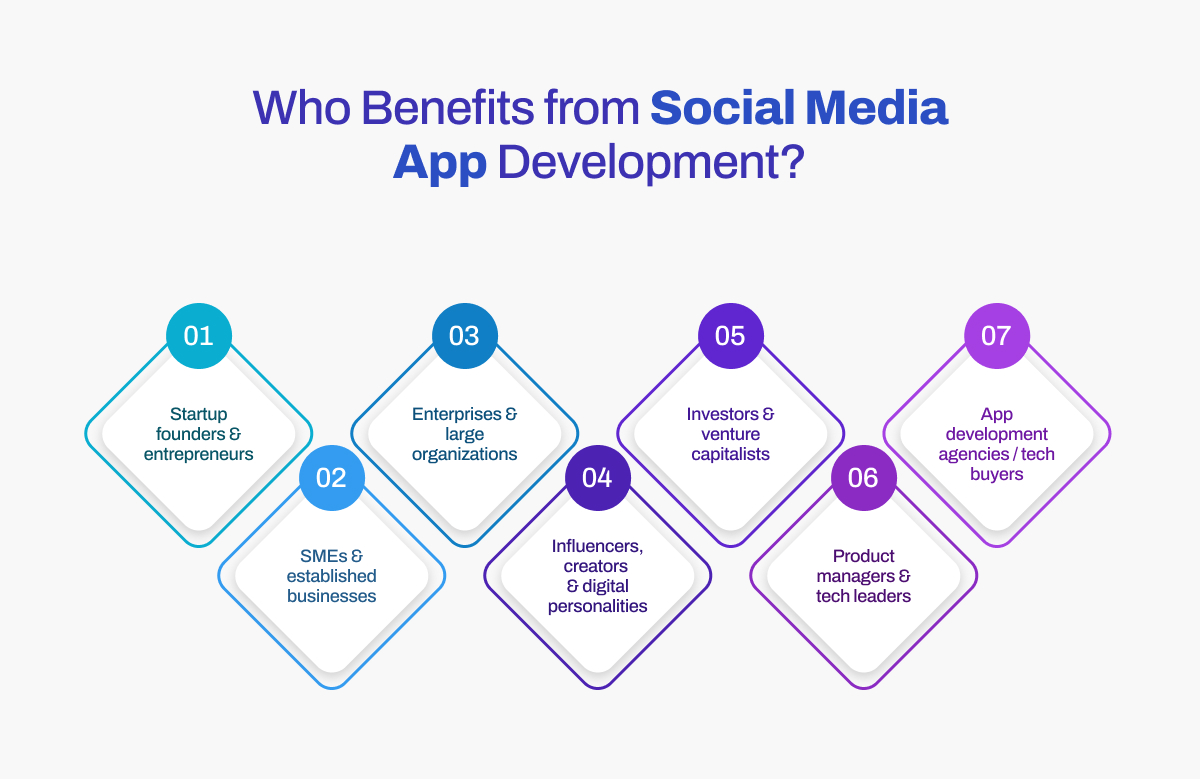
Emerging company owners and established enterprises can outreach more users through online networking platforms. If you wonder whether building a social media app is beneficial, here’s a list of eligible clients.
Startup founders & entrepreneurs
You can consider early-stage founders and innovators in this category who want to launch next-gen digital platforms or niche community apps.
Why it fits their vision
Social platforms offer unmatched opportunities to build interactive, user-driven products from day one. Founders can tap into specific audiences, such as gamers, learners, or investors, and design experiences tailored to their needs.
With the right strategy, these platforms can scale quickly and unlock multiple revenue streams, including memberships, digital goods, and creator-led ecosystems.
What they risk without it
They may miss entering one of the fastest-evolving product categories, limiting their chances of building high-growth, network-driven businesses, and losing early traction to more socially integrated competitors.
SMEs & established businesses
They are retail brands, fitness companies, educators, and media firms wanting to strengthen customer relationships through social media app development.
Why it’s relevant
Custom social platforms allow businesses to create branded communities where customers interact, share feedback, and stay connected. This fosters trust, encourages repeat engagement, and enables businesses to shape their own communication strategies without external constraints.
Risks of inaction
Brands may struggle to build lasting relationships and differentiation, especially as customers increasingly expect immersive and community-driven brand experiences.
Enterprises & large organizations
Corporates, OTT platforms, and large-scale service providers form this category of clients who want to manage vast user bases.
Why it’s important
Social app development supports both internal and external engagement, ranging from employee collaboration tools to large-scale user communities. It helps enterprises create unified ecosystems where communication, content, and user activity are seamlessly integrated.
If left unresolved
Organizations may face inefficiencies in engagement strategies and slower innovation cycles, while competitors build stronger, more connected ecosystems.
Influencers, creators & digital personalities
Content creators, coaches, educators, and digital influencers building personal brands.
Why it counts
Owning a dedicated platform gives creators freedom to design their own content formats, engagement models, and monetization strategies. It enables them to form deeper connections with their audience through exclusive communities and personalized experiences.
Possible drawback
Creators remain restricted by platform limitations, affecting their ability to grow sustainably and build direct, long-term audience relationships.
Investors & venture capitalists
Angel investors, venture capital firms, and startup accelerators.
Why it is essential
Social applications present high-growth investment opportunities driven by strong network effects. Once traction is achieved, these platforms can scale rapidly and command significant market valuations.
If not taken into account
Investors risk missing out on early-stage entry into scalable ventures that have the potential to dominate digital ecosystems and deliver substantial returns.
Product managers & tech leaders
CTOs, product managers, and engineering leaders who are shaping digital products.
Why it plays a key role
Modern applications increasingly incorporate social elements such as feeds, messaging, and communities. Understanding and implementing these features ensures products remain competitive and aligned with evolving user expectations.
Potential risks
Teams may deliver products that feel static or outdated, limiting innovation and reducing their ability to compete in experience-driven markets.
App development agencies / tech buyers
Organizations seeking expert partners to design and build scalable applications.
What value it brings
Developing social platforms requires specialized expertise in scalability, real-time systems, and user experience. Businesses that choose the right development partners can accelerate time-to-market and ensure long-term performance.
If overlooked
Poor technology choices or inexperienced software developers can lead to delays, performance issues, and increased costs, ultimately impacting business growth and user satisfaction.
Major Players in Social Media & Networking
- Meta Platforms (US): Facebook, Instagram, WhatsApp, Messenger
- Twitter/X (US): Real-time microblogging and networking
- Reddit (US): Interest-based community discussions
- Snap Inc. (US): Snapchat with AR-driven short media
- LinkedIn (US): Professional networking and career growth
- Pinterest (US): Visual discovery and bookmarking
These established US-based platforms show how diverse niches, from professional networking to short-form video, have already scaled globally, guiding future social media app development strategies. Continue reading to find out what benefits you can enjoy through networking platforms following any of these business models.
Why Do US Firms Need Social Media App Development?
Here’s why companies must build a strong presence through networking applications:
1. Highest level of user engagement
A significant portion of mobile usage is spent on social platforms. Features like reels, stories, and live streaming dominate attention, making these apps the primary space for digital interaction and content consumption.
2. Rise of niche communities
Users are moving away from broad, mass platforms toward more focused, interest-based communities. Micro-communities around fitness, crypto, education, and parenting are growing rapidly, offering brands opportunities for deeper, more meaningful engagement.
3. Creator economy growth
Platforms that empower creators are scaling faster than ever. Monetization tools such as subscriptions, tipping, and digital tokens not only attract creators but also sustain active user ecosystems.
4. Ownership & data control
Businesses and creators increasingly prefer first-party data access over reliance on third-party platforms. Building their own social ecosystems allows better control over user data, personalization, and long-term growth strategies.
What Happens If Companies Ignore Networking Platforms
Here are the consequences of not considering social media presence for your business.
Loss of market relevance
Competitors embracing social-first strategies will rapidly attract and retain users, leaving traditional platforms behind. As user expectations shift toward interactive, community-driven experiences, companies that fail to adapt risk becoming outdated.
Weak customer engagement
Without integrated social features, platforms struggle to maintain user interest. This leads to lower retention rates, reduced time spent on the app, and ultimately a decline in customer lifetime value (LTV). Users increasingly prefer platforms that enable connection, sharing, and real-time interaction.
Overdependence on third-party platforms
Relying heavily on external social networks exposes companies to risks such as sudden algorithm changes that can drastically reduce visibility. As organic reach declines, businesses are forced to depend on paid advertising, significantly increasing acquisition costs.
Missed revenue opportunities
A lack of social functionality limits avenues for growth, including creator monetization, subscription-based communities, and in-app upselling. These models are becoming essential revenue drivers in the digital economy.
Higher long-term costs
Delaying social integration often leads to expensive retrofitting later. Rebuilding infrastructure and redesigning user experiences is both costly and time-consuming, putting companies at a further competitive disadvantage.
Types of Social Media Apps & Their Exciting Features
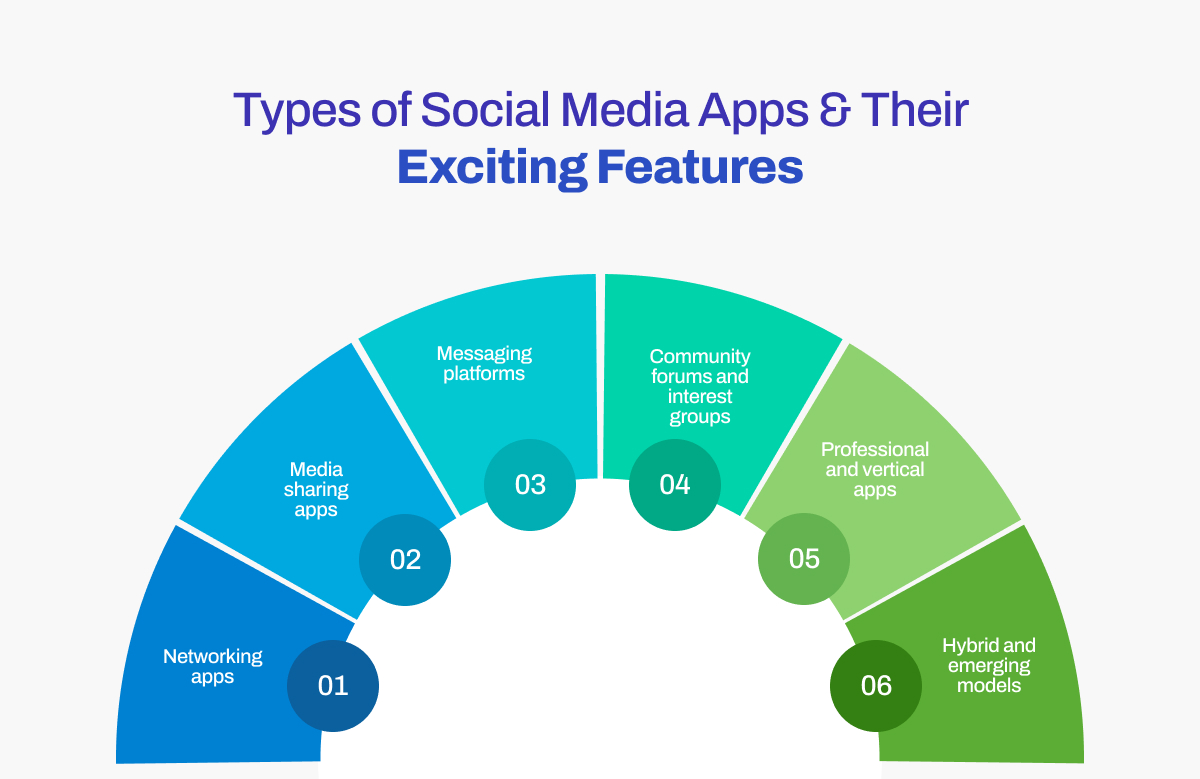
Not all social media platforms are built the same, and each type comes with its own technical challenges and business goals. Choosing the right category early on can shape everything from your development roadmap to how you attract and retain users. Below is a breakdown of the most common types of social media apps and what makes each one unique.
Networking apps
These platforms focus on building connections and enabling large-scale conversations. Think of spaces where users engage through posts, comments, and discussions that can reach thousands or even millions.
- Handle complex social graphs with large networks of connections
- Require smart algorithms to curate relevant feeds
- Need efficient systems to support viral content distribution
- Support detailed privacy controls and search features
Developing such apps means focusing heavily on relevance, visibility, and content moderation to ensure safe and meaningful interactions.
Media sharing apps
Media-driven platforms revolve around photos, videos, and visual storytelling. User engagement often depends on how easily they can discover, process, and share content.
- Depend on strong content delivery networks (CDNs)
- Require heavy storage and bandwidth for media files
- Use advanced video and image processing systems
- Rely on AI-based moderation and recommendation engines
The discovery experience, like personalized feeds, becomes central to the platform’s success, making machine learning a key investment area.
Messaging platforms
Messaging apps prioritize communication, speed, and user privacy. They are often expected to work flawlessly across networks and devices.
- Built around end-to-end encryption for secure communication
- Require real-time message delivery and synchronization
- Support one-on-one chats and large group interactions
- Integrate voice and video calling features
Reliability is critical here, as users expect instant communication without interruptions, even in low-connectivity conditions.
Community forums and interest groups
These platforms bring together users around shared interests, allowing them to create and participate in focused discussions.
- Support nested conversations and threaded replies
- Include roles like moderators, admins, and contributors
- Need flexible community-specific rules and customization
- Use voting or reputation systems to surface quality content
Managing content across multiple communities can be complex, requiring scalable moderation systems and well-designed engagement tools.
Professional and vertical apps
Niche platforms are built for specific industries or user groups, offering tailored features and experiences.
- Include compliance requirements (e.g., healthcare or finance)
- Provide verification systems for specialized users
- Offer tools designed for industry-specific collaboration
- Focus on professional networking or content showcasing
Although these platforms may serve a smaller audience, they often benefit from higher user loyalty and clearer monetization strategies.
Hybrid and emerging models
Modern social apps are increasingly blending features from multiple categories. These hybrid platforms create new ways for users to interact and connect.
- Combine content formats like video, audio, and messaging
- Introduce new engagement formats such as live rooms or timed posts
- Allow experimentation with different user experiences
- Adapt quickly based on user behavior and trends
These models require flexible development approaches, as teams need to continuously iterate and refine features to stay relevant.
Why is your social media app type choice crucial?
Each category brings different priorities, costs, and challenges. While networking apps focus on scale, media platforms demand strong infrastructure, and messaging apps rely on security and reliability.
Understanding these differences helps you make better decisions when planning your product, ensuring your app not only launches successfully but also stands out in a competitive market.
Enterprises and startups invest in specific categories of social media applications to estimate the appropriate development cost, tech stacks, and project timeline.
Steps to Follow During Social Media App Development
There are 100+ social media platforms to explore in the current digital era. In terms of app usability and user reach, only a handful of apps work for modern enterprises, startups, and creators. When you hire a trusted company to create your online networking application, expect the following steps.
Find your market niche
The very first step to developing a custom social media app is to brainstorm the idea that ensures market fit. To figure out a specific niche, go through the unique selling proposition (USP) offered by other leading networking platforms.
Prepare a list of advantages as well as flaws in existing applications to figure out what your community-building platform can do differently. If you want to explore content sharing, decentralized privacy, or AR filter integration, perform competitor analysis, market research to understand user expectations.
Design intuitive UI/UX experience
An intuitive and visually engaging user interface (UI) plays a significant role in user retention for both existing and new businesses. This is also important for businesses to thrive in the highly competitive US market, where users have higher expectations from networking platforms.
Many US-based enterprises and startups begin the UI/UX design process with wireframing. It helps them navigate paths, define screen structures, and core user journeys. Interactive prototyping is also important for social media app development, which involves using Adobe XD, Figma, and other similar tools to simulate real user interactions.
Companies focus on this design approach and prototyping methods to test the usability of online networking applications. It assists them to gather early feedback and refine design decisions before starting the development process, which ultimately helps bring down costly revisions later.
Identify the right tech stack
Selecting the right tech stack is essential for performance, scalability, and long-term adaptability. Businesses must evaluate whether to build native apps for iOS and Android or opt for cross-platform or hybrid app development frameworks to accelerate product delivery.
Technologies like React Native and Flutter are popular for flexibility, while Swift and Kotlin offer optimized native performance. On the backend, scalable solutions such as Node.js, Firebase, or Supabase support real-time interactions. Databases like PostgreSQL or MongoDB help efficiently manage large volumes of user-generated content.
Build and launch MVP first
Building a Minimum Viable Product (MVP) allows companies to validate their concept quickly while minimizing initial investment. Focus on core features such as secure authentication (including social logins), customizable user profiles, and dynamic feed or timeline.
Engagement functionalities such as likes, comments, and sharing are essential for interaction, while push notifications help maintain activity. For U.S.-based companies, prioritizing speed to market is crucial, as early user feedback can guide feature improvements and help achieve product-market fit faster.
App validation and quality assurance
Comprehensive testing ensures your app performs reliably under real-world conditions. This includes functional testing across devices, operating systems, and varying network speeds to guarantee a seamless user experience. Performance testing is especially important to handle high user traffic without crashes or slowdowns.
Security and compliance are critical for businesses, requiring strong encryption, secure authentication, and adherence to data privacy standards in the US. A well-tested app reduces risks, protects user trust, and ensures a smooth launch.
Launch, scale, and maintain App
After development and testing, the app is deployed to platforms like the Apple App Store and Google Play Store, following their strict guidelines. However, launch is only the beginning. A strong go-to-market strategy, including beta releases, user onboarding, and targeted promotions, is key to gaining traction.
Continuous maintenance is equally important, involving regular updates, feature enhancements, and infrastructure scaling. For growing platforms, monitoring user behavior and iterating quickly ensures long-term success in an evolving digital landscape.
How Much is the Cost of Social Media App Development?
Development costs vary significantly depending on complexity, features, infrastructure, and ongoing maintenance of digital interactive platforms. On average, investment of businesses toward social media apps ranges from $35,000 for a basic MVP to $250,000+ for feature-rich platforms, with enterprise-grade networks exceeding $1 million.
Read this guide for more insights into the cost of hiring developers for custom applications.
Cost breakdown by complexity
Simple apps ($5,000 – $50,000): Ideal to develop basic apps with limited features like user registration, simple profiles, and content sharing. Suitable for companies testing ideas or small-scale launches.
Medium complexity apps ($50,000 – $120,000): The cost covers integrating features such as photo or video uploads, real-time chat, notifications, and basic moderation tools. These apps balance cost and functionality.
Complex apps ($120,000 – $300,000+): Advanced platforms with live streaming, AI-powered recommendations, AR filters, and monetization such as ads and subscriptions.
Full Social Networks ($1,000,000+): Enterprise-level ecosystems with scalability, behavioral analytics, advertising engines, and global infrastructure.
What will it cost to build your app?
| Complexity | Estimated Cost | Timeline | Example Features |
| Basic MVP | $30,000 – $80,000 | 3–6 months | Profiles, content sharing |
| Medium | $80,000 – $150,000 | 6–9 months | Chat, notifications, media posts |
| Complex/Advanced | $150,000 – $300,000+ | 9+ months | Live streaming, AI filters |
| Enterprise Platform | $1,000,000+ | 12+ months | Ad systems, analytics |
Factors that influence app development cost
Several modern requirements are pushing development costs higher, which include the following:
- AI-driven recommendation engines for personalized feeds
- Real-time video infrastructure for streaming and live interaction
- Data privacy & compliance with regulations like GDPR and DSA
- Scalable cloud backend to support rapid user growth
Maintenance and ongoing costs
Beyond the initial development phase, social media apps require ongoing maintenance to remain functional, secure, and competitive. These expenses range from $6,000 to $75,000+ per year, depending on the app’s complexity and scale.
For a basic MVP, annual maintenance costs generally fall between $6,000 and $20,000. This includes essential bug fixes, minor updates, and basic server upkeep, making it suitable for early-stage products with limited features.
For medium-complexity apps, costs rise to $16,000 to $37,500 per year. At this level, regular feature updates, performance optimization, security improvements, and backend management become necessary to support a growing user base.
For complex social media platforms, maintenance can range from $30,000 to $75,000+ annually. These apps require continuous updates, advanced security measures, scalable cloud infrastructure, and dedicated support to handle high user traffic and engagement.
These costs cover essential activities such as bug fixes, server and cloud infrastructure, security updates, compliance adjustments, and continuous feature enhancements. To learn about the estimated cost for an MVP or SaaS application development for your networking platform, it’s best to approach experts for a tailored consultation.
Tech Stack Choices for Building Social Media Applications
Building a scalable and engaging social media application requires selecting the right mix of technologies across multiple layers. A well-structured tech stack not only improves performance and user experience but also aligns with modern business needs such as faster development cycles and long-term scalability.
Frontend and Mobile Development
Cross-platform frameworks (React Native, Flutter): These frameworks allow developers to build apps for both iOS and Android using a single codebase, reducing development time and cost while maintaining near-native performance.
Web technologies (React.js, Next.js): Used for creating responsive web apps, admin dashboards, and SEO-friendly landing pages that complement mobile platforms.
UI libraries (NativeWind, Tamagui): Help streamline design consistency and accelerate interface development across devices.
Backend and API Layer
Server-side technologies (Node.js, Express, NestJS): Enable scalable and efficient backend development, handling user requests and managing application logic.
API architecture (GraphQL): Preferred for social apps as it optimizes data fetching, especially for dynamic feeds and personalized content.
Real-time communication (Socket.io, WebSockets): Supports instant messaging, notifications, and live updates, which are essential features for user engagement.
Database and Storage Solutions
Primary databases (PostgreSQL, MongoDB): PostgreSQL is ideal for structured data and analytics, while MongoDB handles flexible, user-generated content efficiently.
Caching systems (Redis): Improves app performance by storing frequently accessed data like user feeds, reducing database load.
Cloud storage (AWS S3, Google Cloud Storage): Ensures secure and scalable storage for images, videos, and other media assets.
Cloud Infrastructure and Scalability
Cloud platforms (AWS EC2, Fargate): Provide reliable hosting and the ability to scale resources based on traffic demand.
Content delivery (Cloudflare, CloudFront): Reduces latency by delivering content through globally distributed servers.
Containerization (Docker, Kubernetes): Simplifies deployment and supports microservices architecture for better scalability and maintenance.
AI, Moderation, and Integrations
AI-driven features (recommendation engines, content moderation): Enhance user experience through personalization and ensure safety with automated content filtering.
Authentication tools (Auth0, Clerk): Enable secure and seamless login experiences, including social sign-ins.
Engagement tools (Firebase Cloud Messaging, OneSignal): Help retain users through push notifications and alerts.
Analytics platforms (Mixpanel, Amplitude): Provide insights into user behavior, helping businesses make data-driven decisions.
Partnering with a custom app development company in the US ensures scalable, secure solution designed to deliver seamless, real-time user experiences in highly competitive digital platforms.

Conclusion
Launching a social media app offers several benefits to your business. From acquiring more users or customers to generating revenue from new products and services, these networking profiles help startups and enterprises thrive in the competitive US market.
Whether you want to hire experts for sophisticated social media app development or handle complexity in an ongoing project, contact Proquantic Software. Get instant support and quality solutions from our team of experts to create your user-engagement application from scratch.
Frequently Asked Questions (FAQs)
How can I create a social media app?
If you want to build a social media app, begin by defining your target audience, core features, and business goals. Some of the common features that are important in networking platforms include user profiles, content sharing, messaging, notifications, and social feeds.
Next, you need to develop wireframes, design the user interface, build backend infrastructure, and integrate security measures. Testing is essential before launching to ensure app performance and usability.
Many businesses also partner with an app development company to accelerate product delivery. Get in touch with our experts at Proquantic Software to create a scalable digital platform that supports your business growth.
Can AI build a social media app?
AI can significantly speed up social media app development, but it cannot independently deliver a complete production-ready platform. AI tools can assist with coding, UI design suggestions, content moderation, testing, and personalized recommendations.
Human expertise is still required for strategic planning, architecture, security, compliance, and user experience, which makes businesses hire expert developers. Our app development team combines AI technology with advanced development strategies to reduce costs, improve efficiency, and accelerate time to market.
What is the cost of building an app like Instagram?
When it comes to social media app development, especially Instagram-like platforms, businesses often consider features, design complexity, development approach, and platform requirements. In the US, a basic version can cost between $40,000 and $100,000, while a feature-rich platform with advanced functionality may exceed $250,000.
Sometimes, expenses to develop interactive social platforms often include UI/UX design, backend development, cloud infrastructure, testing, security, and ongoing maintenance. Moreover, enterprises or startups may also incur additional costs as the digital community app scales and attracts more users.
How to safeguard user data and privacy in social media apps?
Protecting user data requires a combination of secure development practices and ongoing monitoring. Strong encryption, multi-factor authentication, secure APIs, and regular security audits help reduce vulnerabilities. US-based companies are also required to follow privacy regulations such as state-level consumer privacy laws and provide transparent data policies.
Limiting data collection to what is necessary and giving users control over their information can strengthen trust. Continuous updates and threat monitoring are equally important for app security and maintenance.
Is a networking app built for both Android and iOS platforms?
Most modern social media apps are developed for both Android and iOS to maximize audience reach and improve market penetration. Businesses can choose native development for each platform or use cross-platform frameworks that share much of the codebase.
Cross-platform development often reduces costs and speeds up deployment while maintaining a consistent user experience. The final approach depends on project requirements, performance expectations, budget, and long-term scalability goals.
How can I ensure strong user engagement in my social app?
To improve user engagement, create personalized experiences that encourage meaningful interactions through social media applications. Features such as tailored content feeds, community-driven discussions, gamification, and easy onboarding help community members stay active.
Push notifications, reward systems, and AI-powered recommendations can further increase subscribers, user retention, and meaningful participation. Regular feature updates, responsive customer support, and performance optimization also contribute to a positive experience.
When people feel connected to a community, they are more likely to remain active on the platform. If you are ready to hire professionals for social media app development in the US, contact Proquantic Software today.