


Product rebuilds are inevitable in B2B Software as a Service (SaaS) companies. If a software was built five years ago, it may no longer meet the market needs, security standards, and user expectations.
According to Statista, the global SaaS market size will reach US$887.05 billion by 2030 at a 15.65% CAGR. However, rebuilding digital products is a complex process that demands expertise in the trending technologies in the IT sector.
Identifying and hiring these professionals can take months for many U.S. startups and enterprises. To ensure a lack of workforce resources doesn’t impact product development and time-to-market, staff augmentation is essential for businesses.
Read this blog to understand how an offshore staffing solution powers SaaS product rebuilds worldwide. Gain insights into the role of offshore hiring in developing high-quality applications without involving full-time developers.
The complexities of SaaS product redevelopment
Rebuilding a B2B SaaS product is not as simple as writing new code. The redevelopment often involves re-architecting the platform for scalability, which requires specialized expertise that your internal teams may lack. Below are some common challenges that businesses often experience while outsourcing artificial intelligence (AI) engineers, or DevOps or IT professionals.
Complex legacy systems
Many SaaS products were developed using technologies that are not used today. Modernizing requires upgrading outdated software without disrupting user experience. Legacy dependencies often make product redevelopment challenging for companies.
SaaS developers often modify outdated code and redesign architectures for data integrity. To simplify product re-architecture without investing in a full-time expert, you can hire an external developer through staff augmentation services.
High customer expectations
Missteps in the rebuilding process can drive your customers toward products offered by other competitors. Enterprises also demand smooth experiences during software upgrades. This puts enormous pressure on development teams to execute flawlessly, since even small bugs or delays can impact thousands of business users simultaneously.
Tight delivery timelines
Market conditions evolve quickly, pushing SaaS firms to accelerate product redevelopment. With competitors rolling out new features at speed, slow execution leaves little room for businesses to stay competitive.
Many IT leaders outsource experienced developers and engineers to handle complex rebuilds within aggressive timelines. Balancing speed with quality often proves extremely challenging for in-house resources.
Internal teams at most B2B startups and enterprises already spend significant time on maintenance, feature updates, and customer support. Depending on these professionals for software re-architecture can lead to missing out on deadlines to deliver the product on time.
Talent shortages
There is a scarcity of specialized skills like cloud migration, DevOps, and AI integration worldwide. Recruiting these professionals through traditional hiring often takes months, delaying rebuilds. Even when hires succeed, costs are high and retention is uncertain.
Lack of talented engineers and developers remains one of the biggest obstacles to rebuilding SaaS products at scale, especially for growing B2B companies.
Security and compliance risks
Product rebuilds must meet modern security standards and comply with global data regulations. The most common regulations include General Data Protection Regulation (GDPR) or California Consumer Privacy Act (CCPA). Non-compliance can expose sensitive client data, which further cause legal issues and reputational damage for your company.
Integrating firewalls, encryption, and compliance frameworks during rebuilds is essential for enterprises. However, integration could be challenging without including experienced security specialists to guide architecture and implementation decisions.
Resource strain on core teams
Internal teams are usually responsible for ongoing product maintenance, feature updates, and customer support. A complete application rebuild further burdens already limited resources.
Moreover, burnout risks rise as staff attempt to juggle competing priorities. This divided attention often slows progress, increases error rates, and threatens both the rebuild timeline and overall product quality in production.
Integration with modern ecosystems
SaaS rebuilds mostly accommodate integrations with APIs, third-party tools, and cloud platforms. Poor integrations mean disruption in workflows, which result in frustrated customers and limited product adoption. These aspects make integration challenging during large-scale software re-architecture.
Many enterprises that depend on traditional hiring models to rebuild SaaS-based applications often face difficulties integrating with advanced interfaces. To overcome the challenges and streamline software development, they often choose a U.S.-based offshore development company.
How does conventional hiring impact SaaS product evolution?
SaaS organizations choose traditional hiring to recruit talented developers. This approach is often too slow to rebuild software and launch it in the market. Below are the limitations of conventional hiring:
Lengthy recruitment timelines
Finding specialized SaaS experts through conventional hiring can take anywhere between 50 and 90 days. The critical milestones may already be delayed when the engineer joins the team. Product evolution requires fast execution, and slow hiring creates bottlenecks. Teams often lose momentum during these waiting periods, which further impacts project schedules, time-to-market, and overall competitiveness.
High financial overhead
Full-time hires come with salaries, benefits, taxes, and long-term commitments. For temporary or project-specific needs, these costs are inefficient for many enterprises. For example, hiring a short-term AI engineer for a three-month rebuild wastes budget after the task ends. Such overhead strains resources that could be allocated to faster, flexible, and results-driven IT augmentation services.
Limited access to specialized skills
Some application rebuilds require talented staff with expertise in cloud architecture, DevSecOps, or advanced UX design. Traditional hiring doesn't allow tech enterprises to hire these professionals faster due to global talent shortages.
Competing with large tech companies for specialized skills results in unfilled positions, delaying critical tasks, and leaving gaps in project execution.
Risk of misaligned Hires
Even after hiring a candidate, the company may observe a gap in cultural fit and alignment with company processes. Misaligned hires through these conventional processes can slow progress, create friction with internal teams, and lower overall business productivity.
During enterprise-grade software rebuilds, such risks can lead to costly errors, extended timelines, and damaged team morale and cohesion.
Reduced flexibility
Traditional hiring locks companies into long-term employment contracts. When project priorities shift, scaling teams becomes difficult. Overstaffing raises hiring costs, while understaffing may slow down product redevelopment.
This rigidity impacts the dynamic needs of SaaS product evolution, necessitating on-demand product developers.
Strain on internal teams
Internal or dedicated software developers often carry out ongoing maintenance, support, and feature updates during product re-architecture. Hiring through conventional methods increases workload and complicates coordination.
In major development projects, staff shortages, overlapping responsibilities, and delayed onboarding cause burnout and slower progress. Conventional hiring is not effective when it comes to alleviating pressure during product rebuilds.
Competitive disadvantage
Slow recruitment and limited agility allow competitors to innovate faster. Delayed product evolution and launch in the market risks losing customers to more responsive applications. Remember, SaaS product development markets reward speed, innovation, and adaptability. Conventional hiring is ill-suited to meeting these market expectations. Moreover, these recruitment models make companies reliant on traditional recruitment, which is vulnerable during critical rebuild periods.
Staff augmentation and how it supports SaaS development
Staff augmentation is an on-demand staffing solution that allows enterprises and startups to recruit external specialists temporarily. This hiring model is designed for agility, which doesn’t involve several months to hire new talent. Instead, you can simply partner with an offshoring agency to acquire experts for delivering products within deadlines.
These experts remain employees of the augmentation agency but work as part of your internal team.
Unlike outsourcing, where projects are handed over entirely, on-demand team scaling preserves control. Your company retains responsibility for product direction, standards, and delivery. Offshore software developers follow your workflows, tools, and culture to facilitate smooth integration.
For SaaS redevelopment tasks, IT augmentation services integrate speed, specialization, and flexibility. Developers join quickly, contribute expertise in niche technologies, and scale according to project needs. Whether rebuilding databases, migrating infrastructure, or redesigning the front end, workforce expansion ensures talent gaps never stall progress.
How does staff augmentation empower SaaS rebuilds?
Many industry reports suggest teams using extra workforce resources can reduce project delivery timelines by up to 30%. Moreover, adaptive staffing can lower project development costs by 50%. Let’s discuss how augmented staffing powers up the product re-development process.
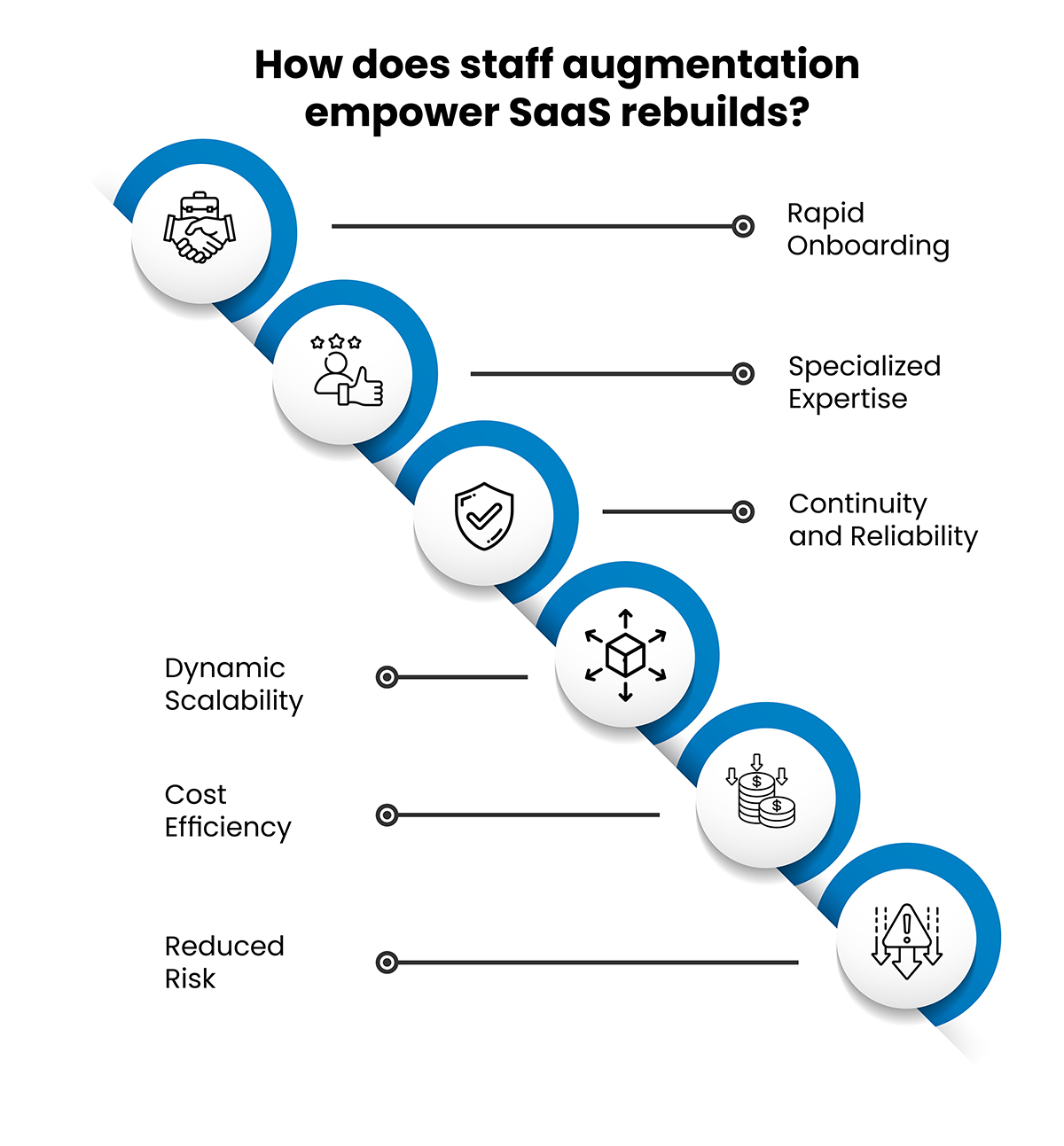
Rapid onboarding
When it comes to rebuilding software, it often starts under tight deadlines. Consulting a staff augmentation agency enables companies to recruit offshore developers within days and not months. This keeps projects moving forward without the hiring bottlenecks that often cripple timelines.
Specialized expertise
SaaS rebuilds usually demand rare skills like AI framework integration, advanced cybersecurity, cloud engineering, and experienced QA staff augmentation professionals. Access to specialized testing experts helps ensure application stability and software quality throughout the redevelopment process.
Dynamic scalability
Project needs may change from time to time across rebuild phases. Early stages may demand the intervention of software architects and cloud engineers. You may need specialists for quality assurance during the testing phase. QA team augmentation enables businesses to quickly onboard experienced software testers and automation engineers without delaying product releases. Offshoring tech experts allows companies to scale fluidly, avoiding resource shortages.
Cost efficiency
Hiring full-time staff for temporary needs wastes resources. Augmentation eliminates costs tied to recruitment, benefits, and long-term contracts. Companies pay only for skills that they require.
Reduced risk
A bad hire can impact product rebuild and disrupt company culture. External hires are safe options for firms as they reduce mismatch risks. If you need a different skills set, layoffs or severance can be avoided with IT staff augmentation services.
Continuity and reliability
Unexpected staff absences can halt rebuild progress. With augmentation, replacements can step in rapidly, ensuring continuity. Projects keep momentum without depending solely on in-house availability.
Core requirements behind SaaS product rebuilds
When SaaS platforms undergo rebuilds, several technical areas often demand specialized augmentation.
- Cloud Migration: With cloud architects and DevOps engineers, you can migrate from legacy hosting to modern cloud environments.
- Database Modernization: Replacing outdated databases with scalable, secure systems demands expert database administrators and solution architects.
- Security Enhancements: Firewalls, encryption, compliance measures, and QA staff augmentation help safeguard enterprise applications through functional testing, regression testing, performance testing, and security validation before deployment.
- AI and Automation Integration: Software rebuilds often involve embedding machine learning or artificial intelligence to enhance product value.
- UX/UI Redesign: Modern SaaS applications are expected to deliver intuitive and user-friendly experiences. Augmented designers ensure rebuilds meet evolving usability standards.
Successful SaaS product rebuilds often require software quality assurance talent augmentation alongside developers, cloud architects, and DevOps engineers. Bringing in experienced QA professionals helps identify defects early, improve test coverage, and ensure reliable product releases.
Each of these areas requires professionals who are difficult to hire permanently but can be secured quickly through on-demand staffing.
Business impact of staff augmentation in rebuilds
The benefits of approaching staff augmentation companies go beyond solving talent shortages. They reshape how SaaS companies deliver innovation.
- Faster Time-to-Market: Quicker onboarding and scalable teams accelerate the delivery of rebuilt products. Learn more about how offshore hiring speeds up product deployment here!
- Higher Productivity: In-house staff stay focused on strategy and core business, while augmented experts handle technical demands.
- Improved Quality: Access to experienced developers together with QA team augmentation improves testing accuracy, reduces production defects, and delivers more reliable SaaS applications with fewer maintenance issues.
- Cost Optimization: Companies save by avoiding unnecessary long-term hiring expenses.
- Customer Satisfaction: Rebuilds completed on time and with modern features strengthen customer trust and retention.
The result is a leaner, more resilient rebuild process that supports business goals without overextending resources.
Best practices to leverage IT staff augmentation
While flexible staffing solutions deliver value, success depends on execution. SaaS leaders should follow these best practices.
Along with software developers, businesses should also consider software quality assurance talent augmentation to maintain application quality throughout planning, development, testing, and deployment. Integrating QA specialists early helps reduce release risks and improve customer satisfaction.
- Select the right partner: Choose vendors with strong vetting processes and proven SaaS expertise. Investigate references and case studies.
- Define clear roles: Outline exact responsibilities for augmented staff to avoid duplication or confusion.
- Onboard thoroughly: Provide documentation, tools access, and workflow introductions from the first day. Smooth onboarding speeds integration.
- Prioritize communication: Use collaboration tools and regular check-ins to maintain alignment across distributed teams.
- Plan knowledge transfer: Ensure augmented staff share knowledge with in-house teams to strengthen long-term capability.
- Maintain control: Keep strategic decision-making internal while relying on external staff for executional expertise.
These practices help many B2B SaaS companies in the U.S. maximize benefits and avoid the common pitfalls of augmented models.

The future of SaaS and augmented teams
The SaaS industry is only becoming more competitive. According to Grand View Research, the global Artificial Intelligence as a Service (AIaaS) market size is expected to reach USD 105.04 billion by 2030 at a CAGR of 36.1%.
With this growth comes pressure for faster delivery, constant innovation, and stronger security. Staff augmentation will play an even larger role in meeting these demands.
Remote-first work has normalized distributed teams, making it easier for external staff to integrate with in-house teams effortlessly. However, the shortage of cloud engineers, cybersecurity experts, and AI developers will intensify. For many SaaS companies, on-demand staffing will shift from a stopgap solution to a core operating model.
Emerging technologies will further transform the landscape of product rebuilds in B2B SaaS companies. Augmented teams may increasingly include AI-assisted developers to accelerate coding and testing.
Conclusion
Rebuilding a SaaS product is one of the most critical projects a B2B enterprise can undertake. Traditional hiring models are often too slow, costly, and rigid to meet the demands of fast-moving application rebuilds. IT staff augmentation solves these challenges by providing immediate access to specialized, pre-vetted talent that integrates directly with existing teams.
Adding external tech teams helps SaaS companies accelerate time-to-market, optimize costs, and reduce risks. It helps enterprises gain the flexibility to scale resources up or down while keeping strategic control of their products.
Modern SaaS product rebuilds require more than experienced developers. Combining software engineering expertise with QA team augmentation and software quality assurance talent augmentation helps organizations deliver secure, scalable, and high-performing applications while meeting aggressive release schedules.
Are you looking for offshore software engineers and developers for world-class product rebuilds that meet customer expectations and secure long-term growth? At Proquantic, we make offshore hiring simple for startups and enterprises with staff augmentation services.
With features like no subcontracting, zero hiring fees, and a 30-day notice period, we provide time-zone aligned teams to meet your project needs. To learn more about our transparent pricing and flexible hiring model, schedule a call with our augmentation specialist.
FAQs About IT Staff Augmentation for Saas
1. What is QA team augmentation?
QA team augmentation is the process of temporarily adding experienced quality assurance professionals to an existing software development team. It enables businesses to improve software testing capacity without hiring full-time QA engineers.
2. What are the benefits of QA staff augmentation?
QA staff augmentation helps organizations accelerate software testing, improve product quality, reduce production defects, and scale testing resources according to project requirements while keeping hiring costs under control.
3. What is software quality assurance talent augmentation?
Software quality assurance talent augmentation involves hiring external QA specialists, automation engineers, performance testers, and security testers to strengthen software quality throughout the development lifecycle. This approach is especially valuable during large SaaS product rebuilds and digital transformation projects.
4. What does a QA assurance job description typically include?
A typical QA assurance job description includes responsibilities such as creating test plans, executing manual and automated tests, identifying software defects, reporting bugs, validating fixes, performing regression testing, collaborating with developers, and ensuring products meet quality, security, and performance standards before release.
5. When should SaaS companies use QA team augmentation?
SaaS companies should consider QA team augmentation during product rebuilds, major feature releases, cloud migrations, or periods of rapid growth when additional testing resources are required to maintain software quality and delivery timelines.
6. How expensive is staff augmentation for companies?
Costs of staff augmentation services depend on hourly market rates plus vendor margin. In some areas, the median pay of U.S. software developers can be around $64/hour, with experienced professionals getting higher payments.
In some marketplaces, the expenses can range anywhere between $40 and $150+ per hour, depending on skill, stack, and scarcity of skilled IT experts. Sometimes, time-and-materials engagements also bundle wages, overhead, and profit into fixed hourly rates.
7. Which pricing models exist for IT staff augmentation?
Here’s an overview of the popular pricing models for staff augmentation.
- Hourly Billing: You pay offshore, onshore, or nearshore teams only for the hours they worked. This pricing model is best for short-term tasks or projects needing flexible effort control.
- Monthly Retainer: It is set as a fixed monthly fee that guarantees ongoing support for the software development project. Monthly retainer pricing is ideal for predictable workloads or continuous development needs.
- Hourly Buckets: Companies prepay external teams for a set number of hours to complete the project and ensure the timely delivery of products. Choosing this pricing model balances flexibility with predictable costs, which is useful for intermittent tasks.
- Fixed-Price Model: Enterprises follow a set price for clearly defined development projects in the IT sector. Fixed pricing model works best when deliverables and scope are well-established for your business.
- Dedicated Team Model: It allows you to hire a team that acts as an extension of your in-house staff. This transparent pricing system allows you to pay a fixed monthly salary to your dedicated team member. The model is suitable for long-term projects needing consistent resources.
- Hybrid Model: This pricing model is a combination of two or more pricing structures. The model offers flexibility for complex or evolving development projects.
8. How do I select the best staff augmentation model?
You must align the staff augmentation model to scope volatility, governance needs, and risk tolerance. Choose time and materials (T&M) for uncertain or iterative work, monthly retainers or dedicated teams for steady backlog, or stick to fixed-price models for tightly defined deliverables with clear acceptance criteria.
Moreover, consider integration with your software development processes, vendor oversight effort, and cost control mechanisms specified in contract language.
9. How does AI influence staff augmentation?
AI accelerates sourcing, screening, and outreach, reducing recruiter effort and improving candidate matching. Many HR teams now use AI to generate job descriptions, customize postings, and screen resumes. Offshore hiring agencies also adopt AI assistants to automate search and scheduling, freeing recruiters to focus on higher-value tasks like candidate engagement and workforce planning.
10. What’s the usual timeline for staff augmentation projects?
Timelines vary by ramp-up and software development complexity. However, AI-enabled recruiting and mature talent networks are shortening time-to-hire for tech roles.
Onboarding can take anywhere from a few days to a few weeks, depending on role complexity and availability. Project duration varies widely, from short-term assignments of several weeks to long-term collaborations, spanning months or even years.
The outsourcing process involves defining skill requirements, selecting a provider, and seamlessly integrating augmented staff into existing workflows. The overall timeline is influenced by factors like specialized expertise, project scope, and the need for smooth knowledge transfer within agile development cycles.
11. Which industries benefit the most from staff augmentation?
Staff augmentation services benefit industries where technology evolves quickly and project demands shift. Healthcare, finance, manufacturing, and retail/e-commerce use it to accelerate digital transformation, from app development to cloud adoption and AI-driven solutions.
Banking and FinTech show particularly strong demand, with staff augmentation addressing needs in cybersecurity, data management, and regulatory compliance. Media and entertainment adopt offshore staffing for application development, VFX, streaming support, and content production, enabling faster scaling while reducing the cost of full-time hires.