


Do you know that building your remote workforce is now possible with IT staff augmentation? According to the Business Research Company, remote workplace services market size is estimated to cross $92.69 billion by 2029 at a 25% of CAGR.
Many U.S. companies already outsource global talent for custom software development. Partnering with an offshore development company India helps businesses reduce costs, scale engineering teams, and accelerate product delivery while maintaining development quality.
From healthcare to finance and real estate to e-commerce, most businesses now choose India to acquire remote professionals. However, finding the right team to keep businesses operational is not sufficient unless you understand how to manage them.
In this guide, we’ll cover what you need to do to keep augmented staff aligned to your business goals and remain productive. You will also find out what makes Indian developers the best for offshoring software development. Read on to run your offshore development center successfully without even flying halfway across the globe.

What is an offshore development center?
An offshore development center (ODC) is a dedicated offshore development center established in a global technology hub such as India. It functions as an extension of a company's in-house engineering team, handling software development, quality assurance, project management, and DevOps while reducing operational costs and improving scalability.
From specialized skills to emerging technologies and smooth team integration to strict data security measures, it covers various aspects for businesses growth.
Businesses often partner with an experienced offshore development company India to establish and manage an offshore development center without the complexity of setting up a legal entity, hiring local talent, or managing infrastructure independently.
Benefits of an Offshore Development Center
In today’s competitive digital era, businesses need IT professionals without the constraints of geography. Hiring a remote software developer provides organizations with the flexibility to innovate faster, scale projects efficiently, and reduce operational overheads. Many U.S. companies gain a strategic advantage that extends beyond cost savings by leveraging global talent.
-
Cost-effective access to skilled talent
Affordability is one of the major benefits of working with offshore development teams. Organizations can cut labor costs by up to 70% compared to in-house staffing solutions through remote hiring. They even provide access to professionals trained in top-tier engineering and technology programs worldwide.
IT engineers bring expertise across diverse areas, which include software development, artificial intelligence, machine learning, data analytics, and cloud computing. Their affordability and diverse skill sets make offshore teams a valuable asset for businesses.
-
Rapid and effortless scaling
Remote developers provide unmatched scalability to modern companies. According to the shift in business demands, companies can expand or contract their teams without conducting lengthy hiring processes. Whether to meet a product launch deadline or acquire specialized expertise, remote development teams ensure flexibility.
A dedicated offshore development center also allows organizations to quickly expand engineering teams, onboard specialized developers, and respond to changing business requirements without lengthy recruitment cycles.
Engagement models can also be tailored, ranging from dedicated teams to project-based contracts, allowing businesses to align workforce size with project requirements. This agility accelerates delivery and reduces the time-to-market.
-
Focus on core business ideas
An offshore outsourcing software development company allows internal teams to take strategic initiatives and focus on innovation. Organizations can free up in-house resources for business-critical activities, including product design, customer experience, and long-term growth strategies.
Distributing responsibilities amongst the onshore and offshore teams improves productivity and ensures that specialized functions are handled by the right professionals.
-
Around-the-clock operations
Global remote teams also prepare the foundation for continuous business operations. With teams distributed globally, businesses can achieve maximum productivity.
Development cycles move faster as tasks are handed off seamlessly between teams, ensuring minimal downtime. Additionally, this model enhances customer support capabilities, enabling organizations to deliver round-the-clock service to a global audience.
An offshore software development services company enables businesses to access world-class talent and operate efficiently across different time zones. Beyond cost savings, it delivers the agility and expertise needed to thrive in a fast-paced digital economy.
Common challenges in managing offshore teams
Managing offshore teams in the Asia-Pacific region offers access to world-class talent, but it also introduces several operational and cultural complexities. Organizations that recognize these challenges early can adopt strategies to foster collaboration, maintain quality, and ensure long-term project success.
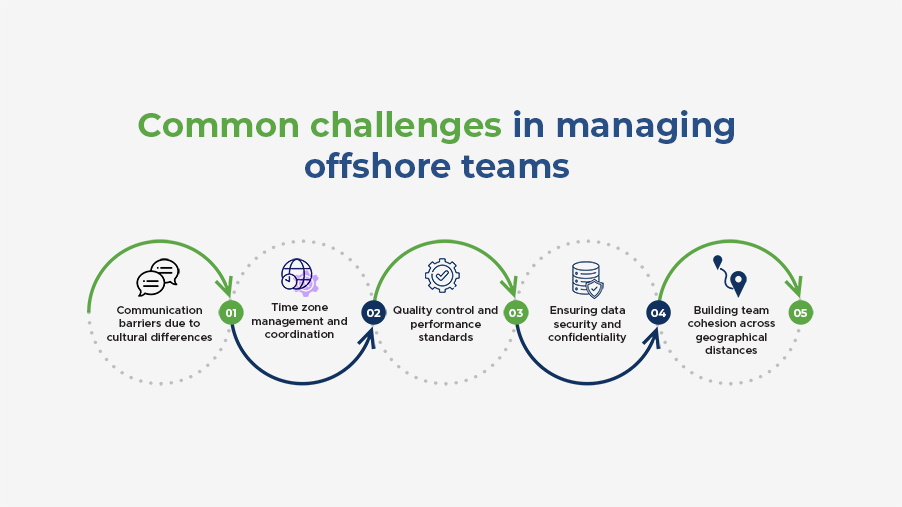
1. Communication barriers due to cultural differences
Most Indian professionals are fluent in English. However, subtle cultural variations in communication styles can create misunderstandings with team members. For example, indirect responses may sometimes be misinterpreted as agreement, while differing approaches to hierarchy can affect openness during discussions.
Companies need structured communication frameworks, clear documentation practices, and cultural awareness training to overcome this problem.
2. Time zone management and coordination
India operates several hours ahead of the United States, which may pose challenges during real-time collaboration. Teams may struggle to meet deadlines or face delays in resolving issues due to limited overlapping working hours.
This challenge requires well-defined communication protocols, flexible working arrangements, and the use of collaboration tools that support asynchronous updates, ensuring progress continues around the clock.
3. Quality control and performance standards
Maintaining uniform quality across distributed teams is often challenging. Differences in work culture, expectations, and review practices can lead to varied outcomes.
However, offshore teams can align with organizational standards by adopting clear quality benchmarks, conducting regular code or deliverable reviews, and integrating performance monitoring systems.
4. Ensuring data security and confidentiality
Offshore development services often involve the transfer of sensitive data and intellectual property across borders. This raises concerns about data privacy, regulatory compliance, and security against breaches.
Companies must implement strict security protocols, sign non-disclosure agreements, and adopt secure infrastructure such as VPNs and encrypted communication channels to safeguard critical assets.
5. Building team cohesion across geographical distances
Working thousands of miles apart can make offshore team members feel left out. This may weaken engagement and reduce productivity further.
Regular virtual meetings, team-building initiatives, and recognition programs help companies bridge the physical gap. Addressing these challenges help utilizing full potential of offshore software developers in the Indian subcontinent. A balance of cultural awareness, strong communication practices, and robust governance frameworks ensures not only smoother collaboration but also sustained project success.
Why U.S. firms prefer India for offshore development?
Around 80% of the US outsourcing companies ranked India as their leading choice for offshore hiring partner. 50% of Fortune 500 enterprises select software outsourcing firms based in Asia-Pacific region.
Choosing an offshore development company India enables businesses to establish scalable engineering teams while benefiting from India's mature IT ecosystem, skilled developers, and competitive operating costs.
Setting up an ODC in the Indian subcontinent has become a strategic priority for many U.S. enterprises. With this approach, they scale operations, reduce costs, and gain access to specialized skills.
Moreover, South Asia’s IT hub continues to stand out as a preferred offshore destination for Western countries. What makes India a global outsourcing leader is its combination of technical expertise with economic and operational advantages, difficult to match elsewhere.
-
Vast talent pool
India’s strength lies in its abundant supply of highly skilled professionals. With over 3 million IT experts and more than 1.5 million engineering graduates entering the workforce annually, companies have access to diverse technical expertise across programming, data science, cybersecurity, cloud computing, and emerging technologies.
This staffing arrangement ensures that U.S. firms can quickly build teams tailored to specific project needs without facing talent shortages.
-
Cost efficiency
One of the biggest drivers for offshore development in India is cost savings. Companies can achieve up to 70% reduction in expenses by leveraging the country’s lower labor costs, affordable infrastructure, and favorable currency exchange rates.
The cost advantage does not always mean compromising the quality of software or deliverables in the IT sector. Companies prefer to work with remote Indian developers, as they are known for their technical depth, problem-solving abilities, strong work ethic, and offering exceptional value at a fraction of the cost.
-
Time zone advantage
The time zone gap between India and the U.S. allows businesses to operate on a round-the-clock model. While U.S. teams finish their workday, offshore teams in the Asia-Pacific region continue development, ensuring faster turnaround times and accelerated delivery cycles.
Consistent workflow helps companies reduce time-to-market and stay competitive in fast-paced sectors.
-
Proven track record and quality standards
India's IT industry has a proven track record of supporting market leaders, such as Ford, Cisco, American Express, General Electric, and Microsoft. This collaboration demonstrates its deep integration with global enterprises.
With advanced infrastructure, robust security frameworks, and strict adherence to international quality standards, Indian firms have established themselves as trusted partners. U.S. companies benefit from mature development processes, data protection measures, and a culture of delivering consistent and high-quality output.
-
Government support & scalability
These advantages make India one of the preferred destinations for establishing a dedicated offshore development center capable of supporting long-term software development initiatives.
Moreover, western companies gain flexibility to scale teams up or down, ensuring cost-effectiveness across the development lifecycle.
-
English proficiency & cultural compatibility
Strong English proficiency and extensive experience working with international clients make collaboration seamless. Cultural adaptability further enhances communication, teamwork, and alignment with U.S. business practices.
With its unique combination of talent, affordability, scalability, and quality, India has earned its reputation as the global hub for offshore development. For U.S. firms seeking to optimize operations and drive sustainable growth, this South Asian country remains the destination of choice.

How to keep remote developers productive and aligned?
Managing a remote development team is more than assigning tasks and waiting for results. Success depends on building the right culture, providing clear direction, and ensuring teams remain productive while working from different locations.
With proper management practices, remote developers can stay aligned and deliver consistently high-quality outcomes.
Create the right work environment
A supportive work culture is the key to effective collaboration between cross-border teams. Offshore developers usually perform better when you provide them with the right resources, which include laptops and cloud-based tools, to secure communication platforms.
Every interaction, whether one-on-one or in groups, should remain respectful, encouraging healthy collaboration. When remote staff feel empowered to work from anywhere without friction, it is reflected in their productivity.
Set clear target goals
Clarity in goals ensures alignment. Development teams must understand not just their tasks, but also the broader release strategy, timelines, and objectives. Defining roles and responsibilities while discussing project milestones helps IT engineers evaluate their contributions.
Setting shared goals is also effective in preventing duplication of efforts and keeping the team focused on specific outcomes.
Provide the right tools
The success of remote development relies on the right tools, including version control, CI/CD, project management, and communication, all aligned with team workflows.
With a streamlined toolset, businesses can accelerate collaboration and ensure that everyone can view the progress of ongoing tasks.
Encourage healthy communication
Regular communication helps build trust and align team members. Scheduled meetings with project managers, business analysts, and team leaders keep everyone updated about evolving software development standards.
However, these sessions should be collaborative discussions rather than top-down instructions. Purposeful communication encourages developers, testers, and operations engineers to work collectively to achieve business goals.
Respect focused coding time
DevOps engineers require uninterrupted time for coding, automation, and system monitoring. While meetings are important, they should not disrupt the core working hours of your remote staff.
Establishing meeting-free blocks allows developers to concentrate deeply on their responsibilities. This is a good practice to achieve high-quality outcomes and experience fewer errors.
Promote collaborative mentoring
Knowledge sharing can help build and strengthen your offshore teams. You can assign senior engineers to mentor juniors on architecture or deployment practices. If there are younger members in your team, try introducing them to new IT frameworks or tools.
This culture of reciprocal learning drives growth, strengthens resilience, and equips teams for emerging software industry challenges.
Align with long-term goals
Companies can define problems clearly and allow the team to propose solutions instead of monitoring their daily actions. This fosters creativity, independence, and stronger ownership of deliverables.
Adapt to time zones and boost morale
Global offshore teams thrive with thoughtful scheduling. Overlapping working hours, staggered responsibilities, and timely feedback cycles make time zones an advantage rather than a challenge. Regular recognition, whether through compliments, bonuses, or public appreciation, keeps morale high, ensuring teams remain engaged and motivated.
When remote software engineers have clarity, the right tools, and strong leadership, they not only stay aligned but also exceed productivity expectations.
Conclusion
Establishing an offshore development center in India continues to be one of the most effective strategies for U.S. businesses looking to scale engineering teams, reduce operational costs, and accelerate software delivery. Partnering with an experienced offshore development company India simplifies hiring, compliance, infrastructure management, and long-term team growth.
Whether you're planning your first dedicated offshore development center or expanding an existing remote engineering team, choosing the right technology partner helps ensure sustainable growth, operational efficiency, and successful software delivery.
If you need developers from India, discuss your requirements with our IT staff augmentation agency. Schedule a call now!
FAQs About Tips to Manage Offshore Developers in India
1. What is the estimated cost of offshore development services?
The cost of offshore developers depends on location, expertise, and engagement models. For U.S. firms, Indian developers typically charge between $20 and $50 per hour, varying by technology stack and seniority.
The offshoring cost in Eastern Europe is between $30 and $70, while developers from Latin America charge $25 to $60. AI/ML skills or more senior developer roles may cost more. Compared to U.S. rates between $100 and $150, offshore hiring can lower expenses by up to 60%.
2. How can U.S. firms set up offshore development centers in India?
Start by defining goals, whether they are related to cost savings, faster delivery, or talent access. Select a city such as Kolkata and choose between building your own entity or partnering with a local provider. Address compliance by registering legally, following labor laws, and protecting intellectual property with strong contracts.
Recruit offshore programmers, QA engineers, and project managers who align with company culture. Finally, set up secure IT infrastructure, integrate collaboration tools, and monitor KPIs to scale operations effectively.
3. Can U.S. firms hire offshore teams in India directly?
Yes. U.S. companies often hire Indian developers remotely as employees or contractors. Some firms also provide visa sponsorship for employees who are willing to relocate to the U.S. for further development tasks.
Businesses must navigate payroll management, tax obligations, and proper worker classification to remain compliant with the hiring laws.
4. Who should you hire when building an offshore tech team?
The roles that you need in your offshore team include frontend, backend, and full-stack developers, along with QA engineers, UI/UX designers, DevOps specialists, project managers, and business analysts. The expertise your startup or enterprise requires depends on its project scope and business objectives.
5. How does offshore hiring differ from outsourcing?
Outsourcing transfers full project responsibility to an external vendor. Offshore teams, however, act as an extension of your company. You manage their work directly, while your offshore outsourcing software development services company handles HR, compliance, and infrastructure.
6. How can U.S. firms align schedules with India teams?
Dealing with time zone differences require flexible planning by the U.S. companies. It's best to establish overlapping hours for critical collaboration, rotate meeting schedules to share the inconvenience, and rely on tools like Slack, Zoom, or Jira for asynchronous updates. Documented processes and proactive communication keep workflows efficient in the IT industry despite geographical distance.