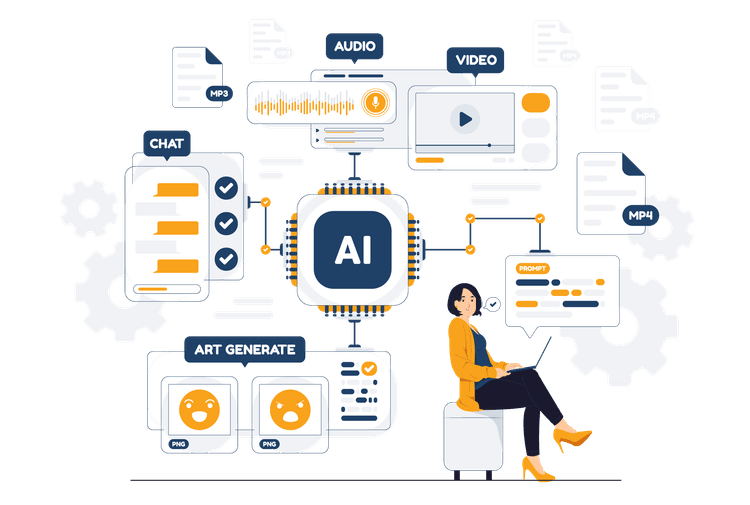
From technology and finance to automotive and defense, enterprises nowadays consider adopting intelligent systems that move beyond text to truly understand and interact like humans. With ongoing advancements in artificial intelligence (AI) and machine learning (ML), multimodal AI enables systems to process, align, and integrate multiple data modalities within a unified framework for more accurate and context-aware outputs.
The shift to adopting context-aware AI systems enables smarter decision-making, improved automation, and more intuitive human-machine interactions across everyday business operations. Enterprises are increasingly investing in intelligent systems that can understand images, audio, and other data together. This helps businesses work more efficiently and stay competitive.
Multimodal AI makes it easier to connect information and gain better insights by combining different types of data in one system. It improves how people interact with technology, making digital experiences more responsive, intuitive, and easy to use.
A recent report suggests that the global multimodal AI market size is likely to cross USD 41.95 billion by 2034 at a CAGR of 37.33%. As AI infrastructure adoption accelerates across industries, enterprises are investing more in research and real-world applications to impact interactions between humans and machines.
Do you know how AI goes beyond text and understands audio, images, and context while generating relevant outcomes for enterprises? This blog offers valuable insights into multimodal AI and some real-world examples, explaining how it improves user experiences, streamlines business operations, and unlocks capabilities that go far beyond traditional and single-mode interactive systems.
Scroll below to learn more about interactive AI use cases, their features, and implementation models, along with the latest trends, to enable smooth interaction across voice, chat, and visual interfaces.
#cta1
What is Multimodal AI?
Multimodal AI or all-in-one interaction systems are designed to handle all kinds of information or data. Implementing these multi-source applications streamlines the process of collecting and processing all types of input data, which includes text, video, audio, and image. With full-spectrum AI systems, you can catch all formats at the same time and decode them properly to generate the best responses.
The ability to distinguish diverse data or inputs and generate precise insights is what makes unified AI applications stand out. Many emerging startups and established organizations across the US leverage multimodal intelligent systems to speed up development processes, boost customer experiences, and explore new avenues for tech integration and business innovation.
Working Mechanism of Multimodal AI Systems
To fully understand the potential of multi-sensory AI applications through real-life examples, let’s discuss how these systems work. Below are the steps that describe what happens to your input or data when processed by interactive systems.
-
Data collection & preparation
Context-aware AI applications gather data from a wide range of sources, which can be images, audio, text, and video. Before processing, this input is usually inconsistent and unstructured. The main purpose of cross-modal interactive systems is to preprocess the raw data, involving noise removal, formatting, and organizing them to acquire a structured form.
Enterprises leveraging custom AI solutions need this type of data for better analysis and error reduction in later stages.
-
Feature extraction across modalities
Once the data is prepared, the system extracts key features from each modality to enable enterprise-grade analysis and decision-making. Computer vision models analyze images to detect objects and patterns, while natural language processing interprets text for meaning and context.
Audio processing is also used to identify speech, tone, and intent from the data stream. In multimodal AI, each modality is handled separately. This allows the system to extract meaningful patterns before combining them for enhanced decision-making or enterprise outcomes.
-
Multimodal data fusion
Various inputs from different data types are combined into a unified representation during this stage. The fusion enables the system to connect information across modalities, for example, inking spoken words with visual cues. Businesses relying on interactive AI systems can easily reduce ambiguity and improve contextual understanding through a holistic view.
-
Model training & optimization
The main objective behind working with integrated data in interactive systems is to stabilize and train different AI models. Using unified data is a proven and effective method to train the model and understand how different modalities relate to each other. It continuously refines its predictions using advanced optimization techniques, improving accuracy with every iteration.
Multimodal AI can handle complex, real-world scenarios more accurately by bringing different types of data together. Many US companies use this unified AI system to build high-performance, enterprise-grade applications that deliver more reliable and context-aware results.
-
Output generation & continuous learning
Multimodal AI systems generate responses, summaries, or predictions by combining signals from different data sources. They rely on patterns learned during training and the ability to align information across multiple data types.
These systems improve over time through model updates, retraining with new data, and structured feedback loops, rather than learning continuously in real time. This iterative process helps boost accuracy, adaptability, and consistency, allowing businesses to achieve more reliable performance in dynamic, real-world environments.
Real-World Multimodal AI Applications Reshaping Industries

Multimodal AI allows systems to process and connect multiple data types, from text, images, audio, and sensor data. US businesses utilize this integrated intelligence to move beyond fragmented insights and make faster, more accurate, and context-aware decisions.
From improving customer experiences to optimizing operations, the impact of context-aware AI is visible across diverse sectors.
1. Healthcare
In the healthcare sector, multimodal AI is used widely in diverse applications. From medical imaging to patient records and wearable data to clinical notes, you will find this model everywhere. The use of this technology allows healthcare service providers to analyze and process data with better accuracy and transparency. Get more insight into the use of AI in healthcare in this blog!
Multi-sensory AI makes use of various data sources and types to perform a combined analysis of patient health. Common sources for data collection include monitoring of sleep patterns, physical activity, heart rate (HR), and heart rate variability (HRV).
Vital data like blood pressure and blood glucose levels are also easy to measure with advanced sensors. Multimodal interactive systems are designed to closely study all these medical conditions and deliver crucial insights that basic diagnosis techniques are likely to overlook.
This approach helps with accurate diagnosis, early detection of diseases, and personalized treatment planning. Multi-source AI integration helps systems process multiples inputs and present them as medical visuals, which includes MRI reports, X-rays, and CT scans.
2. Finance and Banking
Data breach attempts are major concerns in the FinTech sector. Multimodal AI integration simplifies financial operations by reducing dependence on third-party intermediaries. This technology adoption allows for more secure, reliable, and efficient handling of user data and transactions across financial institutions and banks.
Banking and financial companies often adopt multi-input AI systems to combine transaction data, customer interactions, documents, and behavioral patterns. This helps them detect fraud more effectively through anomalies across multiple data sources.
It also enhances risk assessment, compliance, and decision-making by providing deeper insights into financial activities, reducing manual effort, and improving operational efficiency.
The primary approach is to collect and merge different data sets, which include account holders and merchants, transaction logs, and historical financial records. Applications integrating artificial intelligence assist financial enterprises in monitoring and identifying anomalies and tracking the activity of partners in real time.
Relevant authorities are notified instantly, while multimodal AI systems automatically trigger predefined controls to contain suspicious activities.
Many trading companies use multi-sensory intelligent systems to analyze large volumes of market data and identify patterns or trends to boost return on investment (ROI). Unified AI systems support investors with data-driven insights, which allows for informed investment decisions and improved portfolio performance.
3. Retail and E-Commerce
Multimodal interactive models help retailers, supermarkets, and e-commerce platforms analyze customer behavior, product visuals, reviews, and purchase history. This integration enables hyper-personalized recommendations, optimized pricing strategies, and better inventory management. It also improves demand forecasting and enhances the overall shopping experience, both online and in-store.
Modern equipment like shelf cameras, RFID tags, and transaction records provide precise data for processing through AI-powered software to track the status of in-store and warehouse products in real time. E-commerce businesses can make use of the data set and multimodal AI system to enhance inventory management and serve their customers or shoppers better.
Multimodal AI helps track the retail sales of the products in different seasons of the year. You can use this advanced interactive system to predict the demand for a particular product through comprehensive analysis of market factors and past records. Based on the demographics, interests, and preferences of users or buyers, it allows the system or application to suggest relevant products.
4. Manufacturing
In US manufacturing, multimodal AI brings together sensor data, machine logs, and visual inputs to maximize outcomes. Companies use it for predictive maintenance, which helps them identify potential equipment issues in advance, and reduce downtime and costs. Integrating unified AI systems also helps with quality control, detecting defects in real time, ensuring consistent output and smooth business operations.
Multi-input AI systems enable continuous monitoring of production quality by analyzing data from sensors and visual inputs to detect defects. These systems can automatically flag or remove defective items, ensuring that only compliant products move forward in the supply chain.
Manufacturing industries also make use of AI-powered quality control cameras to inspect inventory for physical damage, improve accuracy, and maintain consistency in quality assurance processes.
Enterprises can tailor predictive maintenance using multimodal AI by training models on historical machine data, usage patterns, and maintenance records. Instead of relying on fixed schedules, these unified systems identify early signs of wear or potential failures. In case of anomalies or maintenance needs, they generate alerts. This allows AI software developers or the concerned teams to take timely action to avoid unexpected downtime.
5. Education
Multimodal AI has played a vital role in bringing new learning opportunities for learners in remote areas by offering seamless interaction via different media formats like videos, texts, images, and much more. The model enhances education by integrating different data formats and content to create personalized learning experiences. It adapts to individual learning styles and progress, improving engagement and knowledge retention. Educators can also gain insights into student performance, allowing them to tailor teaching strategies and address learning gaps effectively.
EdTech companies often integrate multi-input AI systems to access multimedia-rich content fast, making education more enjoyable for the learners and increasing overall engagement. Cross-modal AI applications help students learn about their academic concepts with improved features like live pictures, augmented reality, and virtual reality (VR).
6. Security
Multimodal AI transforms security protocols through real-time threat detection feature across diverse data sources, which includes video feeds, audio signals, system logs, and user behavior. It enhances situational awareness and identifies complex attack patterns with input correlation, often missed by single-source systems.
Advanced models incorporate safeguards to mitigate malicious inputs and reduce data leakage or adversarial attacks. Security service providers use advanced AI interaction systems to combine surveillance data with access logs or voice inputs. They integrate this model to detect anomalies that can bring potential risks.
Multimodal environments are expanding, bringing new security and privacy challenges. These systems can track activity, understand behavior patterns, and sometimes use tools like facial recognition to improve security. This makes security more responsive, flexible, and better equipped to handle evolving threats.
7. Marketing
Multimodal AI is transforming marketing by enabling unified analysis and content creation across text, images, audio, video, and social interactions. It helps brands produce cohesive campaigns by combining visual assets, messaging, and creative formats within a single workflow.
Multimodal AI looks at different customer signals like browsing behavior and user content. This modern interactive system allows marketers to deliver more precise audience segmentation, dynamic personalization, and context-aware recommendations.
It allows marketers to create better audience groups and offer more relevant recommendations. The visual search feature also helps users find products that they are looking for. Overall, it helps improve campaigns, increase engagement, and support better decision-making that can lead to higher conversions.
8. Agriculture
Multimodal AI bringing together data from sources like satellites, weather reports, soil sensors, and drones to improve agricultural outcomes. It gives regular updates on crop health, soil conditions, and environmental changes. This technology adoption helps farmers and businesses take timely action and make better decisions to improve results.
Farmers can detect early signs of disease, nutrient deficiencies, or pest infestations and take targeted action using context-aware AI systems, which help correlate visual and sensor data. This technology also supports optimized irrigation planning and yield prediction by analyzing climate patterns alongside field data.
Multi-source AI help agriculture businesses use resources more efficiently, reduce waste, and improve overall productivity. Combining data from multiple sources supports better decision-making and helps farmers respond to changing weather and environmental conditions. This leads to more sustainable and resilient farming practices across different scales.
9. Hospitality
Multimodal AI combines data from text, voice, images, and real-time interactions to deliver more personalized and efficient guest experiences in the hospitality industry. Hotels use these advanced models to cutomize room settings through voice commands, streamline check-in with biometric verification, and provide intelligent concierge services using image or text-based queries.
Businesses can offer targeted recommendations and seamless service across touchpoints by analyzing guest preferences alongside booking and behavioral data. Multimodal AI also supports predictive maintenance by monitoring equipment and infrastructure through sensor and visual data, reducing the risk of unexpected failures.
In the travel and tourism sector, many companies use AI-powered chatbots and virtual assistants to understand customer needs and handle bookings for hotels, transport, and activities. This helps streamline operations, improve service quality, and create a smoother experience for customers across the entire travel journey.
10. Automotive
Multimodal AI plays an important role in the automotive industry by combining data from cameras, radar, lidar, GPS, and in-vehicle sensors. This helps vehicles better understand their surroundings and make informed decisions.
Adopting this technology enables advanced driver assistance features like lane detection, collision avoidance, and adaptive cruise control. It helps companies analyze real-time driving conditions.
Automotive applications with cross-modal AI improve object detection, road understanding, and hazard prediction, making driving safer and more reliable by combining visual, spatial, and sensor data. In autonomous vehicles, multimodal models fuse inputs from multiple sources to navigate complex environments, recognize traffic patterns, and respond to dynamic road conditions.
Beyond driving, multimodal AI enhances the in-car experience through voice assistants, gesture recognition, and personalized infotainment systems that adapt to driver preferences. It also supports predictive maintenance by analyzing vehicle performance data to detect potential issues early.
The adoption of context-aware intelligent systems is accelerating the development of connected and intelligent vehicles while improving safety, efficiency, and user experience across modern transportation systems. Read this blog for more information on the significance of AI in the automotive industry, powering future transportation.
Popular Multimodal AI Models Driving Business Innovation
These models are not only advancing core AI performance but are also transforming industries such as healthcare, finance, retail, manufacturing, education, security, marketing, agriculture, hospitality, and automotive.
Context-aware AI systems are increasingly attracting next-generation enterprises and consumer applications. Many enterprises approach custom AI software developers to implement models that enable deeper contextual understanding and real-time reasoning.
-
GPT-5 or GPT-5.4 (OpenAI)
GPT-5 can handle text, images, audio, and video in a single system. It offers stronger reasoning, better handling of long context, and more reliable outputs, making it well-suited for enterprise-level applications.
OpenAI correlates medical images with patient records for flawless diagnostics in the healthcare sector. Using the latest GPT models enhances fraud detection and risk analysis in financial firms.
Retail and marketing teams use cross-modal AI system for personalized content generation. In the education sector, it powers adaptive learning systems. Its versatility also extends to security monitoring, automotive copilots, and hospitality assistants, making it one of the most widely applicable multimodal models.
-
Gemini 3 Pro (Google DeepMind)
Gemini 3 Pro is designed for large-scale multimodal processing and works closely with real-time data systems. It can handle text, images, audio, and video together, with the ability to process large amounts of information in a single workflow.
From analyzing sensor and visual data to improving production processes, Gemini 3 Pro supports crop monitoring using satellite and environmental data to increase productivity in the agriculture sector.
Retail and e-commerce platforms integrate AI with real-world awareness to enable features like visual search and product recommendations. Its integration with productivity tools also supports better collaboration in education and enterprise settings.
-
Claude Opus 4.5 or Sonnet 4.5 (Anthropic)
Claude 4.5 models are known for strong reasoning, a focus on safety, and the ability to handle long context. They are especially good at analyzing large documents and combining text and visual inputs to generate clear insights.
Several finance companies in the US use this model for compliance checks and regulatory monitoring. In healthcare, they help process clinical records and research data. Their structured approach also supports legal, security, and enterprise knowledge systems, making them useful in sectors where accuracy and transparency matter most.
-
LLaMA 4 (Meta)
LLaMA 4 offers a flexible multimodal framework that can be deployed across different environments, from mobile devices to enterprise systems. It can handle multiple types of data, making it useful for a wide range of applications.
In manufacturing, it supports quality control through visual inspection and sensor data. In automotive, it helps power smarter navigation and driver assistance systems. In agriculture, it can analyze environmental and visual data to support better decisions. Its flexibility also makes it easier for businesses to build AI solutions tailored to their specific needs.
-
Phi-4 Multimodal (Microsoft)
Phi-4 Multimodal focuses on efficient, real-time processing with a relatively compact architecture, making it ideal for edge and on-device applications. It supports text, image, and audio inputs, enabling seamless multimodal interactions in resource-constrained environments.
This model powers smart assistants that respond to voice and visual inputs in the hospitality sector. Phi-4 Multimodal enables in-store AI experiences, which enhances user experience in the retail sector.
In education, it supports interactive learning tools, and in security, it helps monitor environments through combined audio-visual analysis. Its efficiency and adaptability make it particularly valuable for applications requiring low latency and real-time responsiveness.
-
DeepSeek-OCR (DeepSeek AI)
DeepSeek-OCR is a specialized multimodal model designed for document understanding and visual-text integration. It excels at extracting structured information from images, scanned documents, and PDFs by combining visual encoding with language processing. In finance and banking, it automates document processing and compliance workflows.
DeepSeek AI helps digitize medical records and reports in the healthcare sector, making data easier to manage and access. In the US, it is also used in manufacturing and logistics for tasks like invoice processing and handling operational documents. By connecting visual and text-based data, it helps improve efficiency in data-heavy industries.
-
Grok 4 (xAI)
Grok 4 is built for real-time multimodal reasoning, with a strong focus on working with live data. It can process text, images, and streaming inputs to deliver quick, context-aware insights.
In the finance industry, it helps with real-time market analysis. In marketing and digital platforms, it can track trends and understand user sentiment. It is also useful in security, where it can quickly analyze changing data and spot unusual activity. Its speed and adaptability make it a good fit for situations where fast decisions matter.
-
Kimi K2 or K2.5 (Moonshot AI)
Kimi K2 models are gaining traction for their agentic capabilities and efficient multimodal processing. They are designed to handle complex workflows involving multiple data types while maintaining scalability. In retail and e-commerce, they support intelligent automation and personalized experiences.
In education, they enable AI-driven tutoring systems, while in hospitality and travel, they assist in managing bookings and customer interactions. Their ability to execute tasks autonomously positions them as a strong solution for enterprise productivity and automation.
Latest Trends in the Multimodal AI Market
The multimodal AI market is witnessing rapid growth as organizations seek advanced systems capable of processing and interpreting multiple data formats simultaneously. This evolution is driven by the increasing demand for smarter automation, enhanced decision-making, and more intuitive user experiences.
With multiple industries adopting unified AI systems at scale, multimodal capabilities are becoming central to building more adaptive, efficient, and context-aware applications.
-
Convergence of unified AI models
A major trend is the development of unified AI architectures that integrate vision, language, and speech into a single model. These systems improve contextual reasoning and eliminate the need for separate models, enabling seamless cross-modal understanding and more accurate outputs.
-
Expansion in customer engagement platforms
Enterprises deploy multimodal AI to enhance customer engagement across chat, voice, and visual interfaces. This enables more natural interactions, personalized responses, and consistent experiences across digital touchpoints, improving customer satisfaction and retention.
-
Advancements in content moderation and media intelligence
Multimodal AI supports content moderation by analyzing text, images, audio, and video together. It helps platforms detect harmful, misleading, or inappropriate content by distinguishing contexts across different formats.
It is widely used across industries to improve content safety, strengthen moderation processes, and support compliance with platform policies and regulatory requirements.
-
Growth in autonomous and intelligent systems
The use of multimodal AI in autonomous vehicles and intelligent systems is growing quickly. By combining sensor data, visual inputs, and other signals, these systems can make real-time decisions. This helps improve safety, navigation, and overall efficiency.
-
Rise of Edge AI and responsible AI practices
Edge AI deployment is gaining momentum, enabling faster processing and reduced latency by handling data closer to its source. At the same time, privacy-preserving techniques and responsible AI frameworks are becoming essential, ensuring secure, transparent, and compliant AI implementations across industries.
Cost Breakdown for Multimodal AI System Development
The cost to integrate multimodal AI solutions depends on system complexity, data volume, and industry-specific requirements. Modern deployments also include expenses for cloud infrastructure, real-time processing, and compliance, making cost planning a critical part of adoption.
-
MVP and entry-level solutions
The basic cost setup for multimodal AI systems can be between $50,000 and $150,000. These solutions focus on limited integrations, such as combining text and image processing, and are ideal for pilot projects or startups testing feasibility.
-
Mid-scale multimodal systems
Businesses scaling their AI capabilities often invest around $150,000 to $500,000. These systems support multiple data inputs, improved model accuracy, and integration with existing business applications, enabling more practical use cases.
-
Enterprise-grade platforms
The overall expense to adopt advanced multimodal AI platforms can be anywhere between $500,000 to $5M+. It can depend on customization, data pipelines, and real-time decision-making capabilities. Large enterprises in sectors like healthcare and finance may exceed this range due to strict compliance and data security requirements.
-
Infrastructure and GPU costs
High-performance computing is essential for multimodal AI. GPU cluster operations can cost $50,000 to $500,000+ per month, especially for real-time analytics and large-scale AI software deployments.
-
Industry-specific cost factors
Industries such as manufacturing, automotive, and agriculture require additional investments in IoT devices, sensors, and edge computing. In contrast, retail, marketing, and hospitality often implement more cost-efficient, customer-focused solutions.
-
Maintenance and optimization
Ongoing maintenance adds 20% to 30% annually, covering model updates, monitoring, scaling, and performance optimization.
The total investment varies based on business goals, scalability needs, and the level of system customization required. If you want the correct estimation of custom AI solutions for your specific business, contact our AI & ML engineers.
How Proquantic Software Helps with Multimodal AI Projects
Many US companies choose multimodal AI applications to integrate and process different data types. At Proquantic Software, our expert AI & ML engineers create context-aware, responsive solutions to enhance the accuracy and sophistication of AI interactions.
We implement services that enhance user experience and improve application functionality across multiple industries. Our AI software development services helped many enterprises and startups kickstart their journey with multimodal solutions.
Let’s discuss a few of our projects that demonstrate how we helped our clients transform their performance trends and business operations with tailored AI solutions.
-
Professional headshot capture application for a photo studio
We helped our US-based client create Studio Pod, an AI-powered platform that captures professional-quality headshots instantly with minimal human intervention. Our developers used computer vision and automated adjustments to create the platform to ensure consistent lighting, framing, and enhancement. This enabled the company to deliver studio-grade images at scale while reducing manual effort for end users by over 60%.
-
Smart academic performance tracking for an EdTech company
Proquantic Software assisted a Pittsburgh-based client in building an AI assistant that analyzes academic data, behavioral inputs, and performance trends on Gradey, a reliable application for parents, guardians, and educators to evaluate students' academic grades and track their overall performance.
This virtual companion is designed to deliver actionable insights through real-time dashboards, which effectively reduced dropout rates by 30% and motivated students to improve their grades. With advanced tracking accuracy and boosted engagement, Gradey enabled quicker and data-driven academic decisions.
Conclusion
Multimodal AI reshapes how established enterprises and emerging startups interact with technology to transform human interactions. It combines audio, text, images, and video data to allow faster decision-making, deeper insights, and more intuitive user experiences across industries.
Partnering with a trusted AI software development company can help your business gain a strong competitive edge through context-aware solutions. From concept to deployment, you can receive complete professional support to create high-performance applications that drive measurable growth and revenue.
Are you ready to change human-tech interactions with multimodal AI solutions? Get assistance from Proquantic Software’s AI & ML specialists to integrate context-aware intelligent systems and solve real-world problems.
Frequently Asked Questions for Multimodal AI
Is multimodal AI better than generative AI?
Multimodal AI and generative AI serve different purposes, and there is no direct way to compare which one is better. Generative AI focuses on creating new content, which can be text, images, audio, or code, based on patterns learned during training.
Multimodal AI, on the other hand, is designed to process, align, and integrate multiple data types, such as text, images, audio, and video, to improve context understanding.
Many modern intelligent systems combine generative AI and multimodal AI approaches to generate more accurate and context-aware applications in the real world.
What benefits does multimodal AI offer businesses?
Multimodal AI helps businesses work with different types of data at the same time, leading to more accurate insights and a better understanding of context. This interactive model supports smarter decision-making, improves predictions, and enables more effective automation across operations, as it combines structured and unstructured data.
The use of multi-sensory AI allows US startups and enterprises to deliver personalized customer experiences, improve operational efficiency, and solve complex problems more effectively. It supports scalability across industries, helping organizations adapt quickly to changing demands while driving innovation and maintaining a competitive edge.
How does multimodal AI differ from traditional AI?
Traditional AI models are unimodal, which means they focus on one data type at a time. Multimodal AI goes beyond traditional AI systems, as these systems combine text, images, audio, and video in one system to understand the context better.
Full-spectrum AI achieves a more comprehensive understanding of context, improving accuracy and performance by combining multiple inputs. This makes it more suitable for complex applications that require insights from various data sources.
What does multimodal AI development services include?
At Proquantic Software, multimodal AI development encompass a wide range of capabilities required to build and deploy intelligent systems. These include AI strategy and consulting, data collection and preprocessing, and machine learning (ML) model development.
The services also cover deep learning, natural language processing (NLP), and generative AI (GenAI) integration. They involve system deployment, testing, and optimization. Businesses remain reliable, scalable, and aligned with regulatory standards through security, compliance, and ethical AI practices.
Which tools are used in multimodal AI development?
Multimodal AI development relies on frameworks like PyTorch and TensorFlow to build and train models. Developers use architectures such as convolutional neural networks, transformers, and diffusion models to handle different data types.
Tools like Hugging Face offer access to pre-trained models, while OpenCV helps with image and video processing. AI specialists often use Librosa for audio analysis, and FAISS supports fast similarity search, which helps improve app performance and scalability.
Which industries benefit from multimodal sentiment AI?
Multimodal sentiment analysis is especially useful for industries with diverse customer interactions, such as retail, healthcare, finance, and hospitality. These systems help businesses better understand customer emotions, preferences, and behavior by analyzing text, voice, and visual cues together.
Advanced AI interaction systems enable businesses to deliver personalized experiences, improve customer satisfaction, and refine marketing strategies. Continuous learning from multiple data sources also enhances accuracy of outcomes, allowing US organizations to make better decisions and strengthen customer relationships.
How does multimodal AI improve customer experience?
Multimodal AI enhances customer experience by enabling more natural and intuitive interactions across multiple channels. It allows systems to understand user inputs through text, voice, and images, providing faster and more relevant responses.
This leads to personalized recommendations, seamless support, and improved engagement. Businesses can also anticipate customer needs by analyzing behavioral patterns, resulting in proactive service delivery and stronger customer relationships across digital and physical touchpoints.
To integrate interactive AI systems with your existing platforms and elevate user experience, book an appointment with our developers at Proquantic Software.
What challenges exist in multimodal AI adoption?
Despite its advantages, multimodal AI presents challenges such as high computational requirements and the complexity of integrating diverse data sources. Ensuring data quality and consistency across modalities can be difficult, impacting model performance. Privacy and security concerns also increase as more sensitive data types are processed.
Developing and maintaining these all-in-one AI systems requires specialized expertise. Addressing these challenges is essential for organizations to successfully implement and scale multimodal AI solutions. If your ultimate goal is to transform real-world applications with context-aware and accurate solutions, call AI & ML engineers at Proquantic Software.