


Surprisingly, many e-commerce brands lose nearly 35% of their sales simply because their user experience falls short. With a well-crafted user experience (UX) and a visually engaging user interface (UI), businesses can improve conversions by 400%.
For startups and enterprises looking for versatile and agile platforms to improve workflow efficiency, customized web apps provide several benefits. Businesses can easily establish their credibility, retain customers, and boost conversions.
According to a report from Wise Guy Reports, the global web application development market size is estimated to reach USD 108.3 billion by 2035, growing at a CAGR of 9.6%. Integrating artificial intelligence (AI), machine learning (ML), and other rising trends in web apps is a major reason behind this expansion.
The rapid shift toward cloud-native architectures, increasing mobile usage, stronger cybersecurity needs, and the demand for scalable digital solutions all contribute to the growing demand. These factors altogether push businesses, especially startups, to invest in modern, high-performance web applications to stay competitive in a fast-moving digital economy.
Implementing the right web app development strategies can turn your casual visitors into loyal customers. Understanding the key shifts can boost user engagement, automate tasks, enhance business reach, and enable rapid innovation with data-driven insights.
Interested to learn more about the latest web development trends and how they shape your brand value and user behavior. This comprehensive blog clears all your doubts regarding web apps and the emerging development dynamics for startup growth.
Understanding the Digital Ecosystem Framework of US Firms
Digital ecosystems are essential for modern companies, helping them streamline daily operations through the integration of advanced software and tools. A digital ecosystem represents a connected network of IT resources where data, devices, applications, and websites work together.
For US startups, this ecosystem plays a critical role in reaching global audiences, expanding market presence, and generating sustainable revenue. A unified digital platform, created with the help of a reputed software development company, allows them to evolve continually.
These firms are further supported by improvements in technological infrastructure, modern web application development practices, shared data intelligence, and strong governance frameworks. This adaptability ultimately strengthens growth and long-term competitiveness.
Why is it Important for Web Application Development?
America’s digital ecosystem is booming, making web applications essential for startup success. Recently, the digital economy reached an estimated $4.9 trillion, contributing around 18% of US GDP and supporting 28.4 million jobs nationwide. Internet connectivity is nearly universal, with penetration at about 93%, creating vast opportunities for online engagement. - Source
Mobile users dominate, as over 70% rely primarily on smartphones for internet access, intensifying the need for mobile-optimized web apps. For emerging companies, a strong web presence is no longer optional but vital for strategic growth.
With digital services accelerating job opportunities and attracting investment, startups that adopt modern web trends can capture market share, sustain long-term user engagement, and thrive in the US digital economy.
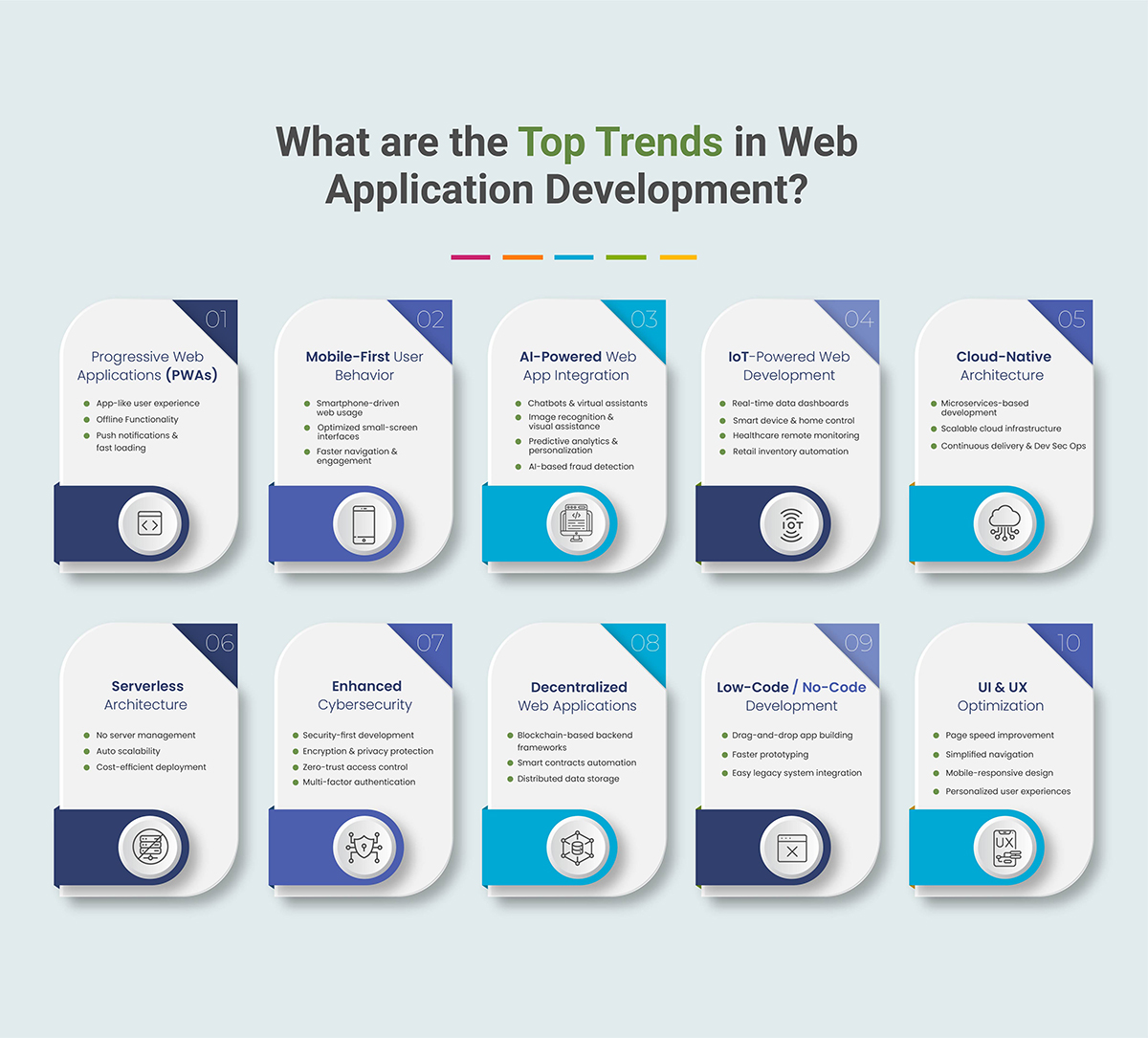
What are the Top Trends in Web Application Development?
App development for startups and enterprises has accelerated rapidly due to technological advancements. Below are the web application development trends, which can help your business remain future-ready in 2026.
-
Progressive Web Applications to Redefine User Experience
A report from Grand View Research estimates that the global progressive web app market size will reach USD 21.24 billion by 2033, growing at 29.9% CAGR. - Source
Progressive web applications (PWAs) are rising in popularity for delivering app-like interactions, boosting retention, and sending push notifications.
What are the reasons behind progressive web app development getting so much hype and being preferred by emerging and established US companies? Continue scrolling below to find out!
-
Mobile-first User Behaviour
As per a recent report from Demand Sage, there are around 5.78 billion smartphone users worldwide, representing about 70% of the global population. About 82.2% American people use smartphones. The facts indicate how important it is for businesses to optimize web application development, prioritizing mobile-first designs to sustain in the competitive market.
If your startup is implementing a user-friendly web application, try optimizing the interfaces for devices featuring small screens, like smartphones. This approach not only ensures faster load times but also intuitive navigation and an engaging experience for users.
PWAs are web-based software programs that function just like native mobile apps. These apps load quickly on any device featuring a modern web browser and allow offline access to users.
-
Cost-efficient Web Development
Progressive app designs reduce development and maintenance costs by eliminating the need for separate native apps. With modern web technologies and reusable components, businesses deliver fast, feature-rich experiences while keeping budgets flexible for startups and established enterprises.
-
Performance Optimization
PWAs use service workers, caching, and optimized loading strategies to deliver fast, reliable performance. Techniques like pre-caching, lazy loading, and code splitting reduce delays, ensure smooth interactions, and keep users engaged across varying devices and network conditions.
-
Cross-platform Web Apps
Progressive web applications are highly versatile and minimize the need for separate web app development for various operating systems due to cross-platform compatibility. You can run these software programs on all kinds of devices using standard web technologies.
Cross-platform solutions can support smooth offline functionality when backed by proper web app performance optimization. With progressive architectures, startups can engage users across devices without maintaining separate codebases for iOS, Android, or desktop.
-
Future-Ready Web Innovation with AI, IoT, and AR/VR
Web application development with artificial intelligence (AI), augmented reality or virtual reality (AR/VR), and Internet of Things (IoT) offers several benefits. These technologies enhance user experience, streamline workflow, and help with decision-making and responding intelligently in real-time.
AI-powered Web App Integrations
- Chatbot & Virtual‑Assistant Integration: AI‑powered chatbots and virtual assistants offer 24/7 conversational support, guiding users through queries, transactions or product discovery, boosting engagement and reducing human‑agent load.
- Visual Assistance & Image Recognition: Visual AI enables web apps to analyze user‑uploaded images or real‑time camera input to tag, search, or guide users, supporting use‑cases like product search, AR previews, or real‑estate walkthroughs.
- Predictive Analytics & Behavior Forecasting: AI models analyse user data and prior interactions to forecast future behavior. These frameworks enable personalized content, suggestions, and dynamic UI adjustments when integrated with web app development services.
- Automated Content Creation & Personalization: Embedding artificial intelligence is helpful for US firms to auto-generate or adapt content, comprising text, visuals, and layout suggestions, for websites in real time. The main objective of AI-powered web application development is to tailor content as per user preferences and reduce manual design effort.
- Fraud Detection & Security Monitoring: Web applications leverage AI-driven fraud detection modules to monitor transactions, detect anomalies, flag suspicious behavior, and block fraudulent activity in real time.
-
IoT-Powered Web Development
- Real‑Time Data Visualization Dashboards: IoT sensors feed live data, which are environmental or collected through device telemetry, to web dashboards. These feeds are then used for real-time charts, alerts, and analytics, allowing instant insights and decision‑making.
- Smart Home & Device Control via Web Interfaces: Web apps connected to IoT allow users to monitor and control smart‑home devices. They can operate lights, thermostats, and security systems through browsers or mobile‑web portals.
- Healthcare & Remote Patient Monitoring Platforms: IoT‑enabled medical devices and wearables stream biometric data to web platforms for remote monitoring, diagnostics, and timely alerts, improving patient care.
- Web‑Based Retail & Inventory Management Systems: Many retailers use IoT-enabled web platforms with smart shelves and RFID sensors to automatically track stock levels, update inventory in real time, and ensure smooth stock management.
Use Cloud-Native and Serverless Architecture for Web Apps
When it comes to web application development, modern developers prefer cloud-native and serverless architecture. Both these backend infrastructure models are implemented while developing programs for websites. Let’s discuss what makes them stand out.
Cloud-Native Architecture
This framework builds web applications using scalable cloud infrastructure, containers, and microservices. Cloud-native web apps enable high resilience, continuous delivery, and faster deployment. Their special features include:
- Modular & Scalable Design: Microservices enable developers to build highly resilient, portable applications that scale effortlessly, allowing teams to quickly adapt to changing business requirements.
- Flexible DevOps Practices: Cloud-native approaches shift teams from monolithic architectures to modular, cloud-optimized processes, encouraging continuous innovation and faster feature delivery.
- Built-in Security with DevSecOps: Security is integrated throughout the development lifecycle, reducing vulnerabilities while maintaining agile deployment cycles for modern web applications.
Serverless Architecture
In this framework, web applications don’t need server management and can function on-demand. Serverless models help businesses save considerably on costs while streamlining development and improving scalability through an automated cloud handling platform.
Serverless infrastructure is important in web application development due to the following reasons:
- Cost Efficiency: Companies pay only when they execute functions, avoiding idle server costs. This makes serverless models ideal for low-traffic, event-driven, or rapidly growing web applications.
- Automatic Scalability: Serverless functions dynamically scale up or down to handle traffic spikes without manual intervention. The infrastructure ensures smooth user experiences during peak demand.
- Faster Deployment: Software developers can focus more on writing code while providers manage infrastructure. This arrangement enables instant deployment and faster time-to-market for web applications.
- High Availability & Reliability: Cloud providers manage uptime, replication, and failover with serverless architecture. Using this platform ensures applications remain available across multiple data centers with minimal downtime.
- Enhanced Security: Features like isolated execution environments and automatic patching by providers reduce security risks. To protect applications from potential attacks and infrastructure vulnerabilities, this model offers a reliable solution to US businesses.
API-first web development ensures seamless integration across cloud-native and serverless environments. It allows startups to build modular, scalable web applications that connect effortlessly with third-party services, modern microservices, and emerging technologies like AI and IoT. For more insights into the scope of APIs in web application development, contact Proquantic.
Protect Sensitive User Data with Enhanced Cybersecurity
Businesses need powerful measures to minimize the risks due to cyber threats. If you are launching your custom web application in 2026, here’s why cybersecurity strategies are essential.
So, how do you protect your confidential data with cybersecurity? Let’s discuss the main aspects of this technology in web application development.
-
Security-First Development Evolution
Modern web applications now prioritize security from the earliest design stages. Integrating security in development ensures vulnerabilities are minimized, protecting sensitive user data and building trustworthy digital experiences.
-
Advanced Encryption & Privacy
Strong encryption safeguards user data both in transit and at rest. Coupled with robust privacy measures, it prevents unauthorized access, ensuring compliance with global data protection regulations.
-
Next-Gen Web Firewalls
Future-ready web application firewalls detect and block sophisticated threats in real time. They protect applications from SQL injection, cross-site scripting, and other evolving cyberattacks.
-
Zero-Trust Architecture Adoption
These modern web app development frameworks assume no user or device is inherently trustworthy. Continuous verification and strict access controls enhance security, reducing risks from insider threats and external breaches.
-
Multi-Factor Authentication Use
Implementing multi-factor authentication strengthens login security by requiring additional verification steps. It drastically reduces unauthorized access, safeguarding sensitive accounts and personal user information.
-
Secure DevOps Practices
Integrating security into DevOps pipelines ensures vulnerabilities are identified early. Automated testing, continuous monitoring, and secure coding practices promote safer, resilient web applications.
-
Eliminate Intermediaries with a Decentralized Web Application
A decentralized application reduces your company’s dependence on central servers by operating on a distributed network. While this improves resilience and transparency, transaction costs vary by blockchain-based web applications and are not always lower than centralized alternatives.
Wondering how this web application development trend is beneficial for your business? Check out its amazing features as we discuss them one by one here.
-
Backend Frameworks
Decentralized web applications leverage specialized backend frameworks to manage peer-to-peer interactions, ensuring secure, transparent data flow without relying on central servers. These frameworks reduce dependency on intermediaries, streamline operations, and empower users with greater control over their data.
-
Smart Contracts
Smart contracts automate agreements and transactions on decentralized platforms, removing the need for third-party intermediaries. By executing code-based terms securely and transparently, they enhance trust, reduce transaction costs, and enable seamless, self-governing interactions between parties.
-
Distributed Storage
Distributed storage solutions store data across multiple nodes instead of central servers, enhancing security, resilience, and accessibility. This approach eliminates intermediaries, prevents single-point failures, and allows users to retain ownership and control over their data in decentralized web applications.
-
Utilize Low-Code Platforms for Web Application Development
App development with the help of no-code or low-code platforms accelerates the process. Businesses can expect better visual workflows, improved collaboration, reduced manual coding, and accelerated prototypes with this approach.
A low-code platform allows a web application developer to build more scalable solutions with minimal technical complexity. Below are the additional features that you can utilize for your firm using this automation and workflow technology.
-
Boost Development Speed Further
Low-code platforms accelerate web application development by offering prebuilt components and drag-and-drop interfaces, enabling teams to launch functional apps faster without extensive coding expertise.
-
Cloud Readiness for Scalable Growth
Low-code solutions integrate seamlessly with cloud services, ensuring web applications can scale effortlessly, handle increased traffic, and support business growth without complex infrastructure management.
-
Seamless Legacy System Integration
These platforms simplify connecting new web applications with existing legacy systems, ensuring smooth data exchange, operational continuity, and minimized disruptions during digital transformation initiatives.
-
Strong Security and Compliance
Low-code platforms provide built-in security features, role-based access, and compliance tools, helping developers meet regulatory requirements while protecting sensitive data across web applications efficiently.
-
Focus on UI and UX to Reduce Churn and Bounce Rates
A powerful way to keep users engaged is by building a web app that feels intuitive and seamless. Effective UI and UX strategies motivate users, encourage longer interactions, and strengthen long-term engagement. Here’s how strong design foundations help minimize bounce rates and reduce churn.
-
Optimize Page Speed
Fast-loading pages improve both UI perception and UX satisfaction. Compress images, minimize scripts, and use skeleton screens so users see a polished interface immediately, reducing frustration and early exits.
-
Simplify Navigation Flow
Clear menus, visible buttons, and logical layouts enhance UI intuitiveness. Combined with structured content and consistent pathways, this UX approach ensures users find what they need quickly. Integrating UX and UI in web application development simplifies navigation and lowers bounce rates.
-
Mobile-First Responsive UI
A mobile-first UI ensures buttons, forms, and visual elements adapt perfectly to any screen. Coupled with responsive UX patterns like swipe gestures or sticky menus, it keeps mobile users engaged longer.
-
Clean and Minimal Design
Thoughtful UI choices, which include whitespace, typography, contrast, and consistent colors, make interfaces visually appealing. This complements UX by reducing cognitive load, making users more likely to explore pages instead of leaving.
-
Interactive and Personalized UI
Dynamic buttons, hover effects, feedback animations, and personalized content enhance the UI’s appeal. Combined with UX strategies like tailored recommendations, this keeps users engaged and encourages repeated visits.
Stay Ahead with Our Web Application Development Trends
Proquantic leads web application innovation by aligning deep technical expertise with strategic business goals. We deliver custom, scalable web apps, from MVPs for startups to enterprise-grade SaaS and portal platforms, which align with real user needs and not assumptions.
Our agile and data-driven approach speeds time-to-market while reducing costs and technical complexities. Like many US firms, you can also trust our web app development company for modern UI/UX design, cloud-native architectures, secure multi-tenant SaaS, and ongoing support, ensuring long-term business growth.
With a strong portfolio across industries, transparent collaboration, and a commitment to quality, we offer tailored solutions that drive ROI, streamline operations, and empower onshore, offshore, and IT augmented teams.
Conclusion
Web application development strategies are consistently evolving, and the trend is likely to continue as we enter 2026. It is that crucial moment for all enterprises and emerging startups to redefine their approaches to accelerate every stage of the product lifecycle.
Whether you are launching a software program for a new website or making apps for existing portals, integrating new technologies helps your business thrive in the US’s competitive digital market.
When it comes to choosing trends for web development, the list comprises mobile-first strategies, AI, VR/AR, IoT, low-code adoption, and more. These technologies enable smarter automation, personalized user experiences, real-time analytics, and more efficient workflows.
Ready to upgrade your digital strategy with user-centric, responsive, and future-ready web apps? Connect with our experts at Proquantic to explore the right web application development approach and build resilient products that drive real business impact. Let’s create your next app together!
Frequently Asked Questions (FAQs)
How much is the web application development cost for a US startup?
For U.S.-based startups, web application costs in 2026 will vary depending on complexity and scope. Based on the latest trends, the estimated pricing can be somewhere around the following:
AI & ML-Integrated Apps: Expect to invest between $80,000 and $250,000+ for developing web applications with AI/ML features. AI adds 30 to 50% to base budgets due to model integration and cloud costs. Mid-complexity AI apps often begin around $90K to $200K.
Progressive Web Apps (PWAs): The cost of PWA development is lower as compared to native apps. It may take $10K to $30K for designing a simple PWA MVP. You may need to invest anywhere between $10,000 and $100,000 for a progressive web application with full functionality.
Cloud-Native or Serverless: Architectures reduce infrastructure management costs, but setup adds 10 to 25% to the project. Base app costs for serverless or cloud-native platforms are similar to mid-tiers, which range from $50,000 to $150,000+.
Decentralized Web: Adds development overhead or Web3 components for better functionality. For example, projects with blockchain or smart contracts may push budgets $100K+ due to security, custom modules, and audits.
Low-Code Platforms: Use frameworks like Bubble or OutSystems to reduce custom code in the range $20,000 to $80,000 for MVPs and early versions. Less coding means faster delivery.
UI/UX-Intensive Apps: High-quality UI/UX increases costs by 10 to 25%, adding roughly between $5,000 and $30,000 to web application development projects.
IoT & AR/VR Integrations: Complex integrations can significantly increase your startup's budget. This means apps with IoT or AR can be in the range $150,000–$400,000+ due to custom hardware, APIs, secure real-time flows, and sensor data support.
Does integrating AI and ML enhance web applications?
Yes, AI and ML integration in web applications enables automation, data‑driven personalization, intelligent features, and improved UX. Modern web apps that embed AI offer smarter user experiences, dynamic content, predictive analytics, and scalable web app performance optimization.
Many US startups that integrate AI/ML into their web apps often deliver more value, better user retention, and competitive differentiation when compared with basic applications. To learn more about AI-powered web apps and how you can use them to grow your business, contact Proquantic.
Do PWAs outperform traditional and native apps?
Progressive Web Apps (PWAs) often outperform traditional web or native apps in many use cases, especially for startups focused on reach, cost, and speed to market. A single PWA codebase works across devices and browsers, cutting development and maintenance costs dramatically relative to separate native builds.
PWAs also benefit from faster deployment, which indicates no app‑store delays, instant updates, offline capabilities via service workers, and better SEO since they’re indexed by search engines.
For many content, e‑commerce, or B2B SaaS startups, PWAs offer an effective, efficient alternative to native apps.
How does serverless or cloud‑native architecture benefit startups?
Serverless and cloud‑native architectures help startups by offering scalability, flexibility, lower upfront infrastructure costs, and quicker time-to-market. Since companies avoid provisioning and manage their own servers, they pay only for what they use and reduce overhead.
These architectures scale automatically with demand, making them ideal for unpredictable or rapidly growing user bases. Combining cloud-native deployment with modern web-app patterns enables faster updates, easier maintenance, and smoother integration with modern services like databases, analytics, APIs.
Which security and compliance matters for modern web apps?
Modern web apps, especially those used by startups and enterprises, prioritize secure-by-design measures. The focus is on data encryption in transit and at rest, secure authentication and authorization, secure session management, and adherence to compliance standards relevant to their industry, including GDPR‑like privacy rules, data‑protection laws, and secure storage of user data.
US enterprises must also guard against vulnerabilities in third‑party integrations, regularly update dependencies, and monitor for permission or browser‑level security gaps (especially for PWAs). Proactive risk assessment, secure coding practices, and ongoing audits help maintain trust and avoid breaches in your custom web application.
How can startups keep web apps relevant with new trends?
Startups can keep their web-based software programs relevant by designing them with modular architecture, scalable cloud‑native backends, and flexible front‑ends that support incremental feature additions. You can also utilize modern frameworks and standards, including responsive design, PWA support, API-first design, and AI/ML readiness to ensure adaptability.
Regular updates based on user feedback, tracking usage metrics, and evolving UX/UI according to the latest design trends also help keep up with web application development trends. Your business can stay technology-agnostic and prioritize routine upgrades, allowing web apps to evolve without frequent costly rewrites and remain relevant as technology trends shift.