


Even five years back, we could see a software developer walk into a stand-up meeting on a Monday morning carrying a familiar burden of endless feature requests, bug fixes, looming deadlines of release and documentation updates. Today, the same developer may ask the AI assistant to create test cases, review pull requests, generate code snippets and summarise the technical improvements.
Once, what took hours can now take place in minutes. The question no longer is the relativity of AI in software development, but how effectively organizations can harness its power to innovate for the future.
The quick adoption of AI in software development is changing how modern software is built, ideated, tested and released.
The development teams no longer rely on manual processes. Instead, they are welcoming the intelligent systems which reduce repetitive tasks, streamline workflows and enable quicker decision making throughout the entire cycle of software development.
This shift is taking place at an unprecedented speed. As per Stack Overflow’s Developer Survey in 2025, nearly 84% of developers plan to use or already use AI tools in their dev workflows.
This figure demonstrates that AI is quickly gaining a position as a standard part of their engineering toolkit instead of an engineering technology.
Launch high-performance apps for Android and iOS.
AI in software development is assisting organizations by:
- Delivering more data-driven and personalized experiences
- Enhancing decision-making with project insights and predictive analytics
- Accelerating the deployment process with intelligent DevOps workflows
- Detecting vulnerabilities and bugs before they affect the end users
- Automating quality assurance and software testing processes
- Optimizing and generating code more quickly with AI-powered coding assistants
The rise of AI-assisted programming, AI coding tools and software development in automation is enabling developers to spend less time on repetitive processes and more time on solving critical business challenges.
Meanwhile, advancements in Machine Learning in generative AI and software development are opening doors to abilities that would have seemed way too futuristic even a few years ago.
In this article today, we will be exploring how AI is being used across the lifecycle of software development, its practical benefits for development teams and business and the key trends that will be shaping the future of software engineering.
AI in software development – scope and definition
AI in software engineering includes using algorithms which mimic human cognitive functions like problem-solving, reasoning and learning for testing, building and maintaining applications
Its scope spans across the entire SDLC or Software Development Life Cycle, right from gathering initial requirements, ideal for release and debugging.
The importance of AI for modern development teams
AI in software development today involves the following aspects:
Increasing complexity of software
Modern applications are composed of intricate APIs, distributed microservices, and vast cloud infrastructures. AI handles the cognitive load of navigating the vast codebases, enabling human developers to concentrate on high-level architecture.
Pressure for quick deployment
To remain competitive, teams must iterate quickly. AI automation speeds up testing and coding, significantly reducing the time to market.
Need for personalized experience
Users expect software to adapt to their unique needs. Predictive analytics and Machine Learning enable teams to create applications that deliver customized and dynamic content in real-time by learning user behaviour.
Enhanced security and code quality
AI-powered tools help in flagging duplicate logic, identifying vulnerabilities and enforcing coding standards. By automating the code reviews, teams can conveniently ship more robust and secure code with fewer manual bottlenecks.
Key technologies that power AI development solutions
- Machine Learning – Powers recommendation engines and predictive models for iteratively enhancing system performance.
- Generative AI – Auto-generates documentation, boilerplate code and test suites based on the natural language inputs.
- Natural Language Processing – Drives chatbots and intelligent code assistants, connecting machine execution and human instruction.
- Deep Learning – Uses multi-layered and complex neural networks for simulating human decision-making that is critical for advanced natural language tasks.
- Predictive Analytics – Analyses the past projects' metrics as well as usage for estimating timelines of the deliveries, forecasting user trends and identifying potential risks of projects.
- Large Language Models or LLMs – large foundation models that are capable of generating complex logic, understanding context and answering technical queries about the codebase.
AI in software development – how the tech is leveraged
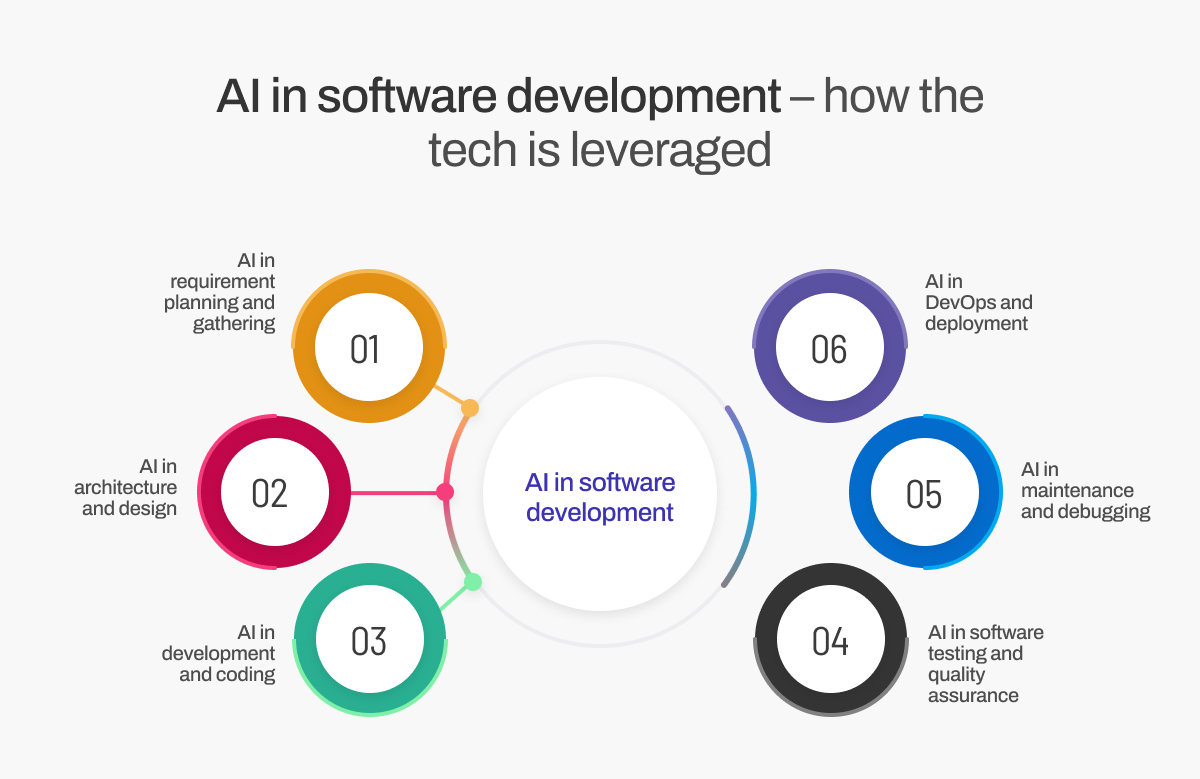
The impact of AI in software development spans far beyond code generation. Today, Artificial Intelligence nearly supports every stage of the Software Development Lifecycle or SDLC, enabling the teams to automate repetitive tasks, make better decisions and speed up the product delivery.
From monitoring applications in production to gathering requirements, Artificial Intelligence is transforming how software is built, planned, maintained and tested.
Let’s have a detailed look:
AI in requirement planning and gathering
Each and every successful software project starts with clear requirements. But translating business goals into technical specifications is often prone to misunderstandings and time-consuming, and this is where AI becomes valuable.
Modern AI tools can analyze emails, transcripts, customer feedback, and stakeholder discussions for extracting actionable requirements. They can identify the missing data and efficiently allocate more resources.
AI also makes resource planning and project estimation more accurate by analyzing the team capacity, historical data of the project and patterns of development. As a result, organizations can come up with more realistic timelines.
The practical applications of AI in software development
- User acceptance and story criteria creation
- Automated documentation generation
- Requirement gap identification
- Resource planning and timeline prediction
By reducing the ambiguity early in the project, AI enables teams to start development with greater confidence and clarity.
AI in architecture and design
Architectural designs can significantly affect a software's security, scalability and maintainability for the long term. The AI architects make proper decisions by assessing large volumes of technical information and recommending the most suitable solutions.
Based on the requirements of the project, AI suggests database structures, architecture styles, design patterns and technology stacks.
AI in software development can also predict scalability needs for the future by assessing the expected growth of users and workload systems.
The key benefits are:
- Quick architectural decision-making
- Reduced design errors
- Planning for improved scalability
- Enhanced alignment between business and technical requirements
Instead of replacing AI architects, AI functions as a smart advisor which supports more data-driven and quicker design decisions.
AI in development and coding
Coding is one of the most evident applications of AI in software development. The AI-powered development tools help programmers with improvement suggestions, code generation, and automation of repetitive development tasks.
Developers can leverage natural language prompts for generating boilerplate code, creating functions, receiving real-time coding recommendations and building APIs. This enables them to focus more on solving the business problems and less on the usual coding activities.
The most popular AI coding assistants
- Tabnine
- GitHub Copilot
- Cursor AI
- Amazon CodeWhisperer
- ChatGPT for Developers
The benefits:
- Better code consistency
- Reduced repetitive work
- Higher productivity of developers
- Quicker coding speed
As AI-powered programming evolves, the developers are working increasingly alongside AI as collaborative partners instead of using it as an automation tool.
AI in software testing and quality assurance
Testing is often considered to be one of the most resource-intensive phases in software development. AI assists in streamlining quality assurance by automating test execution, creation and optimisation.
The AI-powered testing tools can automatically generate test cases, conduct visual testing, perform regression testing and evaluate the application performance under various conditions.
Most importantly, they can figure out the high-risk areas which need deeper attention for testing.
The testing capabilities include:
- Error detection
- Bug prediction
- Test optimization
- Root cause analysis
A rising trend is self-healing test automation, where the AI automatically updates test scripts when there is a change in the application interface. Combine with the AI-based QA platforms, which significantly reduce the effort of testing while enhancing the quality of software.
AI in maintenance and debugging
Software maintenance often consumes a massive portion of development resources. AI simplifies this process by enabling the teams to diagnose, identify and resolve issues more efficiently.
By analysing the monitoring system behaviour, logs and recognising patterns, AI can instantly detect issues and point out the probable causes of failures. It can also forecast issues in the future before they impact users.
The common applications include:
- Technical debt management
- Predictive maintenance
- Intelligent log analysis
- Automated bug detection
Such capabilities enable organisations to reduce downtime, maintain higher levels of software stability and speed up the resolution of issues.
AI in DevOps and deployment
The influence of AI continues even after the development is complete. In DevOps environments, AI improves infrastructure management, deployment process and system monitoring.
The AI-powered tools are able to assess deployment risks, optimise the CI/CD pipelines and detect anomalies in real time. They can also recommend the infrastructure adjustments based on the dynamic workloads.
- The key applications include:
- Deployment risk analysis
- Performance anomaly detection
- Predictive system monitoring
- Smart CI/CD pipeline management
By automating the responses and operational insights, AI enables organisations to maintain high-performing and reliable applications while reducing the complexity of operations.
From architecture, planning, deployment, maintenance, to testing, Artificial Intelligence is giving shape to every stage of the software development lifecycle. The organizations that effectively integrate AI into their workflows, gain significant advantages in speed-to-market, software quality and productivity.
This makes AI an essential component of modern software engineering.
Practical ways businesses use AI in software development
The potential of AI is impressive, and its true value is found in implementation. Businesses across industries are integrating Artificial Intelligence into their development workflows to speed up innovation, improve efficiency and deliver enhanced digital experiences.
Let’s have a detailed look:
Automation of repetitive tasks
Developers often spend a significant amount of time on the routine activities, which, although crucial, add little value. AI helps in automating such repetitive tasks, enabling teams to focus on innovation and problem-solving.
The most common applications include:
- AI-powered code reviews which identify coding inconsistencies and vulnerabilities
- Automated documentation generation from project updates and codes
- Dependency management through compatibility checks and automated updates
- Smart version management streamlines collaboration and tracking changes
By decreasing the need for manual effort, organisations can enhance productivity and minimise human error.
Enhancing team productivity
One of the most significant benefits of AI in software development is its capability to amplify the performance of the team. AI tools function as virtual assistants. Offering technical guidance, instant recommendations and knowledge support through the process of development.
Which leads to:
- Better collaboration among testers, developers and project managers
- Reduced effort for testing, coding and documentation
- Quicker development cycles through automated workflows
- Better knowledge sharing by turning organisational expertise easily accessible
As a result, teams can confidently spend more time creating value and less time managing repetitive processes.
Speeding up product launches
In competitive markets, speed often determines success. AI helps businesses bring in products to market quickly by streamlining the development process and reducing bottlenecks.
Organisations use AI for:
- Speed up the Minimum Viable Product development
- Reduce release cycles through deployment and automated testing
- Enhance responsiveness as per dynamic customer expectations and market demands
This agility enables businesses to validate ideas quickly and gain a competitive advantage.
Enhancing customer experience with AI
Beyond the process of internal development, AI helps businesses create more personalised and engaging experiences.
The popular cases include:
- Smart search capabilities which deliver more relevant results
- Personalised recommendations based on the behaviour of users
- AI-based virtual assistants and chatbots for quick support
- Predictive customer support, which anticipates issues even before they occur
Such capabilities enhance customer satisfaction while strengthening loyalty to the brand.
Benefits of AI in software development
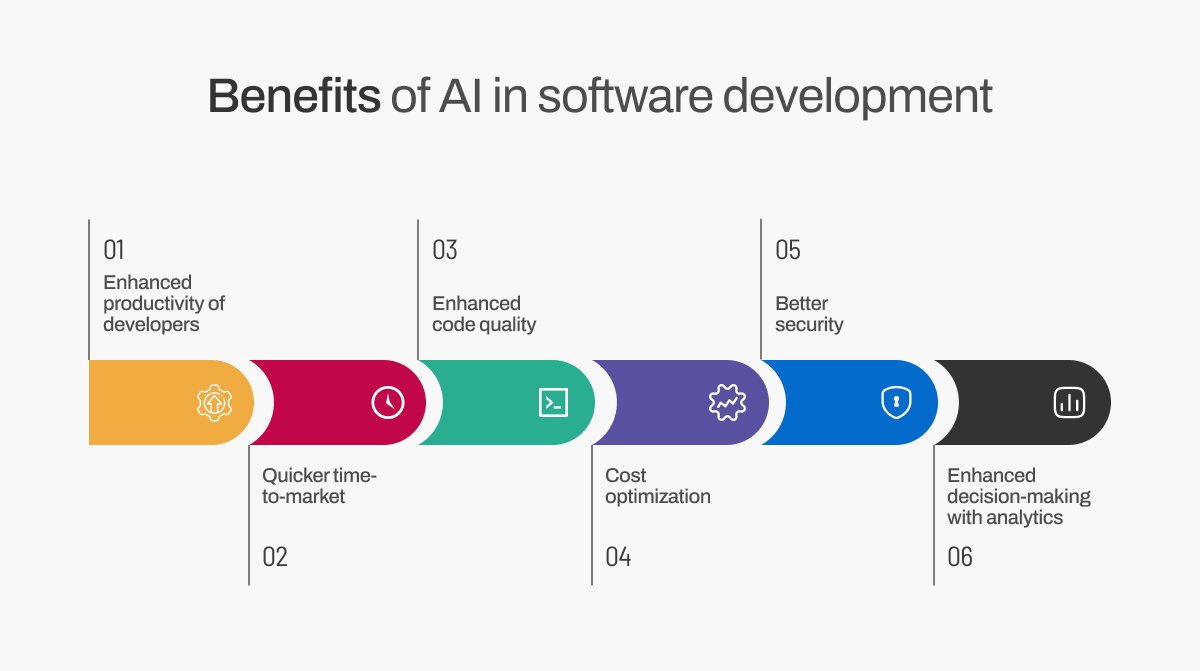
The rising adoption of AI is driven by business outcomes that are measurable. Organisations use AI effectively after realising benefits across quality, productivity, security and operational efficiency.
Enhanced productivity of developers
AI-based coding assistance enables developers to concentrate on innovation and complex problem-solving instead of the usual coding tasks.
Quicker time-to-market
Through automated testing, rapid prototyping, and an accelerated deployment process, AI enables businesses to launch updates and products quickly.
Enhanced code quality
Adherence to coding standards, real-time code reviews, and automated error detection contributes to more reliable and cleaner software with fewer bugs.
Cost optimization
By improving resource allocation and automating labour-intensive tasks, AI helps in reducing the long-term maintenance costs and operational expenses.
Better security
AI strengthens the security of the software with threat prediction, vulnerability detection and secure recommendations, which help in identifying risks before deployment.
Enhanced decision-making with analytics
AI offers valuable insights into resource utilisation, development performance and project success probabilities, enabling companies to make more accurate and well-informed decisions.
Together, these benefits explain why AI is turning into the core element of modern software development strategies, instead of yet another technology trend.
AI in software development – examples around us
The rising adoption of AI in software development is not restricted to experimental projects or startups. Some of the world’s top companies are already leveraging AI for enhancing software quality, improving development efficiency and providing better user experiences.
Their success demonstrates how Artificial Intelligence has evolved from a promising concept to a practical advantage for business.
GitHub Copilot and Microsoft
One of the most significant examples of AI-powered software development is GitHub Copilot, which is developed through collaboration between GitHub and Microsoft.
Often described as an AI programmer, Copilot enables developers to complete functions, generate code, receive context-based coding suggestions and create documentation directly within their development environments.
By reducing the time spent on searching for solutions and repetitive code, Copilot enables developers to focus on solving critical business challenges.
A lot of organisations have reported noticeable improvements in productivity, smoother onboarding experiences for junior to mid-level developers and quicker feature development.
AI's rising enterprise adoption further highlights how AI-assisted coding is becoming the standard component of modern software engineering workflows.
Google’s AI-powered development practices
Google has long integrated AI into its engineering operations. The company leverages AI across various stages of software development, including code analysis, testing, and infrastructure management.
AI-powered systems assist in automated software testing by identifying potential defects and emphasising test coverage areas. Google also uses intelligent code review processes, which detect anomalies, analyse code quality, and recommend improvements before deployment.
Beyond development, AI plays a crucial role in the management of Google’s expansive infrastructure. Intelligent systems continuously monitor workloads, optimise resource allocation and predict potential performance issues to ensure reliability at a mass scale.
Netflix and AI-based engineering
Netflix offers yet another compelling example of how AI can influence operational excellence and software development. Serving millions of users globally needs optimisation, monitoring and innovation.
Netflix's most recognised AI application is recommended by the engine. By assessing the user preferences, viewing habits, and behavioural patterns, AI consistently enhances content recommendations, exhibiting how Machine Learning and Software Engineering work together to create highly personalised customer experiences.
Enterprise software companies using AI
A lot of software providers are embedding AI directly into the development processes and products for improving innovation and operational efficiency.
- Service Now integrates AI into incident management, workflow automation, digital transformation initiatives and predictive analytics.
- SAP uses AI for automating processes, enhancing business applications and helping organisations to make data-driven decisions more effectively.
- IBM works with AI across testing automation, software engineering, enterprise application management and code modernisation through its AI solutions.
- Salesforce uses Einstein, its AI platform, for automating workflows, supporting intelligent app development and generating insights.
The examples highlight a common trend – these organisations are not using AI merely for writing the code quickly, but also for optimising the entire development ecosystem from customer experience, monitoring, deployment, to testing, etc.
As the AI technologies continue to mature, the role in software engineering is expected to become more transformative and strategic.
AI in software development – trends for 2026 and beyond
The quick evolution of AI is giving shape to software development at a never-seen-before speed. What started as a simple code and automation assistance is now evolving into smart systems that are capable of coding, planning, testing, optimising, and securing software with minimal human intervention.
As organisations continue to invest in AI-driven innovation, various trends are emerging to define software engineering in 2026 and beyond.
Let’s have a look at some of the trends:
Rise of the Generative AI development platform
Generative AI is shifting beyond code suggestions to become a full-fledged development companion. Today's platforms can transform the natural language prompts into application components, functional code and even complete workflows.
The key developments include:
- Prompt-based development, where the developers describe requirements in plain language.
- Acceleration of non-code and low-code development environments.
- Natural language-to-code generation for quicker prototyping.
Such a trend is significantly decreasing the development barriers while facilitating quicker software creation.
AI-trained software engineers
Instead of replacing developers, AI is transforming them into more efficient and productive professionals. The future of software engineering will revolve around collaboration between AI systems and humans.
The key characteristics will include:
- AI pair programming for problem-solving and coding assistance
- Human-AI collaboration for the entire lifecycle of development
- Enhancement of productivity by automating repetitive tasks
With these, developers will spend less time focusing on innovation, architecture and strategic decision-making.
Autonomous software testing
Software testing is becoming increasingly self-sufficient and intelligent. AI-based testing platforms can now identify risks, generate test cases and adapt well to the app changes automatically.
The capabilities include:
- Intelligent bug prediction by using historical development data
- Self-healing automation, which updates the test scripts when there is a change in the interface
- Consistent assurance of quality integrated into development pipelines
Such advancements enable organisations to release software more quickly without any compromise to the quality.
AI-powered DevSecOps
As the cyber threats increase and become more sophisticated, security is becoming an integral part of the development process. AI-powered DevSecOps combines security, development and operations into an intelligent and unified workflow.
Organisations are using AI for:
- Real-time risk assessment and threat intelligence
- Continuous monitoring of security
- Secure development of lifecycle management
Such a proactive approach helps in the identification of vulnerabilities earlier and strengthens the security overall.
Hyper-personalized applications
Modern users expect digital experiences tailored to meet individual needs. AI is making this possible with continuous behaviour analysis and adapting to apps in real-time.
- Dynamic interfaces which evolve based on preferences
- Analysis of user behaviour
- Adaptive experiences which improve satisfaction and engagement
As personalisation turns into a competitive differentiator, the AI-powered apps will continue growing to gain prominence.
Multi-agent AI systems
One of the most exciting developments is the emergence of multi-agent AI systems. Rather than relying on a singular AI assistant, organisations are starting to deploy multiple specialised agents which collaborate to complete complex tasks.
The potential use cases are:
- Foundations for autonomous software engineering environments
- Automated development workflows with minimum human intervention
- AI agents working together on testing, coding and deployment
This trend may refine how software projects are executed and managed in the upcoming years.
AI-based no-code and low-code development
No-code and low-code platforms are becoming more potent with AI integration. Such platforms enable users with limited expertise to build applications through natural language instructions and visual interfaces.
- Quick initiatives for digital transformation
- Democratisation for creating software
- Spiked participation from the citizen developers
Businesses can rapidly develop customer-facing apps and internal tools without entirely relying on traditional development teams.
Development of explainable AI or XAI
As AI is becoming deeply integrated into software systems, accountability and transparency are turning into critical concerns. The XAI or Explainable AI focuses on making the AI decisions understandable to users, developers and regulators.
Its rising importance comes from:
- Development of more trustworthy AI systems
- Increased transparency in the AI-driven decisions
Organisations adopting AI at scale will be increasingly prioritising explainability for ensuring responsible as well as ethical AI implementation.
These trends together highlight a future where the AI is not merely assisting software development but also actively shaping how software development is conceived, secured, built and maintained.
Businesses which embrace such innovations early will be well-positioned to compete in an increasingly AI-powered digital landscape.
Limitations and challenges of AI in software development
In spite of the transformative potential, AI comes with limitations as well. While the organisations are increasingly integrating AI into their developmental workflows, reliance on it without proper oversight can come with challenges and risks.
Understanding the limitations is crucial for maximising the benefits of AI while minimising the potential drawbacks, like:
Issues in code accuracy
One of the most common concerns involving AI-based code generation is accuracy. Although the modern AI tools can generate functional code quickly, they are not fail-proof.
AI models can sometimes come up with responses which are known as ‘hallucinations’. Here, the output may appear to be convincing, but they are outdated by practice, carry incorrect logic or are non-existent functions.
Likewise, AI may come up with recommendations that are valid technically but not suitable for a specific need of the business or the architecture of the project. AI must be seen as an assistant, but not an autonomous decision-making authority.
Privacy and security risks
AI systems often need access to large sets of data for generating useful recommendations and insights. This creates potential privacy and security concerns, particularly when it involves sensitive information.
The crucial risks include:
- Intellectual property concerns arise when AI-generated results resemble proprietary and copyrighted code.
- Compliance challenges that are related to regulations like GDPR, as well as industry-specific standards.
- Exposure of confidential customer or business data.
Organisations have to establish clear policies for governance regarding which data can be shared with AI tools and ensure compliance with applicable regulatory and legal requirements.
Overdependence on the AI tools
While AI can enhance productivity significantly, excessive reliance on automated systems might create unintended consequences for the development teams.
Developers who consistently depend on the AI-generated solutions might gradually experience:
- Knowledge gaps regarding the underlying technologies and system architecture
- Reduced problem-solving and critical thinking abilities
- Skill degradation in core programming competencies
Maintaining a balance between human expertise and AI assistance is crucial. Teams must continue investing in encouraging developers and technical training for understanding the reasoning behind AI-powered recommendations instead of accepting them blindly.
Governance and ethical concerns
As AI is becoming more deeply integrated into software development, the ethical considerations are gradually gaining importance. AI models learn from the existing data, which means that they can amplify and inherit biases in the training datasets unintentionally.
For addressing such concerns, businesses have to prioritise the implementation of responsible AI by establishing governance frameworks that promote:
- Compliant and ethical AI usage practices
- Clear oversight and accountability mechanisms
- Transparency in AI-driven decisions
- Bias and fairness mitigation
While AI provides a lot of scope for innovation, its successful adoption needs a thoughtful and careful approach which combines human judgment with technological advancement, responsible governance and security awareness.
Implementing AI in software development – best practices
Successfully adopting AI in software development requires more than just purely deploying new tools. Organisations that achieve the best value from AI follow a structured approach, balancing innovation with training, governance and continuous improvement.
Take a look below:
Begin with clear objectives
A lot of AI initiatives fail because organisations adopt the technology without a clear understanding of what they want to achieve. Before implementing Artificial intelligence, businesses must define the measurable goals which align with their broader business and developmental strategies.
These goals might include improving code quality, reducing development time, lowering operational costs and accelerating testing. Equally crucial is determining suitable use cases where AI can deliver the most significant impact.
Starting with the high-value and focused applications enables teams to build confidence and demonstrate success before expanding AI adoption across the organisation.
Keep the human users in the loop
While AI can automate a lot of aspects of software development, human expertise remains essential. AI-generated results must always be validated and reviewed by experienced professionals to ensure security, accuracy and alignment with the requirements of the business.
Organisations must establish processes that emphasise:
- Code validation before deployment
- Human oversight of AI-based recommendations
- Decision review mechanisms for important architectural and critical development
Invest in AI training
The efficiency of AI tools is dependent largely on the people using them. Organisations must invest in upskilling programs for developers, which help teams to understand how to effectively work with AI-based technologies.
Training must focus on:
- Prompt engineering techniques for better outputs
- AI foundational concepts and literacy
- Best practices for refining and reviewing AI-based codes
A workforce which understands both the limitations and capabilities of AI is well-equipped to use the tools responsibly and productively.
Establish security and governance policies
As AI becomes integrated into developmental workflows, strong governance becomes increasingly important. Organisations have to create policies that address data protection, responsible AI usage and compliance.
The crucial focus areas include:
- Defining clear guidelines for responsible and ethical AI adoption
- Aligning the AI usage with compliance and regulatory requirements
- Protecting sensitive customer and business information
A powerful governance framework helps ensure that innovation does not come at the risk of compliance and security.
AI in Software Development – what to expect ahead
The future of AI in software development is expected to move towards coding assistants towards autonomous agents that are capable of handling tasks like system optimisation, deployment, testing and analysis.
As AI takes over time-consuming and repetitive activities, software engineers will increasingly focus on architecture design, innovation, strategic decision-making and problem-solving.
The shift will also need developers to strengthen skills in AI literacy, critical thinking and prompt engineering, alongside traditional programming expertise.
While AI automation will continue to improve efficiency and speed up human creativity - development cycles, business understanding and contextual judgement will stay essential.
In the coming decade, most successful organisations will be the ones which effectively combine AI capabilities with human expertise, creating fast innovation, a smarter development process and more resilient software solutions.
Choose Proquantic Software for AI-driven software innovations
Proquantic combines a business-first approach with deep engineering expertise for delivering measurable outcomes in AI and software development. From custom software development to post-launch and deployment optimisation, our team build secure, scalable and future-ready solutions tailored to the business goals.
Using AI-powered automation, cloud-native architectures, predictive analytics and industry-specific expertise, we enable organisations to speed up their digital transformation and create smart applications at reduced cost for long-term growth with a competitive advantage.

Final words
AI is changing every stage of the software development lifecycle, empowering organisations to build high-quality apps more efficiently, faster and at lower costs. But the greatest value lies in empowering the developers and not replacing them.
By blending AI-driven capabilities with human expertise, businesses can easily streamline operations, unlock greater innovation and deliver unparalleled digital experiences.
Organisations that strategically welcome and integrate AI today will be well-equipped to adapt, scale, and function competitively in the technology-driven future.
FAQ (Frequently Asked Questions)
How is AI used in software development?
AI is leveraged throughout the entire lifecycle of software development, maintenance, deployment, debugging, software testing, code generation and requirement analysis. It helps in improving code quality, repetitive tasks and speeding up development.
Can AI replace software developers entirely?
No. AI can automate the routine testing and coding tasks, but it cannot replace human critical thinking, creativity, strategic decision-making and business understanding. AI functions best as a collaborative assistant instead of a replacement for developers.
What are the best AI tools for software development?
Some of the most popular AI development tools are ChatGPT, GitHub Copilot, Tabnine, Amazon CodeWhisperer, Cursor AI, etc. Such tools help in debugging, code generation, intelligent code suggestions and documentation.
What are some of the main benefits of AI-based coding?
AI-based coding increases the productivity of developers, reducing repetitive work, minimising errors, improving code efficiency, generating code quickly, etc. This allows the developers to focus on solving critical business and technical challenges.
Are AI-generated codes secure?
AI-generated codes enhance the efficiency of development, but they must always be tested or reviewed before deployment. Human validation is crucial to identify compliance issues, potential security vulnerabilities, and coding inaccuracies.