


If you think that app development for startups is just another engineering task, then you are already lagging because, in 2026, as every second counts, app development for startups has turned into a significant determinant for success. In the current market, users expect innovations that feel intuitive, fast, and smart, backed by personalization. Hence, the app development companies today compete on experience.
The days when products were built and deployed with the approach of 'ship it and fix later' are gone. The successful app development companies focus on creating the most relevant solution and scaling intelligently.
This trend is due to skyrocketing expectations in the US market, where consumers now prefer applications that use AI features like:
- Automated workflows
- Predictive interaction
- Personalized recommendations
Nearly 68% of the top-performing startups have reported investing in these capabilities in recent years since they have already turned into baseline requisites.
Navigating through this shift is not simple because more than ever before, the options of frameworks, tools, and platforms are endless, and startups could risk countless rewrites and wasted spend, whereas the users could abandon even before using it for a month. App development in 2026 calls for a new mindset, which balances strategy with innovation and thoughtful architecture with agility.
What startups should know about app development in 2026
App development for startups in 2026 will travel far beyond choosing the right tech stack or writing clean code. It is crucially a completely different discipline from enterprise application development. Typically, enterprises optimize to achieve stability, long release cycles, and compliance. On the other hand, startups create under uncertainty with constant pressure from the market, evolving ideas, and limited budgets. Their goal is not perfection but validation.
One of the most significant distinctions remains in how startups think about new features. Enterprise applications often grow based on layered functionality, but in the case of startups, they must fight an overload of features. Success stems from achieving a product that is fit for the market. Every feature must answer a very common question: 'Does the product solve the problem of the users currently?’ because anything else is clearly not relevant and hence, not needed.
Adaptability and speed define the app development process of modern startups, but speed does not always imply recklessness. In the year 2026, the smartest entrepreneurs and founders will prioritize quick experiments with controlled risks by learning, releasing, and refining in small cycles.
This is exactly where the clickable prototypes, MVPs, and iterative releases play an important role. It is important to know that MVP is no longer just another stripped-down product, but a strategic learning tool that is designed for testing assumptions quickly and affordably.
App development for startups also aligns with the lifecycle of the startups, as well, because during the idea stage, prototypes help in validating the demand. At the phase of early traction, MVPs evolve with quick iterations. On the larger scale, data-driven optimization, performance, and architecture will take the center stage rightfully.
In the year 2026, startups that treat app development as a business-led continuous process, which sustainably scales and is not a one-time creation.

The key trends to watch in app development for startups in 2026
The landscape for app development for startups in 2026 is being reshaped by resilience, intelligence, and speed. A process that once required long cycles of development and large engineering teams is currently being driven by experience-based thinking, modular architecture, and smarter tools. For startups, staying competitive currently is not just about how to create the apps, but also about what direction the ecosystem will be moving.
Integration with Machine Learning
One of the most crucial shifts is the rise of Machine Learning and AI-first embedded applications. Artificial intelligence today is implemented at the very core of the applications that power:
- Automated decision-making
- Chat interfaces
- Predictive workflows
- Personalization
Startups are increasingly designing applications where Machine Learning evolves alongside the user behavior and creating smarter products over time without any constant rewrites.
Leveraging low-code/no-code platforms
Another crucial accelerator is the low-code and no-code platforms. Although these cannot replace full-scale engineering, such tools allow startups to validate ideas early, create prototypes faster, and reduce the cost of initial development. In app development for startups, this means that the founders can test user journeys, workflows, and internal tools even before they commit to major builds.
API for seamless third-party integration
API-driven architecture is also dominating the current year. Startups are now creating flexible ecosystems instead of monolithic systems with integration of third-party services, AI models, analytics, and gateways, with the help of APIs. The approach makes spaces for easier expansion of features, faster scaling, and seamless integration with the maturity of the products.
Rising preference for cross-platform applications
On the executional front. Cross-platform development continues to gain dominance. Frameworks that enable a single codebase for powering web apps, Android, and iOS enable the startups to function faster, while maintaining a consistent user experience. This is, in fact, critical for the lean teams.
Compliance standards and security
The growing focus on compliance readiness and privacy-by-design is equally important. With rising user awareness and stricter data regulations, startups have to bake privacy and security into the architecture of the app right from day one and not keep them for retrofitting later.
Models for monetization
Finally, monetization models are also going through a significant evolution. Usage and subscription-based pricing are becoming normal, demanding apps that can track behavior, seamlessly scale billing, and deliver ongoing value.
This year, successful app development for startups is all about aligning adaptability, trust, and growth with the right choices of technology and not just focusing on rapid launches.
The right ways to prepare for app development for every startup
Even before beginning to write a single line of code, app development for startups must initiate with clarity and not creativity. A lot of startups fail in this phase because they create an app for a problem that really did not exist at that time. In the year 2026, successful founders spend a lot of time validating the problem instead of defending the solutions. The shift from problem validation to solution bias is what separates the expensive experiments from scalable products.
Validating problems
The very first step in this journey is problem validation. Founders have to ask whether the problem area or the pain point is urgent, frequent, or real enough for the users to care. Usability observations, surveys, interviews, and early landing pages assist in testing the assumptions even before the development begins. Startups that validate demand at the early stage diminish the risk of costly pivots at a later stage in the app development lifecycle.
Market competitor research
Once the problem is visible, competitor and market research enter the scenario. This is not about mimicking the competitors but also about determining the gaps. Analyzing the existing applications helps startups to identify where the users are frustrated, overcharged, or underserved. In app development for startups, the competitive insights shape pricing, positioning, and feature priorities more evidently than guesswork alone.
At the center of the preparation is a core value proposition, which is defined sharply. This answers a critical question: 'Why should a user choose an app created by you over other alternatives?’ The clarity of this question prevents overload of features and keeps the product centered on outcomes, rather than novelty.
The crucial pillars of preparation before the beginning of development:
- Define the early metrics of success – Concentrate on the metrics which reflect real value, like time-to-value, task completion, retention, or rate of activation, in place of vanity metrics like number of downloads.
- Align the goals of the application with outcomes of business – Whether your objective is operational efficiency, engagement, lead generation, or revenue earning, each and every feature must support a measurable business goal.
- Continuously validate assumptions – Treat validation as a consistent and continuous process and not a single-time checkpoint.
When correctly done, preparation revolutionizes app development for startups into an insight-driven and disciplined process. Startups that validate before they create, launch applications of products with direction, purpose, and a greater chance of market adoption.
Full-scale app or MVP? What should the startups start with?
While thinking about app development for startups, one of the most strategic and earliest decisions a company has to make is what to build first: an MVP, or Minimum Viable Product, or a full-scale app. In 2026, investors' expectations and market dynamics make the choice far more consequential than ever before. Startups that master the MVP mindset are at a much better position for validating their ideas with minimal risk and focus on a real product for the market before committing to any heavy creation.
Importance of an MVP in 2026
Today, an MVP has surpassed being a barebones prototype. It has transformed into a strategic testbed that is created for validating the core value proposition with real users. It must include only the most relevant features that directly answer the crucial user needs, enabling them to gather meaningful data and feedback early.
As per recent research, companies that use MVP approaches are likely to adapt as well as succeed, while avoiding feature overload and conserving capital.
Founders must avoid the following MVP myths
#Myth1 – MVPs are built ugly, hacked together.
Reality – When built with creativity, MVP quality reflects the usability standards and brand. Companies must not launch a sloppy MVP.
#Myth2 – MVPs must include most planned and crucial features
Reality -Adding too many features in MVP will dilute learning. It will also increase the time-to-market without validating any demand.
#Myth3 – MVPs replace full products.
Reality – MVPs inform as well as de-risk the full builds, and they do not replace them.
Frameworks for feature prioritization
Smart startups leverage prioritization tools for deciding what matters in an MVP, actually, like:
- RICE – Scores the features that are based on reach, impact, confidence, and effort. The scores help the teams to quantify value before building.
- MoSCoW- This categorizes the features as must-have, should-have, could-have, and won't have.
Skipping an MVP is logical. Here's when
There are rare instances where skipping MVP building can be justified, for example:
When the safety or regulatory compliance, or when the market demands a polished and robust experience from the very first day. But even in such scenarios, staged rollouts or phased releases still apply to the philosophy of MVP in spirit.
Some contextual examples:
- FinTech App – Create core account access as well as basic transactions before including personalized insights and analytics.
- Social networking startup – Launch MVP with features like discovery, posting, and profiles without advanced messaging or monetization.
- Health Tech Service – Release appointment scheduling and symptom checkers as MVP before insurance and telehealth integrations.
In the year 2026, creating an MVP first is the most intelligent path to conserving resources, validating assumptions, and preparing the stage for developing full-scale apps.
Choosing the right type of app for your startup
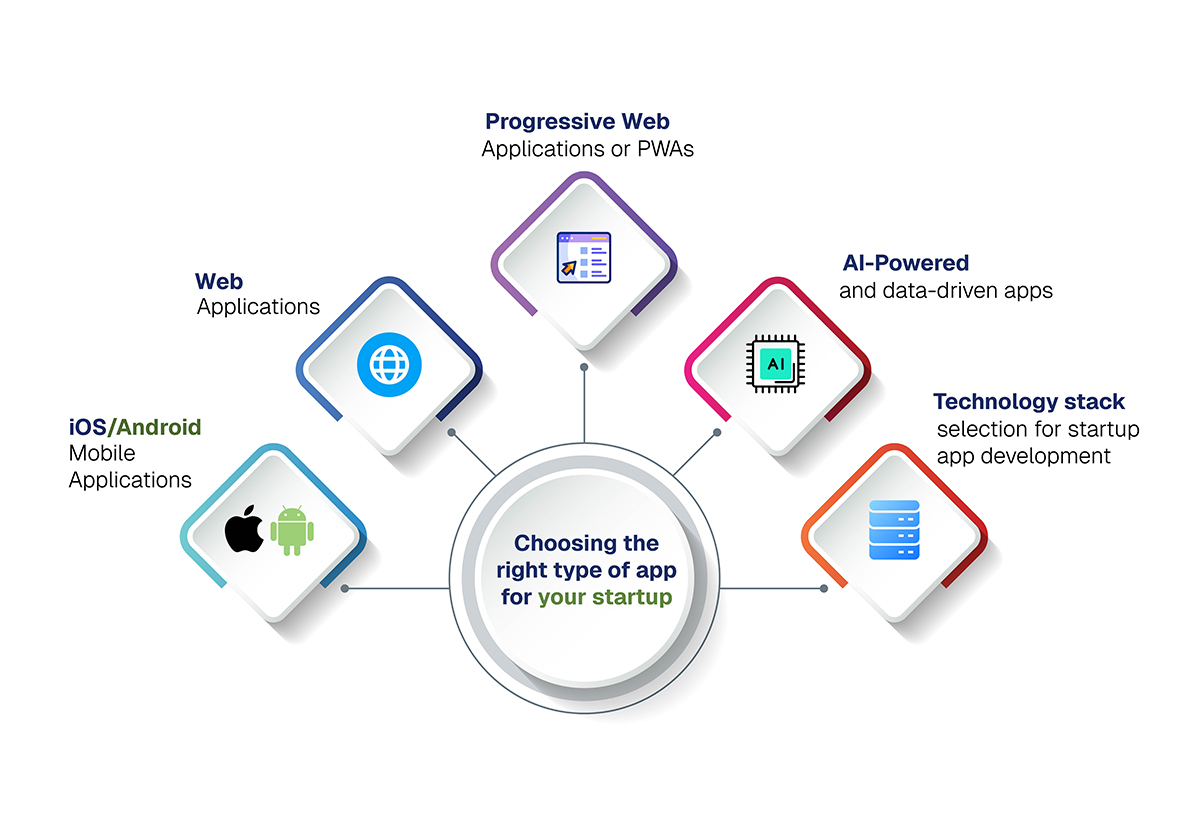
In the year 2026, app development for startups will not be 'one-size-fits-all'; in fact, it will be crucial to select the right type of application first, which depends on the growth stage, budget, target users, and business model. As mobile usage dominates the behavior of the consumer and web technologies evolve rapidly, founders must understand where each type or platform shines the most.
Let's have a look at the different types of mobile apps:
iOS/Android mobile applications
Mobile applications provide high performance and high engagement, especially for consumer-facing startups like gaming, social, and e-Commerce. Users spend a major part of their time on mobile applications, and studies show that mobile experiences drive rapid interactions as well as deeper engagement as compared to web interfaces. For the funded startups, targeting the rapid user generation and retention, cross-platform or native app development is often considered worth the investment.
Web applications
Web applications are great for startups that focus on SEO, fast iteration, and broader accessibility. They need no downloads and are typically cheaper and quicker to launch, making the applications perfect for B2B SaaS tools, early validation, and content-centric platforms. Web applications also enable easier analytics integration and instant updates.
Progressive web applications or PWAs
The progressive web applications combine the reach of web applications with app-like experiences, including offline support as well as push notifications. The market for PWA is gradually growing with higher engagement and increased session lengths for the brands that are adopting this approach. For startups having a limited budget but deeper goals of engagement, PWAs provide a strong ground in the middle.
==
If your startup value remains with the subscription-based services or enterprise workflows, SaaS web platforms deliver multi-tenant access, business logic, and scalability, which are needed for monetizing the recurring revenue.
AI-powered and data-driven apps
Applications that use AI for personalization, automation, and predictive insights are gradually becoming more common in 2026. Such apps frequently require powerful backends and mobile or web-powered front ends, which aligns with the startups that already have a proper data infrastructure and product fit for the market.
Quick tip – Web for cost efficiency and accessibility; mobile for retention and engagement, SaaS for monetization and B2B, PWAs for hybrid value, AI apps for competitive differentiation and advanced personalization.
Technology stack selection for startup app development
Choosing the correct technology stack is one of the most significant strategic decisions for application development for startups, which directly impacts performance, scalability, cost, and the ability to innovate over time. In the year 2026, with users demanding fast experiences and sleek interfaces, your technology stack must support today's MVP and the roadmap that follows.
Take a look at the crucial tech stacks from app development:
Frameworks of frontend
The frontend frameworks determine how users will be able to interact with your application. In the previous year and current, cross-platform frameworks like Flutter and React Native are consistently dominating the new builds of mobile as they deliver native-like performance with a singular codebase, reducing both engineering and time-to-market costs. Cross-platform alone accounted for nearly 67% of the recent trends of mobile app development.
React, on the other hand, stays strong for web app development, especially with TypeScript + broader React ecosystem, while Flutter consistently grows with high-performance and visually rich interfaces.
Native options like Kotlin for Android and Swift for iOS are still smarter when platform and performance-specific experience cannot be compromised.
Backend options
Python and Node.js, on the server side, are very common selections for startups given their broad ecosystem of libraries, massive community support around the globe, and flexibility, particularly when you plan for AI workflows and cloud services. .NET and Java still shine in the highly regulated and enterprise environments, especially where long-term maintainability and robustness are priorities.
Cloud and database infrastructure
Cloud setup and database infrastructure define how well the app developers can scale. Managed services like serverless platforms, Google Cloud, and AWS help startups to avoid any kind of extravagant DevOps cost while automatically scaling with the demand. NoSQL options like MongoDB, MySQL, and PostgreSQL are popular, but Firebase, Supabase, and similar serverless databases allow early-stage teams to avoid complexity from backend and still support the real-time user and data auth.
Analytics and AI integrations
Modern startups build AI-based features as well as analytics into the core stack of their applications. More than 80% of developers who leverage AI tools for coding support, for them directly or indirectly integrate APIs or ML libraries into the stack, which speeds up personalization capabilities and product iteration.
Why deciding on the right tech stack matters
The right tech stack influences the ability to scale, speed of development, long-term cost, and recruitment of talent. Making a poor choice at the early stage can swell up the cost of rewrite and maintenance even before the fit for the product market is achieved. In the year 2026, smart founders select a stack that balances future expansion, user expectations, and immediate requirements, which are not just sustainable but also trendy.
Native or Cross-platform, which is the best for app development for startups?
One of the first big choices that the founders are going to face in 2026, app development for startups, is to decide between native and cross-platform development. Both of these approaches come with clear advantages, and the ultimate choice depends on goals for future growth, performance, speed, and cost.
Here are the determinants of the choices:
Time, cost, and performance trade-offs
Cross-platform frameworks like Flutter and React Native have rapidly matured, and today, they power a majority of brand-new mobiles. Nearly 67% of the newly developed applications currently use cross-platform tools, all thanks to shared codebases and quicker builds. Such an approach typically cuts the development time by nearly 40 to 50 percent and costs by nearly 50% as compared to creating native Android and iOS separately. Native development still leads when hardware-level integration and performance are the top priorities, delivering quicker load times, smoother animations, and direct access to the specific APIs.
When is native development justified?
Native app development is logical when you are creating performance-critical applications like complex A/VR experiences, high-end games, or tools that need data processing in real-time.
The most popular cross-platform frameworks:
- React Native – JavaScript familiarity and robust ecosystem.
- Flutter – Consistent UI across ecosystem and high code reuse.
- Others – Kotlin Multiplatform and .NET MAUI for niche scenarios.
Considerations of long-term maintenance
Cross-platform signifies a single codebase, which reduces maintenance and simplifies updates. The Native applications might incur higher costs in the long term due to the dual codebases, but they provide platform optimization and predictable performance, which can matter at scale.
To summarize: Cross-platform is a smart choice generally for startups that seek broad reach and quick validation, while the native excels where deep platform or maximum performance features are crucial.
Focus on UI/UX, the hidden growth level of apps in 2026
In the year 2026, app development for startups is all about feeling as much as it is functional. An exceptional UI and UI design concept does not mean just impressive screens and layouts, but also determines whether users convert, stay, or advocate for your product. With the continuation of app retention being a significant challenge, smart startups are increasingly treating user experience as an engine of growth instead of an afterthought.
Here are certain considerations for stunning UI and UX design
User-Centric Design Principles
Putting users at the centre means designing interfaces that are intuitive, predictable, and goal-oriented. Interfaces that reduce cognitive load and guide users through clear pathways increase conversion and satisfaction. According to design benchmarks, superior UX can boost conversions by 200% – 400% and improve retention rates significantly compared to poorly designed apps.
Design for the early adopters
Early adopters want value. Your onboarding experience must express the core value effectively with little friction. Applications with optimized onboarding can experience a jump in retention by nearly 50% as the users grasp the value in fewer steps quickly.
Onboarding experiences
First-time communications give shape to the long-term behavior. Thoughtful onboarding, which highlights features as well as benefits, keeps the users engaged beyond the first day, which is a period when applications experience dramatic drop-offs. Design patterns that emphasize clarity and reduce complexity lead to significant improvements in task completion and user retention.
Inclusivity and accessibility
Inclusive design broadens your addressable market and fosters brand trust. Accessibility features like clear text hierarchies, contrast options, and voice navigation not only help in amplifying the overall engagement but also comply with the regulations.
How the UX influences funding perception and retention
Investors evaluate the quality of UX as an indicator of market readiness and product maturity. A data-informed and polished UX hints at deep user understanding and diminishes the risk that can influence funding discussions positively. Companies that prioritize UX frequently achieve stronger confidence from investors and higher retention, turning design into a strategic asset from a cost centre.
In a nutshell, we can say that UX and UI are not just another design task, but also the growth lever that gives shape to retention, engagement, and 2026's perception in the broad landscape of startups.
Development models for startups: in-house vs outsourcing vs hybrid
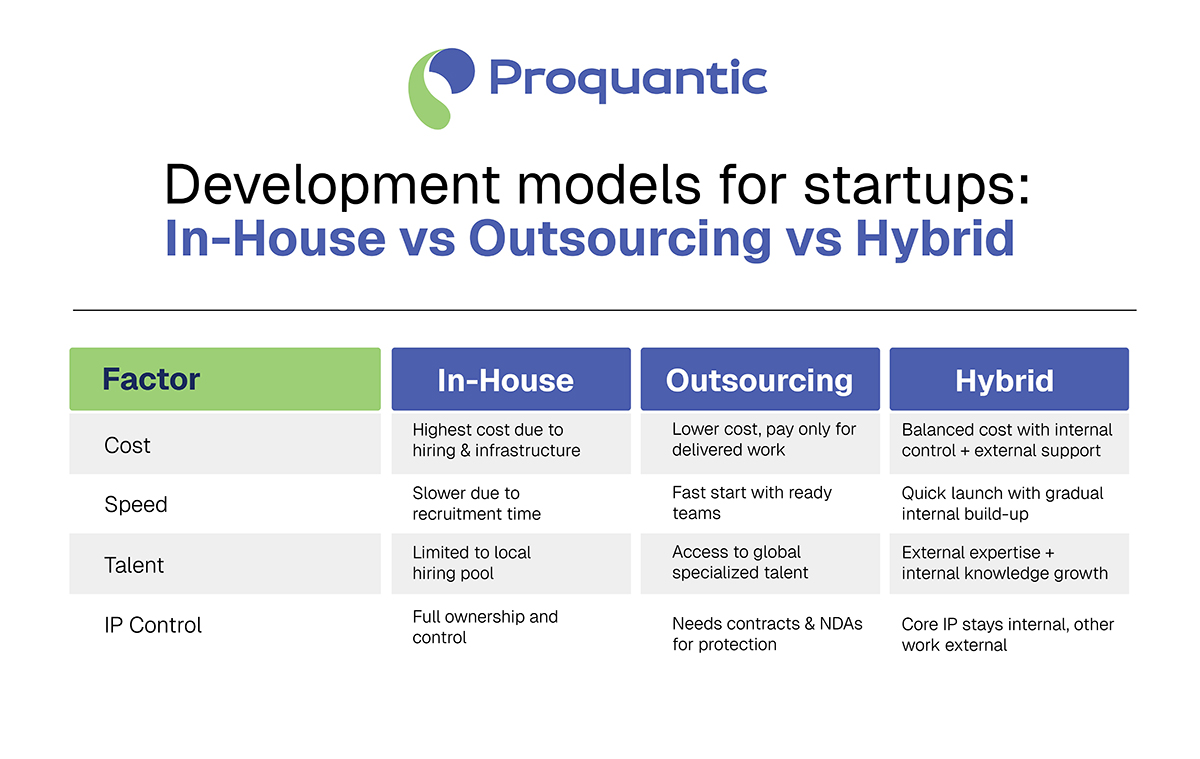
Choosing the correct model for application development is, needless to say, a high-stakes decision that influences long-term growth and control. In the year 2026, startups must balance several priorities like technical ownership, product complexity, market timing, and runway, and there is no common answer that serves the purpose of all. Instead, the choice will be among hybrid, outsourcing, and in-house approaches, which depend on the size or stage of the startup and what outcomes the startup values the most.
Considerations to choose the best development model for startups among hybrid and outsourcing:
Implications of cost
In-house development provides full control and deep product knowledge, and it also comes at a premium cost. The infrastructure, recruitment, training, benefits, and salaries in the US, especially for the MVPs, can thwart the app development budgets for startups significantly. Outsourcing in regions like South Asia, Latin America, and Eastern Europe can reduce the costs by nearly 50% as the developers get paid only for the product delivered, without any overhead expenses for the long term. This hybrid model often provides you with the best of both worlds: flexible external talent with execution support and in-house core strategy.
Speed to market
Outsourced teams can initiate app development within weeks, which helps the startups to accelerate their development speed and test the ideas fast. This is a crucial advantage when first-mover advantage matters and the runway is short. The in-house teams take more time for onboarding talents, which eventually slows time-to-market. The Hybrid model helps the startups with quick onboarding of external talent while building the internal knowledge over time.
Availability of talent
Recruitment of experienced engineers, especially for cloud computing, AI, or specialized architecture, is intensely competitive and can take a lot of months. Outsourcing opens access to a vast talent pool, which enables the startups at their early stage to quickly onboard talent while creating internal knowledge over time.
IP considerations and control
In-house teams offer stricter control over intellectual property, culture, and vision. Outsourcing needs clear IP ownership, NDAs, and robust contracts to ensure that the startups retain the rights to their data and app. Hybrid models keep the focal IP development internal, while delegating the non-focal work externally.
Why do so many startups choose partners for specialized app development?
Partners with expertise in application development offer cross-functional teams, industry experience, and delivery models that are predictable, which a lot of startups fail to build internally.
The specialized external team brings in the best practices, tools, and established workflows, which help in reducing the risk of and speeding up the development process when the pressure for scalability is on the higher side. For a lot of founders, the strategic value of outsourcing expertise surpasses the perceived control loss, making specialized app development partners a preferred choice during the early stages.
In the year 2026, the most successful startups often mix outsourced execution with in-house vision by aligning control, cost, and speed for fuelling sustainable growth.
Cost of App Development for Startups in 2026
Here’s a comprehensive cost breakdown for app development for startups in 2026
| Area | Typical Cost | Price range includes |
| Basic MVP | $10,000 to $25000 | Backend setup, basic UI, core feature |
| Standard MVP | $25000 to $50000 | Analytics, UX design, APIs, Auth |
| Complex MVP | $50000 to $90000 | Real-time features and marketplaces |
| Full-scale application | $60000 to $150000 | Security, multi-platform, and scalable backend |
| AI-based or advanced application | $150000 to $300000 | Readiness for high-traffic, automation, AI/ML |
| Crucial cost drivers | NA | Platforms, integrations, and features |
| Hidden costs | 20% - 30% every year | Updates, APIs, Cloud, Maintenance |
| Optimization | Save 40% to 50% every year | Phased rollout, cross-platform, MVP-first |
Grow app with scalability, compliance, and security from day one.
Planning for scalability, compliance, and security since day 1 is not an option anymore, but a strategic inclusion. Modern application users, as well as regulators, expect the application to perform reliably at scale and protect personal data. Negligence of such elements at the very early stage can gradually lead to catastrophic results like costly rewrites, lost trust, regulatory fines, and data breaches.
Here's how you can strengthen the security, compliance, and compatibility of your apps since day one:
Basics of data security
Security must be created in the architecture itself and not bolted on at the conclusion. Practices like automated threat detection, secured session management, strong authentication, and encryption help in protecting the user data against smart attacks. In fact, as the mobile security incidents are rising rapidly, with the security flaws still present in nearly 75% of the applications and breaches costing millions of Dollars on average in every incident.
App scalability and performance
Planning for scalability assures that the app stays responsive as demand increases. Load balancing, cloud infrastructure, and a scalable backend are crucial for reducing downtime and maintaining performance. Ignoring the scalability from an early stage will require re-engineering later, and rewriting code can cost 50x to 100x more than fixing issues during the app development.
Regulatory considerations with HIPAA, GDPR, etc.
Compliance regulations like CCPA, HIPAA, GDPR, and more protect the users. The compliance also shields the startups from fines, which can touch millions or a massive percentage of the revenue. Including principles of privacy-by-design as well as documenting the data practices improves market acceptance and creates trust.
Why re-engineering late is expensive
Fixing compliance or security gaps post-launch means patching on an emergency basis, which involves potential legal exposure or expensive audits. Early integration with compliance and security speeds up the time-to-market and empowers the startup for growth with little to no surprises along the path.
Go-to-market readiness, deployment, and testing
When it comes to app development for startups in 2026, deployment, launch, and testing readiness are perceived as strategic as coding. What separates the potent launches from the expensive flops is the effective beta testing, automated pipelines, rigorous QA, and a well-disciplined checklist that ensures confidence before going live.
Let’s have a detailed look at the crucial aspects of this phase:
Testing and QA strategies
Today, quality assurance is not just a last-minute phase; it is integrated throughout all stages of development. The modern QA combines automation with manual exploratory tests tests so that teams can catch bugs early and frequently.
Automated testing in the CI/CD pipelines can decrease the post-release defects by letting the developers fix issues and validating every build even before they hit the users. Integration of the AI-powered tests also predicts failure points, as well as generating the latest test cases without the need for any manual effort.
CI/CD Pipelines
Continuous integration and continuous delivery, also known as CI/CD, automates testing, building, and deployment and turns weeks of work into minutes.
The shift-left approach means that tests function with each change of code, preventing the accumulation of regression errors and providing quick feedback. Teams that use automated CI/CD workflows perceive a frequency of deployment and quicker time-to-market, which is crucial for startups that target the early adopters.
App Store Approvals
Publishing to Google Play and Apple App Store includes navigation through the platform guidelines, which can delay the launch when requirements are not met. Complying with the rules of metadata, preparing assets, and anticipating review timelines help in avoiding surprises.
Proper testing before final submission reduces the risk of rejections, which force costly resubmissions and rebuilds.
Early feedback loops and beta testing
Beta testing with the help of real users is a valuable bridge between the market reality and quality analysis. Startups that leverage beta programs often uncover usability kinks, device-specific issues, and the missing scenarios that the internal teams cannot simulate. This improves delight, stability, and performance before the complete launch.
Checklist for full launch readiness
A solid checklist for a full app launch must have the following boxes ticked:
- Green CI/CD pipelines across all environments
- Completed compatibility and regression tests
- Incorporated beta feedback
- App store assets are validated and prepared
- Benchmarks of all securities and performance
In the year 2026, treating deployment and testing as a continuous process assures that the startups not only launch quickly but also deliver high-quality and stable experiences, which build momentum and convert users.
Post-Launch Strategy: Iteration, Scaling & Feature Expansion
Once launched, the journey of app development for startups takes the next course of evolution – POST-LAUNCH STRATEGY. This phase is all about leveraging the real data for:
- Preparing funding and growth
- Monitoring app performance
- Avoiding feature bloat
- Making smarter decisions
Let’s have a look at their details:
Using analytics for steering decisions
Data today is the compass for product evolution. Analytics platforms like Amplitude, Firebase, and Mixpanel offer insights into how users communicate with the applications, where they drop off, and which features drive the maximum engagement. Startups that use analytics at the earliest stage can make decisions that are backed by real behavior. Accurate analytics reduce time wastage and boost retention by underlining the features that drive value significantly.
For instance, tracking the DAU or daily active users, as well as adoption of features, enables the app builders give importance to app development while the retention metrics point out the places where users churn significantly.
In 2026’s competitive landscape, a mere 10% of the applications manage to retain active users by day 30, but the applications that are tuned with the user analytics consistently raise engagement and outperform the averages significantly.
Bloat vs iteration of features
Iterations have to be intentional. Data helps in deciding when to cut or improve features. On the other hand, feature bloat increases the cost of maintenance, diminishes the pace of performance, and distracts the users from core value, which is a fairly common pitfall, and analytics can help app development companies to avoid it.
Monitoring performance
Scalable performance is crucial. Monitoring metrics like API responsiveness, load times, and crash rates ensures that the application continues to function reliably with the growth of users. Tools like performance monitoring dashboards are able to alert the teams before small issues turn out to be significant problems.
Preparing for funding rounds and growth
Investors assess the signals of growth like lifetime user value or LTV, engagement trends, retention, and how quickly the app learns from data. A data-driven and potent post-launch strategy implies maturity, reduces risk, and increases the chances of funding rounds.
By driving iteration through performance insights and analytics, startups can efficiently scale while demonstrating traction, which speaks to both market demand and execution.
Mistakes in app development by startups and how to avoid them
Even the best of ideas can fall flat in app development for startups when the foundational errors are not avoided. A lot of startups pour money and time into building an app, only to discover the most common mistakes, right from ignoring user feedback to overbuilding quickly. Such mistakes undermine performance, growth, and adoption.
Nearly 42% of the startups fail to judge the market-readiness of the apps and end up building features that the users do not need.
Quick and early development of the app
One of the most common mistakes is overbuilding at a very early stage. Startups often attempt to pack every conceivable feature in their very initial release, which increases costs and delays time-to-market without validating the needs of real users. Successful launch of the products is lean and focuses on core value, which is iterated based on data only and not assumptions.
Ignoring user feedback
Ignoring the feedback is another mishap. Startups that skip the feedback loop at the early stage miss the critical insights into the behaviour of the users, often failing in adjusting priorities and fixing points of friction. Applications that iterate based on the input of real users outperform the apps that are built on intuition only.
Inadequate architecture and choosing the wrong tech stack
Poor architecture and choice of tech stacks too haunt a lot of startups. Underestimating the scalability or choosing the wrong tech stack can gradually lead to technical debt and performance issues, which prove to be immensely expensive to resolve later.
Roughly 45% of failures in mobile startups trace back to the unmanaged technical debt and poor initial infrastructure.
Not planning a timeline.
Another significant trap is the underestimation of the timeline. Founders frequently find that the applications can be built cheaply and quickly, only to find out that quality app development with platform security, testing, and platform compliance takes months.
Not planning for post-launch support.
Finally, treating app development as a single-time project rather than an ongoing process proves to be the doom for many startups. Applications require continuous optimization of performance, iteration, and updates as the user needs evolve. Failing to plan or provide post-launch support leads to churn or stagnation.
Avoiding such common pitfalls can significantly improve the odds of building an application that sticks.
Choosing the right app development partner for your startup

Selection of the right partner for app development is one of the most challenging decisions in app development for startups because the development team and businesses select not just build apps, but they also give shape to the future of the product.
A professional app development company brings in executional discipline, strategic thinking, and structure that helps the startups to avoid any kind of failed launches, technical debt, and costly mistakes.
In 2026, when user experience, scalability, and speed define success, having and working with an experienced app development partner becomes a growth-enabling power.
Looking for a potential app development partner? Look for:
Understanding of technicalities, expectations, and realities
The correct partner easily understands the realities of startups, the need for quick validation, evolving ideas, and tight budgets. They must be comfortable working with iterative releases, data-powered decisions, and MVPs instead of strict project scopes.
Technical vs industry experience
Technical skills are, needless to say, crucial, but exposure in the industry adds to the context. Partners having experience in your niche can suggest better features, anticipate challenges, and align the market expectations with app development. This accelerates the product-market fit.
Transparency and communication
Regular updates, clear communication, and honest feedback are never negotiable. An experienced app development partner explains risks early, explains the trade-offs, and keeps the founders engaged in key decision-making through every level of the development cycle.
Mindset for long-term collaboration
App development for startups is a consistently ongoing journey. Choose a partner who thinks the same and provides unparalleled post-launch support for future enhancements, optimization, and scaling of the app.
Choose Proquantic as your reliable app development partner. Here’s why:
- With more than 240 successful mobile application deliveries across diverse sectors like e-Commerce, Health, FinTech, and more, we carry proven industry validation and a track record.
- Proquantic creates applications with advanced integrations like third-party APIs, cloud capabilities, and AI/ML.
- Whether you require single cross-platform apps, iOS apps, or Android apps, our hybrid services involving Flutter and React Native streamline development with a single codebase, which reaches a broader range of audiences by cutting down costs and complexity.
- We also specialize in developing MVPs and quick prototyping, which helps the startups in quick validation, optimizing prioritized features, and reducing time-to-market.
- We offer full-stack mobile application development across cross-platform and native frameworks, which enables startups to turn ideas into future-ready and scalable experiences for mobile.
Conclusion
Startups that think beyond features and give importance to long-term value, performance, and adaptability, WIN in the long run. It is important to treat app development for startups as a strategic business investment in place of a single-time technical task, as it supports sustainable growth, wins investor confidence, and facilitates broader user adoption. The correct decisions, when taken, define how far the startup can scale. Have an idea in mind for your next app? Reach us at proquantic.com today to give it the shape of reality and success.
Frequently Asked Questions (FAQs)
How much does app development cost USA-based startups?
App development for startups in the USA usually ranges between $30,000 and $150,000. The prices are completely based on complexity, platforms, and features. MVPs are more affordable than full-scale products.
How much time does a startup take for app development?
App development for startups can range from 3 to 5 months for MVP building, while a full-featured app can take 6 to 12 months for the same. Timelines are heavily dependent on scope, iteration cycles, and tech stack.
MVP or full app? What should startups build first?
Most of the app development for startups starts with creating MVPs for validating a concept quickly and reducing future risks. Full-scale app development proves to be logical when market traction takes place.
What is the ideal platform for app development for startups?
The most potent choice for app development for startups depends on the budget and target audience. A lot of startups select cross-platform app development for launching applications quickly on both Android and iOS.