


In the rapidly evolving tech and business landscapes of the United States, Computer Vision in retail has shifted to become a core technology that is shaping how stores are competing and operating. The massive volume of visual data, generated from smart mirrors, smartphone interactions, shelf-mounted sensors, and ceiling CCTV cameras, has somewhat exploded, creating both opportunities and challenges for retailers in retaining real-time insights.
In fact. The US is the leading market in the world. North America alone claims nearly 1/3rd of computer vision AI for the retail sector. North America also comes up with advanced innovations that improve efficiency as well as customer experience at every possible point.
This surge is not accidental; rather, the retailers are changing their course from traditional point-of-sale focused strategies towards experience-based environments where technology can easily anticipate the needs, even before customers can anticipate them.
There was a time when analytics looked backwards, but today, visual AI empowers retailers of predictive operations where they can:
- Personalize experiences
- Instantly detect thefts
- Anticipate the shortages of inventory
With the intensifying competition in the US retail sector, businesses are now considering visual AI as a mission-critical infrastructure that is crucial for growth and survival.
In this write-up today, Proquantic USA will be exploring the 10 cutting-edge applications where computer vision is transforming every retail operation, right from autonomous checkout, smart inventory, to personalization of in-store experiences, which delight the shoppers and generate the desired revenue.
Computer vision in retail from the business-first perspective
At its very core, computer vision in retail defines the ability of the machines to see, interpret, and act on the generated visual data in the retail environment. Unlike traditional analytics, the technology and the data rely on the inputs from the real world, from shelf images, in-store camera feeds, and interactions of the customers for delivering actionable insights in real-time. For the retailers, this implies gaining visibility into what happens across the store floor and not just at the billing counter.
It is crucial to differentiate between traditional video surveillance and computer vision. The conventional video surveillance systems are passive, mainly because they record footage for reviewing any incident after it has happened.
Computer vision, on the contrary, is smart and active. It not only records visuals, but it also understands the situation. Similarly, compared to manual analytics, computer vision automates these processes with scalability, speed, and higher accuracy.
But what powers computer vision in retail? Well, there are several technologies, like:
- Facial landmarking, when used compliantly and responsibly, interprets engagement patterns and expressions without putting any reliance on personal identity.
- Object detection, which tracks shelf activity, movement, and items.
- Image recognition for identifying anomalies, people, and products.
- Deep learning models that continuously enhance the accuracy in decision-making.
Retailers are choosing computer vision today because time is critical. The consumers' expectation for frictionless and personalized experiences is currently at an all-time high, whereas the operational pressures, ranging from labor shrinkage and shortages, consistently rise.
While combined with Machine Learning, advanced retail analytics, and AI, computer vision turns out to be a competitive lever that empowers predictive insights as well as autonomous decision-making. The retailers who delay significantly risk falling behind their competitors, especially in an industry where experience, speed, and precision define market leadership significantly.
Computer vision in retail – decoding its business value
We are witnessing an era where customer expectations are sky-high, and the retail margins are questionably razor thin. Here, computer vision in retail offers measurable value to the business by turning the visual data into a strategic advantage. As per the market research, the global computer vision AI for the retail market is expected to reach 12.56 billion by the year 2033, which reflects the rapid adoption driven by the demand for better customer experiences and automation.
Let’s have a look at its relevant aspects:
Opportunities for revenue growth
Computer vision unlocks brand-new revenue streams by increasing sales conversion and improving customer experience. Retailers who implement visual AI report tangible gains from revenue with features like:
- Real-time inventory insights
- Personalized recommendations
- Automated checkouts
These benefits, together, reduce the lost sales from stockouts. Here, the estimates show implementation of retail, which has the capacity to deliver nearly $2+ million in revenue benefits, by bolstering efficiency and throughput.
Optimization of cost
The operational costs, too, are significantly improved as computer vision automates the labor-intensive tasks like checkout processing, shelf audits, and stock counting. Automation reduces the need for manual workload, which gradually leads to the estimated reduction of labor costs by nearly 10% to 15% across numerous retail environments, while improving speed and accuracy.
Reduction in fraud
Labor shrinkage due to fraud and theft costs US retailers billions every year. Advanced vision-powered analytics readily detect suspicious behavior in real-time, which reduces the losses even before they occur. It serves as a robust and reliable tool for fraud mitigation, which complements the strategies of preventing losses.
Efficiency of the workforce
By taking over the usual monitoring tasks, computer vision frees up the staff to focus on highly impactful activities like merchandising and customer service. Intelligent allocation of human resources during the peak hours leads to reduced bottlenecks and improved service delivery.
Data-powered merchandizing
Visual AI offers granular insights into product interaction, like what the customers ignore, pick up, and look at. All these details directly influence smarter merchandising decisions, which improve promotions and product placement. This bridges the gap between actionable in-store strategies and retail analytics.
Competitive differentiation in omnichannel retail
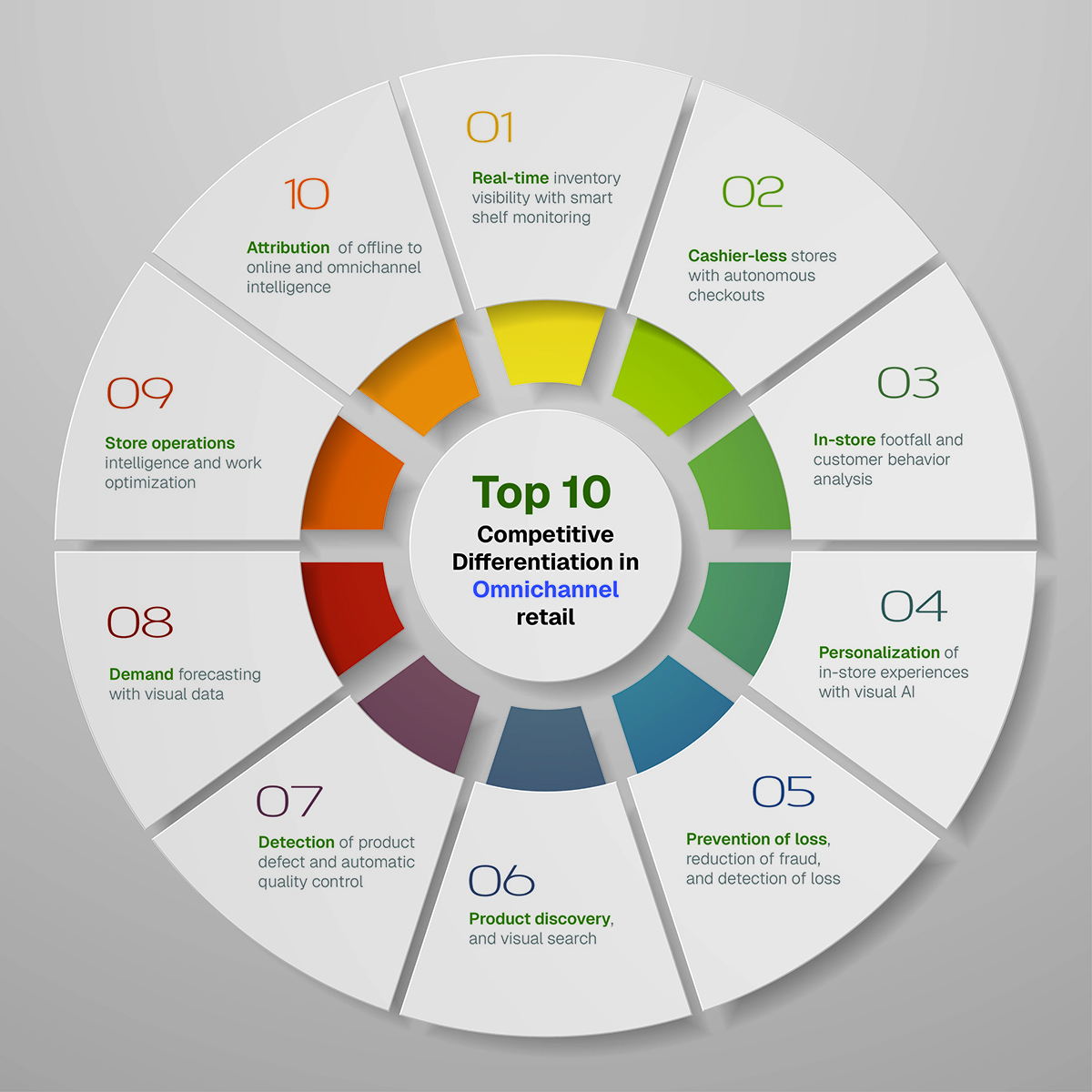
Retailers who embrace computer vision differentiate themselves by delivering seamless experiences across the offline and online channels. Real-time visual data facilitates personalization, inventory view, and seamless checkout, paving the way for competitive leadership in the omnichannel era.
In short, computer vision is more than just a technology upgrade; it is a strategic investment for retailers that slashes cost, enhances revenue, and sharpens the retailer's competitive posture in a rapidly increasing digital marketplace.
Let’s have a look at the top 10 applications of computer vision in retail:
Application #1: Real-time inventory visibility with smart shelf monitoring
Smart shelf monitoring leverages computer vision technology for facilitating the detection of shelf stock automatically for a real-time visibility of the inventory levels. Traditional or manual audits of stocks are error-prone and slow, but AI-powered sensors and cameras can readily scan shelves and trigger alerts for items that go out of stock.
The solution also checks planogram compliance, which ensures that the products are placed exactly where they are intended to be for merchandising and promotional purposes. They can detect label and pricing mismatches by comparing them with the centralized pricing database and reading the products' digital tags. This approach enables the retailers to avoid errors in pricing, which can frustrate customers and erode margins.
A study shows that solutions of computer vision when implemented in retail outlets can reduce ‘out-of-stock’ occurrences by nearly 30% as compared to manual checks, driving enhanced inventory accuracy and fewer missed opportunities for sales.
From the business point of view, insights into real-time inventory translate into reduced cost of sales by enabling customers to find the exact products they need. The insights also offer improved satisfaction with consistent stock availability, backed by enhanced accountability across the distribution and suppliers' centers.
We can see Walmart's shelf scanning robots, which highlight how computer vision in retail improves a store's performance and operational accuracy.
Application #2: Cashier-less stores with autonomous checkouts
Autonomous checkout is often branded as the 'just walk out technology', eliminating the need for traditional cash registers. The approach is strongly backed by computer vision, which automatically recognizes the items that are picked by customers and charges them as they leave the store.
These systems blend object tracking with overhead cameras to continuously monitor the selection of products without the need for barcode scans. A great example of this is Amazon Go, which empowers the customers to enter, shop, and exit the outlet as the system tallies products and readily bills them hassle-free.
Item tracking and recognition are crucial to this application, with AI being able to distinguish between various products, even similar ones, while aligning them to the correct user. Customer identification without any friction may also include an anonymized session token or secure app authentication, which maintains privacy, ensuring accurate attribution of purchases. The approach results in lower costs of operations, reduced time for checkouts, a need for fewer staff, and improved store throughput during the peak time.
But privacy and ethical concerns are crucial as well. Retailers have to:
- Ensure compliance with regulations for data protection, like CCPA in the USA
- Provide clear opt-in/opt-out mechanisms
- Avoid the permanent storage of identifiable biometric data
When managed responsibly, autonomous checkouts not only strengthen the overall operational performance but also improve customer satisfaction.
Application #3: In-store footfall and customer behavior analysis
Leveraging computer vision for analyzing the in-store footfall and customer footfall provides retailers with deep insight into how shoppers move through physical spaces. Computer vision models and cameras generate heatmaps which visualize the dwell time analysis and areas of high engagement for measuring how long the customers linger in certain zones, and queue analytics for understanding the checkout line behavior, and movement tracking for following the customer paths throughout the store.
As per a recent industry survey, more than 50% of the retailers having revenue more or equal to $500M now use AI-powered store analytics for generating insights like queue monitoring and heatmaps.
Heatmaps empower retailers in identifying aisles and displays that attract the most attention, enabling a more relevant and smarter placement of products with high margins. Movement tracking reflects the most common paths through the store, which helps in improving the wayfinding and eliminating bottlenecks. Dwell time analysis highlights areas where the customers may disengage or hesitate, facilitating the flagging of signage issues or potential merchandising.
Here, the business impact is clear: smarter layouts of the stores informed by real behavior of the shopper often lead to spiked rates of conversion as the products are placed where the customers are naturally pulled. Optimized placement of products ensures that the high-interest items are easy to find and are compelled to engage with, which improves sales. Retailers can also experience higher rates of conversion as the bottlenecks are reduced and the overall shopping experience turns out to be more intuitive and smoother.
Application #4: Personalization of in-store experiences with visual AI
Computer vision facilitates the highly engaging personalization of in-store experiences without the requirement of invasive data collection. Intelligent technologies like smart mirrors leverage visual AI to let customers virtually try on products, right from cosmetics to apparel, by overlaying the items onto their reflected visuals.
Visual recommendations are empowered by expression and gesture analysis, which help the systems tailor suggestions in real-time and systems to infer the interest of the customers in real-time.
Unlike the systems that depend on personal identifiers, the demographic-based personalization strengthens privacy while boosting relevance.
These technologies increase the engagement of shoppers, which prompts them to spend more time in the store by exploring more products. Retailers express that visual experiences have the potential to improve the engagement rates significantly and eventually drive higher purchase intent as compared to static displays. For example, virtual try-on technology has been involved with lower return rates and higher conversion, specifically in categories like cosmetics and eyewear.
From a business perspective, computer vision in retail not only strengthens the brand recall but also enhances engagement. As a result, there is a higher average order value, as the interactive visual and personalized recommendations influence additional purchases outside the initial intent of customers.
Application #5: Prevention of loss, reduction of fraud, and detection of loss
Prevention of loss is one of the most significant applications for finance in computer vision, especially when retail shrinkage continues to challenge profitability. Traditional security monitoring devices record footage passively; on the contrary, vision-powered systems leverage AI for recognizing suspicious behavior like prolonged handling of the items without any purchase, attempts to bypass scanning in self-checkout lanes, and usual patterns of concealment. Advanced computer vision models can also analyze shoplifting patterns like movement into blind spots or repetitive behavior that is associated with concealment.
In the self-checkout areas, computer vision decreases checkout fraud, which includes scanning avoidance, by comparing against an expected list of items for every customer session and verifying the items visually. The in-store theft challenge is also eliminated when the vision systems alert or flag irregular actions at the most sensitive zones, like back doors or stockrooms.
Business impact is substantial because the computer vision-based systems are able to achieve nearly 30% to 40% reductions in shrinkage, directly translating into profit protection and cost savings. The systems also contribute to creating a safer retail environment because the early detection enables staff or security intervention before the loss escalates. Real-time alerts enable faster responses, and the analytics help in refining strategies for loss prevention over time.
In a nutshell, we can say that computer vision in retail strengthens security while freeing up the human staff from the need for manual monitoring and enabling them to concentrate on operational priorities and customer service.
Application #6: Product discovery and visual search
Visual search confirms how customers find products by allowing them to leverage images in place of text queries. Customers take a photo, upload it, whether they are in the store or online, and the computer vision-based system returns with similar or exact matching items.
The image-based product search rules out every barrier towards discovery, especially for customers who do not exactly know the SKU or product names. Visual search, many times, integrates easily with in-store kiosks or mobile applications, and seamlessly links the digital purchase paths with physical inspiration.
The 'find similar items' helps customers to explore the relevant styles, alternative colors, sizes, and even complementary accessories. The retail market is a place where visual appeal drives decision-making, which reduces search friction and boosts additional purchases.
From a business point of view, visual search improves the journey from online to offline by connecting the cues of in-store visuals to the full catalogue of the retailers. The latter, leveraging the visual search, reports enhanced engagement metrics as well as deeper session times because the customers function within the ecosystem for a long time. This boost of engagement often correlates with better conversion rates and improved cross-selling opportunities.
Visual search also levels the omnichannel playing field. Shoppers who look at an item at the window display can pull it up on their phone instantly, check for the item's availability in real-time, and buy or book for pickup. Computer vision, hence, becomes a core bridge between the digital and physical commerce.
Application #7: Detection of product defect and automatic quality control
Computer vision technology transfers much beyond front-end retail to workflows of quality control, which safeguard the customer trust and brand reputation. By leveraging cameras as well as AI for performing inspection of goods visually, the supply chain and retailer partners can detect product defects. Incorrect labelling and damaged packaging even before they reach the customers or shelves. Autonomous distribution centers as well as retail systems monitor the packages that enter the facility, and proactively flag anomalies like incorrect barcodes, tears, and dents.
Computer vision screens for labeling and expiry issues that are critical in pharmaceutical or grocery retail, where the safety and compliance regulations are non-negotiable. The early detection supports retailers in avoiding costly recalls, compliance penalties, and customer complaints.
These capabilities, from a business point of view, give a boost to the brand reputation by ensuring that only the high-quality products are placed on the shelves. The systems reduce occurrences of returns, which are expensive to process and often damage the loyalty of the customers. Automated quality control systems also enhance operational efficiency by replacing manual inspections, which, otherwise, can be inconsistent and slow.
In industries with tight regulatory oversight, computer vision compliance monitoring lessens safety and legal risks. Overall, such an application highlights how the visual AI not only drives customers to face value but also strengthens quality assurance processes internally.
Application #8: Demand forecasting with visual data
Traditionally, demand forecasting is reliant on historical trends and sales data. Computer vision enhances this through incorporating customer interactions and real-time visual signals from the shelves. Data from shelf interaction levels, customer interest signals, and the products that are more frequently touched, help the retailers to predict the demand patterns more accurately than what the sales data alone can do. Retailers can easily identify the spiking interest in the slow-moving categories even before the traditional sales analytics can register the trend.
Computer vision also enables visual trend analysis by blending the promotional or seasonal context with metrics of product visibility. For example, a rise in the interaction regarding a specific product around its launch can hint at repositioning and replenishment of the related items.
The business impact of data-enhanced forecasting includes more accurate demand predictions, which reduces both stockouts and overstock. Strategies of intelligent replenishment lower waste and minimize the cost of carrying inventories, especially in the perishable categories, while enhancing the availability of product. Such insights also support synchronization of the supply chain planning with the actual dynamics in-store, making the full ecosystem of retail more agile.
By linking the traditional analytics with interaction, retailers get a nuanced view of the customer's intent, which maximizes revenue opportunities and speeds up decision-making.
Application #9: Store operations intelligence and work optimization
Computer vision backs optimization of the workforce by ensuring task compliance, monitoring the movement of the staff, and uncovering numerous inefficiencies like bottlenecks, as well as service lags. Cameras that are paired with AI models analyze how the staff interact with customers, how quickly price audits and restocking are completed, and whether the threshold triggers prompt any actions. Retailers can easily allocate the resources where they are needed the most, especially during the promotional events of peak hours.
Monitoring of task compliance ensures that procedures like safety checks, planogram adjustments, or promotional displays are executed consistently and accurately across all locations. When the deviations are detected, these systems alert managers, ensuring the uplift of brand standards and reducing errors.
Insights into queue management help retailers to optimize staffing at the service and checkout zones. By predicting the timing of queue growth, the system can signal the exact time for opening new registers or reassigning different personnel, which improves efficiency and quality of service.
At this level, the business benefits include optimized levels of staffing, which aligns demand with the labor, reduces the high cost of labor without hampering the standards of services. Smarter operational intelligence improves the quality of service because the managers have real-time insights into the inefficiencies of workflow for proactive reaction and decision-making. Ultimately, it reduces the total friction in operations and spikes throughput, which results in assisting the brick-and-mortar stores.
Application #10: Attribution of offline to online and omnichannel intelligence
In the modern ecosystem of retail, it is crucial to bridge the gap between online engagement and offline behavior. Computer vision plays a crucial role in offering comprehensive visibility into how in-store customer behaviors translate into digital interactions. Visual data, such as aisle dwell times, shelf engagement, and product views, can proactively feed the CRM as well as CDP systems, thereby enriching the customer profiles with signals of real-world behavior. When combined with mobile app data and loyalty, such signals help in attributing the digital conversions back to physical experiences.
For instance, a shopper who can frequently interact with an in-store category can get personalized promotions via e-Mail, based on experience and interest. This closes the loop between online conversion and offline exploration. The unified perspective of customer intelligence enables true omnichannel visibility, implying that retailers can see which of the physical interactions correlate with enabling smarter attribution models and specific purchase behaviors.
The business impact consists of improved marketing attribution, where the retailers measure the touchpoints more accurately to drive revenue and strengthen ROI on the campaigns. It also drives stronger strategies of personalization when the data from offline engagement feeds digital recommendations, and customers get cohesive experiences across the channels.
With the integrations of computer vision in retail with broader platforms of data, retailers can cultivate deeper insights into the full journey of customers, right from online checkout interaction over the window display, which drives long-term loyalty, reduces churn, and enhances relevance.
Challenges faced while implementing computer vision in retail
While computer vision unravels powerful insights as well as unlocks automation, scaling its capabilities across real-world operations provides various key challenges that the retailers must navigate carefully.
Let’s explore some of the common challenges of implementing computer vision in retail:
Privacy and data compliance
Data compliance and privacy are foremost in this list. Retailers have to ensure that the visual data, especially that which involves people, is processed, collected, and stored in ways that comply with the privacy laws like GDPR in Europe or CCPA in the US. Failing to do so can hamper the trust of the customer and result in regulatory penalties, which will push many retailers to invest in transparency and anonymization practices.
Infrastructure readiness
Another major hurdle is the readiness of the infrastructure. EDGE computing devices, HD cameras, secure storage, and a reliable network add a fortune to the cost and complexity. Legacy stores working with outdated IT systems may also struggle in supporting real-time video analytics without any kind of significant upgrades.
Model bias and accuracy
Bias and model accuracy also pose a major risk. The computer vision models that are trained on non-diverse and limited datasets can easily misinterpret behavior or items, which can further lead to inconsistent or false positive results.
Legacy system integration
Integration with legacy systems also adds to another layer of complexity. Connecting the vision-generated data with CRM, inventory, POS, or HRMS often requires middleware or custom APIs, which extend the timelines and costs of deployment.
Cost considerations
Finally, the cost considerations that include ongoing maintenance, upfront hardware, and skilled personnel can imply that various retailers must phase the implementations depending on the managed services. As per industry research, only 23% of retailers have been able to deploy comprehensive AI systems, with technical complexity and cost complexity mentioned as the primary barriers.
Partnerships, careful planning, and pilot testing with experienced vendors can easily address such obstacles, ensuring sustainable value from investments in computer vision.
Best practices for successfully deploying computer vision in retail
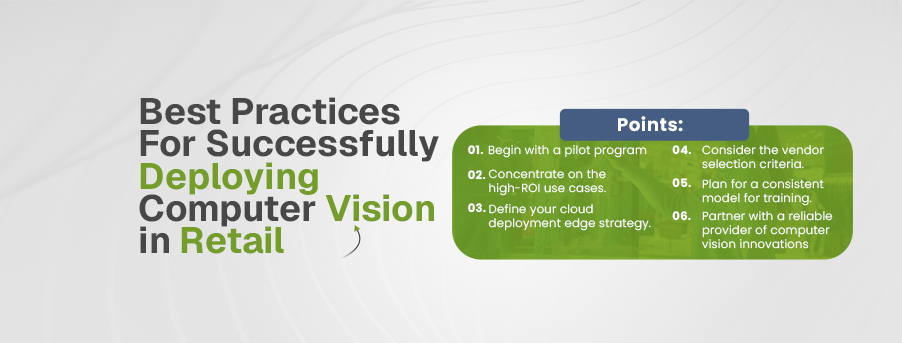
Harnessing computer vision in retail successfully needs more than just purchasing AI models and cameras. It needs strategic execution of careful planning and continuous refinement. A structured way ensures smoother integration and higher ROI across the business.
In case you are all set for the journey, here is how you can take the steps fruitfully:
Begin with a pilot program
Pilot programs are conducted in controlled environments before a final rollout. Pilots assist in measuring key performances, validating technical feasibility, and fine-tuning the workflows without hampering core operations. Research reflects that phased implementation with transparent KPIs can deliver nearly 50% of high ROI as compared to ad hoc deployments.
Concentrate on the high-ROI use cases.
Focus all your efforts on the use cases that generate higher ROI, autonomous checkout, and prevent losses. These are the application cases where rapid feedback loops and measurable business benefits speed up value capture. Once you've successfully achieved your core winds, you can seamlessly expand to broader workflows.
Define your cloud deployment edge strategy.
Edge processing reduces bandwidth needs and latency for on-site real-time analytics, while the cloud infrastructure provides centralized management and scalable model training. A lot of retailers blend both to strike a balance between scalability and performance.
Consider the vendor selection criteria.
Your vendor selection criteria must put ongoing services, integration support, and solution maturity at the forefront. Look for providers with proven retail deployments as well as APIs that smoothly connect to analytics platforms, ERP, and POS.
Plan for a consistent model for training.
Visual environments are dynamic and change continuously. Your store's layouts, lighting, and products will keep changing, and hence, regular retraining with new data ensures reduced bias and accuracy. Establish retraining pipelines and monitoring dashboards as crucial inclusions of your AI operations strategy for the long term.
Partner with a reliable provider of computer vision innovations
Your retail business might lack the needed infrastructure or resources to invest time and money in building a competitive environment powered by computer vision. In that case, partnering with an experienced and proven provider of computer vision innovation for retail, like Proquantic USA, turns out to be the best move.
Professional solution providers bring in
- Pre-trained retail models
- Domain-specific expertise
- Integrational capabilities
Which readily integrate into your unique business functionalities without any risks involved. As per the industry standards and trends, retailers who are already working with specialized vendors of AI report higher success of implementation and shorter cycles of optimization as compared to the in-house focused approaches.
Choose Proquantic for your computer vision-based retail innovation needs.
When it comes to implementing computer vision in retail solutions, Proquantic USA poses as a strategic partner that blends deep technical expertise with scalable and practical execution. Proquantic's computer vision and custom AI services are built for transforming complex visual data into actionable insights for the business, tailored to the unique needs of retail businesses.
Our solutions span:
- Visual search capabilities
- Automated image classification
- Smart object identification
- Real-time video analysis
And all other crucial components of today’s retail AI stack. Partnering with Proquantic USA brings in:
- End-to-end support from deployment to strategy and refinement of the ongoing model.
- Proven framework of delivery, which is backed by high client satisfaction and 150+ success stories from across the globe.
- Scalable architecture for cloud and edge deployments that ensure real-time processing where it matters.
- Custom solutions that are tailored for performance metrics and retail workflows.
- Industry-focused computer vision expertise that seamlessly integrates with the existing enterprise systems.
Get more from technology as you partner with us, as we are committed to unlocking a tangible ROI through unparalleled visual intelligence-based solutions, which speed up the digital transformation as well as future-proof operations.
Future of computer vision in retail: what’s next?
The future of computer vision in retail points towards an intelligent and autonomous future where the visual AI becomes the very spine of retail operations. As the brick-and-mortar stores are determined to match the seamless experiences of the online tools, the autonomous ecosystems of retail will emerge, where checkouts, shelves, and customer interactions will be fully automated.
This future is not far off, because, as per a study by Grand View Research, the computer vision AI in the retail economy is projected to expand and touch $12.56B by the year 2033, underlining the rapid rate of adoption of such advanced systems.
Let’s have a glimpse at what we can experience in the times ahead:
- AI-powered store management solutions soon will orchestrate every operation of retail, right from staff allocation to dynamic pricing, based on real-time data.
- Integration of AR/VR will blur the lines between digital and physical experiences. Augmented displays and virtual mirrors will create personalized moments of product exploration and try-on.
- Predictive CX and Emotion AI are enabling retailers to infer sentiments from body language and facial expressions, facilitating tailored offers and contextual engagement without breaching privacy.
- The rise of real-time decision engines will elevate in-store responsiveness, create more adaptive and smarter environments, and optimize staffing and inventory, which will drive competitive advantage and customer loyalty.
Conclusion
As the retail sector continues to evolve and pace, computer vision in retail has gradually emerged as a necessity instead of just being a technological experiment. It enables retailers to traverse beyond hindsight and intuition, enabling autonomous operations, predictive decision-making, and real-time intelligence across the value chain. From reducing losses, driving smarter merchandising, to elevating customer experience, computer vision in retail delivers long-term and sustainable competitive advantage. It also reframes technological investment and acts as a growth catalyst, which fuels differentiation, efficiency, and revenue, and as a cost center. For retailers who are aiming to lead instead of following, adopting computer vision will prove to be the foundation for them to transform into a future-ready, successful business.
Frequently Asked Questions (FAQs)
What is computer vision in retail? How does it work?
Computer vision in retail refers to the technology that uses cameras and AI for interpreting visual data in stores, like checkout activity, customer movement, and tracking inventory in real-time. It assists in speeding up checkout, reducing stockouts, and minimizing shrinkage. With Proquantic custom solutions, the retailers in the US can improve operational outcomes and boost accuracy, transforming the video feeds into actionable insights.
What are the benefits of computer vision in retail?
Computer vision in retail delivers benefits like enhanced customer experience, inventory monitoring, and better prevention of loss. The technology minimizes employee shrinkage, speeds up checkout, and reduces stockouts. With solutions by Proquantic, US retailers can use the real—time analytics for driving ROI and boost efficiency across both omnichannel operations and stores.
Is computer vision compliant and safe for retail use?
Of course! Computer vision in retail systems can be easily deployed in privacy-aware approaches, concentrating on object detection and anonymous behavior instead of personally identifiable information. Retail partners like us, Proquantic USA, design solutions that adhere to the privacy standards of the USA while delivering actionable insights for the purpose of enhancing customer service and store optimization.
How does computer vision in retail improve retail inventory management?
In the modern shops, computer vision in retail, consistently detect items that are going out of stock, scan the shelves, and notify the systems or staff for replenishment. Automation improves accuracy, reduces manual checking of stocks, and helps in preventing loss of sales. Proquantic's implementations of computer vision enable retailers to maintain the level of inventory and align the customer demand with physical stock.