


Mobile apps have become a major revenue-generating factor for most businesses today. With the integration of AI assistants and other modern features, companies maintain user interface (UI) / user experience (UX) across different platforms.
Creating separate native Android and iOS applications means additional expenses and engineering hours. Modern cross-platform mobile app development helps enterprises and startups reduce hiring and development costs by up to 30-50%. Some frameworks even allow up to 95% code reuse, helping to launch apps to market faster.
Around 70% of cross-device app development projects fail, sometimes due to the wrong choice of frameworks, a weaker architectural foundation, or not hiring expert developers. Several tech leaders, top-notch developers, and emerging firms face challenges with performance optimization, native integration, and compatibility issues due to poor development environment selection.
To succeed with shared-codebase development, businesses must evaluate frameworks that truly matter. This blog covers the best frameworks that will ensure a consistent user experience across all platforms. Read on to make cross-platform mobile development more uniform and economical.
Move from ASP.NET Boilerplate to ABP with confidence.
Start Your Migration

Move from ASP.NET Boilerplate to ABP with confidence.
What is Cross-Platform Mobile App Development?
Cross-platform, or unified, app development means creating mobile applications that run on multiple operating systems (OS), mainly iOS and Android. The objective is to use one shared codebase to build and launch a single app that helps businesses simultaneously target both these major mobile ecosystems.
According to a recent report from MarkWide Research, the global mobile application development market size is projected to reach $884.76 billion by 2035, growing at a CAGR of 13.70%. This rapid growth is backed by user behavior, as nearly 90% of mobile usage time is spent browsing various apps.
Referred to as near-native or hybrid app development, cross-platform apps are ideal for SaaS, e-commerce, and content-driven products. Developers can simply write code once and deploy it everywhere to generate platform-specific output.
Enterprise-grade mobility solutions are expected to cross $510 billion, raising the demand for custom mobile applications. It also paves the path for organizations to create versatile mobile applications that can be availed by as many people as possible.
Many US-based enterprises and startups prefer cross-platform or hybrid app development services to reduce development time as well as costs. Continue scrolling down to find out more about the amazing features of unified application development for mobile devices.
Top Features of Cross-Platform Mobile App Development
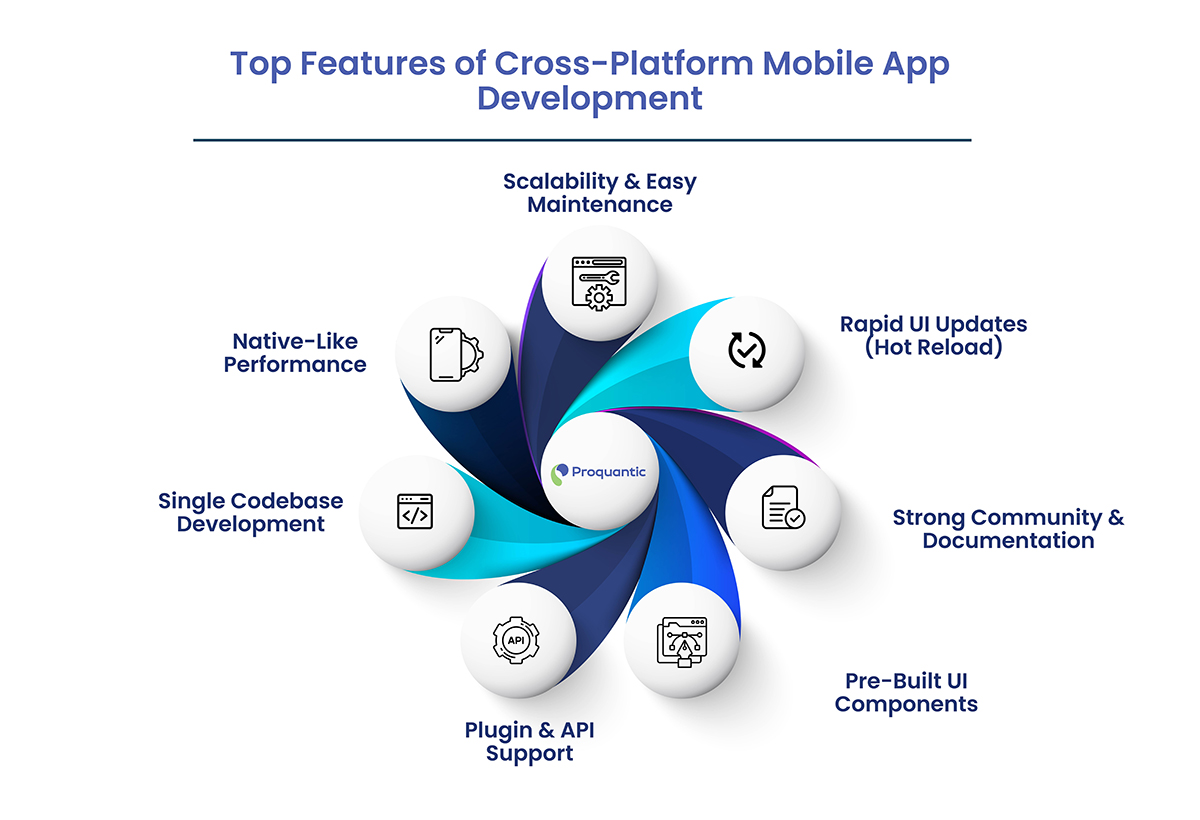
Below are the key aspects of cross-platform app development for businesses.
Native-like performance
What makes cross-environment applications popular among enterprises is their ability to perform like native apps.
- It uses several powerful frameworks to utilize Ahead-of-Time (AOT) compilation to convert Dart code directly into native ARM as well as x86 machine instructions.
- The framework also uses synchronous native communication to prevent lagging or UI freezing during multi-layered data handling.
- High-performance graphics engines are used to draw UI components on the mobile screen pixel-by-pixel. It helps optimize GPU rendering and eliminating the limitations of structural OS layouts during the development process.
- If the development involves direct access to device hardware or extreme computing, developers use platform-specific code bridges to embed them directly into the application.
Benefits: Features like micro-interactions, fluid scrolling, and instant page transitions help minimize user drop-off rates on cross-platform mobile applications.
Single codebase
When it comes to understanding cross-platform vs native mobile app development, a single codebase emerges as a leading feature. Unified framework doesn't require developers to maintain separate codebases, such as Kotlin for Android and Swift for iOS, allowing them to build and manage both platforms efficiently.
A reusable code structure means the following advantages for businesses.
- Working with smaller teams for the development process helps bring down costs, eliminate redundant, expensive tech stacks, and reduce the possibility of code duplication.
- Companies can develop and launch multiple apps simultaneously using platforms like the Apple App Store and Google Play.
- Use rapid prototyping to build minimum viable products (MVPs) fast and collect appropriate responses or real user feedback for continuous improvement.
Benefits: Faster development cycles, reduced costs, and consistent performance across platforms make single codebases highly efficient for modern app development.
Plugin and API support
Cross-platform frameworks offer extensive plugin and API support, which assist mobile app developers in integrating advanced features.
- Plugins simplify access to key device features such as the camera, GPS, storage, and sensors. APIs also help mobile apps connect with external services, including payment gateways and cloud platforms. Both these elements improve app's functionality and enhance user experience.
- Developers can avoid building features from scratch by leveraging pre-built integrations. This significantly reduces development time and complexity.
- Well-maintained plugin ecosystems also ensure compatibility with platform updates and evolving technologies.
Benefits: Faster feature integration, reduced development effort, and improved functionality enhance overall application performance and scalability.
Pre-built UI components
Pre-built UI components simplify the design and development of user interfaces in cross-platform apps. These ready-made elements help maintain consistency across different devices and screen sizes.
- Developers can use built-in widgets, buttons, navigation bars, and layouts without starting from scratch. This accelerates the UI creation process and ensures a polished look.
- Such components are optimized for performance and responsiveness across platforms. They also follow modern design guidelines for a better user experience.
- Customization options allow developers to modify these components based on brand requirements.
Benefits: Consistent design standards and improved user experience make pre-built components highly valuable and ensure faster UI development.
Community and documentation
A strong developer community and detailed documentation process aids in cross-platform mobile app development. Popular frameworks get proper recognition and support from active global communities.
- Developers can solve issues quickly with easy access to tutorials, forums, and open-source resources. This reduces dependency on internal troubleshooting and speeds up development.
- Comprehensive documentation provides clear guidance on features, updates, and best practices. It helps both beginners and experienced developers work more efficiently.
- Regular contributions from the community also ensure continuous improvement of tools and libraries.
Benefits: Continuous learning, faster problem-solving, and reliable support systems enhance development efficiency and project success.
Rapid UI updates without restart
One standout feature of cross-platform frameworks is the ability to update UI instantly without restarting the application.
- Hot reload or live reload features allow developers to see changes in real time during development. This removes the need for repeated app compilation.
- Design adjustments, bug fixes, and feature enhancements can be tested immediately. It significantly improves productivity and reduces development delays.
- Fast UI updates also help in refining user interfaces through quick experimentation.
Benefits: Faster debugging, improved developer efficiency, and seamless UI refinement accelerate the overall development process.
Scalability and maintenance
Cross-platform applications are built to scale smoothly as business needs evolve over time. A unified codebase makes it easier to introduce new features and roll out updates without rebuilding separate systems.
- Maintaining a single code structure simplifies debugging, testing, and performance optimization across platforms. It also ensures a consistent user experience during upgrades and version changes.
- Updates can be deployed simultaneously to multiple platforms, reducing operational complexity. This approach minimizes long-term maintenance efforts and lowers overall development costs.
- A well-designed scalable architecture also enables applications to handle higher user demand and growing data loads efficiently without compromising performance.
Benefits: Simplified maintenance, easier scalability, and long-term cost efficiency make cross-platform apps suitable for growing businesses.
Best Frameworks for Cross-Platform Mobile Development – Use Cases & Examples
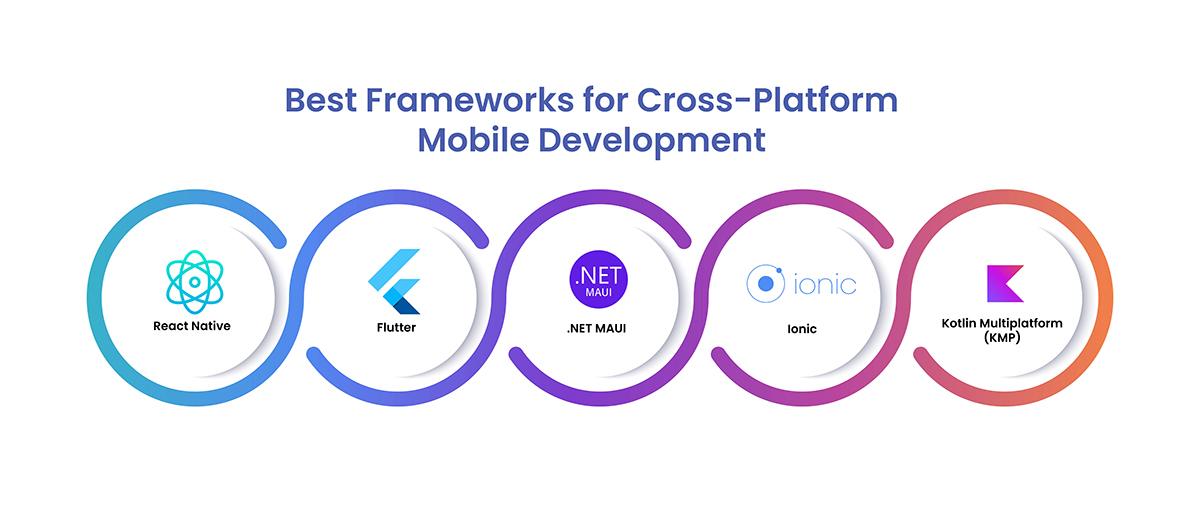
Cross-platform mobile development is no longer limited to cost-saving projects. It has become a strategic choice for businesses that are looking for fast app launches, efficient scaling, and reaching more users across devices with consistent experiences.
Research suggests that around 67% of newly developed mobile applications make use of cross-platform frameworks. However, not all frameworks work the same when making your apps market-ready and acquiring more customers or users for business growth.
Below are the top 5 cross-platform mobile development frameworks that help many entrepreneurs, startup founders, SaaS companies, mobile app developers, product managers, CTOs, enterprise IT teams, and even technical decision makers.
React Native
React Native is an open-source framework developed by Meta for custom mobile applications using JavaScript and React. It allows developers to create cross-platform apps that render real native UI components instead of relying on web-based interfaces, which improves performance and user experience.
The framework works by connecting JavaScript logic with native modules through a communication layer, enabling developers to use platform-specific features when needed. With the introduction of its new architecture, including Fabric and TurboModules, React Native has significantly reduced performance bottlenecks.
Today, many global companies actively hire React Native developers because they can deliver mobile applications quickly while maintaining a user experience that closely matches native apps, making them a cost-effective and scalable hiring choice.
Primary language:
React Native primarily uses JavaScript and TypeScript, making it highly accessible to developers already familiar with web technologies. It is built on top of the React ecosystem, which simplifies UI creation through reusable components and structured state management.
This approach enables faster onboarding for development teams, especially those transitioning from web to mobile platforms. Developers can reuse logic across platforms, reducing the effort required to maintain separate codebases. The availability of rich tooling, debugging utilities, and widespread documentation further improves the overall development experience.
Top features:
- Uses native UI components for an authentic feel
- Strong ecosystem with massive third-party libraries
- Supports hot reload for faster development iterations
- New architecture improves performance and reliability
- Easy integration with existing web applications
- Cross-platform compatibility with a single codebase approach
Advantage:
Its biggest strength lies in its extensive JavaScript ecosystem and active developer community. This significantly reduces hiring challenges and accelerates development cycles across teams.
Ideal for:
React Native is suitable for startups and fast-growing product teams with JavaScript expertise that need scalable mobile applications without long development timelines. The cross-platform mobile app development framework excels in applications that demand continuous updates, real-time interactions, and strong backend integration.
Its JavaScript ecosystem allows faster feature rollout, which is essential for content-heavy platforms. Businesses focused on user engagement, frequent releases, and personalization often rely on React Native to maintain agility while scaling globally.
Primary use cases:
Content-driven platforms, social media apps, and scalable consumer applications requiring frequent updates.
Notable examples:
- Facebook: a social networking platform with dynamic content feed
- Instagram: a media sharing application with interactive UI features
- Shopify: e-commerce platform enabling scalable merchant solutions
Flutter
Flutter is Google’s UI toolkit that allows using a single codebase for creating applications for mobile, web, and desktop platforms. Instead of native UI components, the framework depends on its own rendering engine to display every interface element, giving maximum control over the app’s design and ensuring a consistent experience across platforms.
Flutter allows developers to build apps with a consistent look and feel across different platforms and devices. By reducing dependence on platform-specific UI components, it gives enterprise teams more flexibility to customize interfaces, create smooth animations, and deliver a seamless, unified user experience.
The framework helps developers build fast-loading and visually appealing apps. Its powerful rendering engine makes it easy to create smooth animations and handle complex designs without slowing down performance.
Primary language:
It uses Dart, a modern programming language developed by Google, which is optimized for building user interfaces. Dart compiles directly into native machine code, which improves execution speed and minimizes runtime lag.
Dart provides features such as structured programming, asynchronous processing, and strong typing, helping developers build applications that are easier to maintain and scale over time. While it is not as widely used as JavaScript, Dart offers a productive development experience and works seamlessly with Flutter, making it a strong choice for cross-platform app development.
Developers can expect faster compilation, cleaner syntax, and enhanced debugging tools for efficient cross-platform mobile app development.
Top features:
- Custom rendering engine ensures consistent UI design
- High-performance animations with smooth frame rates
- Hot reload enables instant UI updates
- Rich widget library for flexible interface creation
- Single codebase supports mobile, web, and desktop
- Strong tooling support with rapid development capabilities
Advantage:
Flutter ensures a consistent look across platforms by giving developers full control over how every element appears on the screen. This makes it a great choice for businesses that need highly customized, design-focused applications with precise user interface control.
Ideal for:
Flutter helps businesses build brand-focused applications that prioritize consistent design, smooth animations, and user experience. The framework is necessary to maintain design consistency and smooth app performance.
This framework features a custom rendering engine to keep the interface consistent across different platforms, especially for e-commerce and brand-focused apps. It also helps businesses move faster with prototypes while delivering visually engaging experiences, making Flutter a strong choice for customer-facing apps where first impressions matter.
Primary use cases:
E-commerce platforms, MVPs for startups, and visually intensive applications needing high UI consistency. Read this blog to understand the process of app development for startups.
Notable examples:
- Google Ads: mobile advertising management dashboard application
- Alibaba: global e-commerce marketplace with rich UI experience
- eBay Motors: an automotive marketplace with a fast-browsing interface
.NET MAUI
It is Microsoft’s modern cross-platform framework designed to build native applications using a single, unified codebase. .NET MAUI is the successor to Xamarin and enables developers to create applications for Android, iOS, macOS, and Windows using one project structure.
The framework follows a modern handler-based architecture that connects user interface elements directly to native platform controls. .NET MAUI helps applications run smoothly across different devices. It also works with Microsoft's ecosystem and can easily integrate services such as Azure and other enterprise-grade development tools.
.NET MAUI focuses heavily on productivity, scalability, and enterprise-level application development. It simplifies multi-platform development while maintaining native performance and flexibility.
Primary language:
.NET MAUI uses C# as its core programming language, and XAML for UI design. This combination allows developers to maintain a clear separation between interface and logic, improving maintainability.
It integrates seamlessly with the .NET ecosystem, enabling developers to reuse existing code, services, and APIs across projects. For organizations already working with Microsoft technologies, this significantly reduces the learning curve.
The framework is backed by robust support in Visual Studio, which allows developers to access tools to debug, test, and deploy mobile applications.
Top features:
- Unified .NET ecosystem for cross-platform development
- Native UI rendering with platform-specific control
- Strong integration with Visual Studio tools
- Single codebase for multiple operating systems
- Built-in support for cloud and backend services
- Enterprise-grade security and scalability features
Advantage:
You can easily integrate .NET MAUI with various tools and infrastructure of Microsoft, helping development teams build applications faster and manage them more efficiently. This framework it a practical choice for many US-based companies looking for reliability, scalability, and easier maintenance.
Ideal for:
Enterprise teams and organizations already using .NET who require scalable, secure, and maintainable cross-platform business applications. It enables businesses to build connected solutions across mobile and desktop environments.
Companies often choose MAUI for internal tools, employee productivity apps, and enterprise workflows that require strong backend integration and long-term maintainability.
Primary use cases:
Enterprise-grade systems, internal business applications, and cross-device corporate solutions.
Notable examples:
- Microsoft Office: productivity tools with cross-device integration systems
- Skype: a communication platform supporting voice and messaging services
- Xbox: interactive entertainment services with a connected user ecosystem
- Facebook: enterprise tools and internal cross-platform applications
Ionic
Ionic is a cross-platform framework that allows developers to build mobile applications using web technologies such as HTML, CSS, and JavaScript. It runs applications inside a native container using WebView, making it possible to deploy the same application across multiple platforms.
The framework integrates with Capacitor or Cordova to access device features like camera, storage, and location services. Ionic is widely used for building hybrid applications, progressive web apps, and lightweight mobile solutions.
Because of its web-based architecture, Ionic is easy to adopt and supports rapid development cycles. It is especially useful for applications where performance requirements are moderate, but development speed is critical.
Primary language:
Ionic primarily uses HTML, CSS, and JavaScript, often combined with frameworks like Angular, React, or Vue. This allows developers to reuse existing web development knowledge without learning entirely new languages.
Its flexibility enables integration with modern front-end frameworks, making UI development faster and more intuitive. Developers can also leverage browser-based tools for testing and debugging, simplifying the development workflow.
This makes Ionic an attractive choice for teams transitioning from web to mobile development environments.
Top features:
- Web-based development using familiar front-end technologies
- Cross-platform deployment including progressive web apps
- Plugin system for accessing native device features
- Rapid development with reusable UI components
- Integration with Angular, React, and Vue frameworks
- Easy testing and debugging using browser tools
Advantage:
Its web-first approach enables quick development using existing front-end skills, significantly lowering both cost and development time.
Ideal for:
The Ionic framework is suitable for web development teams building progressive web apps, internal tools, or lightweight mobile applications with faster turnaround requirements. It is best suited for businesses prioritizing speed, flexibility, and cost-efficiency.
Its web-based architecture makes it ideal for dashboards, internal tools, and content-focused platforms. Organizations with strong web development teams often choose Ionic to extend existing capabilities into mobile apps without investing heavily in native development resources.
Primary use cases:
Content apps, internal business tools, and lightweight applications requiring rapid deployment.
Notable examples:
- Shipt: grocery delivery app with responsive web-based interface
- MarketWatch: financial news platform delivering real-time updates
- Sworkit: a fitness application with guided workout experiences
- Untappd: social networking app for beverage discovery and reviews
Kotlin Multiplatform (KMP)
Kotlin Multiplatform is a development approach created by JetBrains that focuses on sharing business logic across platforms while keeping user interfaces fully native. Unlike traditional cross-platform frameworks, it does not aim to unify UI design across platforms.
KMP allows developers to reuse core logic such as networking, data handling, and business rules for iOS and Android app development. The UI layer is built separately using native frameworks, ensuring that apps maintain platform-specific behavior and design standards.
This approach makes KMP particularly useful for applications where performance and native experience cannot be compromised. It offers flexibility without forcing a single design system across platforms.
Primary language:
Kotlin Multiplatform uses Kotlin for writing shared code across platforms. Kotlin can be compiled into native binaries, making it efficient for performance-critical applications.
Developers still use Swift or SwiftUI for iOS interfaces, and Jetpack Compose or native views for Android. This separation allows teams to maintain complete control over the user experience on each platform.
Kotlin also offers modern programming features such as null safety, concise syntax, and strong type support, improving code reliability and maintainability.
Top features:
- Shares business logic across multiple platforms efficiently
- Maintains a fully native UI for each platform
- Near-native performance with Kotlin native compilation
- Gradual adoption into existing native codebases
- Strong support for modern Android development tools
- Flexible architecture supporting modular development approach
Advantage:
It strikes the right balance between code reuse and native performance. Teams can deliver platform-specific experiences without duplicating core logic across projects.
Ideal for:
Mature development teams and enterprises that prioritize performance, scalability, and fully native user experiences across platforms. KMP is ideal for organizations that cannot compromise on native performance yet want to reduce code duplication.
It allows shared business logic while preserving platform-specific UI, making it suitable for finance, healthcare, and enterprise-grade systems. Many large companies adopt KMP when modernizing legacy apps while maintaining stability and scalability.
Primary use cases:
Enterprise software, fintech apps, and applications requiring native-level performance and gradual migration strategies.
Notable examples:
- Google: internal tools and scalable mobile service infrastructure apps
- Duolingo: language learning platform with performance-focused modules
- McDonald’s: global ordering system with integrated user experiences
- Philips: healthcare technology applications with secure data handling
Cross-platform framework comparison
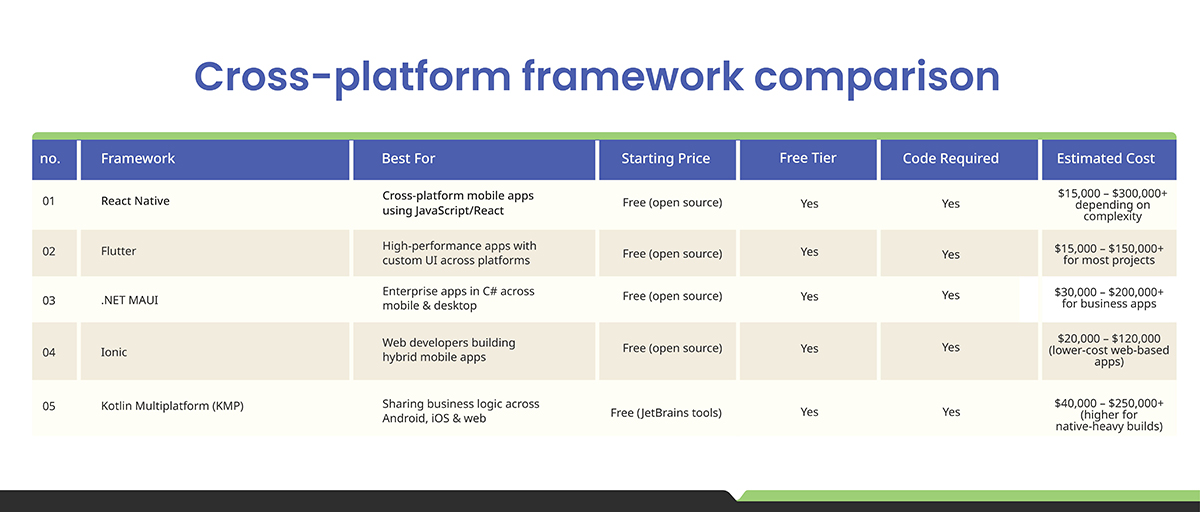
Get more insights into mobile app development cost breakdown here!
How Proquantic Software Helps with Hybrid App Development
Whether you are looking for an MVP launch with the basic features or extend market reach through a full-fledged mobile application that works for Android and iOS users, our experts are here for you.
At Proquantic Software, we provide comprehensive cross-platform app development services to help your business grow fast. From EdTech to real estate, healthcare to fintech, and various enterprise tools, we have showcased our expertise in every domain. Companies often hire our mobile app developers for the following services.
-
Custom cross-platform app development
We build scalable apps that work smoothly across different devices and as per your business needs. For strong performance, user satisfaction, and long-term growth, we create applications using Flutter, React Native, and other powerful frameworks.
-
UI/UX design & prototyping
We create simple and engaging user experiences that are easy to navigate. From early wireframes to interactive prototypes, we plan every strategy so you can test ideas early and ensure your app feels right before beginning the development.
-
Cross-platform strategy & consultation
We help you choose the right technology and define what your app really needs. Our team guides you through budgeting, timelines, and planning so you can move forward with clarity and confidence.
-
App integration & migration
We connect your app with your existing systems, APIs, and cloud services to keep everything running smoothly. If you're moving from an older or native app, we handle the transition without disrupting your business.
-
Testing, deployment & support
We thoroughly test your app to make sure it works well across all platforms. Our developers work alongside you for app store launches and provide consistent support with updates, monitoring, and maintenance to keep everything running smoothly.

Conclusion
Cross-platform development gives businesses the ability to move faster without compromising quality or user experience. With the right framework and execution strategy from a custom mobile app development company in the US, you can launch products that scale across platforms, such as iOS and Android, while staying cost-efficient and future-ready.
If you’re planning to build a cross-platform mobile app, having the right team makes all the difference. Let’s turn your idea into a high-performing application that works smoothly across every platform at Proquantic Software.
Schedule a consultation with our expert hybrid app developers to discuss your business requirements, get recommendations on the best cross-platform frameworks, and develop and launch mobile apps with minimal upfront investment.
FAQs
Do top enterprise apps use cross-platform tech?
Yes, many enterprise-level applications use cross-platform technologies to reach users across different devices. Popular apps like Instagram, Shopify, and Google Pay leverage shared codebases to support hundreds of millions of users while maintaining consistent performance.
Cross-platform mobile app development enables faster deployment, consistent user experiences, and easier maintenance across a wide range of devices. For many US-based companies, it is a reliable choice for high-performance, scalable applications.
How do cross-platform and native app development compare?
Cross-platform app development uses a single shared codebase to build applications that run on both iOS and Android, reducing development time and cost. Native mobile app development, on the other hand, requires creating separate applications tailored to each platform using platform-specific languages and tools.
There are cases when businesses choose native app development for deeper integration with operating system features and slightly better performance. However, adopting cross-platform solutions provides greater efficiency and faster delivery. The choice between native vs cross-platform mobile development depends on project needs, budget, development time, and required user experience.
Which cross-platform framework leads today?
Flutter is one of the most popular cross-platform frameworks in recent years. With more businesses embracing cross-platform development, this framework is widely used for its reliable performance, ease of maintenance, and consistent user experience across Android and iOS platforms.
More than 1 million apps use Flutter as the framework. As per the latest industry reports, it continues to rank among the most popular cross-platform mobile app development frameworks worldwide.
How can you build a cross-platform app?
Building a cross-platform app is possible with the right development tools and approach. You need to find suitable frameworks that allow a single codebase to run smoothly across platforms like iOS and Android. React Native, Flutter, and KMP are some of the popular frameworks for consistent performance and user experience. Consulting a specialist is the best option to streamline development.
Many businesses approach cross-platform development company like Proquantic Software to gain access to the right skills and technologies for their mobile apps. They often use IT staff augmentation services to strengthen their development teams, accelerate delivery, reduce project risks, and build applications maintaining current industry standards.
Can multiple frameworks be used together?
Yes, you can use multiple frameworks for mobile app development, though it requires extensive knowledge and careful planning. For example, Kotlin Multiplatform is designed to work alongside native code, making hybrid approaches feasible for tech firms in the US.
Combining frameworks introduce additional complexity in development, testing, and maintenance. Therefore, it should only be done when there is a clear benefit, and the architecture is deliberately designed to handle integration challenges effectively.
How to choose the right app framework?
You must always select the right near-native or hybrid framework as per project complexity, developer expertise, timeline, and budget. Simpler apps with tight deadlines may benefit from solutions like Ionic or Cordova, which enable rapid development.
Frameworks like Flutter, React Native, and .NET MAUI offer a strong foundation for startups and enterprises who want to build advanced, scalable applications. However, when performance, security, and seamless access to native device features are critical, switch to native development.
Businesses should choose a framework that not only meets their technical requirements but also fits their long-term vision and budget. The best approach is to hire dedicated mobile app developers to find the right framework and implement them right away.