


According to Spacelift, a market research company, the market for DevOps for businesses is anticipated to rise from 10.4 billion dollars in 2023 to 25.5 billion dollars in 2028. It also suggested that in 2023 North America accounted for 38.5% of the global market share in DevOps.
Spacelift is also of the opinion that 61% of companies have vouched for their quality improvement due to the utilization of DevOps practices in their business processes. Also, organizations adopting DevOps culture can put in 33% more time for infrastructural improvement.
The above statistics testify how powerful this approach has become for today’s businesses. Many of the IT stalwarts have already introduced it and have witnessed the magical transformation in their people and process improvements.
DevOps for business – the must-knows
The term DevOps was coined in 2009 by Patrick Debois, a renowned name in the IT space. This word is a perfect blend of 2 vital terminologies-operations and development. Through this term he wanted to focus on a collaborative approach for the software development professionals and the IT operation teams.
In other words, DevOps can be defined as a strategic software engineering approach aiming to lower the gap between the software operations and development teams. This technique is well suited to enhance collaboration and strengthen shared responsibilities. Thus, DevOps play a crucial role to boost operational efficiencies and productivity and enable business profitability.
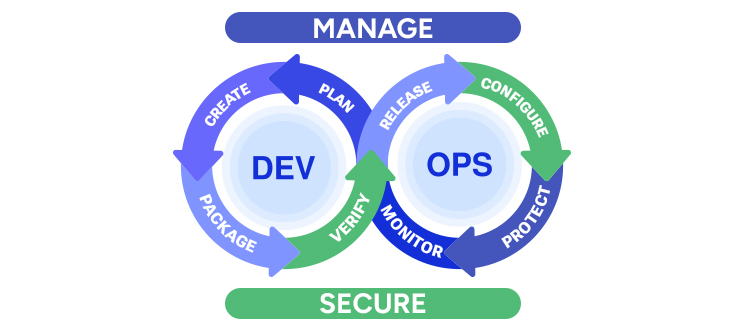
How DevOps for business is impacting the current business landscape
Spacelift, a renowned IT enterprise opines that to generate greater business value 83% decision makers in the tech space incorporate DevOps practices. It has also been reported that 49% of companies after adopting DevOps have made faster delivery for products and services. Moreover, it has also indicated that 83% of developers follow DevOps practices during their work mode.
From accelerating software delivery time to improving product quality and from fostering collaboration to facilitating process development, DevOps for businesses perform multiple functions with ease and convenience. Additionally, it empowers enterprises to incorporate changes faster, ensure customer satisfaction and loyalty, attain purpose driven results and experience outcome-oriented businesses.

Transformational journey from traditional IT to DevOps
In today’s fiercely competitive business scenario, companies across the globe are constantly competing with each other to stand out. Traditional IT approaches are becoming inadequate to keep pace with the global demands. Hence companies are looking for suitable approaches that can make them competitive and profitable.
This calls for the need to transform from traditional IT to DevOps. This shift has indeed become prominent because of its noteworthy changes from slow-release cycles and manual processes to an automated and an agile ambiance.
Because of individual development and operation teams, traditional IT approaches faced a lot of limitations. But with the advent of DevOps for businesses, things have become simpler and less time consuming. From reducing communication gaps to maintaining robust security, DevOps make your business stable and innovative.
For instance, DevOps have helped in embracing automation and promoting constructive feedback to reduce complexities and enhance collaborative spirit. Last but not the least, the growing popularity of DevOps has made IT functionalities highly aligned with the business growth prospects.
Key ingredients of DevOps
DevOps for businesses as a holistic approach encompasses a vast range of interconnected principles, practices and components. All these work in close coordination with each other to ensure reliable and efficient software delivery, and promote automation, continuous improvement and strengthen collaboration. Through a rigorous process of testing, deployment and integrating development,
DevOps for businesses focus on augmenting software delivery cycles without any compromise on quality improvement. This immersive technology facilitates faster iteration and hence results in creating a culture of continuous improvement.
To have a deeper insight on how DevOps work in practice, let us go through the following key components:
Continuous integration:
This is an important practice of DevOps whose primary objective is to identify integration glitches in the initial phases of the development process. This approach automates the testing and build process to help integrate the code changes effectively making it seamless to identify defects before they escalate. This is a huge advantage for the developers as they do not have to experience complex integration tasks in the later stages of the development phase.
Furthermore, it encourages small updates to the codebase and makes it simpler to validate and test the changes in isolation. DevOps for businesses utilizes prominent tools such as Travis CI, Jenkins, and Gitlab CI for test automation.
As a result, each time a code is run, developers can have feedback instantly to incorporate the desired changes. Last but not the least, CI facilitates improving overall system stability, swift release cycles and team empowerment towards delivering software updates rapidly.
Continuous delivery:
This approach is an extended version of the previous one whose focus is to ensure that the changes made are released to production at any given point of time. Here DevOps for businesses automate the release process to make the delivery faster and efficient.
In the pipeline of Continuous Delivery, codes after clearing the testing phase are automatically deployed to production without any human interference. This reduces human induced errors and enhances the frequency of releases.
CD or Continuous Delivery utilizes tools such as Docker, Jenkins, Kubernetes to automate the deployment phase and reduce the delivery time. This equips the developers to iterate faster and fix bugs promptly making the customers loyal and satisfied. To make your software competitive in today’s market, this approach is pivotal as it serves the customers in an exclusive manner.
Automation:
DevOps for businesses is primarily based on automation. Its main purpose is to prevent manual interventions in routine tasks and to utilize the intellectual capacities for strategic tasks. From standardizing workflows to a faster delivery process, and from infrastructure management to deployment, automation plays a crucial role to ensure that the allocated tasks are executed consistently.
With suitable automation tools like Puppet, Chef and Ansible, the DevOps consultant can reduce the time required for a manual set-up. For example, via automated testing it can be assured that the codes are thoroughly verified and, in the process, minimizes glitches in production. Automation not only helps in productive development but also improves the reliability of deployment to enable teams focus on innovation.
Continuous testing:
This approach is very integral to DevOps practice as it integrates automated testing throughout the lifecycle of your software development. Contrary to the conventional approach, CT or Continuous Testing emphasize that testing happens whenever changes take place. With automation in integration, unit and functional testing, code quality can be verified frequently. This further helps in identifying issues faster and fixing them sooner.
DevOps for businesses use testing tools such as TestNG, JUnit, Selenium to automate code running tests. This approach generates feedback faster resulting in identifying and fixing bugs at the earliest. Also with continuous testing, you can enhance the quality of your codes via assessing new features and functionalities. This approach prevents bugs from getting accumulated and stops delays in the release process.
Feedback and monitoring:
Both feedback and monitoring are significant to maintain the performance of your software, user satisfaction and stability. DevOps for businesses encourage minute monitoring of the infrastructure and the application to assess issues in real time environment.
Using monitoring tools like Datadog, Nagios and Prometheus, your IT team will have insights into the security metrics, application performance and systems health. This equips them to resolve issues effectively and with convenience.
Now talking about monitoring it is evident from the term that it deals with software performance and user satisfaction. So, with thoroughly tested and evaluated software you can make your customers/users highly satisfied and loyal.
Through a constructive feedback loop, teams can make necessary adjustments based on real time. As monitoring addresses issues proactively, smooth operation of application prevails. This results in increased reliability, reduced downtime and highly responsive product development.
Version control:
DevOps for businesses uses version control as a critical component to assess that the changes made in the codes are properly managed and tracked. Developers use version control systems like Git, to collaborate among them and work on various features in a hassle-free manner. Apart from managing changes, version control also enables tracking versions and reverting to previous ones if required.
Version control in DevOps is well integrated with other tools to make the entire process consistent and traceable. Teams utilizing version control remain confident that every environment runs the same codebase results in reduced errors and increased consistency.
Infrastructure as code:
DevOps for businesses follow this approach to treat infrastructure as software. This process prevents manual configuration and encourages defining infrastructure in code. It results in enabling automated management of environments, configuration and provisioning.
Using tools such as Puppet, Ansible and Terraform, infrastructure is provisioned via scripts. This can further be versioned and treated like application code. Additionally, IaC or infrastructure as code, helps teams to automate production, development and testing environment to make sure that there is no human error but consistency.
In this process, environments are easy to replicate as they are well defined in shareable and reusable code. It improves collaboration, speeds up deployments, and facilitates the operation and development teams to work using the same configuration scripts. Thus, it fosters a transparent workflow and transforms your business processes to achieve excellence.
Security:
DevSecOps or security in DevOps emphasizes integrating security protocols all through the lifecycle of software development. As security measures are applicable from the very beginning, it is evident that the vulnerabilities are identified and resolved early. This ultimately helps in reducing the scope of security breaches in production.
DevSecOps automates security testing and integrates tools such as SonarQube, Snyk, OWASP ZAP into the pipeline of CI/CD. By doing this it helps in detecting glitches before deployment. Availing DevOps for businesses you can have the right security elements to encourage collaboration among security specialists, developers and operation teams.
As security is an indispensable part of the development process, DevSecOps makes your code compliant, secure and resistant to attacks.

How DevOps functions for business
Businesses today across the globe are driven by advanced and interactive technologies. DevOps is a methodology which involves diverse technologies to transform business processes and ensure customer satisfaction.
From maintaining the highest standards of security to enhancing collaboration and from reducing human errors to availing constructive feedback instantly, DevOps empowers your business to remain highly productive.
With DevOps you can reinforce your business strategies and gain insights on your current progress along with availing developmental suggestions for further advancement.
Let's look at some of its value-added features:
Time-saving tool: In the fast-paced business scenario, companies globally are facing challenges to stay competitive and relevant. From delayed deliveries to doing time-consuming tasks manually, traditional tactics have become inadequate to keep pace with the rising demands.
However, with the advent of DevOps for businesses things have undergone a sea change. Companies working with DevOps strategies have become capable of enhancing productivity and collaboration without hampering consistent quality.
Manual errors have been reduced, routine tasks are automated, development and testing have become efficient and security measures are deployed at every stage right from requirement gathering. This has resulted in reducing complexities and saving time along with empowering the intellectual abilities to focus on innovation.
Collaborative tool: This is another significant advantage of DevOps which has made it prominent among businesses of today. Think of a situation where the development and the IT operations team work separately towards achieving a common goal.
It is quite natural that there would be issues related to coding, deployment, production, testing and final release. But have you ever thought that all these issues can be resolved using a single solution.
Well, the presence of DevOps in your business process can simplify all your queries and equip you to take the final step towards achieving excellence. By enhancing reliability, it helps in making the process consistent, security stringent and deployment faster.
Imagine a scenario where both developers and operation teams are working using the same scripts and with the same objective. DevOps as a collaborative tool has made IT more inclined towards attaining core business aims and objectives.
Task automation: This advantage deserves special mention with respect to DevOps for businesses. Traditional approaches involve performing routine tasks which results in human induced errors and delays in delivering solutions.
But with the use of DevOps practices, businesses across industries have now become capable of automating tasks and processes to prevent timely delays in the delivery process. Now as the daily tasks are automated, more time can be utilized on innovation and developmental activities.
Considering the rapid pace of development, DevOps practices if utilized in an optimum way can benefit your business models to serve customers better than the best player in the industry. Also, with automation you can witness a vast transformation in your testing, development, production and deployment phases which enable business expansion and an increase in ROI.
Factors boosting the popularity of DevOps for business
The limitations of traditional software development lifecycle have made DevOps for businesses increasingly popular and prominent. Considering the capabilities of DevOps features and functionalities, enterprises worldwide are adopting this approach to enhance their efficiencies towards creating custom software development.
Look below to know the major challenges and issues eliminated using DevOps resulting in faster delivery and increased output.
Siloed structures and management bottlenecks
In the conventional SDLC method, test engineers, software developers and maintenance departments are segregated into 3 distinct categories. Each of these departments works sequentially but without any collaboration or interaction.
Thus, there remains a communication gap which results in a long-drawn approach along with delivering imperfect products.
Late feedback and lack of transparency
Due to many work stages involved, customers normally engage with their products pretty late. This leads to confusion and inconsistencies between the actual delivery and the proposed model. Moreover, due to lack of communication and collaboration, employees need to work for longer duration. Also, due to late feedback, addressing user complaints often gets delayed.
Late fixes and updates
With little or no connection between the developers and the test engineers, detecting and fixing bugs/glitches, incorporating changes and making a final release often takes a significant amount of time. This often hampers the productivity of the teams and results in reduced customer satisfaction and loyalty. Enterprises cannot expand and compete if they continue to lag in their delivery schedule.
High risk and inadequate testing
Tests in conventional SDLC approach are conducted in unit formats independently. Test specialists often face challenges to maintain a consistent process throughout the development stages due to departmental silos. Due to lack of coordination and communication, the team's productivity suffers a lot, which leads to the delivery of improper products.
Thus, from the above list it is evident that traditional software development lifecycle involves significant limitations that can hamper the normal workflow of businesses across industries. But with DevOps for business companies now are enhancing the collaboration and coordination among teams and resources to stay relevant and profitable.
They can identify bugs faster, incorporate changes sooner and deliver within the scheduled time to ensure customer engagement and retention for long. This has made customers more engaged with their products’ development processes and has enhanced the feeling of oneness among them towards achieving business growth and expansion.
DevOps benefits for businesses:
Before getting onto the benefits of DevOps approach, it is to be remembered companies who have not yet embraced this strategy are prone to developing information silos. This will make the teams work in isolation from one another. So, if you want centralization in your process and unity in your information, a functioning DevOps model is apt for your business.
So, if you are working on projects which need fast updates and releases DevOps approach is your much needed solution. Otherwise, you will fail to meet the time to market and can even lose out to competitors. Listed below are the major advantages of DevOps for businesses.
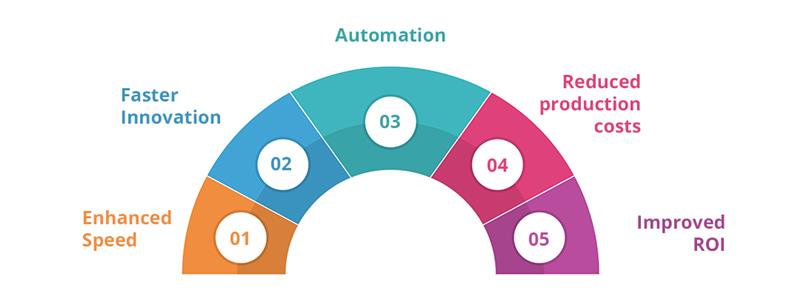
These are:
Enhanced speed: This is one of the prime benefits of DevOps which deserve special mention. In the present fast-paced and competitive business scenario, speed and accuracy matter a lot. Traditional SDLC lacks both and hence makes the development and production cycles prolonged.
On the other hand, DevOps approach facilitates collaboration among operations, development and QA teams to remove complexities and create a productive environment towards achieving a common business objective.
Moreover, with DevOps you can add value to your company as all your processes and procedures are interconnected. Also, as the majority of your tasks are automated, you can deliver faster along with maintaining accuracy related to the proposed quality.
Faster innovation: DevOps for businesses have become the key to harness innovation for software development. With this approach your business can create software products and services faster. Due to faster delivery, your development and IT operation teams will have more time to experiment with new features and functionalities. The feasibility of the new concepts is tested by the developers via proof of concept. Once approved it can extend further without hampering the ongoing projects. Thus, there is room for unstoppable growth and innovation without any compromise on top notch and exclusive quality.
Automation: This is another noteworthy advantage of DevOps for businesses which has made it reliable and productive. Think of saving your valuable time by automating routine tasks and making them error free. Imagine a scenario where streamlining tasks is seamless and focusing on innovation is the prime objective.
Yes, you have heard it right. Utilizing DevOps for your custom enterprise software development you can increase efficiency in your deliverables along with maintaining accuracy in the output. Automation involves immersive technologies like Artificial Intelligence and Machine Learning to ensure reliability in data management and predictive analytics in decision making.
This makes your business process futuristic and sustainable. So, this is a profitable aspect for the decision makers to ensure that the people and the processes are in close coordination towards making dreams a reality.
Reduced production costs: This is another promising advantage which significantly decreases the amount of time and effort spent on routine tasks due to the utilization of automation. Using DevOps your departments can minimize production and management expenses through purpose driven collaboration. In the process it brings new upgrades and maintenance under a single umbrella. It utilizes cloud migration to simplify the challenge of inefficient resource usage.
Improved ROI: Better ROI or a faster return on investment is a significant advantage of DevOps. With DevOps your businesses can have maximum profits by eliminating bugs before the deployment stage and by releasing software updates faster.
Operational excellence empowered via DevOps boosts the development lifecycle and helps in efficient running of the programs. Hardened security is another aspect of DevOps which helps in effective system protection and preventing data breaches to ensure confidentiality and privacy.
Cost optimization, performance efficiency and infrastructure management are all vital elements of DevOps which facilitate lowering the operational expenses and the total cost of ownership. Hence you can boost ROI for your business by appropriately using DevOps practices.
Conclusion:
Are you ready to transform your digital ecosystem with DevOps for businesses and stay competitive using a futuristic and an agile approach? Feel free to consult our experts and escalate your business towards achieving excellence. We enable you to improve the reliability and speed of your productivity and stay relevant in the current market. If you are looking for an ultimate solution, we can be your ultimate solution provider in terms of faster delivery and outcome-oriented businesses.
Explore how DevOps for businesses accelerate your business and transform your development lifecycle.
Frequently Asked Questions
What is DevOps in simple terms?
DevOps for businesses is defined as a comprehensive process where the development and the IT people work together towards creating software in the most collaborative and reliable manner.
Why is DevOps important for modern businesses?
With DevOps for businesses, companies can make their tech-based operations reliable, efficient and purposeful. From reducing costs to increasing collaboration and from productive improvement to faster delivery, this approach makes businesses competitive and relevant.
How does DevOps improve the development process?
From early bug detection to continuous integration and from automation to faster feedback, devOps for businesses empower brands to enhance productivity and improve the quality of work life.
Also read: Cloud-Based App Development.