


Enterprise resource planning software solutions have expanded their capabilities to support many businesses in streamline the functionalities like e-Commerce, marketing automation, sales force automation, manufacturing and procurement, human resources, accounting, etc. Still, ERP integration or any other system integrations for that matter remain a sensitive topic for many enterprises. Why? because
• 1 of every two tech professionals are stressed with their current automation tools and integrations.
• 1 in 2 still believe that integration challenges hold them back from using the data to achieve their enterprise goals.
Nearly 56% of the North American businesses agree that new software integrations are easier today and we agree on that too.
Businesses that rely on ERP not only save money by eliminating the redundancies of the processes, but also by automating repetitive tasks, providing employees the access to crucial information for better decision-making. The global ERP software market is projected to grow from USD 106.22 billion in 2026 to USD 281.58 billion by 2034, reflecting the increasing need for connected, scalable, and data-driven enterprise systems.
In 2026, choosing the right ERP integration solution is essential for businesses that want to connect data, automate workflows, and reduce operational complexity across finance, sales, inventory, HR, and customer service.
What Is an ERP Integration System?
An ERP integration system connects an enterprise resource planning platform with other business applications to improve data flow and streamline operations. It synchronizes existing software systems with the ERP, helping organizations achieve better efficiency, communication, productivity, and real-time visibility.
ERP software solutions contain various modules for running various operations in a business, predominant ones are:
• Manufacturing and production
• Inventory management
• Human resource management
• Customer relationship management
Well-planned ERP integrations enable these modules to share accurate information with connected applications, reducing manual work and helping teams make faster, data-backed decisions.
ERP integration has empowered many businesses to witness nearly 67% boost on their operational efficiency and 54% reduction in manual errors.
Advantages of ERP integration
A scalable ERP integration solution helps organizations unify disconnected systems, improve process visibility, and create a reliable foundation for long-term growth, like:
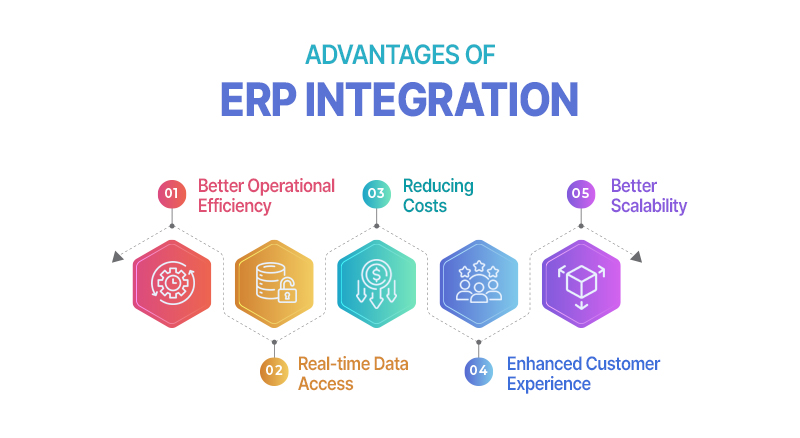
Better operational efficiency
ERP integration empowers business processes to collect data from various sources like inventory management, procurement, human resources, finance, etc. The system stores all the data on a unified platform which is accessible to all employees.
ERP is a robust system that decreases manual errors and data duplication, alongside regulating the routine tasks that boost productivity. Employees are able to rapidly access information and check the progress of workflow – facilitating seamless collaboration between departments to facilitate data-powered decision-making.
All businesses can effectively combat challenges along the way effectively, with ERP’s centralized information and well-defined processes. Employees can also concentrate on strategic goals as well as administrative tasks. Integrating ERP with CI/CD servicees further ensures that all resources are efficiently used so that they boost the overall productivity of the organization.
Real-time data access
Centralized units of ERP systems empower the decision makers for accessing the correct and updated information before responding timely to the dynamic market trends as well as operational hurdles. The availability of correct information enhances collaboration and transparency among various departments of the business enabling it to track performance, identify trends and make well-informed decisions.
ERP systems reduce dependence on incomplete or outdated information that minimizes risks of miscommunication or delays. This ability of ERP integration is particularly valuable for the fast-paced industries where the employees are required to quickly access the information needed.
Reducing costs
Investment in an ERP system seems costly at first but it can help your business save a lot of money through automation of manual processes. This enables businesses of continuity with minimized errors and effective handling of the resources. ERPs are all-inclusive systems which eliminate the requirement for various systems for looking after specific operations. Businesses do not have to manage or invest in multiple setups for the purpose.
A great feature of ERP integration is that the process enhances inventory management that ensures optimal levels of stock all the time. Automating the process aids businesses to take the necessary action after determining an inventory imbalance and preventing overstocking or stockouts. This ensures better functioning of the supply chain and reduces waste.
In the long run, advantages of systematic operations and workflows as well as affordable labor outweigh the initial investment of ERP software acquisition.
Enhanced customer experience
For FMCG businesses, ERP integration can enhance customer experience. Access to updated and accurate data enables employees to personalize address issues, monitoring orders and customer interactions more effectively.
The inventory management and demand forecasting capabilities of ERP tools ensure that the availability of the products is consistent with the customer needs.
ERP also facilitates customer relationship management or CRM modules for collecting feedback and identifying customer preferences. This facilitates safer and faster delivery of services and products as well as customization of the marketing process.
ERP systems enable seamless collaboration and improve operations among the departments that ensure customers have a satisfying brand experience.
Better scalability
Most of the individual software systems aren’t able to adapt to the changes of the growing businesses. ERP systems, on the other hand, are scalable solutions that accommodate, seamlessly, to new customers as well as the dynamic market conditions. As businesses penetrate new markets or expand their product line, ERP systems enable storing of new user information and data and functions without glitch.
The different modules of ERP software enable businesses to begin leveraging the functions that are needed initially and also add new modules that require changes. This ensures that the enterprises can rapidly adapt to size or scope changes without facing much organizational disruption.
ERP software are value-addition for enterprises that have multi-location presence or who have to deal with multi-currency transactions – obligated to comply with all regulatory standards.
While we have enlisted the crucial advantages of ERP systems, explore the:
Challenges and risks of ERP integration
ERP integration comes with a lot of benefits, and it has its fair share of challenges as well. By understanding these challenges, organizations can prepare for ERP implementation and follow the steps to avoid those mistakes.
Data silos
Before migrating to ERP systems, enterprises mostly depend on the legacy systems that oversee many operations. This means that they would have needed multiple systems for governing and collecting data from various sources. Such lengthy and complex processes cause inefficiency, duplication, inconsistencies and lack free flow of information.
Accuracy of the data collected from various sources is questionable and might impact on the business owners’ decisions.
Another crucial challenge in this case is the transferring of data from legacy systems to advanced ERP systems. ERP implementation is powerful, complex and requires data validation and careful planning. Organizations must invest in evolving technologies for minimizing such gaps in integration.
Compatibility
Gaining platform compatibility remains as a primary concern during the process of ERP integration. Organizations maintain multiple legacy platforms, contemporary software and third-party applications that operate distinct architectures with various communication protocols and data formats.
Organizations have to build middleware platforms and specific interfaces that facilitate communication between various systems. When the API standards remain inconsistent and the software version lack match, technical system issues and installation delays take place.
For addressing this challenge, organizations have to perform strict compatibility evaluations and invest in ERP solutions that offer flexibility. This ensures they get end-to-end support from their vendors. A capable ERP integration concentrates primarily on iterative improvements and comprehensive testing which enables all the system components to function together.
Budget constraints
Investing in an ERP creates substantial expenses that strain on excessive organizational funds whenever there are extra costs. Employee education, data transfers, development requirements, system updates and licensing payments are all included in the maintenance expenses and total management costs.
Improper planning causes the expenses to increase uncontrollably which later on leads to excessive time delays and reduced scope in the project. The unguided financial strains put most of the small and medium scale businesses at risk and to tackle these issues, companies must create a contingency plan, adequately distribute resources, analyze cost-benefit effectiveness, etc.
Ruling out on-premises ERP implementation and opting for cloud computing ERP can empower businesses to consistently maintain objectives by lowering the expenditure requisites through vendor partnerships.
Change resistance
Operational changes that are initiated through ERP system implementation cause resistance in employees. While navigating a transition, employees who rely heavily on current systems carry the tendency to worry about these changes. System resistance becomes visible when the employees show error in the operation of the system, resist new tools and display intentional opposition to the transitions.
Effective ERP integration demands a proactive management change approach that initiates with clear messaging and allows the employees to take full ownership of choices that deliver full-swing training programs.
For promoting advantages of new systems, the crucial stakeholders must help the employees to use newly introduced ERP systems and acknowledge performance progress to boost the morale of each member of staff.
An effective ERP integration depends on factors like setting ERP goals with employee incentives and facilitating workplace flexibility through organizational change.
What are the different types of ERP integration methods?
Selecting an ERP integration solution depends on the organization’s existing systems, data complexity, security requirements, budget, scalability needs, and long-term digital-transformation goals. Understanding the ERP integration methods is crucial in choosing the appropriate approach for the process. Some of the primary methods include:
Point to point integration
The point-to-point integration approach includes data transferring by connecting two systems. It is an economical method that benefits the company that has fewer complex operations and small-scale needs.
The method is not at all effective for the growing business that manage multiple connections or systems – leading to inadequate collection of data. It is not scalable and is only appropriate for companies that have basic integration needs and limited workflows.
Enterprise Service Bus or ESB
ESB or enterprise service bus is a middleware architecture that facilitates communication and cooperation between various systems from a centralized platform. It is ideal for businesses that have complex connection needs and need segmentized and structured information for reducing dependency on multiple connections.
In case you invest in ERP systems for the very first time, ESB delivers long-term benefits, reliability and scalability which makes it suitable for comprehensive ERP infrastructure.
iPaaS or integration platform as a service
iPaaS approach delivers ERP integration through cloud by offering scalable operations and flexible capabilities. Such platforms support modern businesses by establishing smooth transfer of data between cloud architecture and the physical systems through predesigned tools for integration.
The subscription-based pricing model of the business with flexible design provides businesses scalability and quick deployment possibilities whenever needed.
Custom API integration
Custom APIs provide tailored integration solutions that empower businesses to take complete control of the system operations. This design is ideal for businesses that have distinct needs for operations and proprietary solutions.
Custom API integration calls for significant initial expenses but provides precision and adjustable architecture that ensures ongoing system compatibility with enterprise needs and technological advances.
Use cases of API integration
API integration plays a crucial role in modern ERP integrations, enabling seamless communication between applications, real-time data exchange, and automated workflows. It helps businesses connect their ERP with financial tools, CRMs, e-commerce platforms, HR systems, and business-intelligence software. Here are some impactful use cases:
Automating financial workflows
ERP integration facilitates seamless automation of financial processes like reporting, invoicing, expense tracking and budgeting. Here, ERP is connected with the accounting software of the company that reduces data silos, time taken by manual entry and real-time visibility of the finances.
Automated workflows reduce errors by humans and improve compliance to ensure accurate forecasts, rapid month end closings, etc. Such integrations are valuable especially for the finance teams that manage complex transactions and multi-department budgets, offering the teams actionable insights for better financial planning and centralized control.
Integrating ERP and CRM systems
Integrating CRM and ERP systems enable businesses to establish a bridge between operations and sales. Billing information, inventory levels and customer data flow freely between the platforms involved that enable better sales forecasting and customer service.
This integration enables sales teams with access to real-time pricing and stock, while the operations gain visibility into pending orders and customer histories. This results in more efficiency in end-to-end customer lifecycle management, reduced duplication and improved collaboration.
Inventory and ERP synchronization
e-Commerce platform integration with ERP ensures real-time order synchronization, shipping data, pricing and inventory. As the customers are making online purchases, ERP triggers order fulfillment workflows and automatically updates stock levels.
This integration crucially eliminates the needs of manual updates, streamlines supply chain management and operations and reduces overselling risk.
Companies, with this integration, gain control over transaction history across various channels. Customer data and product listings to deliver a smooth buyer experience that boosts operational efficiency in both B2C and B2B environments.
Payroll and HR system ERP integration
Integrating payroll and HR systems with ERP brings in accuracy to workforce management. Employee compensation, leave balances, time tracked and data can be unitedly updated in real-time.
This ERP integration reduces data redundancy, ensures accurate processing of payroll and simplifies labor law compliances.
HR departments reap the maximum advantage with improved reporting and streamlined onboarding while the finance team get labor cost transparency. The integration enables planning of a strategic workforce with overall better employee experience.
Special mention – role of accounts payable in ERP integration
AP or accounts payable automation has a transformative role in ERP integration. This type of automation streamlines all financial operations and enhances overall efficiency of the systems.
By automating payment workflows, approvals and invoice processing, AP automation uproots the need for consistent manual data entry – reducing occurrences of human errors and reinforcing the processing times.
When AP automation is integrated with ERP, it facilitates tighter control over the finances, improves visibility of cash flow and ensures real-time system updates.
The results we get are more agile, as well as an accurate financial function that scales with the growth of business while reducing costs and maintaining compliance.
Business systems commonly integrated with ERP
An effective ERP integration system connects the ERP platform with the tools teams already use, ensuring reliable data synchronization and reducing the need for duplicate manual updates. Here are some modern business systems that commonly integrate with ERP:
CRM or Customer Relationship Management
Integrating CRM systems like HubSpot or Salesforce reflects a unified view of invoices, orders, sales pipelines and customer data synchronization. This facilitates improved decision-making, targeted sales efforts and enhanced customer service.
E-Commerce platforms
ERP integration with e-Commerce platforms like WooCommerce, Magento and Shopify assure of efficient order fulfillment, automatic status updates of orders and real-time inventory updates. This facilitates seamless online shopping experience for the customers and reduction in manual data entry.
SCM or supply chain management systems
ERP integration with a supply chain management system provides accurate real-time delivery timelines, procurement status and inventory level updates. This collaboration minimizes disruptions, optimizes management of inventory and improves supply chain management.
Business intelligence tools
Integrating BI tools like Tableau or Power BI with ERP facilitates data visualization and advanced reporting – allowing the business to identify trends, analyze ERP data and make informed decisions based on the accurate insights.
With ERP integration of these systems, businesses can build more efficient and interconnected ecosystems that enable data-driven decision-making, improve overall decision-making and an efficiently interconnected ecosystem.
ERP integration enhances business performance – here’s how
Enterprise resource planning integration boosts business operations significantly by:
Facilitating cross-department collaboration
- ERP systems can be integrated with many business processes, enabling elimination of data silos and promoting streamlined communication as well as data sharing across various departments.
- Such integrations foster enhanced cooperation and coordination with transparency to reduce communication barriers and to enable more efficient utilization of resources.
- ERP integrations facilitate real-time access to relevant information, that further empowers all the stakeholders to make data-backed decisions and accomplish their responsibilities effectively.
- For instance, the sales and marketing team can share details of marketing campaigns customer data effortlessly while the operations and finance departments can collaborate on order fulfillment and inventory management.
Supporting growth and scalability
- ERP systems are built to manage the rising business complexities and volumes that empower the businesses to scale without major hurdles or glitches.
- The systems can also be adapted to support new locations, services or products by adding new integrations or modules to it.
The ability of ERP integration to automate workflows or routine tasks free-up resources and time for strategic growth or initiatives.
For instance, a growing business would be able to add a new module for e-Commerce to an existing ERP system for handling online sales or integrate a project management tool for tracking multiple project progress.
Improving customer satisfaction
- By integrating data from various departments, as well as touchpoints, ERP systems can give a comprehensive view of all the customer interactions.
- This feature enables the businesses to deliver tailored and personalized customer experiences that lead to higher customer loyalty and satisfaction.
- Real-time insights enable proactive customer engagement by addressing potential issues before they can create an impression or impact on the customer.
- For instance, an ERP system can integrate with CRM system for tracking preferences of customers and provide real-time recommendations.
Different ERP integrations require different levels of customization. Businesses should evaluate each platform’s APIs, pre-built connectors, security controls, data-mapping capabilities, and scalability before selecting an ERP system or integration partner.
Popular ERP systems for integration
To summarize, ERP integrations pave the way for business success by improving customer satisfaction, enabling scalability and fostering collaboration. By providing real-time insights and unifying business processes, ERP systems empower the companies to optimize operations and make data-backed decisions and achieve sustainable growth.
| System names | Functions and market growth |
| SAP | Provides robust capabilities for integration through SAP business technology platform or BTP and facilitates seamless third-party application connectivity as well as real-time data sharing. Great for handling complex processes for large enterprises. |
| The global market for ERP is expected to touch $238.79 billion by the year 2032 with a significant role played by SAP as one of the top market players. | |
| Oracle NetSuite | API-friendly and cloud-based, Oracle’s NetSuite facilitates seamless integration with CRM, financial systems, e-Commerce and more such business systems, which makes it a flexible choice for the growing businesses. |
| Oracle’s NetSuite has experienced a 22% revenue growth in 2023 which reached $0.7 billion. With more than 40,000 customers around the world, NetSuite’s integrational capabilities are crucial factors in its high adoption rate. | |
| Microsoft Dynamics | Integrates easily with Microsoft tools like Azure service, Office 365, Power BI, etc. Microsoft Dynamics 365 offers strong connectors and APIs for streamlining the business operations across various departments. |
| In 2026, Microsoft Dynamics 365 continues to expand its ERP and business-application capabilities through its latest release wave, including AI-assisted and role-based features across Dynamics 365 and Power Platform. | |
| Odoo | Open-source and highly modular, Odoo carries in-built integration tools alongside supporting API connectivity for many third-party applications – making it an economical option for the SMEs. |
| In 2026, Odoo remains a flexible option for small and mid-sized businesses because its modular ecosystem, built-in integration tools, and API connectivity support tailored ERP implementations. | |
| Infor | Focused on the industry-based solutions, Infor’s Infor ION facilitates efficient integration with many other systems – enabling smart process automation and data flow. |
| Infor was recognized as a Leader for the fifth consecutive year in the 2025 Gartner® Magic Quadrant™ for Cloud ERP for Product-Centric Enterprises—the latest cited recognition available for this category in 2026. | |
| Workday | Workday supports integration through pre-built connectors as well as Workday Studio that allows scalable and secure connections for external systems. |
| Workday reported USD 9.552 billion in total revenue for fiscal 2026, representing a 13.1% year-over-year increase. Its subscription revenue reached USD 8.833 billion. |
Lacking in-house infrastructure to build a custom ERP solution? Cannot depend on freelancers? Why not hire professionals?
You can hire a professional enterprise software development company to develop custom-built ERP solutions that will provide your business the strategic edge – especially in a competitive market like the US. Whether your business is a startup that needs to streamline its core processes or a large corporation that manages complex integrations, tailored ERP software solutions ensure precision and better scalability.
In fact, businesses, that partnered with ERP consultants, reported 85% success rate in implementation – highlighting the increasing reliance of expert-built adaptable solutions.
Choose Proquantic software as your enterprise software development building partner
Hiring Proquantic Software USA as your partner for enterprise software development assures of strategic alliance with a company that is trusted by hundreds of businesses for delivering scalable and tailored solutions to drive business efficiency and growth.
Proquantic helps businesses design and implement a customized ERP integration solution that aligns with their workflows, industry requirements, existing technology stack, and growth plans. From API-based integrations to custom enterprise applications, we build secure and scalable systems that improve operational visibility.
Proquantic has a global presence blockchain well as a commitment to innovation. We specialize in crafting customized enterprise applications that are at par with the unique operational needs – facilitating enhanced collaboration and seamless workflows.
What we bring to you:
- Bespoke enterprise software development services that ensure every solution to be tailor-made for meeting the specific requirements of businesses to enhance operational efficiency.
- Diverse expertise across multiple sectors like Education, Logistics, Healthcare, FinTech and more. We leverage our wealth of knowledge to address the industry-focused challenges effectively.
We also provide services like:
- AI software development
- DevOps consulting
- Blockchain
- Cloud Solutions
- App development
Our software solutions meet all your enterprise needs.
We operate in the US, UAE and UK by combining the best global practices with local as well as international markets by delivering solutions that are aligned with the target audience.
We boast a client retention rate of 93% with a success rate of 98% - figures that demonstrate our proven track record of delivering reliable and high-quality software solutions that not only meet but also exceed the client expectations.
When you collaborate with us, you are partnering with a dedicated team that commits to drive your business forward with efficient and innovative technological solutions.
Conclusion
Modern ERP integration goes far beyond operational convenience. A reliable ERP integration system helps businesses connect CRM, e-commerce, HR, finance, supply-chain, and analytics platforms to create a more agile, efficient, and data-driven organization.
In 2026, successful ERP integrations require a clear strategy, quality data, scalable architecture, security controls, and strong change management. By choosing the right ERP integration solution, businesses can reduce manual complexity, improve customer experiences, and support sustainable growth.