


A majority of the businesses today lose themselves in data but remain starved when it comes to having efficient insights. A survey by HubSpot reflects that nearly 42% of sales teams waste their productivity and work hours in switching between tools, which leads to frustrated customers and lost opportunities. Off-the-shelf CRMs deliver slow adoption, irrelevant features, and rigid workflows, and that is why the smarter organizations choose to build a CRM from scratch, tailored to the exact customer journeys, sales cycles, and processes. A custom CRM system eliminates the noise, provides analytics that drive decisions, and automates the repetitive tasks smartly.
For example, a mid-sized company from the USA that switched from a plug-and-play CRM solution to a personalized one, and it reportedly fetched the company 30% quicker lead conversion within a span of 6 months.
Creating a bespoke CRM is not just about flexibility, but about business acceleration. It assures seamless integration, tighter control over data, and a system that grows with the company.
In this write-up today, Proquantic Software USA will dive deep into the importance of CRM for modern businesses, and businesses should choose to build a CRM to outperform the off-the-shelf alternatives. Enabling them to avoid costly mistakes and gain a competitive advantage.
CRM – definition and importance of bespoke solutions
CRM, or customer relationship management system, is the core system of every modern business operation. It automates workflows, tracks interactions, consolidates customer data, and provides insights to support the sales and marketing team to work cohesively. Right from improving lead retention rates to nurturing new ones, a CRM assures that every customer touchpoint adds to the measurable value. In essence, it is more than just software; it is an operational framework that connects decision-making with data.
But the real challenge for various organizations lies with adaptability. A majority of the ready-made CRM systems, like HubSpot or Salesforce, are designed for the masses. They are overloaded with the most widespread modules, limited customization options, and steep tiers of subscriptions, which force the teams to adapt their workflow to the software rather than the other way around. This disconnection quite often results in missed insights, poor rates of adoption, and insufficiencies.
And this is where businesses should make the choice to build a CRM, which will be a strategic addition to the workforce. A customized CRM powers up companies for designing each and every function like automation flaws, integrations, reporting structure, pipeline stages, and more, exactly around their company goals and processes. Bespoke CRM eliminates redundant features while embedding what matters most.
Crucial reasons for building custom CRM solutions
- Greater adoption among team – Employees can seamlessly embrace systems that are aligned as well as intuitive with their daily work.
- Cost efficiency over time – No unnecessary upgrades for features or recurring license fees.
- Scalable growth – As the business grows, new features too can be addressed without any limitation of structure.
- Complete data control – Sensitive customer data stays protected within the infrastructure.
- Tailored architecture – Every dashboard and workflow reflects actual operations and insights of the business.
When businesses build a CRM, they are not just creating a tool; they are creating a smart ecosystem that evolves with the business. It transforms the customer management from being a routine function into a data-powered strategy of growth, which is built on long-term scalability, ownership, and precision.
Types of CRM businesses that can be built
When businesses decide to build a CRM system, it is crucial for them to understand the various types of CRM systems so that they build the right system that aligns with their business objectives. Each of these types serves a unique purpose by addressing collaborative, analytical, or operational needs.
Selection of the right model or even combining the elements can improve the efficiency, customer satisfaction, and data utilization significantly.
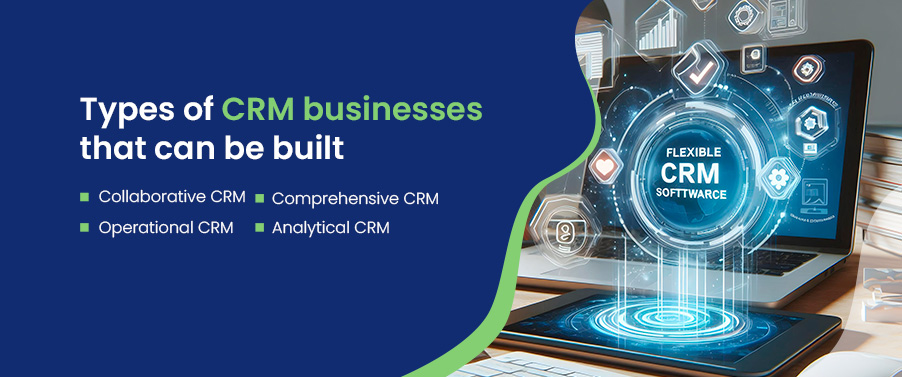
Let’s have a look at the various types of CRM, built by businesses around the world:
Collaborative CRM
Collaborative CRMs focus on information and communication sharing across customers, partners, and departments. The system assures that the marketing, sales, and support teams function in harmony, sharing insights as well as feedback in real-time. By integrating the collaborative tools in the custom CRM, businesses can bring in a unified approach to customer engagement, which eventually leads to improved service quality and stronger relationships.
Operational CRM
Operational CRM streamlines the daily businesses processes. It automates tasks like customer support workflows, marketing campaigns, pipeline tracking, and lead management. By centralizing the operations, businesses can enhance their response time and reduce manual effort, alongside ensuring that no opportunities are lost. When businesses decide to build a CRM with operational features, their teams can handle massive volumes of customer interaction efficiently, alongside maintaining consistency across every touchpoint.
Comprehensive CRM
Comprehensive CRMs blend collaborative, analytical, and operational functionalities into a singular and cohesive platform. When businesses decide to build a CRM platform of such type, the system not only provides actionable insights and automates workflows, but it also enables a streamlined collaboration across every department of the organization. It's a holistic approach that ensures that every business scales quickly, makes data-powered decisions at every level, and proactively responds to the customer needs.
Analytical CRM
Analytical CRMs are built for transforming customer data into actionable insights. They gather data from numerous channels, predict trends, analyse purchase patterns, and offer reports for great decision-making. A customized analytical CRM helps businesses turn their customer retention, marketing, and sales strategies into a transformation faster, enhancing the forecasting accuracy and personalization.
By choosing the right type of CRM or even integrating multiple types, businesses experience streamlined operations, maximized value, and an overall strong customer strategy.
Benefits of creating a custom CRM
Choosing to build a CRM from scratch is one of the most strategic moves that businesses can make today, in an overly competitive digital environment. While off-the-shelf solutions assure convenience, they come with limited flexibility and mandate the teams to adapt their processes to that software.
A custom CRM software, however, aligns technology perfectly with the growth objectives, culture, and workflow objectives. Here are some of the crucial benefits that make building their own CRM a long-term solution, acting as the company's true competitive edge.
Let's take a detailed glimpse at the benefits of creating a custom CRM:
Centralization of customer data
When businesses build a CRM, one of the most powerful advantages is the capability to create a unified and singular database for all customer interactions. Rather than juggling disconnected tools or multiple spreadsheets, the team instantly gains access to a comprehensive customer view that covers preferences, support tickets, purchase history, and past communications. Such an approach of unified data enhances the condition among departments, ensuring real-time decisions and little to zero duplication of work. Customized systems facilitate advanced features like AI-powered personalized outreach and customer segmentation.
Enhances customer relationships
A personalized CRM enables businesses to tailor their strategies around specific preferences and customer behaviours. Unlike the generic CRMs that apply a one-size-fits-all approach, a custom CRM can be easily programmed to trigger loyalty-based rewards on real communications, follow-ups, and personalized e-Mails. Such a personalization level deepens the trust, boosts retention rates, and improves satisfaction. Moreover, when the CRM reflects the tonality of the brand, service ethos, and workflow, customers experience a reliable and cohesive journey right from the very first interaction.
Better team productivity
The generic CRMs are often cluttered with unnecessary modules that slow down the users. By selecting to build a CRM, businesses can design workflows and interfaces that match how the teams work. Automation is able to handle repetitive tasks like reporting, follow-ups, and data entry by freeing up the employees to focus on client engagement and strategy. Integration with tools that the teams already use, like Outlook, Slack, Teams, etc, further strengthens and streamlines the operations. With time, such alignment enhances the rates of adoption and reduces the costs of training as the CRM gets intuitive since day 1.
Better decision-making and analytics
Off-the-shelf or ready-to-use CRMs provide generic reports as well as dashboards, which rarely capture metrics that matter to the business. A custom CRM solution gives businesses the freedom to define KPIs, track performance, and create tailored dashboards that are unique to the company's sales and industry model. You can integrate advanced reporting mechanisms, AI-powered forecasting, and predictive analytics to gain deeper insights into business performance and customer behaviour. Such a data-driven approach empowers leadership teams to make smarter, faster, and more confident decisions.
Total control over data and features
This is perhaps the most valuable benefit of building a CRM, both data and functionality-wise. When businesses rely on third-party software, they are limited by a custom CRM solution that the business can control in every aspect, right from UI design, scalability, compliance, and security. Businesses can integrate new technologies like Blockchain, automation, or AI without waiting for any external releases, ensuring the evolution of the system, synced with the vision.
When businesses build a CRM, they are not just developing just another software but also engineering a smarter ecosystem that is built to grow with the business. From personalized engagement, data centralization, offering full control, to boosting productivity, a custom CRM transforms customer management into a strategic advantage that no other off-the-shelf product can replicate.
Ready to build a CRM for your business? Here’s a list of ‘must-include’ features
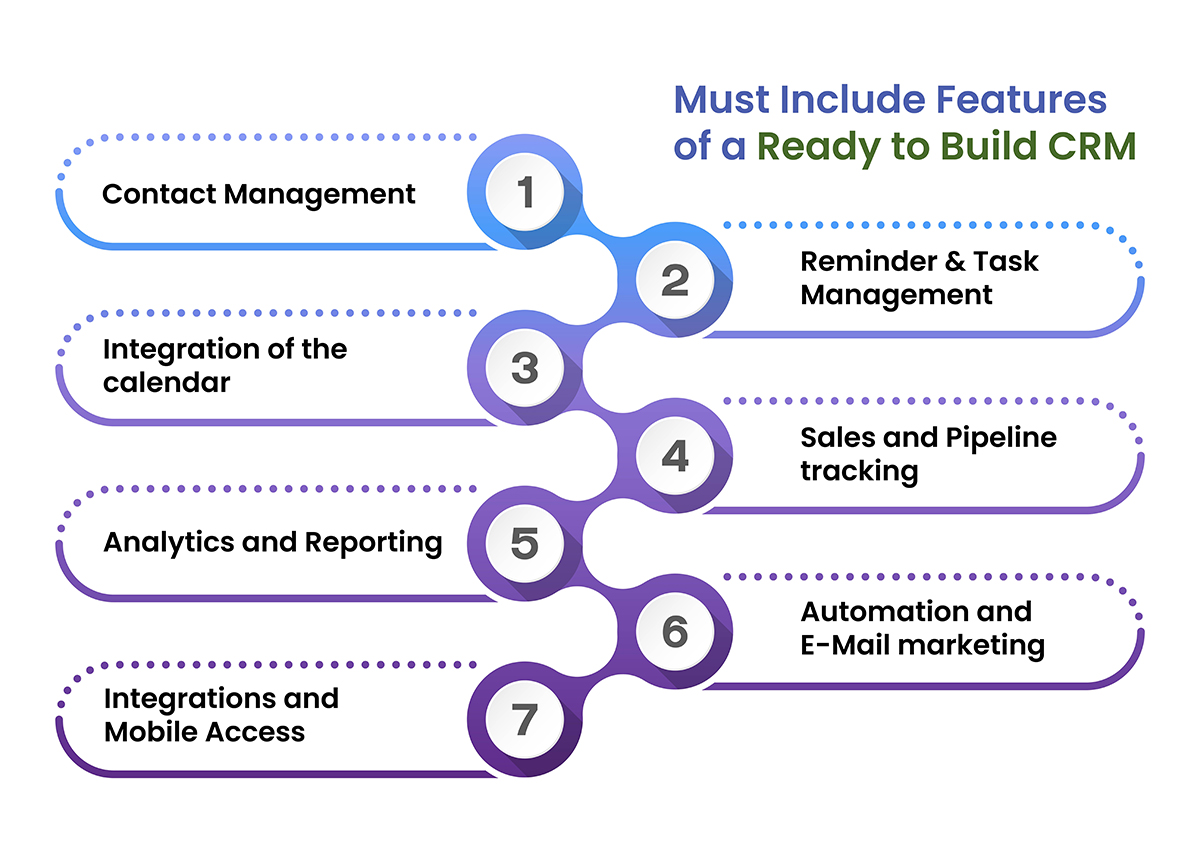
When businesses decide to build a CRM, the success of the software depends on the features that they load it with. An efficient CRM is not a contact database; rather, it's a dynamic system that strengthens the relationships, streamlines the workflows, and facilitates the collaboration across every touchpoint of the business. Below is the list of the features that businesses must include to form the backbone of the custom CRM solutions.
Contact management
At the very core of every CRM, there is contact management, which has the ability to access, organize, and store customer information seamlessly. A robust CRM facilitates businesses to maintain detailed profiles, consisting of not just basic information like e-Mails or names, but also preferences, communication records, purchase history, behavioural data, etc. Such a 360-degree customer view empowers the support and sales team to build long-lasting client relationships, respond quickly, and personalize interactions.
When businesses build a CRM, they must focus on the system's flexibility, enabling custom tags and fields so that the teams can structure data in ways that align with the unique processes of the business.
Reminder and task management
A custom CRM must act as the business's digital assistant. From reminder management to task integration, customized CRM system must ensure that no follow-up or leads slip through the gaps. The teams must be able to receive automated notifications, set deadlines, assign tasks, and create to-do lists. For example, the sales representative of the company must get a reminder about a prospect who has not replied in the past week, and this simple feature can mark the line of difference between a lost opportunity and a closed deal. Automation promotes accountability and keeps each and every person aligned on priorities without needing manual tracking.
Integration of the calendar
When businesses build a CRM, the integration of the calendar feature is never negotiable. Whether the teams use Apple Calendar, Outlook, or Google Calendar, synchronizing all schedules within the CRM will eliminate missed appointments or double bookings. Moreover, the real-time synchronization means that the calls, events, and meetings are updated automatically across all devices. Combined with task management, this feature improves coordination with the client, enhances time management, and makes the CRM a productivity hub.
Sales and pipeline tracking
A business CRM must make it convenient for the organization to visualize the journey of the customer, right from the first enquiry to the final point of sale. The feature of sales and pipeline tracking enables businesses to let the teams predict revenue with better accuracy, identify the bottlenecks, and monitor the stages of the deal. A sales pipeline that can be customized assures the business of alignment of CRM with the specific methodology of sales, whether it is consultative selling, SPIN, or BANT. With progress bars and drag-and-drop pipelines, the sales team can quickly see which deals require attention and where the opportunities are getting stalled.
Analytics and reporting
To build a CRM without strong analytics is like working blind. Real-time data visualization tools as well as dashboards empower the teams to track key performance indicators like campaign performance, customer retention, sales velocity, and conversion rates. Customized CRMs also come with the ability to integrate predictive analytics to forecast the upcoming trends and suggest actionable insights. For instance, identifying which sales representatives are performing great or which segment of customers is bringing the most recurring revenue can assist the management in making informed decisions. The goal is never to collect data, but to transform the data into insights that can be leveraged to drive growth.
Automation and e-Mail marketing
In the lifecycle of the modern customer, email still functions as a powerful channel of communication. When businesses build a CRM, it must include automation and e-Mail marketing capabilities that trigger campaigns, send personalized messages or nurture leads based on the customer's actions. As an entrepreneur, you can customize anything – right from follow-up post-purchase, drip campaigns to welcome e-Mails. This not only saves time but also ensures a timely and consistent engagement. Integrated analytics can further demonstrate which e-Mails perform the best, enabling refined marketing efforts.
Integrations and mobile access
CRM reflects that today's workforce is largely mobile. A mobile-responsive CRM or a dedicated application for the mobile device ensures that the team can update pipelines, access customer data, or communicate on the go. Integrations are equally crucial. When businesses build a CRM, it ensures an effortless connection with tools for project management, communication, accounting software, etc. Such integrations create a unified ecosystem where data automatically and freely flows across the platforms, enhancing productivity and reducing manual work.
A step-by-step guide on how to build a CRM
Building a CRM is a strategic project. When a business decides to build a CRM, it must follow a disciplined approach to avoid poor adoption, rework, and wasted budget. Let's have a look below at the practical roadmap to build a productive and practical system for the business.
Define your goals with the CRM
Start with the results and not the features. Clarify the core objectives like centralization of support tickets, improving retention, and shortening sales cycle, and of course, success metrics like adoption rate, LTV, response time, conversion rate, etc. Map the core user personas like customer success, account manager, sales rep, and document their workflows. Such a strategy turns out to be the north star for every subsequent decision.
Decide between ready-made vs custom CRM
Off-the-shelf CRMS offer robust ecosystems and speed up time-to-value, whereas custom CRMs provide the exact fit with full data control and low friction for the long term. Compare the expected scale. Required custom workflows, complexity of integration, and total cost of ownership to decide whether you should choose a ready-made solution or build a CRM.
Search for a reliable partner for CRM development
If you choose a hybrid solution, select a custom partner who is experienced in building CRM projects for the industry. Go through the case studies, read testimonials, check for reviews, references, and security certifications. Validate their ways of onboarding professionals, post-launch support, and knowledge transfer. Ensure that they prioritize modular design, test automation, and documentation so that the CRM can evolve without any kind of heavy refactoring.
Choose the right tech stack and features
Translate strategies into an MVP feature list that includes analytics, mobile access, integrations, e-Mail automation, calendar synchronization, etc. Pick the right tech stack that supports quick iteration, like scalable hosting, cloud DB, Graph/SQL APIs, and a modular backend. Decide the patterns of integration, like middleware or webhooks, for ERP, billing, and marketing systems. Plan for audit logs, role-based access, and security.
Test, build, and integrate CRM
Develop in short sprints along with frequent demos to the stakeholders. Prioritize automated tests as well as data migration scripts if moving the legacy records. Integrate with crucial systems that are early to reveal the edge cases. Run a closed beta with power users for validating KPIs, workflows, and UX. Leverage real data in the staging for catching permission and performance issues.
Launch your CRM and maintain
Team by team, gradually roll out, combined with in-app help and targeted training. Monitor the business KPIs, support tickets, and adoption metrics. Treat the CRM as a product, maintain a roadmap, release iterative improvements, and collect user feedback. Plan ahead for scalability checks, backups, and security reviews.
By following such steps, businesses can build a CRM that grows with the company, gains team buy-in, and solves true business problems by turning customer data into efficiency and repeatable revenue.
Crucial considerations to build a CRM
When businesses build a CRM, success will follow when it is about foresight and not just about features. The compliance strategy, architecture, and security framework set since the first day will determine whether the CRM will turn out to be a technical liability or a scalable asset. Below are certain crucial factors that each and every business must consider while developing a custom CRM solution.
Infrastructure and scalability
Scalability is the very core of a future-ready CRM solution. A properly built CRM must easily handle the expanding customer data, evolving workflows, and growing teams without any significant overhauls. Cloud infrastructure like Azure, Google Cloud, or AWS offer the needed elasticity, global accessibility, and automated scaling. Businesses must choose a modular architecture or microservices to independently scale specific components like communication modules or analytics. This ensures consistent performance even during high-demand periods, to keep the operational cost at a manageable scale.
Compliance and legal requirements
Compliance should always be treated as a mandate, because it is an enabler of trust. When businesses build a CRM, it must be ensured that the solution aligns with regional and global data protection laws. For example, if the CRM is for a European company, the system must align with GDPR. For Healthcare, HIPAA is crucial. The business's CRM must include features like access logs, data anonymization, and consent tracking for ensuring regulatory compliance. Integrate automation for retention policies and user consent management systems for fostering user confidence and avoiding penalties.
Observe best practices in data security
Customer relationship data is the most vulnerable yet most valuable asset. Secure them with multi-layered defence strategies including two-factor authentication, SSL/TLS for data in transit, AES–256 encryption for data at rest, and strictly role-based access controls. Implement regular assessments for vulnerability, security audits, and penetration tests. Incorporation of real-time anomaly detection and threat monitoring ensures that the CRM stays resilient against breaches.
Integration of systems with the existing tools
A CRM cannot operate in isolation and thrives as a crucial part of the business's vast ecosystem. Seamless integration with helpdesk tools, accounting e-Mail marketing and ERP is crucial for operational efficiency and unified dataflow. Leverage APIs like MuleSoft or Zapier to automate such connections. When businesses build a CRM, they must design it for interoperability to create a 360-degree view of the customer journey and avoid data silos across all departments.
Employee recruitment and training
Even the best CRM system in the world fails significantly without any adoption. From the nascent stages of development, consider training and user experience strategies. Implement an intuitive UI/UX which are guided by in-app tutorials and guided workflows. Provide hands-on training sessions as well as role-specific training for various teams, like support, marketing, and sales, to maximize efficiency. Encourage continuous loops of feedback for consistently refining usability and ensuring that the CRM becomes a natural extension of the daily work.
What is the cost of building a CRM system?
When a business is about to build a CRM, the first question that should come to mind is cost. CRM development is not a one-size-fits-all process, and it depends on the customization level, technology stack, complexity of the features, and business goals. To make an informed investment, it is crucial to understand the cost drivers and how they give shape to the total spend.
Let’s have a look at the
Factors which influence the cost of CRM
development
Many variables determine the total cost of CRM development, such as:
- Complexity and scope – The more features are added, like predictive insights, automation workflows, or AI-powered analytics, the higher the effort of development.
- Location of the development team – Hiring developers in Asia or Eastern Europe can cost around $30-$70 every hour, whereas the same from North America may cost between $80-$150 every hour.
- Compliance and security – If you are working with sensitive data like finance or healthcare, GDPR compliance or HIPAA compliance can increase the budget by 25%.
- Needs for integration – Connecting ERP with CRM, marketing, or accounting automation tools can add both cost and time.
- Tech stack – Cloud-powered CRMs are engineered using modern stacks like Python, Node.js, or React, which may require higher investment at the initial stage.
Cost of advanced vs basic CRM features
- A basic CRM with reporting, contact management, and contact management costs typically costs between $20,000 $40,000 in development. It is ideal for SMEs and startups for a scalable yet simple solution.
- Enterprise-grade CRM solutions, with features like cloud scalability, real-time dashboards, advanced analytics, and AI, can exceed the threshold of $150,000 to $250,000. Such systems need consistent cycles for improvement, multi-tenant architecture, and custom APIs, which are perfect for larger enterprises that manage complex pipelines.
- A mid-range CRM solution loaded with features like mobile access, e-Mail marketing or automation may cost between $50,000 to $100,000 based on the UX design and integration.
Ready-made CRMs vs long-term cost
- At the very first glance, ready-made solutions like Zoho CRM, HubSpot, and Salesforce may seem to be cheaper alternatives, but in the long run, the story dynamically changes its course. As the business scales, integration, customization, and licensing fees add up to, sometimes they may even exceed the cost of building a CRM that is aligned with the business needs.
- With the help of a custom-built CRM, businesses can own the source code, eliminate third-party dependency on pricing, and have unlimited scalability. The initial investment might seem to be higher, but in the long term, ROI proves to be superior. Entrepreneurs can continuously optimize workflows, add automation, and refine features without any recurring cost of subscriptions.
How much time does it take to build a CRM?
While planning to build a CRM, time is as crucial as the budget. The timeline of development heavily depends on the scope of the project, level of customization, and complexity required. By understanding these parameters and timelines, businesses can plan better and set realistic goals for getting market-ready.
Timeline for various scopes of the project
An enterprise-level CRM developed as part of Enterprise Software Development, loaded with advanced API integrations, predictive analytics, AI insights, and automation, enables businesses to expect a development time period of 8 months to 12 months. These large-scale CRMs require performance optimization, extensive QA testing, and meticulous planning—key aspects of Enterprise Software Development—to effectively manage larger volumes of data and higher user loads.
A mid-level CRM system, loaded with features like multiple-device access, pipeline validation, and email automation, typically needs 4 to 6 months. The phase covers crucial processes of testing cycles, third-party integrations, and UX design which ensures scalability and stability.
A basic CRM with modules like basic analytics, sales tracking, and contact management usually takes up 2 to 3 months for development. Such systems often serve small teams or startups that need minimal customization and quick deployment.
Off-the-shelf vs custom comparison
Ready-to-use CRM solutions like HubSpot or Salesforce can be deployed in just a matter of weeks or months, but when it comes to customization, it naturally takes more time. Custom CRM systems are created specifically around the workflow of the business, which means that the system will make fewer compromises and will grow with you.
Future trends in CRM development
With the evolution of customer expectations, technology also changes to support them. When businesses build a CRM, the incorporation of the emerging innovation creates a huge difference between a proactive growth engine and a reactive system. The future of CRM development is getting shaped by three crucial trends, such as smarter self-service tools, predictive analytics, and AI automation.
Let's explore the technologies that will shape the CRMs of the future:
AI-powered automation
AI is redefining how CRMs function. By automating repetitive tasks like follow-up reminders, data entry, and lead scoring, the CRMs of the future will enable the sales and marketing teams to concentrate on strategic engagement, instead of administration. Gartner predicts that nearly 70% of customer interactions will be driven by AI, which will further enhance personalization and streamline workflows. When businesses build a CRM, powered by AI, they create a system that consistently learns from user behaviour and evolves with the customers.
Smart recommendations and predictive analysis
The CRMS of tomorrow will not just store data but will also interpret it. Predictive analytics will enable businesses to forecast buying behaviour, customer churn, and sales trends with enhanced accuracy. By analysing the past engagement patterns and historical data, a CRM can provide real-time recommendations on which leads to put more focus into or determine which customers stand at the brink of attrition. Such data-powered intelligence transforms CRM into a decision-making asset from a passive tool.
Customer service tools and chatbots
With the increasing demand for quick support, AI-powered self-service portals and integrated chatbots are becoming the standard. They provide customer satisfaction by routing complex issues to the human agents, automating the FAQs, and providing 24/7 assistance. When businesses build a CRM powered by conversational AI, they can reduce the response time while maintaining consistency across the channels, right from social media to e-Mail.
Choose a reliable tech partner to build a CRM
When you decide to build a CRM, the most important decision that you have to make is the selection of the right application development partner. The right partner, not just code, translates the purpose of your business goals into user-friendly, scalable, and intelligent systems that yield measurable results.
What you should look for in a CRM development company
A reliable CRM development company must carry a proven record for delivering complex enterprise solutions. Assess their experience in handling scalability, integration capabilities, and creating customized software. Look for strong standards of documentation, practices of project management, and a focus on compliance and security measures. The right partner must also adopt agile methodologies for ensuring proper adaptability, quicker iterations, and adaptability throughout the lifecycle of the project.
The importance of tech stack and industry expertise
Every industry has its distinctive cycle of sales, compliance regulations, and customer patterns. When entrepreneurs build a CRM, the tech partners must understand the nuances. A company proficient in advanced technologies like cloud-native frameworks, Python, Node.js, and React ensures scalability and performance. Domain-focused experience, like logistics, finance, and healthcare, enables businesses to design workflows that are aligned with the real operations of the business.
Maintenance, support, and communication
Clear communication as well as reliable support for the post-launch phase are as crucial as the development stage. The business's CRM partner must offer continuous optimization, updates, and maintenance to keep the systems efficient and secure.
Why trust Proquantic
Proquantic is one of the leading and few CRM development companies that combine strategic understanding with technical depth. We specialize in enterprise software development by offering tailored CRM systems with AI-powered automation, cloud scalability, and end-to-end integration. With proven expertise in modern tech stacks, a collaborative approach, and a focus on long-term support, Proquantic assures that the business's decision to build a CRM transforms into a story of measurable success.
Conclusion
When you build a CRM personalized to your business's workflow, you gain adaptability and control. Right from personalized engagement to data-driven decisions, each and every feature contributes to smarter growth. Partnering with an experienced tech firm like Proquantic Software USA ensures that the CRM is not just a custom-built solution, but also a scalable and future-ready growth machine that is designed to empower your business for the years ahead.
Frequently Asked Questions About Build a CRM
How much time does it take to build a CRM?
On average, it takes 3 to 9 months to build a CRM, but the timeframe depends on the level of integration, complexity, and features. The basic systems take less time, while enterprise-grade CRMs need detailed testing and customization.
What is the price of building a CRM?
The cost to build a CRM ranges from $20,000 to $25,000, based on region of development, scalability, and feature set. Custom CRMs offer complete ownership and ROI for the long term, compared to subscription-based tools.
Why should a business create a CRM instead of buying one?
When businesses build a CRM, they get full control over integrations, features, and data. Unlike the ready-made platforms, a customized CRM scales with the business and eliminates the recurring costs of a license.
What are the best technologies for building a CRM?
Modern CRMs are normally built by leveraging cloud-native frameworks, Python, Node.js, and React frameworks. Choosing the right tech stack assures scalability, seamlessness, and speed of integration with the current enterprise applications.
