


Talent shortages are a real problem for industries across the US. According to some studies, around 73% of employers struggled to find experienced professionals in the IT/data sector.
The ongoing situation of a shortfall of skilled workers predicts a huge amount of productivity and monetary losses for tech startups and enterprises. Projects that involve expertise in artificial intelligence (AI), machine learning (ML), software development, and cybersecurity are likely to slow deliveries and innovation, and impact market competitiveness.
Is there any way you can reverse this situation, acquire the right talent, and help your business scale while cutting overheads? With outsourced IT support, you can gain access to professionals who have adequate experience in carrying out projects using emerging technologies.
Are you interested in learning how the process works and the benefits of IT support outsourcing for businesses? This blog offers a complete guide on cost control, performance, and operational outcomes for US firms.
The Role of Outsourced IT Support for Modern Firms
According to Business Research Insights, the global outsourced IT services market size will reach USD 785.1 billion by 2035 at 7.58% CAGR. IT outsourcing services allow companies to hire specialists from a staffing agency to perform many tasks. The process involves a third-party managed service provider (MSP) to take care of the firm’s IT requirements.
From implementing an operating system (OS) to performing network security configuration, outsourced professionals cover many aspects of business operations. You can hire them on a contractual or project basis through IT staff augmentation to work on software development, installation, security measures, data backups, and more.
Keep scrolling below to understand what makes 92% of companies hire external teams and why this trend is likely to continue in the upcoming years.
Hire top IT talent for AI, cloud, and cybersecurity projects.

How Outsourced IT Support Benefits Your Business?
Emerging startups and established businesses can easily find reliable professionals through outsourcing companies or IT augmentation service providers in the US. Let’s discuss how hiring external staff with specialized skills can be advantageous for your firm.
1. Focus more on growth
Sometimes, the process of recruiting suitable employees for IT projects can prevent you from focusing on organizational growth or business objectives. With the inclusion of offshore IT teams, your in-house team can easily prepare strategies to strengthen core operations in your business.
2. Access specialized IT expertise
IT outsourcing providers with specialists having up-to-date skill sets to handle all types of project requirements in US companies. You can hire professionals with deep knowledge in cybersecurity, artificial intelligence (AI), machine learning (ML), cloud platforms, custom software development, and other areas as per your needs.
3. Better employee experience
Hiring remote engineers and software developers can have several challenges if not done through a responsible IT outsourcing agency. Delay in the response times, mismatched time zones, cultural misalignment, or communication gaps can impact productivity and frustrate your on-site staff.
For better management of remote and in-house teams and to create a stress-free work culture for everyone, businesses often rely on outsourced IT support.
4. Improved data security
Working with external teams means risking the security of shared tools, files, or platforms. During a potential breach, a delay in responses can result in irreversible consequences like data corruption or permanent loss.
Outsourcing IT services takes care of all these aspects and implements the best security protocols to minimize hacking attempts.
5. Lower IT operating costs
Some studies suggest that US companies outsource 300,00+ jobs each year. Around 68% of such firms rely on overseas workers to reduce operating costs considerably. Estimates indicate that 2 out of 3 outsourcing firms hire offshore teams as part of their cost-optimization strategies.
Clearly, hiring remote professionals is a common practice among many small and medium-sized enterprises (SMEs). Depending on the nature of the project and a transparent pricing model, businesses can partner with an outsourcing agency to onboard remote IT teams within a specific budget.
6. Stay ahead of competitors
Vendor-managed services help tech startups and organizations maintain a competitive edge in the US market. You can easily access specialized global talent to rapidly scale your business as per the ongoing demands.
Working with offshore teams or outsourced IT support allows internal teams to develop strategies for core innovations and accelerate time-to-market for products. Alongside boosting profitability and agility, outsourcing helps firms allocate resources more efficiently to outpace competitors.
What You Need to Consider When Outsourcing IT Functions?
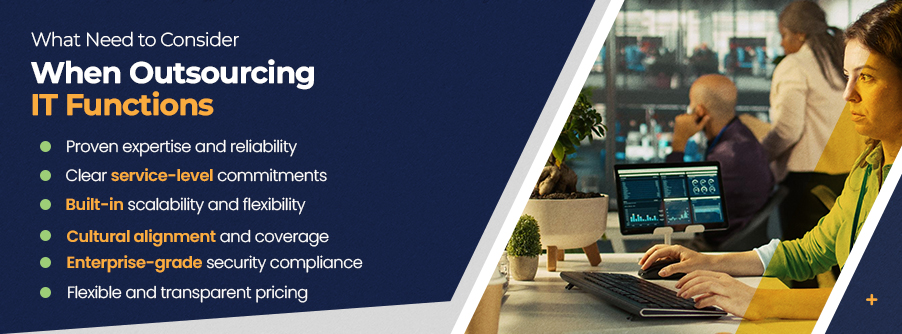
Planning to hire top-notch IT engineers or tech experts to work on your projects while not indulging in long-term hiring commitments? Here are a few important considerations to make your hiring journey easier.
-
Proven expertise and reliability
When outsourcing IT functions, evaluate a provider’s technical depth, industry experience, and delivery track record. Look for teams with proven success across similar business environments, not just certifications.
Reliable partners demonstrate consistency through documented processes, client references, and measurable performance metrics. This ensures your IT operations remain stable, responsive, and capable of supporting long-term business goals without frequent disruptions or rework.
-
Clear service-level commitments
Service-level agreements (SLAs) define expectations and accountability. Strong SLAs clearly outline response times, resolution targets, uptime guarantees, and escalation processes.
For US businesses, these commitments reduce operational risk and ensure predictable service quality. Clear SLAs also make performance measurable, enabling data-driven vendor management and faster issue resolution when service standards are not met.
-
Built-in scalability and flexibility
Your IT needs will change as your business grows or faces market shifts. Outsourced IT support solutions offer flexible engagement models that allow you to scale resources up or down without delays.
Built-in scalability ensures your IT support can adapt to new projects, seasonal demand, or rapid expansion while avoiding long-term staffing commitments or unnecessary overhead.
-
Cultural alignment and coverage
Cultural fit plays a major role in outsourcing success. Providers should align with your business communication style, work ethics, and time-zone requirements.
For US companies, this includes strong English proficiency, overlapping working hours, and responsiveness. Cultural alignment improves collaboration, reduces friction, and ensures smoother day-to-day interactions across distributed IT teams.
-
Enterprise-grade security compliance
Security is non-negotiable when outsourcing IT functions. Providers must follow strict security frameworks, data protection practices, and compliance standards relevant to US regulations.
This includes access controls, monitoring, incident response, and regular audits. Strong security practices protect sensitive business and customer data while minimizing compliance risks and reputational damage.
-
Flexible and transparent pricing
Transparent pricing models help businesses control IT costs and avoid surprises. Outsourcing providers should clearly define what is included, how pricing scales, and where additional costs may arise.
Flexible pricing allows companies to pay only for what they need, making budgeting easier and aligning IT spending directly with business value and outcomes.
Business-Critical IT Tasks You Can Outsource
Uplifting your business with outsourced IT support services may be a new step for you. If you’re unsure about which tasks can be handled by external teams, the following list will help clarify.
-
On-demand help desk and tech support
Tech enterprises and startups often need experienced technicians to address customer inquiries and troubleshoot IT-related problems. Working closely with an outsourcing company allows you to hire experts for technical support and help desk services.
Customer satisfaction is a crucial parameter for businesses. Prompt response times can help your company receive the recognition it deserves in the client-handling domain. You can easily implement this in practice without involving an on-site team by recruiting external IT professionals.
-
Network and infrastructure oversight
Outsourced IT providers help companies manage their network infrastructure, as it can be resource-intensive and complex without professional intervention. If you lack skilled technicians for intrusion detection, firewall management, and routine scanning of vulnerabilities, outsourced IT support can fill these gaps.
Network failures can be reduced significantly with the expertise of remote IT engineers. From implementing preventive maintenance strategies to applying regular updates, they perform a variety of tasks to fix broken infrastructure or systems. You can rely on them to create and manage backup or disaster recovery plans to ensure business continuity.
-
End-to-end cybersecurity protection
Cyberthreats pose real dangers to tech firms, often costing US firms hundreds of thousands per hour in lost productivity and revenue. As per a recent report, 64% of organizations assess AI risks before deployment, highlighting heightened concern over cybersecurity.
For startups or companies lacking a cybersecurity analyst, outsourcing specialists can help with incident response, threat identification, compliance to GDPR, PCI DSS, vulnerability assessment, and remediation. They are equipped to handle the entire security lifecycle, keeping data protected with advanced technologies.
-
Cloud environment management
Many firms rely on external teams to manage cloud environments or adopt new features for faster deployment of IT projects, which influences business value. Collaboration with an outsourcing agency assists them with quick migration, resource optimization, storage management, and keeping the platform up to date.
Enterprises can easily hire offshore cloud specialists to boost security and compliance, ensure scalability, and optimize costs. For better operational efficiency and faster innovation through cloud technology, you can always turn to professionals for outsourced IT support.
-
Custom software development
Extended IT teams accelerate your software development process, be it custom apps, web portals, or mobile apps. Their expertise and resources can bring your projects to life while mitigating risks. If there are projects involving AI, cloud, or other cutting-edge technologies, outsourcing can speed up time-to-market.
US tech firms prefer these flexible hiring models for providing on-demand access to specialized QA experts, software developers, and architects. Working with an offshore team lowers development risks and helps businesses focus on innovation through offshore software development services.
-
Data analytics and management
A report from Market.Biz reveals that around 2.5 quintillion bytes of data is generated on a regular basis. 80% of organizations estimate that nearly 50% to 90% of the data they handle is unstructured, comprising social media, web logs, audio, text, and video content.
Advancements in AI and ML have improved the accuracy and speed of processing large datasets. These technologies help companies run real-time analytics, improve customer insights, optimize marketing strategies, and enable faster decision-making.
Outsourcing IT professionals is a fast and convenient way for businesses to manage growing data volumes. They eliminate the need to hire costly in-house data analytics teams to deliver actionable and high-quality insights.
Where to Look for Scalable Outsourced IT Support?
Businesses can directly approach Proquantic to book our staff augmentation services and address skill gaps. Check out this blog to understand the right approach to building a high-performance offshore tech team.
Below are some of the effective ways to acquire global talent to work on your IT projects.
1. IT consulting and outsourcing firms
These agencies provide end-to-end IT support to businesses of all sizes across the US. Their expertise includes application support, ensuring security, and infrastructure management.
From keeping business software functional to troubleshooting bugs and managing updates to user support, they handle all critical applications to maintain workflows. You can rely on them for structured service deliveries, long-term partnerships, and scaling workforce resources as per project or operational demands.
Agencies offering outsourced IT support and consultation safeguard sensitive business data and prevent downtime. They keep your core systems well-maintained, which includes cloud platforms, networks, services, storage, operating systems (OS), and data centers.
2. Staff augmentation and talent networks
Many sectors rely on staff augmentation providers to help their businesses acquire the best IT professionals on demand. They also connect their firms with pre-vetted IT professionals with expertise in various technologies.
A recent report from Research and Markets estimates that the global staff augmentation market size will reach USD 11.94 billion by 2032, growing at 7.11% CAGR.
Both these approaches help tech enterprises, insurance and financial services, energy and utilities sectors to hire experts as per requirements. They scale resources on demand, fill skill gaps, support rapid growth phases, and build talent networks while enjoying flexible hiring models.
3. Managed service providers (MSPs)
MSPs deliver outsourced IT support through predefined service models and SLAs. They handle day-to-day operations such as monitoring, maintenance, helpdesk, and cybersecurity, allowing businesses to maintain predictable costs while ensuring reliable, scalable IT performance as they grow.
4. Technology partners and system integrators
These providers combine IT support with expertise in cloud platforms, enterprise systems, and digital transformation. They are ideal for businesses modernizing their IT environments and seeking scalable support aligned with complex integrations, upgrades, or multi-vendor technology ecosystems.
5. Nearshore and offshore providers with US presence
Providers with US offices and global delivery centers offer access to broader talent pools and cost efficiencies. This approach enables 24/7 support coverage, faster scaling, and compliance alignment while maintaining strong communication through shared time zones or local account management.
Emerging Trends in IT Support Outsourcing
Working with remote software developers or IT augmentation staff enables businesses to launch products quickly and continue revenue generation. Below are some of the latest trends adopted by businesses worldwide to make the most of outsourced IT support services.
-
Automation through RPA solutions
Robotic Process Automation (RPA) is reshaping IT support outsourcing by taking repetitive, rule-based tasks off human hands. Software bots work around the clock to handle activities like ticket routing, system checks, data updates, and routine requests, dramatically improving speed and consistency. This always-on execution reduces backlogs and shortens resolution times.
Automation also lowers operational costs by minimizing manual effort while improving accuracy and compliance through error-free processing and clear audit trails. Most importantly, RPA frees IT professionals to focus on strategic work, innovation, and complex problem-solving, directly improving service quality and customer satisfaction.
-
AI & machine learning integration
AI and machine learning are making outsourced IT support more proactive and intelligent. AI-powered chatbots now handle common Tier-1 requests instantly, improving response times while reducing agent workload. Machine learning analyzes system logs and supports data to predict failures before they happen, helping prevent downtime instead of reacting to it.
The use of artificial intelligence also strengthens cybersecurity by detecting unusual patterns and responding to threats in real time. Beyond support, AI optimizes project planning, resource allocation, and even software testing, enabling faster delivery, better reliability, and smarter decision-making across IT operations.
-
Platform-agnostic development models
Platform-agnostic development gives businesses freedom from rigid technology dependencies. Instead of being locked into a single vendor or ecosystem, companies can choose tools and platforms based on performance, cost, and evolving needs.
Outsourced IT partners using this approach make it easier to scale systems, integrate new technologies, and adapt quickly to market changes. It also opens access to a broader talent pool, as teams are no longer limited to niche proprietary skills. With better interoperability and reusable codebases, businesses achieve faster launches, smoother integrations, and stronger long-term ROI.
-
Blockchain-powered IT security
Blockchain is emerging as a powerful layer of trust in IT support outsourcing. Its decentralized structure enables secure identity management, ensuring only authorized users and devices can access business systems. Because blockchain records are immutable, they create tamper-proof audit trails that strengthen compliance and accountability between clients and providers.
Distributed data storage reduces single points of failure, while encrypted transactions protect sensitive communications. Smart contracts further automate service-level agreements by enforcing terms without manual oversight. Together, these capabilities make outsourced IT environments more transparent, resilient, and secure, especially for compliance-heavy and data-sensitive industries.
-
Immersive VR and AR support
Virtual Reality (VR) and Augmented Reality (AR) are redefining how outsourced IT support is delivered. Remote experts can now guide on-site teams or customers visually, overlaying real-time instructions onto physical environments to resolve issues faster. These technologies also transform training, allowing teams to practice complex scenarios in safe, simulated environments.
AR-driven product demos and setup guides enhance customer experience, while VR enables global teams to collaborate in shared virtual spaces. By reducing travel, downtime, and miscommunication, immersive technologies improve efficiency while lowering operational costs.
-
Sustainable and green IT initiatives
Sustainability is becoming a key factor in IT support outsourcing decisions. Providers are investing in energy-efficient infrastructure, renewable-powered data centers, and optimized cloud environments to reduce environmental impact. Automation and AI help monitor energy usage and eliminate waste, while responsible e-waste management ensures compliant hardware disposal.
Remote and distributed work models further lower emissions by reducing physical infrastructure needs. Increasingly, businesses also expect transparency through ESG reporting, making sustainability not just an ethical choice, but a measurable performance metric in partnerships for outsourced IT support.
How Does Staff Augmentation Fit Modern IT Support Services?
You might wonder about the purpose of hiring a staff augmentation agency to manage IT services in your company. Here’s what happens when you consider this approach to address talent shortage and hire the right professionals.
-
Close critical skill gaps instantly
Workforce augmentation gives US companies immediate access to specialized talent. Employers can select from a large pool of dedicated IT engineers or developers with expertise in cybersecurity, AI, cloud platforms, and other domains without long recruitment cycles.
-
Enables scaling teams as per demand
Enterprises work on a wide range of IT projects throughout the year. They form their teams depending on the project requirements, deadline, growth stage, and budget.
Staff augmentation helps to scale your team as per business needs. You don’t have to think about hiring additional staff just to keep up with the pace of projects.
-
Strengthens co-managed IT models
When it comes to accelerating growth with outsourced IT support, firms struggle to find the right fit that can get along with their permanent professionals. Augmented staff are hired to collaborate with your in-house teams and build a hybrid IT structure successfully.
-
Reduces hiring risk and operational costs
Many businesses prefer to hire IT experts on a project basis without involving any long-term payroll commitments. Working with extended or offshore experts helps enterprises save considerably onboarding costs, minimize attrition risks, and maintain high-quality tech support.
-
Speeds up execution and service delivery
Businesses often need a backup team to collaborate effectively when there is an urgency to deploy software or other IT services. If the time is of essence and you need to keep a specialized team to meet evolving business priorities, services from our IT staff augmentation agency are more effective.
Partner with Proquantic USA to Strengthen Your Tech Team
As technology continues to evolve, SMEs and many big enterprises face numerous challenges in meeting their IT requirements. There are tasks that need expertise from offshore developers and engineers to speed up product delivery and achieve business goals. They help reduce the workload burden from in-house teams, leaving adequate room for innovations and working on core functions.
Looking for outsourced IT support to manage your IT operations or assist with infrastructure setup? At Proquantic USA, we bring technical depth, top-tier software developers, QA testers, project managers, industry insight, and a team to help your company meet the changing dynamics of the US market.
Whether you need staff augmentation services or IT project outsourcing, we promise to deliver reliable and experienced tech resources. Schedule a call and discuss your requirements with our tech experts.
Frequently Asked Questions (FAQs)
How much does it cost for US firms to outsource IT services?
Outsourcing IT support can cost anywhere between $80 and $500 per user per month for businesses. The overall expense depends on the complexity of projects and the expertise necessary to deliver them within deadlines.
Vendor-managed IT services can be in the range of $100 to $250 per user monthly. You may also need to spend around $75–$250 per hour on specialized support from external teams.
For small to mid-sized companies needing comprehensive IT solutions, the estimated costs are between $5,000 to $7,000+. Contact Proquantic USA to find out how much you will have to spend on outsourced IT support in the US.
What IT outsourcing models work best for US businesses?
IT outsourcing comes in several forms, each designed to solve different business challenges. Tech firms commonly choose between IT staff augmentation, onshore outsourcing, offshore outsourcing, nearshore models, and hybrid approaches. Staff augmentation works well for filling skill gaps quickly, while onshoring supports compliance-heavy needs.
Offshoring and nearshoring offer cost efficiency and scalability, and hybrid models blend control with flexibility. Understanding these options helps businesses balance cost, speed, risk, and performance. They also ensure the chosen model aligns with operational goals, budgets, and long-term growth strategies.
How does the US outsourcing policy impact IT support decisions?
US outsourcing policies directly influence how businesses handle offshore and global IT engagements. Recent legislative proposals focus on transparency and cost accountability, including excise taxes on certain outsourcing payments and stricter reporting of outsourced income.
These measures aim to protect domestic jobs while ensuring tax compliance. For US businesses, this means outsourcing decisions must factor in regulatory exposure, documentation requirements, and total cost impact.
Working with compliant providers and understanding policy implications upfront helps companies avoid legal risks while continuing to benefit from global talent access. If you are searching for an IT augmentation agency compliant with the US outsourcing policy and that streamlines project delivery, call Proquantic USA.
Why is IT outsourcing so widely used by US firms?
IT outsourcing is common because it delivers measurable business value. Enterprises and many emerging companies often reduce IT operating costs significantly by avoiding expenses tied to hiring, training, benefits, and infrastructure. Outsourcing also provides access to specialized skills that are difficult to source locally, especially in cybersecurity, cloud, and AI.
Beyond savings, it improves agility, speeds up project delivery, and allows internal teams to focus on strategic priorities. In competitive markets, hiring dedicated professionals helps businesses stay efficient without compromising service quality or innovation.
What causes most IT outsourcing challenges for businesses?
The most common outsourcing problems usually stem from unclear service definitions and unexpected cost overruns. When expectations, deliverables, or responsibilities are poorly defined, misunderstandings quickly arise, leading to delays and inconsistent service quality. Cost issues often occur when scope creep, hidden fees, or unrealistic pricing assumptions are not addressed upfront.
For US businesses, these challenges highlight the importance of detailed contracts, transparent pricing models, and well-defined SLAs. Clear communication and governance structures significantly reduce outsourcing risks.
What is the first step to managing outsourced IT support?
The first and most critical step in managing IT outsourcing is clearly defining your business needs. US companies must assess which functions to outsource, desired outcomes, budget constraints, and risk tolerance before engaging vendors. This clarity guides provider selection, contract development, and transition planning.
Businesses can evaluate partners, set performance metrics, and plan a smooth handover after defining their needs. You can always start with a structured outsourcing roadmap to ensure better alignment, fewer surprises, and stronger long-term results from outsourced IT support initiatives.