


The past ten years have revolutionized the way entrepreneurs and organizations see productivity, talent and collaboration. During pandemic, the concept of remote job and remote hiring began as temporary conveniences but later, it transformed into a competitive advantage. As we are all set to step into 2026, companies across the world are reimagining their structures of workforce by tapping into the expansive talent pool with remote hiring for building agile as well as resilient offshore tech teams.
These remote teams function beyond the geographical limits and operate seamlessly, aligning with the values and working conditions of the organizations.
The evolution of remote working has given prominence to distributed models where borders and time zones no longer are considered as the biggest factors behind business decisions. Now, teams in Manila, Warsaw or Bangalore can seamlessly collaborate with organizational locations like London, New York or Dubai, not only as outsourced entities but off the international extensions of the global companies.
Remote hiring – a brand-new way of building a global team
The new era of remote work and remote hiring culture thrives entirely on accountability and communication instead of constant oversight. Yet, there are still a lot of companies still, who struggle with the old-style managerial instinct of micromanagement, which is detrimental to employee harmony and company stability.
By 2026, the companies who truly perform with remote hiring will eventually replace rigid control in organizations with empowered systems. It’s beyond just tracking the work hours; it’s gauging the outcomes of every effort made. The modern offshore teams are data-driven, self-sufficient and culturally aligned, functioning with maximum ownership and minimal supervision. Such shift to enabling from managing defines the brand-new frontier of distributed leadership.
With this blog today, Proquantic Software USA will be exploring how the organizations can create high-performing offshore technical teams without need of micromanagement. The journey towards mastering remote hiring begins with the right understanding of platforms, processes and people who foster autonomy, boosting productivity with a purpose and not from pressure.
Remote hiring in 2026 – a comprehensive overview
The entire landscape of remote hiring looks vastly different from what the organizations had envisioned few years ago. What once began as an experimental model for overcoming the geographical limits has now turned into a significant strategy for global workforce to succeed.
Organizations today are not choosing remote hiring out of necessity but opting it to stay competitive, scale smarter and innovate faster in a vastly interconnected economy. The maturity of the AI-powered recruitment tools, digital collaboration tools and evolving work cultures are playing crucial roles in shaping such transformation.
The evolution of remote hiring
During the initial days of 2020, remote hiring was greatly synonymous with gig work, like freelancers handling small projects from around the continents. By 2026, this evolved into a more distributed and sustainable strategy of the workforce where cultural integration and long-term collaboration define success.
The remote hiring trends in 2026 reflect on the world consensus which states that businesses that invest in system, trust and structure get the most out of the distributed teams. Remote work has shifted to becoming a deliberate model of organizational details from a contingency plan.
Here is how the evolution unfolded:
- Synergy of time-zone – Rather than fighting the differences of time zone, companies now use it in the advantage by ensuring 24/7 productivity through the distributed flow of work.
- Skill-based roles over resumes – Recruiters today focus less on the academic background and concentrate in adaptability and problem-solving abilities, the traits that are important for success of the remote work.
- AI-powered recruitment – Artificial Intelligence streamlines the candidate sourcing, which enables the HR for identifying the HR teams in identifying the performing candidates quickly with behavioral analytics and skill-matching algorithms.
- From gig to global workforce – Remote hiring has transitioned to becoming structured and long-term offshore collaborations from one-off project-based hiring.
Trends in hiring offshore tech teams
With the expansion of digital economy, remote hiring of offshore tech teams continues to dominate the strategies. Companies across the industries are looking past the borders for accessing highly specialized talent alongside optimizing the operational costs. Even after that, the focus has dramatically shifted from value arbitrage to cost arbitrage. The real gain lies in accessing innovation-driven and diverse professionals who can accelerate growth and elevate product quality.
Here are some of the emerging trends in offshore hiring:
Hubs of excellence
- India will continue to lead with scalability and deep expertise.
- Eastern European countries like Romania, Ukraine and Poland will offer a stronger infrastructure backed by agile development talent.
- Brazil, Colombia, Argentina or the LATAM will rise as a dependable option for the Western companies.
- Philippines will remain as a powerhouse nearshore support for the DevOps roles.
Emergence of engagement models
- Organizations are increasingly blending contract-based professionals with dedicated teams offshore who will create reliable and flexible structure.
- Offshore teams are not task executors, but R&D partners. They will solve complex tech challenges, improve UX and co-create products collaboratively.
- The most efficient and successful offshore teams function as extensions of the main business and not as isolated units. Cross-border inclusion, shared vision and consistent communication will drive cohesion.
Such transformation highlights the crucial point that offshore ecosystem is longer deemed as a support function, but a reliable and efficient core of the main business, which is powered by transparent leadership, trust and technology.
Transformed expectations from employees and employers
The dynamic between employees and employers has transcended with the maturing of remote hiring. What was once used to circumnavigate cost-efficiency, has now transformed into a more human-centric equation which values shared purpose, autonomy and flexibility.
Today’s employers expect:
- Continuous upskilling and learning aligned with the dynamic needs of the projects.
- Proactive reliability, transparency and communication over supervision.
- Self-managed progress and seamless collaboration from the offshore teams.
Today’s employees expect:
- The freedom to work from anywhere as well as define their rhythm of productivity.
- Reduced dependency on the real-time meetings which ensures elevated work-life integration.
- Respect and recognition across time-zones and nationalities.
- Project-based autonomy – Opportunities for strategic contribution and independent decisions, not just functionally.
By the year 2026, remote hiring will no longer be a logistical advantage but will rather be a strategic imperative. Companies which harness the full potential with offshore hiring, inclusive leadership and clear systems of communication, will set a global standard for high-performing work cultures.
Organization which embraces the shift not only just hire talent but also create ecosystems which thrive on collaboration instead of micromanagement.
Why micromanagement affects leadership remotely
In the world of distributed teams, one of most significant challenges in hiring is not finding the right talent but learning how you should lead them. What worked inside of the physical office collapses often in a remote environment and at the center of this collapse lies the persistent issue called micromanagement.
Micromanagement is, by practice, counterproductive, especially in the case of remote settings. Rigid monitoring of the tasks, constant check-ins and excessive demands of documentation signals mistrust and drain energy. Rather than empowering the high-performers, micromanagement in remote hiring reduces the performers to instruction-executors. As a result, the process is affected by slow decision-making, reduced innovation and low morale – sending a message to the employees that the leadership has nominal trust in the team.
In fact, remote set-ups easily reveal symptoms of micromanagement quicker than the traditional models. Leaders, quite often, confuse productivity with visibility by obsessively tracking the hours, demanding real-time status updates and monitoring screens.
Employees put emphasis on appearing active, instead of creating a real impact. One might notice:
- Decisions getting stuck as no one if made to feel empowered.
- Talented employees quietly leaving or disengaging.
- Slow down of work due to over-reporting.
- Team members are hesitant to take any initiative.
Such indicators signal at the leadership model which depends more in control over clarity.
The key here is to understand the division between mentoring and monitoring
Monitoring is all about surveillance and checking what an employee is doing at every moment. Mentoring, on the other hand, is all about enlightenment which ensures that the person can easily determine expectations, goals and available resources. Remote leadership requires mentoring. Distributed and high-performance offshore teams thrive when the leaders offer outcomes and frameworks, instead of friction and oversight.
The friction from enablement to control is a defining characteristic of successful leaders in today’s digital era. Enablement looks like:
- Setting clear OKRs instead of asking for hourly updates
- Providing trusting expertise and autonomy
- Providing guidance only when needed
- Evaluating results and not activities
- Creating a culture of shared accountability
A lot of companies unfortunately learn this the hard way. Organizations which enforce rigid log-in systems, time trackers and mandatory webcams see a steep spike in attrition and decline in morale for working. A number of well-funded startups fail miserably because the founders try to replicate the model of office-style supervision, which eventually leads to slow innovation of products, talent burn-out and loss of market advantage.
As the challenges of remote hiring are ready to evolve in 2026, it becomes clear that remote teams do not fail due to distributed work but fail due to faulty leadership approaches.
To create high-performing offshore teams, business leaders should let go of micromanagement and welcome the culture of autonomy, mentorship, trust and outcome-based performance. Such mindset transition speeds-up innovation unlocks creativity and turns remote work into strategic advantage instead of a logistical struggle.
Build foundation of a successful remote hiring model
While you are scaling with distributed teams, the strength of remote hiring process turns out to be the very spine of long-term success. Hire for technical capabilities alone is longer enough as remote work demands a completely different kind of ‘fit’.
Explaining the ‘fit’ in remote hiring
Across remote environments, the traditional markers of suitability change. Beyond traits and hard skills, the aspects that drive performance are:
- Self-discipline and time management – Remote employees have to structure their own workday.
- Communication – Clarity in verbal and written communication is important when the face-to-face interaction is at minimal.
- Adaptability – The ability of switching tools, time zones and workflows without any friction.
For identifying such qualities, companies are increasingly screening for accountability and autonomy. Behavioral interviewing tailored for the remote roles enable uncovering such traits, Questions like ‘tell me about the time you have resolved an issue without supervision’ or ‘how do you prioritize while working asynchronously” tell companies whether the candidates can thrive without constant oversight.
Leveraging the technology for smarter remote hiring
The modern AI remote hiring tools are revolutionizing how the organizations choose and evaluate global talent. The AI-powered platforms are able to scan wide pools of candidate and match profiles to the required roles as well as removing bias in the initial screening. Machine Learning models also help in predicting performance-based historical hiring data.
For the digital or technical roles, companies depend on skill validation platforms like situational judgement, problem-solving, live simulations, and coding assessments which reflect the real-world scenarios. The culturally fit tools analyze further preferences of collaboration, adaptability, and communication style, ensuring that the offshore candidates are able to align with dynamic of the teams.
Data analytics add to another layer of intelligence by predicting team compatibility, empowering the organizations to proactively create high-performing and balanced teams.
Structuring the offshore hiring process
A robust offshore hiring strategy starts with clarity. Organizations must clearly define roles by segregating peripheral vs core tasks for ensuring the right responsibilities, assigned to the offshore talent.
Next, build an evaluation matrix which is transparent, is remote-ready, covers all skills, is culturally fit and learns agility. This reduces the subjective bias and keeps offshore recruitment fair and systematic.
Finally, establish a structured framework for onboarding which supports remote talent from day 1. This includes communication guidelines, tool orientation, mentorship and workflow expectations during the first thirty to sixty days. A properly designed onboarding process speeds up the integration, improves retention and boosts confidence.
Steps to build a high-performance offshore tech team
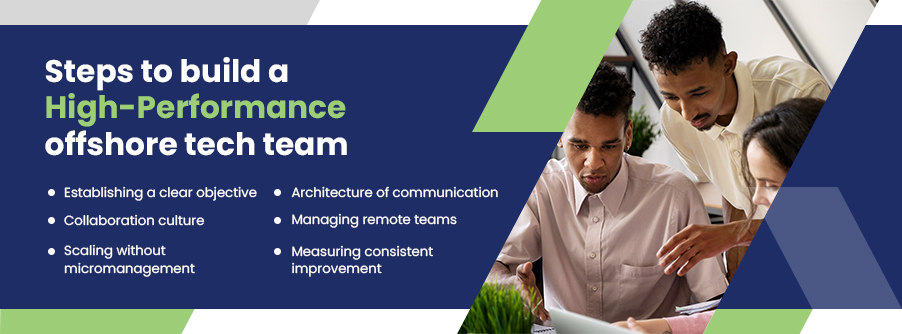
Creating high-performance remote teams traverse far beyond hiring skilled developers, which demands leadership, communication, structure and clarity, which travels effortlessly around the globe.
When done right, the offshore tech collaboration amplifies the delivery efficiency, innovation and speed of the company. The following steps define how to for a team that performs efficiently at a global standard.
Form and establish a clear objective
High-performing teams thrive on transparent execution of work. Rather than a vague task list or loosely defined KPIs, adopt deliverable and OKR-based systems which anchor to each engineer’s work into tangible business outcomes. This removes ambiguity and ensures offshore contributors understand how their work influences the larger vision of company.
Design the accountability structures which distribute ownership functions of tech leads, QA heads and product managers. Remote teams work best when autonomy is balanced properly with alignment. Provide developers the freedom for making technical decisions alongside ensuring that every sprint follows a clearly etched roadmap. The ownership paired with visibility becomes a multiplier of the performance in offshore tech collaboration.
Architecture of communication
Communication engines are the spine of a distributed execution. For high-performing remote teams, asynchronous communication tools like Slack Huddles, Jira Updates and Notion comments provide consistency without forcing the teams across tome zones to always stay online.
A strong culture of documentation prevents traps of dependency. Y using platforms like GitHub Wiki, Confluence or Notion, teams can easily document the architecture plans, decisions, troubleshooting notes, and sprint summaries which dramatically speed up onboarding and reduce miscommunication.
Synchronous rituals like retrospectives, sprint planning and daily standups must remain non-negotiable. They create a shared momentum and maintain human connection which is common to lose in remote working settings.
Innovation and collaboration culture
Offshore teams must be more careful than the execution units. Encourage them for proactive problem-solving, providing the developers the space to propose performance optimizations, automation ideas and architectural enhancements.
Sharing knowledge across geography through code walkthroughs, tech talks and pair programming sessions, build collective intelligence and ensure that no expertise remain siloed.
Facilitate virtual brainstorming as well as creative syncs by using digital whiteboards. Such environments replicate the energy of in-person ideation, helping the remote engineers contribute purposefully to product direction. A culture which rewards initiative and curiosity evolves naturally into a high-performing powerhouse.
Leadership practices to manage remote teams
Leadership is deemed as the defining factor which transforms the good offshore teams into world-class remote engines. Companies must adopt empathy-driven management where the leaders can understand communication nuances, cultural contexts ad work-life balance patterns across regions.
Implement growth frameworks and continuous feedback loops like quarterly performance reflections, weekly one-on-ones and personalized development plans. This gives the offshore talents a sense of progression as well as belonging.
Develop micro-leaders within the offshore teams, senior engineers who guide juniors, own modules and act as the cultural anchors. Micro-leadership strengthens decision-making, ensures continuity and transforms distributed teams into resilient and cohesive units with the ability of high-scale delivery.
Scale without micromanagement
Scaling distributed workforce needs leaders to shift from a control-driven environment to result-driven environment. When remote leadership is created on clarity and trust the teams function with minimal oversight, innovate more freely and teams scale faster. The goal is about creating an environment where the offshore talent performs at the highest potential, without the need of constant supervision.
Implement trust as a leadership framework
Trust is the spine of managing offshore teams effectively. Leaders must set their expectations upfront with sprint structures, timelines, clear deliverables and the definitions of ‘done’. Rather than monitoring online status or hours, companies must adopt a model where the outcomes matter more than activity.
Creating a psychological; safety net is vital as well. Remote-first environments call for spaces where the engineers feel comfortable about flagging early potential risks, asking questions and sharing ideas. When people trust that their voices carry weight, the creative confidence amplifies and eventually leads to high-quality output and few blind spots in operations.
Using technology as the manager
Technology plays a crucial role as an invisible and quiet supervisor in remote leadership. Instead of micromanaging, leverage the tools that offer visibility without intrusion. Platforms like Asana, ClickUp or Jira enable the leaders to perceive the task progress, sprint health and workload balance in real-time.
Performance analytics and smart dashboards highlight the blockers early, track velocity of the development and display quality trends of the codes to collectively offer a data-backed way of managing the offshore teams. Milestone trackers ensure that no deliverables slip through the cracks while respecting the engineers’ work patterns and autonomy.
Systemization of autonomy
Scaling turns out to be seamless when the autonomy is baked into operating system of the team. Create SOPs for easing the decision-making process. These guardrails reduce the dependency on managers alongside enabling predictable and consistent decisions across the time zones.
Introduce micro-teams or self-managed pods led by a rotating leader. The process helps in distributing ownership, strengthening cross-functional collaboration and reducing pressure on a single manager.
A great example is any remote-first tech company which scales autonomously by defining the modular roles, letting data drive the leadership decisions and implementing the pod ownership. The system ensures that even with an increase of the headcount, the operational clarity stays intact.
Nurturing connection and culture in remote hiring
With remote organizations scaling across the continents, the true differentiator is human experience, beyond just technology or process. A strong remote work culture ensures that the people feel connected, valued and seen even when they are working across time zones. When the culture is intentional instead of accidental, offshore teams move from ‘delivering tasks’ to genuinely growing, innovating and contributing.
Creating a borderless environment needs replacing the organic interactions of a physical office with deliberate connection-building experiences. Virtual engagements like learning circles, team celebrations, weekly wins and cross-team demo days for helping to create shared identity. Peer recognitions where the team members appreciate the contributions of each other, reinforce desired behaviors and boost morale within the distributed setting.
A significant pillar of offshore team engagement is supporting the mental wellbeing as well as the work-life balance. Remote teams often blur professional and personal spaces which may result in a burnout. Leaders must normalize the asynchronous communication, promote healthy routines and respect the offline hours which honor the individual working rhythms across different geographies.
Inclusion and diversity also function at the heart of a resilient remote work culture. Offshore teams represent the blend of problem-solving techniques, perspectives and languages. Rotating speaking opportunities, inclusive meeting etiquette and culturally sensitive communication guidelines ensure that each and every voice is heard. Representing cultural nuances like conversational norms, work styles and holidays strengthen the psychological safety as well as foster mutual respect.
Remote leadership must always be rooted in empathy. Leaders managing the multicultural offshore talent have to listen more, communicate more and assume less. Whether through regular one-on-one check-ins, personalized growth pathways, open feedback channels, and empathy transforms distributed teams from the transactional teams to high-trust and collaborative communities.
Nurturing human elements is a strategic advantage, When the people feel connected as well as cared for, offshore team engagement turns out to be effortless and the entire organization benefits with the risen productivity.
Measuring consistent improvement and success
Sustaining high performance in distributed teams requires a structured approach to measurement. In the remote-centric work setting, evolution of remote team performance means tracking the results and not activities. Objective and clear KPIs act as the very core of consistent improvement and ensures that the offshore teams stay aligned with organizational goals.
The most dependable indicators include:
- Delivery velocity which reflects on the insights on how quickly the teams can transform tasks into completed work.
- Quality that measures the rework, defect rates and overall technical excellence.
- Engagement which is a vital predictor of collaboration and creativity.
- Retention which reveals whether the remote culture supports stability for the long-term.
Another critical layer is 360-degree from the cross-functional teams. In the distributed environment collaboration spans operations, product, QA, design and engineering. Collecting inputs from all the stakeholders provides a holistic view of the performance and helps in validating whether offshore productivity is aligned with expectations beyond the immediate team.
Continuous learning also plays the defining role. High-performing offshore teams thrive when they have the access to knowledge-sharing sessions, certifications, upskilling platforms and on-the-job-learning opportunities. Embedding learning into workflow ensures that the competencies evolve with technical demands.
Organizations must conduct regular audits of remote hiring as well as management systems. Reviewing processes like communication standards, performance tracking, onboarding and screening ensure that the overall ecosystem stays scalable, fair and efficient.
By combining systematic audits, structured learning, feedback loops and KPIs, companies can maintain exceptional offshore productivity, alongside building a culture which consistently elevates itself.
Proquantic Software, you trusted offshore partner for success
Proquantic Software USA stands as a reliable offshore development partner which is committed to helping businesses grow with confidence, speed and precision. Whether businesses need specialized tech talents onboard or need end-to-end engineering support, Proquantic delivers expertise which blends innovation with dependable execution.
By combining the deep knowledge of domain with flexible models of engagement, we empower the global companies to launch, optimize and build world-class digital solutions without any overhead of the traditional hiring.
What makes Proquantic the ideal partner for remote hiring?
- Get access to the top-tier skilled engineers for AI, Blockchain, DevOps, cloud, software development, app development and more.
- Enjoy flexible IT staff augmentation and scale your teams down or up instantly based on the needs of your project.
- End-to-end expertise in enterprise software development, mobile apps (iOS/Android), SaaS platforms, and legacy modernization.
- Enjoy advanced tech capabilities in cloud migration, computer vision, NLP, Web3 platforms, crypto wallets, CI/CD, and cybersecurity.
- Enjoy seamless collaboration through aligned delivery cycles, transparent communication and cybersecurity.
- Enjoy high coding standards, powerful QA practices and long-term support for sustainable growth.
Conclusion
Remote hiring will not be a staffing strategy only from 2026, rather, it is a competitive advantage. High-performing offshore teams function when leadership prioritizes systems, trust and clarity more than control. By embracing the outcome-driven management, cultural intelligence, and modern tools, companies can easily scale globally without the practice of micromanagement. The future belongs to organizations which create connected, empowered and autonomous distributed teams and the people who master this approach will easily lead to the upcoming era of innovation.
Frequently Asked Questions on Remote Hiring
Why is remote hiring important?
Remote hiring enables companies to recruit talent from anywhere, providing access to more specialized and larger pool of skills. With the acceleration of global digital transformation, remote hiring has become a core strategy for building innovation-powered and agile teams.
How can I ensure quality while remote hiring the offshore tech talent?
Use skill-based assessments, define clear expectations and rely only on the structured frameworks of evaluation. Blend these practices with strong onboarding and performance data to ensure consistent offshore quality.
Does remote hiring lead to issues in productivity?
No, not when managed with clear communication channels, outcomes and documented workflows. Companies which focus on autonomy instead of oversight frequently see higher productivity from the remote teams.
What tools support effective team management and remote hiring?
AI screening platforms, collaborative workspaces and project management tools streamline both execution and recruitment. These tools reduce micromanagement and offer leaders better visibility without any intrusion.
How can companies maintain culture with remote hiring across numerous countries?
Create rituals, prioritize transparency and inclusion and encourage cross-team bonding. A robust cultural foundation assures that the remote teams feel aligned, engaged and connected with the mission.