


Launching a new digital product successfully in the market involves several challenges for entrepreneurs. Around 42% of early-stage companies fail in their innovative ventures because they are unable to identify market needs. It is essential for startups to integrate project ideas with various software development strategies to launch products while minimizing the risk of failure.
Many startup founders struggle to understand the difference between PoC vs Prototype vs MVP. While these terms are often used interchangeably, they serve different purposes during software development. Understanding PoC vs Prototype, PoC vs MVP, and Prototype vs Proof of Concept helps businesses choose the right approach before investing in full-scale product development.
A lot of research is involved in developing a functional product from an idea or thought process. This is where PoC, MVP, and prototype come into the picture, serving as a foundation for custom software development.
Do you want to learn more about these different stages in software development and their impact on the success or failure of your product? Get valuable insights on the essential building blocks of new product design and development as you scroll below!
Let’s find out whether your future business needs PoC, prototype, or MVP by discussing their roles in getting projects off the ground.
PoC vs Prototype vs MVP: What's the Difference?
One of the most common questions startup founders ask is whether they should build a Proof of Concept (PoC), Prototype, or Minimum Viable Product (MVP). Although these stages are closely related, each serves a different business objective.
A Proof of Concept (PoC) validates whether an idea is technically feasible. A Prototype focuses on demonstrating the product's design, workflow, and user experience before development begins. An MVP is a functional product released to early users for real-world feedback.
If you're comparing PoC vs Prototype, the biggest difference is that PoC validates technology, while a prototype validates usability and design.
Likewise, when evaluating PoC vs MVP, remember that a PoC stays internal, whereas an MVP reaches actual users to validate market demand.
Understanding the difference between Prototype vs Proof of Concept helps startups reduce technical risks, improve product design, and launch products with greater confidence.
What is PoC?
PoC, or proof of concept, is an essential aspect of software development. It involves a feasibility study of the product before being fully developed. Considered a stand-alone, internal project, it helps startup owners understand and explore the tools, resources, and technical capabilities. PoC validates that their ideas are viable and can be put into practice for the final development of the digital product.
When implementing strategies to manage technical problems in new projects, proof of concept often emerges as the best solution. Developers often try this approach to determine if their ideas regarding the projects are technically and operationally feasible. The goal of proof of concept is to test the functionality of your product against that of the competitors.
PoC helps with the decision-making during the initial phase, notifying emerging entrepreneurs if their concepts can work for projects. You can expect a small-scale demonstration to validate whether a proposed solution or idea can be implemented in a real-world scenario.
A detailed concept about the entire project is extremely rewarding for an innovative firm. It gives an in-depth understanding of competitors, present market scenario, risk assessment, and unique prepositions to make your business stand out.
Smart PoC practices that work
Do you want a successful proof of concept to streamline your custom software development? Let’s discuss the best practices for creating an effective PoC based on your business goals.
-
Set your specific goals
Always focus on the ultimate scope of the development project rather than exploring the resources. This helps to set clear business goals and determine the problem areas for a quick resolution. Entrepreneurs also need to define their ultimate scope of proof of concept, which is essential for accurate and measurable outcomes.
-
Identify tangible project outputs
It is important to track the success metrics through the measurable deliverables. With PoC, it is easier for startup owners to set their own benchmark through concrete project outputs.
The list of tangible deliverables for such cases includes a functional module or working demo of the core functionality of a software. In this list, you can also consider a summarized report, covering the technical validation, potential limitations, and other aspects of the project.
-
Execute your proof of concept
Once you have a PoC ready for your development project, run it to check whether the key features are practical for real-world use. A concept isn’t exactly your product’s simplified version. You may need to test several features of your software by running multiple PoCs, one by one. If any feature needs modification, removal, or inclusion, this practice helps.
-
Monitor key performance indicators (KPIs)
It is essential to track your metrics to understand if the development can yield positive outcomes for your business. Set specific performance goals for your development project and check how far you have to go to achieve progress.
What is a prototype?
Concepts that are approved and demonstrated for any digital product are further defined with a prototype for a successful implementation. Prototyping is needed to get a clear picture of the idea before full-scale development.
A prototype helps startup owners create a visual model of system interaction and explain user experience graphically. A well-designed prototyping for an emerging business idea is significant for capturing the interest of stakeholders and customers. It is an important aspect in assisting designers and engineers to align on the development roadmap.
The use of a prototype in software development is to clearly define wireframe models and service specifications through visual short films. It can help identify listed features for project implementation to develop high-quality software that brings customers or stakeholders from across the globe.
The benefits of prototyping for startups
Here’s what prototyping can help emerging businesses with:
- Innovative thinking and the generation of fresh ideas
- Validation and shaping key features of UX development
- Comprehensive visualization of complex development ideas
- Scope to identify design and development mistakes
- Implement improvements for software development
Prototype forms used in many startups
- Low-fidelity: Categorized as hand-drawn, simple diagrams or sketches, these prototype forms represent the basic flow and design layout of a digital product.
- High-fidelity: Entrepreneurs choose this form for highly detailed and interactive prototypes for users. These resemble the final software in functionality and design.
- Physical: If your requirement is a three-dimensional, tangible form of product for clearly demonstrating industrial design and development standards, this is the right choice.
- Digital: It is utilized for mobile app development and software development to stimulate the functionality of the product and improve user experience. This prototype was created with the help of specialized tools like Axure RP, Figma, and Adobe XD, and is used by startups to provide a visually realistic representation of products.
Various prototyping models
- Extreme: This model is utilized by developers for web development. To maximize productivity, it is more focused on product deliveries instead of exploring all product specifications.
- Incremental: In this model, the final product is further split into several small stages, each comprising individually developed prototypes. The main feature of this approach is that all the stages can be merged into a final product.
- Evolutionary: Here, the prototypes are developed consistently until startups can build their actual scalable products. One special feature of this model is that each prototype works as the foundation of the next one. This continues till the completion of the final product development.
- Rapid: Often known as close-ended, these models help explore several product-related ideas and receive feedback instantly. Rapid prototypes are necessary to examine specific functions during software development. Once implemented, these are never reused, which is why they are sometimes referred to as throw-away prototype models.
What is a Minimum Viable Product (MVP)?
A minimum viable product serves as a cornerstone for startup business models. This development technique is also used in agile environments, when the final software is ready to be tested for the market. MVP works on the principle of demonstrating digital products with enough features that will grab the attention of investors and customers.
Alongside targeting potential stakeholders for the business, a minimal viable product is useful in gathering feedback from real users. The feedback received set the foundation for future product development to meet the market needs. Moreover, MVP is essential to determine what customers are ready to invest in, which helps avoid building unnecessary products.
Many startups rely on developing a minimum viable product to save considerable time and resources for a full-fledged software. This development approach helps businesses understand what users want and improve their DevOps products as per their demands.
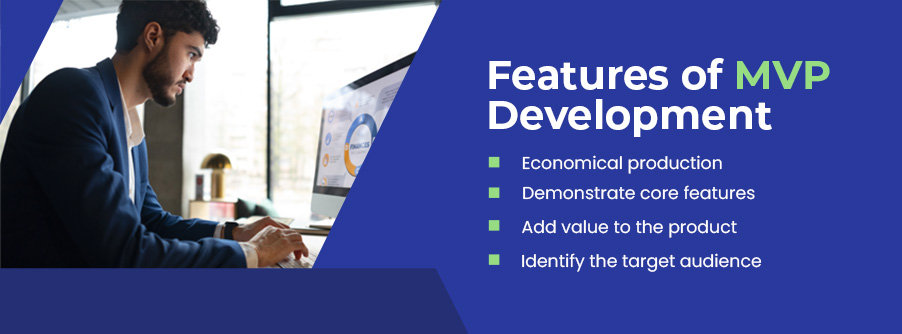
Essential features of MVP development
Below are some top characteristics of developing a minimum viable product.
-
Economical production
Business owners can create an economical version of their digital product with the help of an MVP. When you are short on time and or don’t want to spend too much, a minimum viable product can be a secure investment.
-
Demonstrate core features
Showcasing all the features at once is not necessary during MVP development. You can include only a few main features of the software, which saves money and time. Developers mostly recommend including minimal set of core features that revolves around the basic concept of the development project. This keeps customers focused on your product and provide genuine feedback.
-
Add value to the product
A minimum viable product is developed to address any key issue faced by potential users. Instead of tackling various pain points, it picks a major problem and provides the correct solution. Doing this makes the product more reliable and valuable to customers.
-
Identify the target audience
A startup firm can reach a wider audience if the digital product is exceptional. However, any attempt to achieve this target too early can backfire at times, raising failure risks for the business. With MVP, it is possible to avoid this situation and continue focusing on target users through a specific niche. You can collect feedback from these customers and use it to make your product better than your competitors.
PoC vs Prototype vs MVP: Key Differences Explained
Your future business can benefit from proof of concept, prototype, and MVP. Keep scrolling below to gain valuable insights into these various product development stages.
Comparison on different product development stages
| Criteria | PoC | Prototype | MVP |
| Goal | Prove technical feasibility | Demonstrate business concept | Validate an idea & find a product‑market fit based on real end‑user feedback |
| Development time | Days/weeks | Weeks | Months |
| Audience | Researchers, Developers | Stakeholders, Investors, Focus groups | Early adopters, Investors |
| Use case | Test technical aspects | Fill gaps in a flow, pitch the product idea | Look for a market fit by assessing user feedback, Get funding |
| Risk evaluation | Reduces risk of technical problems | Reduces risk of user dissatisfaction | Reduces risk of building a product with no market |
| Investment | Small budget | Medium budget | Well‑defined budget |
| Revenue | Not for sale | Not for sale, Generates further investment | Sells to early adopters, Generates investment |
| Further use | Technical prototype or MVP development | MVP development | Full‑fledged product development |
PoC vs Prototype
When comparing PoC vs Prototype, the main difference lies in their objective. A PoC validates whether a solution is technically possible, while a prototype demonstrates how the product will look and function. Startups usually begin with a PoC when testing complex technologies and then move to a prototype to gather design feedback from stakeholders.
PoC vs MVP
The discussion around PoC vs MVP often creates confusion for startup founders. A PoC is an internal validation exercise that proves technical feasibility, whereas an MVP is a market-ready product containing only essential features. If your goal is validating technology, build a PoC. If your goal is validating customer demand, launch an MVP.
Prototype vs Proof of Concept
Comparing a Prototype vs Proof of Concept reveals that they solve different problems. A proof of concept answers, "Can we build it?" while a prototype answers, "How will it work for users?" Both stages reduce development risks but focus on different aspects of product validation.
When it comes to evaluating the pre-product stage, you need a PoC and a prototype. Once you decide to enter the product stage, focusing on core functionalities, technologies, and features, it becomes possible with MVP development.
In terms of money and time, expect less investment in the case of proof of concept and prototyping. For demonstrating the final look or functionality of a digital product without undertaking any actual development, a prototype is the ideal choice.
From integrating UI/UX in the finished product to securing funding for further development, prototyping can help demonstrate these aspects. It does it without even having a clear understanding of the business logic.
On the other hand, MVP entirely supports the business concepts of new entrepreneurs. You can present it as a functional product to stakeholders, even if it only includes primary features and not the complete design roadmap. Startup owners can use this stage of software development to add or modify product features and collect user analytics.
How to choose the best approach for a startup?
Are you still wondering about which development stage is appropriate for your digital product? Let’s cover some essential tips to help you improve your startup ideas using proof of concept, prototype, and minimum viable product.
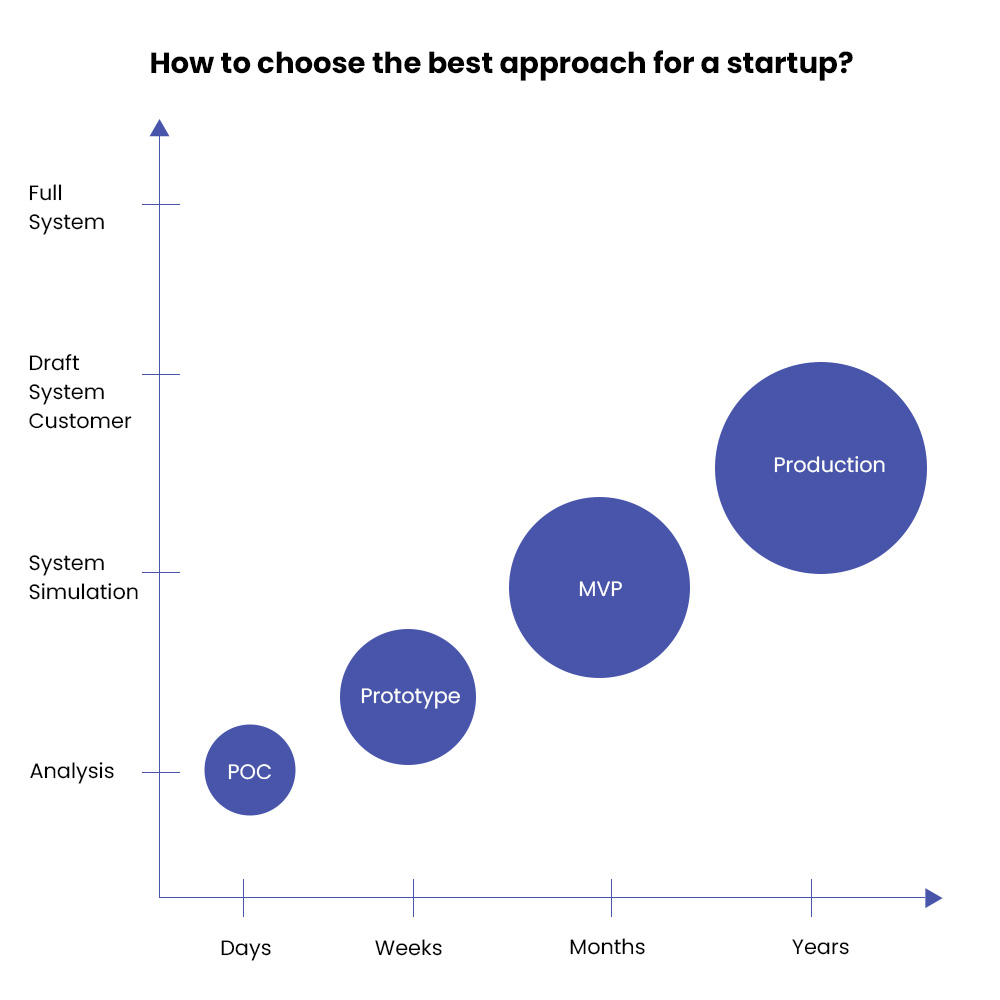
If you're unsure whether to choose PoC, Prototype, or MVP, the decision depends on your current product stage. Businesses exploring technical feasibility should begin with a PoC. Companies looking to validate user experience should build a prototype, while startups ready to test market demand should invest in an MVP.
When to select PoC
- You are thinking about developing an innovative and unique product.
- Your ideas for the final product need validation to ensure they are technically feasible.
- Out of many strategies for software development, you need technology that suits the project.
- You want more insights into the technical knowledge and product features to share with your team.
When to start with a prototype
- You are eager to visualize how the final product may look
- As an emerging entrepreneur, you want to explore and secure seed-stage funding from potential stakeholders.
- You have set focus groups and are ready to receive preliminary feedback about your digital product.
- There’s limited time to showcase your business ideas to stakeholders.
When it's best to consider an MVP
- You have found your target users and are ready to take their help in understanding market reception.
- Your final product needs to be presented without overspending on development costs.
- There’s an urgency to rapidly monetize your idea of a digital product.
Remember, the purpose behind developing software and the resources available decide which strategy to follow next. Proceeding with proof of concept, prototyping, and MVP is not always needed to make business ideas technically feasible. You can track the progress made by your startup company regarding software development and decide accordingly.
There's no golden rule that it's mandatory to review the PoS, prototype, and minimum viable product before every launch. However, these developed strategies can be beneficial for your business, helping you release only polished products in the market.
Final Thoughts
Choosing between PoC vs Prototype vs MVP depends entirely on your product goals. If you need technical validation, start with a PoC. If you want to refine user experience, build a Prototype. If you're ready to test your idea with real customers, launch an MVP. Understanding the differences between PoC vs Prototype, PoC vs MVP, and Prototype vs Proof of Concept enables startups to minimize risks, optimize development costs, and bring successful products to market faster.
Frequently Asked Questions on PoC Vs Prototype Vs MVP
1. What is the significance of PoC in startups?
Emerging companies rely on proof of concept to test whether an idea or technology is technically feasible. It helps validate assumptions, minimize risks, and engage stakeholders in the software development project.
With PoC, business owners can identify hidden challenges in advance, which saves their time and money. It is the first step to turn a raw idea into a real product, ensuring the solution works practically.
2. Does MVP come after PoC in project development?
Yes, MVP is considered after the PoC in the project development lifecycle. Once the conceptualization confirms that the idea is technically feasible, startup owners can proceed to develop a minimum viable product.
MVP tests the core features of a digital product. PoC, on the other hand, validates the questions regarding the building of the solution. MVP helps new businesses gather user feedback, evaluate the market scenario, and plan product improvement.
3. What are the various types of MVP?
There are several types of MVPs, each serving specific goals in software development.
- Concierge MVP: The product is delivered manually to each customer, validating the service concept without building automation. It tests user interest and gathers direct feedback from real interactions.
- Wizard of Oz MVP: Users believe the system is automated, but tasks are performed manually behind the scenes. This module is ideal for testing features before investing in the full technical implementation of software.
- Landing Page MVP: A simple webpage is used to describe the product with this MVP development. It aims to test user interest through sign-ups and validate messaging, pricing, or demand without building a working application.
- Single-Feature MVP: It focuses on delivering one key feature to assess whether users find it valuable. This helps validate the core idea quickly while keeping development efforts to a minimum.
- Crowdfunding MVP: This MVP uses platforms like Kickstarter to test if people are willing to pre-order or support the product idea. It helps validate demand and raises initial funding from stakeholders interested in custom software development.
4. Is a prototype the same as an MVP?
No, a prototype and an MVP are both different in software development. A prototype is an early visual or interactive mock-up that simulates how the final digital product will look and function. Developers usually use it to test UI/UX, gather early feedback, and refine project design.
An MVP is a working product with minimal features launched to real users. The prototype explores the concept, while the MVP tests real-world adoption and business viability.
5. What are the best examples of an MVP?
Several successful software products began with the MVP development phase.
- Dropbox: It launched with a short demo video to show how file syncing would work, gathering user interest before building the actual product.
- Buffer: The company tested its social media scheduling tool using a landing page that explained the idea and collected sign-ups.
- Twitter: This web-based platform started as an internal messaging tool at a podcasting company. Each of its MVPs had limited features but validated core functionality before scaling for global users.
6. What is a prototype in software testing?
In software testing, a prototype is an early, simplified version of a product used to visualize ideas, user flows, or system behavior. The idea is to help stakeholders understand how the software might work before development begins.
Prototyping is essential to spot design flaws, test user interaction, and refine requirements in the digital product. They don’t include backend logic but help prevent costly revisions by aligning developers, designers, and users early in the process.
7. Which one comes first, PoC, prototype, or MVP?
The correct order for software development strategy is to start with PoC, then prototype, and finally MVP. PoC tests help new entrepreneurs determine if their software development idea is technically possible. Once this aspect is validated, a prototype is created to visualize how the product will appear and function.
Furthermore, the design and user flow are refined through feedback. Only after this stage, companies opt for MVP development to test core functionality in the real world or competitive market. Each stage builds upon the previous one, gradually reducing risk and increasing the market readiness of the software.
8. Is MVP lean or agile?
MVP is closely aligned with both lean and agile principles. In lean methodology, it helps avoid waste by building only the features necessary to validate product assumptions. In agile, it fits within iterative development cycles that emphasize continuous feedback and adaptation.
MVP allows startups and teams to release quickly, learn from real users, and improve rapidly. In the custom software development process, a minimum viable product is used as a core tactic by startups in both lean and agile frameworks.
Also read How Enterprise Software Solutions Enhance Business Productivity