


In the past 10 years, we have witnessed the software world undergoing a radical transformation, where what once required manual updates and heavy installations is now just cloud-delivered and subscription-based solutions. The modern SaaS product is now expected to deliver personalization, speed, and intelligence, beyond just accessibility and hosting. As users and businesses demand a more efficient, productive, and intuitive software, the SaaS model is rapidly evolving. As per a 2025 survey, more than 52% of the SaaS companies have already embedded the features of AI into their solutions, clearly indicating the yesteryear solutions as history.
This shift is driven by a rising need for predictive power, personalization, and automation. Users expect that the tools:
- Adapt to their behavior seamlessly
- Anticipate their demands and needs
- And help them make better decisions
In this case, Machine Learning or ML comes forward as the core enabler of the next-generation SaaS product. By blending Machine Learning with SaaS, developers can revolutionize rigid feature sets into data-driven and dynamic experiences, right from predictive analytics, anomaly detection, workflow automation, and recommendation engines.
Today, Machine Learning-powered SaaS products are significantly but quietly giving new shape to companies on how they operate with:
- Usage-dependent behavior insights
- Suggestions for personalized marketing
- Automatic detection of threats
- Smart support for customer chatbots
As you keep reading on, today’s blog by Proquantic Software USA will provide you with details about use cases across the industry, real-world impacts, and what the future holds for a SaaS product powered by Machine Learning.
Why Machine Learning matters for every SaaS product
Today's modern SaaS product can no longer function as a passive tool; it must evolve into an intelligent and proactive platform that can accurately anticipate the needs of the user, deliver insight-driven value, and automate routine tasks. That is where Machine Learning turns into a game-changer. Rather than waiting for users to request reports or features, Machine Learning empowers the SaaS platforms to assess the data and behavior behind the scenes, predict and trigger actions automatically. The shift to intelligent from reactive software marks the most significant leap in what SaaS can offer.
With the SaaS lifecycle becoming increasingly data-driven, Machine Learning empowers the product teams to continuously evolve. User engagement metrics, usage patterns, performance data, and customer support insights all feed into Machine Learning models, enabling the companies to deliver smart upgrades, tailor user experiences, and refine features.
As a result, the lifecycle of the SaaS product becomes more adaptive and evolving based on real usage instead of assumptions.
Machine Learning also plays a critical role in differentiating the products within the crowded SaaS market. As per a 2025 report, nearly 64% of the SaaS providers now have AI/ML capabilities in their platforms, which is a clear indicator that smart features are now baseline necessities instead of 'good-to-have' or luxury add-ons.
Another survey finds that more than 50% of the SaaS firms agree that AI/ML integrations have significantly boosted customer-centric personalization efforts. In this context, SaaS products without Machine Learning powered features risk being perceived as basic and outdated.
Machine Learning delivers tangible benefits in cost optimization, efficiency, and scalability beyond competitive differentiation. By automating repetitive workflows, right from user segmentation, support, analytics to data processing, the Machine Learning-powered SaaS platforms free-up the human effort for strategic tasks by freeing up human effort.
For instance, automating routine workflows with Machine Learning is considered one of the most common uses of Artificial Intelligence in SaaS. With the growth of the user bases and scaling of data volume, manual approaches turn out to be untenable. Machine Learning assures quicker response, consistent performance, and lower marginal cost per additional user.
Finally, with the evolution of user expectations, smart features are increasingly becoming the norm. Users today expect responsive behavior, smooth automation, predictive insights, and personalization out of the box. A SaaS product that fails in offering such intelligence will not just lag but may not fully meet the user demand or keep up with expectations.
Machine Learning technologies powering modern SaaS
When you look under the hood of smart and modern SaaS products, chances are, you will be able to see one or even more technologies, powered by Machine Learning, at work. Various Machine Learning techniques facilitate various capabilities, right from natural language understanding to predictive analytics, collectively forming the next generation of SaaS offerings.
Here's a detailed breakdown of the key Machine Learning technologies and a glimpse of how they power SaaS.
Supervised learning for churn forecasting and predictive analytics
Supervised learning is the most widely leveraged Machine Learning paradigm for SaaS. The models were trained on the labelled historical data for predicting future results. For example, a SaaS company may feed the past behavior of the customer, like:
- Support tickets
- Feature adoption
- Usage frequency
Into the supervised model for forecasting which customers are likely to churn. This enables the product teams to take retention measures. Also, supervised learning paves the way for user-activity forecasting, revenue/sales forecasting, and demand forecasting, making SaaS products more data-driven and business-intelligent.
Unsupervised learning for anomaly detection and customer segmentation
Not all of the useful patterns have labels. Unsupervised learning assists in detecting the hidden patterns of user data. For instance, clustering algorithms can easily segmentize the customers by usage patterns or behavior, enabling the SaaS product to offer tailored experiences to various segments like trial users, occasional users, and power users.
Unsupervised techniques also facilitate the detection of anomalies, which are useful in security threats, unusual spikes in usage, and fraud detection, and add a layer of insight and safety without any explicit labeling.
Reinforcement learning for personalized suggestions and workflow automation
In certain SaaS contexts, especially where the user interactions over time matter, reinforcement learning plays a significant role. Reinforcement learning-based agents learn to make sequences of decisions for optimizing long-term objectives. For example, a SaaS workflow automation tool may learn the best time for suggesting the best action, or the content management system can learn which suggestions to surface to maximize user engagement. Over time, reinforcement learning assists the products to adapt behavior dynamically, making SaaS more personalized, context-aware, and intelligent.
Deep learning for advanced recommendations, image processing, and NLP
Deep learning techniques or neural networks unlock the advanced capabilities for SaaS products like semantic search, natural language processing, complex recommendation engines, image or video processing, etc. For instance, if a SaaS product provides customer support or document management, a deep-learning NLP model can power summarization, sentiment analysis, auto-tagging, intelligent search, etc. For media or design-related SaaS, deep models can easily handle image transformation for classification.
Such capabilities push the SaaS beyond simple feature tools, thereby enabling the smart and rich functionalities that the users expect today.
Generative AI and LLMs for summarization, conversational interfaces, and auto documentation
Lastly, the rise of large language models or LLMs, as well as Generative AI, has dramatically changed what is possible. As per the recent data of the industry in 2025, a major chunk of SaaS providers report including at least one generative AI feature, including content generation, intelligent chatbots, text summarization, auto-documentation, etc.
In the SaaS product, which offers content workflows, support, or collaboration, LLMs facilitate:
- Generating user-facing content like templates, reports, and e-Mails
- User activity logs or summarizing long texts
- Automated documentation
- Conversational interfaces like chatbots
This heightens the UX instead of rigid workflows or clunky menus. The users are able to interact conversationally, get insights instantly, and rely heavily on the software for high-level assistance.
Key impacts of Machine Learning on SaaS products
Machine Learning is doing more than plain adding features; the technology is fundamentally reshaping what today's modern SaaS product can do. From security, personalization, analytics, to automation, Machine Learning underpins a vast range of capabilities that were, even a few years back, seemed to be impossible.
Keep reading below to understand the major impacts Machine Learning is having on SaaS today.
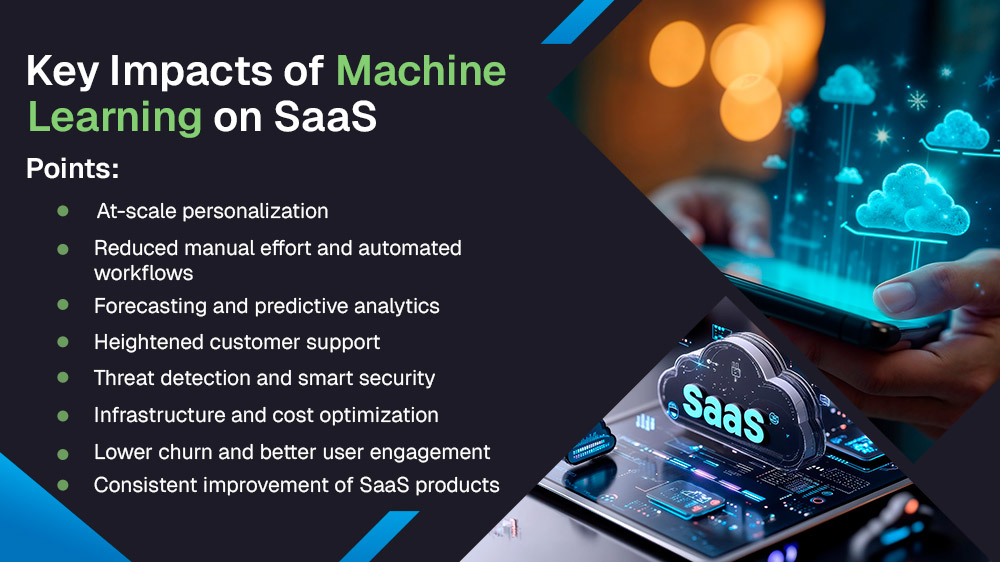
At scale personalization
-
UI adjustments, dynamic content – ML facilitates SaaS products to personalize the experience for every user. Recommendation engines suggest relevant content, features, and actions from past behavior, preferences, or usage patterns. The user interface itself can adapt by showing surface-relevant notifications or commonly used tools first.
-
Modeling real-time behavior– By analyzing and tracking user behavior in real-time, the software can update the interface and recommendations dynamically. As the users change their habits, the SaaS products can also evolve with them, enhancing engagement and relevance.
Reduced manual effort and automated workflow
-
Process mining – Machine Learning helps in identifying repetitive tasks or insufficiencies within the workflow of the user. By assessing the patterns of usage, a SaaS product can determine redundant steps or bottlenecks and enable the developers or the product owners to streamline the flaws.
-
Intelligent triggers powered by user actions – The SaaS product can automatically trigger actions like follow-ups, workflow kick-offs, and reminders, based on how the users interact with the brand. This reduces the need for manual intervention and helps the users to stay on track.
Forecasting and predictive analytics
-
Prediction of churn– By leveraging the behavior signals, engagement metrics, and usage data, Machine Learning models can determine the customers who are likely to churn, enabling personalized efforts for retention.
- Predictions on sales and revenue – SaaS businesses can leverage Machine Learning to identify growth scopes, forecast the streams of revenue, and plan as per the insights.
- Demand forecasting for B2B SaaS – For SaaS products that serve business clients, Machine Learning can help in forecasting demand, capacity, and usage of resources, empowering the providers to scale.
Heightened customer support
- Sentiment analysis – Machine Learning models can analyze the user feedback and messages for detecting sentiment like satisfaction or frustration, helping the support teams to tailor and prioritize responses.
- Automated ticket routing – This system can easily categorize as well as route support requests smartly, based on user history, sentiment, urgency, and content, thereby reducing the response time.
- AI chatbots – Machine Learning driven chatbots can easily guide onboarding, routine user queries, provide help documentation, and answer the FAQs round the clock.
Threat detection and smart security
- Fraud scoring – For the SaaS product that offers payment-related, transactional, and financial services, Machine Learning can analyze the risk as well as score user behavior or transactions for detecting misuse or fraud.
- ML-powered detection of anomalies – SaaS products can leverage Machine Learning to detect suspicious or unusual behavior like usual data access, abnormal login patterns, or unexpected surge in usage, which may signal security threats.
- Risk modelling for enterprise SaaS products – For enterprise-grade SaaS, Machine Learning backed risk models can help in assessing permission levels, user access, and potential vulnerabilities.
Infrastructure and cost optimization
- Predictive allocation of resources – Machine Learning models can accurately forecast peaks of usage, like seasonal surges or busy hours, which allows the SaaS provider to efficiently allocate the resources, save costs, and avoid downtime.
Lower churn and better user engagement
- Smart nudges – Based on the behavior of the users, Machine Learning can trigger subtle prompts or reminders for using complete setup, underutilized features, or revisit the aspects of the products to help in retaining client interest.
- Machine Learning-powered recommendations – Suggesting relevant tutorials, features, or next-best actions encourages deeper adoption of the SaaS product with better engagement.
Consistent improvement of the SaaS product
- Analysis of the usage patterns – By consistently analyzing the interactions of the user with the SaaS product, Machine Learning empowers the product teams to understand which features are used mostly and which are not, guiding decisions of the product roadmap.
- Automating A/B testing – Instead of manual A/B testing, Machine Learning can surface insights, analyze results, and automate experiment tracking to accelerate learning cycles.
- Prediction of feature adoption – Before initiating a new feature broadly, Machine Learning can easily predict which user segments will adopt it, facilitating tailored marketing and targeted rollout plans.
Industry-Specific Use Cases
Machine Learning is never a one-size-fits-all tool. Its power turns out to be more evident when tailored to the most unique demands of the industry. Below are several crucial sectors where Machine Learning is transforming the way a SaaS product delivers value.
FinTech SaaS for risk management, credit scoring, and fraud detection
In the financial sector, Machine Learning powered SaaS products are influencing major shifts in how institutions manage risk, evaluate credit, and verify transactions. Machine Learning algorithms continuously detect suspicious patterns, monitor transaction data, and flag fraudulent activities more accurately than the usual rule-based systems.
Moreover, Machine Learning-based models enhance credit-scoring as well as underwriting processes by assessing behavioral signs and non-traditional data, aiding the lenders to assess risk more accurately.
HR Tech SaaS for attrition prediction and talent matching
Within the HR-centric SaaS products, Machine Learning enables organizations to manage talent more efficiently. For instance, models powered by Machine Learning can match the candidates to jobs based on role success metrics, past behavior, skills, and company culture fit, enabling the HR teams to hire faster and better.
Likewise, the Machine Learning-driven models of attrition prediction assess the usage of internal tools, behavioral metrics, performance reviews, and engagement data for flagging those who may leave soon. These insights gave companies the chance to intervene or retain valuable staff. Such capabilities transform a typical HR SaaS product into a predictive people-management tool that offers both retention and hiring insights.
MarTech SaaS for automated campaign optimization and predictive segmentation
Sales and marketing SaaS tools significantly benefit from Machine Learning when it comes to automating outreach and understanding customers. Machine Learning powered customer segmentation helps in segmentizing users into data-powered cohorts based on engagement patterns, past purchases, demographics, and user behavior. This enables more targeted campaigns.
Furthermore, Machine Learning can optimize the marketing campaigns automatically, predicting:
- Predicting the channels that work the best
- Predicting the segments that are likely to convert
- When to send offers to messages
For a marketing SaaS product, this means delivery of higher ROI for the customers, reducing the guesswork, and relying on data-powered decisions.
Healthtech SaaS for personalized care and diagnostic pathways
In the healthcare sector, Machine Learning opens the avenue to personalized care recommendations, risk predictions, and smarter diagnostics. By assessing patient data, clinical metrics, and historical outcomes, Machine Learning models can determine the early signs of warning, recommend tailored paths of treatment, and predict complications.
Patient management SaaS platforms and telemedicine SaaS platforms leverage Machine Learning for triaging cases, automating scheduling, suggesting follow-ups, and monitoring patient adherence, improving both quality of care and efficiency. As the adoption of AI in healthcare rises broadly, Machine Learning enabled SaaS products are turning out to be crucial tools for patients and providers alike.
EdTech SaaS for personalized learning and adaptive assessments
Education technology SaaS platforms leverage Machine Learning for personalized learning experiences. Machine Learning powered analysis assesses the performance of the learners, detects their weaknesses and strengths, and dynamically adjusts the difficulty of the content flow or lesson accordingly.
Similarly, the personalized learning paths, driven by behavioral data, pace, and performance, enable the learners to receive customized recommendations for revision schedules, study, and courses. This makes an EdTech SaaS product more effective than fixed-content platforms, boosting engagement and learning outcomes.
e-Commerce SaaS for recommendation engines and dynamic pricing
For the e-Commerce SaaS products, Machine Learning delivers Machine Learning offers major business advantages. Machine Learning-powered recommendation engines assess the demographics, preferences, browsing history, and past purchases for suggesting relevant products, which increase upsell and conversion rates.
Moreover, the dynamic pricing algorithms, which adjust prices in real-time based on demand, buying trends, competitor pricing, and stock levels, enable the e-Commerce SaaS platforms to amplify their revenue and stay competitive.
Data Challenges in Building an ML-Powered SaaS Product
| Challenges | Description | Effect on ML-Powered SaaS Product | Solutions |
| Infrastructure Challenges | Creating ML-powered ready frameworks requires data pipelines, MLOps architectures, and monitoring system storage optimization. | Weak infrastructures lead to failures in real-time ML serving, inability to scale, and unreliable features, for scaling the SaaS product worldwide. | Implement MLOps, adopt feature stores, use containerized deployments, and select scalable cloud-native architecture. |
| Need For Continuous Retraining and Model Drift | Market patterns, user behavior, and datasets evolve, causing the Machine Learning models to become outdated. | A SaaS product with drifted models delivers lower quality personalization, inaccurate insights, and reduces confidence for decision-making. | Set up CI/CD pipelines, drift detection systems, and retraining hoops for Machine Learning. |
| Scaling Inference and Model Training | High-volume data needs powerful compute resources for deploying and training Machine Learning models efficiently. | When scaling is poor, the SaaS product will experience latency in accurate predictions, degraded performance, and slow automation during peak usage. | Adopt model optimization, cloud auto scaling, distributed training, and GPU/TPU acceleration. |
| Data Privacy Regulations | SaaS organizations have to comply with the global privacy standards and laws for ensuring consent, handling user deletion requests, and enabling data portability. | Non-compliance will expose ML-based SaaS products to legal loss of customer confidence, fines, and legal risks. | Leverage encryption, access control policies, anonymization, and region-based data handling alongside maintaining compliant audit trails. |
| Data Quality Issues | Noisy, inconsistent, and incomplete data reduce the reliability and accuracy of the model. | Poor quality of data directly affects the performance of an AI-powered SaaS product, which affects user trust, personalization, and predictions. | Implement automated cleaning, continuous monitoring, and robust data validation, and enforce strict standards of governance. |
Best Practices for Integrating Machine Learning into a SaaS Product
Integrating Machine Learning into a SaaS product is not just about creating a model, but about embedding Machine Learning thoughtfully so that it delivers consistent value and adapts efficiently to the user’s needs.
To begin with:
- Start at a small scale with high-impact features – Instead of overhauling the entire product, start with one crucial use case. For example, churn personalized recommendations and predictions, which will quickly show value and create stakeholder confidence.
- Create an alternative map of Machine Learning – With the growth of usage and data accumulations, gradually amplify the scope of the SaaS product by adding more features, integrating feedback, and refining models. This incremental approach will reduce the risk and help you to measure the impact over time.
- Ensure an explainable and transparent AI - Customers and users have expert clarity on how Machine learning-based decisions are made. Incorporating explainability supports compliance, fosters trust, and assists in refining or debugging models at the time of need.
- Leverage privacy-preserving ML or synthetic data while dealing with user data – This approach helps in meeting the regulatory requirements, enables powerful model training, and protects user privacy. It is crucial for SaaS tools that handle enterprise and personal data.
- Facilitate cross-functional collaboration – Between the engineering, product management, and data-science teams. Machine Learning is not siloed, and it should align with business goals, real user needs, backend architecture, and UX design.
- Embed a continuous cycle of improvement – Regularly monitor performance, retrain models, and collect user feedback to ensure that the SaaS product evolves with dynamic user behavior and changing data.
Trust Proquantic as Your Machine Learning Innovation Partner
Proquantic Software USA's approach to Machine Learning innovation positions us as a compelling partner for organizations that are looking to embed intelligent capabilities in their software. Our team emphasizes building ML-based features that are perfect for the real world, right from automation to predictive analytics.
Our approach and mindset make us particularly valuable for enterprise platforms and SaaS products where data-powered decision-making, futureproofing, and scalability are priorities.
We offer end-to-end ML development solutions that reduce the friction for companies that may lack in-house data resources, crucially acting as an extension of their engineering teams and product.
Why do we stand out as an ML partner
- We are a full-stack ML developer
- Our innovations are built with a business-first focus
- Our solutions are scalable and easily maintainable
- You incur lower internal overhead with our solutions
- We deploy our ML solutions more quickly than building everything in-house from scratch
Future of Machine Learning in SaaS products
The future of every SaaS product is walking towards intelligent autonomy. As Machine Learning continues to mature, SaaS platforms will transform from being support workflows to systems that run as well as optimize those workflows on their own. Such evolution marks the beginning of autonomous SaaS platforms that are capable of executing tasks, making decisions, and enhancing themselves consistently.
AI-based SaaS will gradually take the place of the traditional models, which means that the product will be engineered on the foundations of Machine Learning right from day one. Real-time personalization will turn out to be universal, where every user will be receiving the dynamic interfaces, product journeys, and communications that are tailored to their micro-behaviors.
Customer operations will be trending towards full automation, powered by smart AI agents, predictive resolution systems, and sentiment-aware communication tools. At the infrastructure level, the SaaS products will feature auto-optimizing performance, self-healing capabilities, allocating resources without human intervention, and detecting anomalies.
In a nutshell, Machine Learning will fuel product-led growth, where automated onboarding, intelligent insights, and personalized nudges will generate higher engagement rates, making Machine Learning a non-negotiable aspect of the next generation SaaS products.
Conclusion
Machine Learning is no longer an add-on, but a foundational layer that will define every modern SaaS product. Organizations that will adopt Machine Learning early and invest in strong data pipelines, experimentation, and governance will lead the next lap of innovation. The future winners in SaaS will be those people who master personalization and automation. By having experts like Proquantic by their side, companies can speed up the journey and build SaaS products ready for the AI-focused future.
Frequently Asked Questions (FAQs)
What is a SaaS product?
A SaaS product is a tool that is delivered over the internet via a subscription model. The users can access it via web browsers instead of a local installation. It is centrally hosted, updated by the provider, and is accessible from anywhere with proper internet connectivity.
What are the main benefits of using a SaaS product?
SaaS products offer lower upfront costs, automatic updates, and easy deployment, eliminating maintenance and installation burdens. They also facilitate scalability, which businesses can efficiently adjust to with the growth of subscriptions.
How secure is the data in the SaaS product?
Most reputable SaaS providers implement robust encryption, compliance standards, and access standards for protecting user data. However, the security depends on both vendors’ practices as well as how carefully users configure permissions and access.
How does pricing typically work for a SaaS product?
Pricing usually follows a subscription-based model, depending on the monthly or annual usage tier. This enables the companies to pay based on the actual usage, avoiding the massive upfront costs of traditional software licenses.
Can a SaaS product be customized to my business needs?
Various SaaS products provide configurable settings, modular features, and integrations for adapting to varied business workflows. Advanced solutions may also offer APIs or integrational capabilities for tailoring functionality for certain use cases