


A few days back, we had an existing client ask us, 'I want to build an e-Commerce website for my business, based on Shopify. How do you charge for that?' If you are reading this, chances are, you too, are wondering about the Shopify website development costs, and you have indeed arrived at the right place.
Everything comes with a cost and so do Shopify-based e-Commerce websites. Today, Proquantic will be laying down a complete cost guide on the same, so that, based on your budget, you can either do it yourself or you can opt for professional Shopify website development services to get an e-Commerce store built and launched on the web.
Whether you're launching your first online business or upgrading an existing eCommerce platform, understanding Shopify store development cost is essential for planning your budget. The final investment depends on factors such as store complexity, custom functionality, integrations, Shopify theme development cost, and any additional Shopify app development cost required to support your business operations.
With more than 4.7 million live sites, the US online stores capture around 29% of the total count. This figure not only highlights the merchant trust but also ensures that it comes with advantages like third-party support, innovation, and great ROI. Shopify comes with friendly entry plans, but its total cost of ownership will greatly surprise you!

What is Shopify Store Development?
Shopify store development refers to the complete process of creating an online store using Shopify, including store setup, UI/UX design, theme customization, payment gateway integration, product catalog configuration, third-party app integration, SEO optimization, and post-launch support.
Depending on your business requirements, Shopify store development may involve using pre-built themes, creating a custom storefront, or developing custom Shopify applications to extend functionality. The overall Shopify store development cost varies based on the scope of work, customization level, and business goals.
Shopify Store Development Cost: Upfront and Recurring Expenses
Shopify is one of the most significant and biggest online platforms for e-Commerce website development. When you are having a Shopify-based website built, you can expect to pay two types of costs: upfront costs for having it developed by a professional and recurring operating costs.
The amount of upfront website costs depends on the number of features you want to incorporate into the website for your visitors. Here, a basic website will cost you something between $3500 and $5000, with features like:
- Up to 10-12 pages of content, written professionally.
- One full year of web hosting support
- A basic 5-field contract
- Professionally designed website structure that can accommodate up to 25 distinct products.
A basic website is ideal for startups or small companies. The structure of a basic Shopify website enables the business to focus on its limited products, but it has to be designed in a user-focused way so that it can be managed efficiently. Paying for additional features at the initial stage can invariably bring higher returns on your initial investment for the long run, and in this case, a fully optimized website will normally cost between $6000 and $10000 with features like:
- Invoices, e-Mails, and custom cart page
- Custom payment gateway
- Abandoned cart feature
- Related products feature
- MailChimp integration for e-Mail Marketing
- Advanced product filter
- Product catalogues
- Search engine optimization
- 35 to 42 pages of content written professionally
Right after the website building is completed, there are various recurring costs associated with the Shopify platform. Such costs can be segmented into two categories – per purchase charges and Shopify platform costs. The former is incurred when a customer purchases an item from the online store. Below are the three different plan options:
- Advanced Shopify ($299/month)
- Shopify ($79/month)
- Shopify Basic ($29/month)
Basic Shopify plans have critical features like the Shopify point-of-sale app, discount on shipping labels, discount codes, manual order creation, 24-hour tech support, etc. Both the Mid and advanced plans include all features of the basic plans, along with advanced features like a discount on shipping labels, reports on professional performance, and usability of gift cards.
The chosen plan must be based on both the amount of online business you are expecting after the website is made live and the current size of the business.
Shopify website cost per purchase
There are some costs involved on a per-purchase basis, and these must be incorporated into the price of each item that you are selling on your website. Such charges are based on the types of plans you have selected, while some are calculated as a percentage of the overall purchase value. The per purchase charge for each Shopify plan is:
| Type of costs | Shopify Advanced | Mid Shopify | Shopify Basic |
| Charge for online purchase | 2.4% + 30 cents | 2.6% + 30 cents | 2.9% + 30 cents |
| Additional fees for using all the payment providers other than Shopify payments | .5% | 1.0% | 2.0% |
Shopify for mobile-using customers
By the year 2030, the mobile shopping market in the US is expected to grow significantly, backed by the projected revenue of nearly $1,994.8Tn trillion – Source
The figure implies how people are proactively viewing and purchasing products online from their mobile devices, and relying solely on a website would not cater to your e-Commerce growth in the long run. According to Google Research, people having a negative experience on mobile websites are 62% less likely to purchase from the same brand. So, it is imperative to include mobile optimization of your website into the Shopify website development cost budget.
Choose your Shopify website development solution with responsive design and elements for catering to mobile visitors. A responsive website can detect the kind of device the users are visiting the platform from to automatically adjust the size of the web structure.
Ensuring that your Shopify-based e-Commerce website is structured to accommodate mobile users is a significant aspect of owning an e-Commerce website.
Until now, we have s tated the costs you can expect to get a Shopify website built for your e-Commerce business. From here, we will be breaking down the aspects in detail.
The crucial elements of Shopify website development
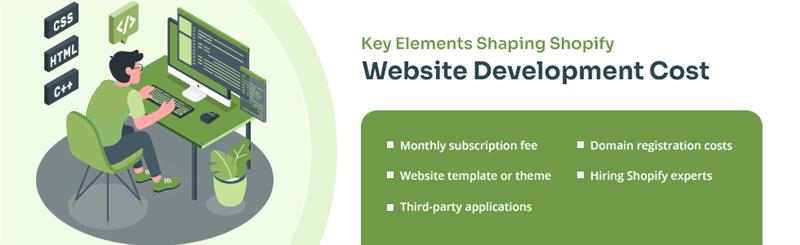
Before you launch your online store, it is crucial to understand what actually contributes to the total Shopify development cost. As implied before, Shopify offers an intuitive platform, and it takes several elements into consideration for shaping the final budget, right from expert customization to monthly subscription fees. Knowing all these cost drivers can help you plan a realistic budget for your project, even for the scaling stage, by avoiding any unexpected costs. Take a look at the details:
Monthly subscription fee
The Shopify monthly subscription starter plan starts as low as $5/month, but most stores use the Shopify Basic that costs $29/month billed annually or $39/month billed monthly. The Higher tiers include Shopify Grow, which costs $79 and $105, whereas the Shopify Advanced costs $299 and $399. The enterprise-level Shopify Plus begins at $2300/month based on a multi-layer contract. When you switch to the annual billing, you can roughly save 25%, which aids in budget predictability.
Website template or theme
Free themes minimize upfront prices but offer limited spots for customization. Premium themes of Shopify usually cost between $150 $360 to deliver advanced features. For full flexibility and unique branding, custom-themed development ranges between $1000-$5000 for moderate customizations, whereas, for feature-rich and bespoke stores, the Shopify website development costs can range between $5,000-$20,000.
Shopify Theme Development Cost
One of the biggest factors affecting Shopify theme development cost is the level of customization required. Businesses using free Shopify themes have minimal upfront expenses, while premium themes typically cost between $150 and $360.
For brands requiring unique layouts, advanced user experiences, and conversion-focused designs, custom Shopify theme development generally ranges between $2,000 and $20,000+, depending on design complexity, responsiveness, animations, and custom functionality.
Third-party applications
Various merchants depend on paid applications for enhancing store functionality with CRM tools, loyalty, subscriptions, reviews, and SEO. The monthly application fees usually range between $5 $100 for each of them. It is important to know that Shopify stores use around six such apps. As demand grows, recurring application subscriptions can increase ongoing Shopify development costs significantly.
Shopify App Development Cost
Businesses often require custom applications to extend Shopify's default functionality. Shopify app development cost depends on the complexity of the app, API integrations, user authentication, third-party services, and ongoing maintenance.
A simple private Shopify app may cost between $3,000 and $10,000, while advanced public or enterprise applications with custom workflows, inventory synchronization, ERP integration, or AI-powered features can exceed $25,000.
Domain registration costs
A customized domain typically costs between $10-$30/year, depending on the registrar and TLD. Although Shopify includes an SSL certificate free of cost, the wildcard or premium certificates may add $50-$200/year when handling outside the platform. Although modest, such expenses later on compound across advanced domain setups or multiple stores.
Hiring Shopify experts
Businesses investing in Shopify store development often choose experienced agencies for custom development, scalable architecture, and long-term maintenance. Although hiring professionals increases the initial investment, it usually reduces future maintenance costs and improves overall store performance.
The developer rates start from $15/hour for hiring junior freelancing professionals and may shoot up to $150-$200/hour for senior professionals from agencies or North America. Project-based pricing is very common, right from minor tweaks ranging between $500-$200, whereas advanced or custom build integrations can surpass $5000 and reach as high as $25,000+. Agencies provide full service and often charge between $10,000 and $150000 for long-term and high-complexity work.
| Cost Component | Cost Range |
| Hiring Experts | $15-$200/hour; Fixed: $500-$25000+ per project |
| Domain Registration | $10-$30/year (Optional SSL $50-$200) |
| Third-Party Apps | $5-$100+/month per application (6 applications on average) |
| Template or Theme | $0 to $360 (custom $10000-$20,000+) |
| Shopify Subscription | $29-$399 (up to $2300/month for Plus) |
The best approaches for setting up Shopify stores
In this approach, we will be highlighting two of the best approaches for setting up your online store so that your budgeting for Shopify website development cost becomes hassle-free.
1. The DIY approach
If you are an entrepreneur who loves to do hands-on work, have a lot of time to learn, and prefer to stretch the budget, then DIY can be the best choice to set up your Shopify-based website. Thanks to the user-friendly interface, users do not have to be developers or coders to get started.
The user-friendly interface of Shopify offers a wide variety of tools, step-by-step guidance, drag-and-drop builders, and more such features to enable users to build attractive and functional storefronts.
Here are some of the unavoidable costs that you have to pay for:
| Essential Apps | Upselling, reviews, SEO tools, etc., that range between $5 and $50/month for each |
| Domain Registration | Typically ranges between $10 and $20/year |
| Theme | Starting from $0 and reaching up to $350 for premium themes |
| Subscription | Starting from $39/month for Basic |
Of course, there are additional hidden costs, and that's TIME! While doing it yourself may keep you lean with cash, you have to spend hours learning to navigate the platform, optimizing product pages, integrating shipping settings, configuring payment gateways, and setting up collections.
Who is DIY best for?
- Non-technical founders who have the bandwidth to learn
- Businesses that are testing the market
- Simple catalogues under 20-30 SKUs
- Solopreneurs or Bootstrapped startups
Limitations to consider while following the DIY approach
The most significant risk involved with DIY is not launching, but launching without a proper guide. Many first-time entrepreneurs cannot optimize mobile responsiveness, SEO, or speed, and this can affect the conversions and search rankings. Additionally, any kind of custom logic, like product bundles, third-party logistics, or tiered pricing, can turn into a challenge without the developers' help or skills.
2. Professional Shopify store development
Professional Shopify store development is recommended for businesses that require custom themes, advanced integrations, optimized checkout experiences, and scalable infrastructure. While DIY solutions reduce upfront expenses, professional development often delivers better performance, SEO, security, and long-term ROI.
Not every business has the bandwidth to experiment with a trial-and-error method. In case your store is a significant channel for revenue, it is ideal to invest in hiring an expert Shopify website development team as the smarter route.
When you hire Shopify professionals, you will get:
- CRO guidance, analytics, and post-launch support
- SEO best practices, as well as Google indexing readiness
- Integration with 3PL or third-party logistics, ERPs, and CRMs
- Product info, trust signals, and strategic placement of the CTAs
- Responsive design for all devices
- Efficient and clean code that bolsters site performance
- Custom UI/UX designed for your brand
The experts you may need for the Shopify website development project
- A Shopify designer who will be focusing on user experience, fonts, colors, and layout
- A Shopify developer who will add APIs, integrations, and custom functionalities
- Shopify SEO professional or strategist
- Shopify marketer who will help with the analytics, ads, and e-Mail flows
Who is it ideal for?
- Enterprises that need system integrations like inventory sync, CRM, and ERP
- Drop shipping businesses that need automation
- Complex product catalogues with multiple categories and variants
- Businesses that want to explore new markets
- Brands that have existing capital or transaction
The considerations while hiring Shopify website development professionals
- Look carefully for Shopify development experts who have reliable experience. Avoid the ones who are not accustomed to the platform's ecosystem.
- Ask them to share portfolios that are specific to Shopify projects, alongside generic e-Commerce sites.
- Be clear about the project scopes, like hidden fees, post-launch support, and revisions.
Some of the hidden costs to consider:
- Subscription-based tools like analytics, SMS, e-Mail
- Landing page design and marketing assets
- Branded visuals or custom photography
Bonus tip – The hybrid approach, where you start with DIY and scale with expert support later
A lot of business owners start with a DIY model for testing market-fit of the product, and once their revenue-earning stabilizes, they invest in professional revamping. The strategy makes space for lean beginnings without long-term growth compromising.
e-Commerce website development costs – beyond Shopify
Even after you are done selecting the right plan for your Shopify website development project, alongside customizing your online storefront, there's still more to add to the budget than you might think.
Trust us when we say that behind every successful online store, every entrepreneur has to pay multiple and recurring expenses, not included in the budget, many times. Right from essential add-ons to hosting nuances, here's what you can expect to include in your budget beyond Shopify's expansive ecosystem.
Cost of hosting
When you are choosing a headless setup or Shopify Plus, you may opt for custom hosting via platforms like Cloudflare or AWS, which again, have their own cost. These costs often begin from $20 to $100+ monthly, depending on performance needs and traffic. Reliable hosting is important for security, uptime, and loading speed.
Fees for payment processing
No matter which gateway you choose for payment, like PayPal, Stripe, Shopify Payments, or even a local provider, processing fees are something you cannot simply avoid. Shopify charges nearly 3.0% + 30 cents for every transaction for online purchases under its Basic scheme. For high-volume stores, such small fees can add up to thousands every year. Planning for them in margins is crucial to keeping the profits healthy.
Cost for e-Commerce website design
In case you want your brand to stand out in the crowd, you have to invest in a professionally ideated Shopify theme. The store of Shopify offers a bouquet of free themes as well as premium ones that range between $180 and $350. But when you hire a professional designer for the job, you may have to pay an amount between $500 $5000, depending on the complexity.
This can be a recurring expense or a one-time investment that will shape your user journey and directly impact conversions.
Custom development for custom features
Shopify’s pre-loaded features may not cover each and every functionality that you require, especially when you need ERP integration, multilingual support, APIs, or checkout flows. Custom development by Shopify professionals may range between $7 and $200 every hour. For a 3-month project, the development costs can range between $3000 and $20,000 based on the customizations.
Extensions, apps, and add-ons
The App Store by Shopify is a library of plugins that improve functionality, like loyalty programs, reviews, marketing apps, email, and SEO tools. While various applications provide free tiers, most of the business-level applications range between $10 and $100 every month each.
Business operation costs
To run an e-Commerce store, entrepreneurs need more than just tech. As an online business owner, you have to consider employee salaries, accounting tool expenses, inventory management system costs, custom support tool costs, and logistics costs. Such operational costs may be variable, but even for a small brand, allocating $500 to $1500 every month is ideal, depending on the website's scope of services and scalability.
Choose Proquantic as your partner for Shopify website development
Proquantic does not just build Shopify stores, but rather it empowers entrepreneurs like you to build a flourishing online presence. Right from ideating a conversion-focused storefront to cutting through the confusing add-on costs to launch a potent platform, we are consistently simplifying delivery at every level. Whether you are starting afresh or scaling, our Shopify professionals will provide you with a smarter, faster, and leaner Shopify website development journey.
Here's what we bring to the table:
- No surprise costs – We keep every online entrepreneur in the loop so that you know what you are paying for and why it is important.
- Optimize conversion – Every Shopify e-Store we ideate is fine-tuned for sales, speed, and performance.
- Hassle-free custom integrations – Right from payment gateways to CRMS, we manage backend integrations that work.
- Quicker turnarounds – We follow agile development practices to get stores live on budget and on time.
- US-focused CRO and UX strategies – Keeping the audience in mind, we create potent content copies and impressive designs, aligned with the US market trends and demands.
- Consistent store maintenance and support – We don't stop even after the launch phase; rather, we consistently work behind your Shopify store to keep it secured, growing, and updated.
Shopify Store Development vs Shopify Website Development
Although the terms are frequently used interchangeably, Shopify store development focuses specifically on building and optimizing an online Shopify storefront, including products, checkout, themes, and applications. Shopify website development may include additional pages such as blogs, landing pages, corporate websites, and custom integrations. Understanding this distinction helps businesses estimate their Shopify store development cost more accurately.
Conclusion
Whether you're estimating Shopify store development cost, budgeting for Shopify theme development cost, or planning Shopify app development cost, investing in the right development strategy can improve customer experience, increase conversions, and reduce long-term operational expenses. Choosing experienced Shopify developers ensures your store is built for performance, scalability, and future growth.
Shopify website development isn’t only about setup costs, but rather it’s about planning for long-term growth ahead. Entrepreneurs must be strategic while budgeting, and they must prioritize future scalability, user experience, and functionality. Whether you hire professional Shopify website development experts like Proquantic or want to DIY. You must understand all layers of cost to make an informed decision, which eventually pays off with store growth.
Frequently Asked Questions About Shopify Website Development Cost
What is Shopify, and why should I use it?
Shopify is popular as a user-friendly e-Commerce platform that enables users to manage, build, and scale online stores without involving much technical hassles. It is a great platform for both growing brands and beginners and offers secure payment options, mobile optimization, and built-in SEO, along with 8,000 other applications to customize store functionality.
Do I require coding skills to create a Shopify store?
Of course not. Shopify comes with a drag-and-drop builder as well as customizable themes that make it easy for non-coders to launch a store. However, in case you need unique designs or advanced features, it is crucial to hire a professional Shopify website development expert who can tailor your online store with speed, high-converting UX, and performance.
Is Shopify Plus worth the investment?
Shopify Plus is an enterprise version and is built for fast-growing online businesses. It comes loaded with features like priority support, multi-store management, automation, advanced tools, etc. In case your brand generates $1M and more every year and needs an enterprise-focused flexibility, Shopify Plus would be a great investment.
How can I make my Shopify-based online store SEO friendly?
Shopify comes with built-in SEO features like automatic sitemaps and clean URLs, for improving your Shopify website visibility, focusing on regular blog updates, mobile responsiveness, fast-loading themes, and keyword-optimized pages. Also, avoid the application overload that can slow down your website.
Which payment gateways can I implement in my US Shopify e-Store?
Shopify supports leading payment gateways like Authorize.net, Stripe, PayPal, Shopify Payments, etc. In fact, Shopify Payments is great for US-based merchants, and it offers full integration with no extra fees. Shopify also supports Apple Pay, major credit cards, and more to provide a seamless checkout experience.
Can I shift my existing e-Commerce website to Shopify?
Yes, Shopify provides tools for importing and migrating order data, customers, and products from platforms like Magento or WooCommerce. While most of the data can be transferred easily, hiring a professional Shopify website development team helps in customizations, speed optimizations, and SEO during the process of migration.