


Offshore software development is a practice of transferring a software development project partially to a third-party development firm located in a different country, with lower labor costs. Offshore software development has been regarded as a cost-cutting tactic for years, and in 2026, it has evolved into a strategic approach for offshore software product development, enabling organizations to improve scalability, accelerate product delivery, and build high-performing engineering teams.
For example, if you are a US-based entrepreneur, you can choose to hire a cost-effective and skilled IT vendor from Eastern and Central European countries like Ukraine, Poland, Estonia, or if your business is in Australia, you can choose a firm from Southeast Asian countries.
A lot of companies mix nearshore and offshore teams within a hybrid model for obtaining the right balance among cultural similarity, overlapping time zones, and round-the-clock efficiency.
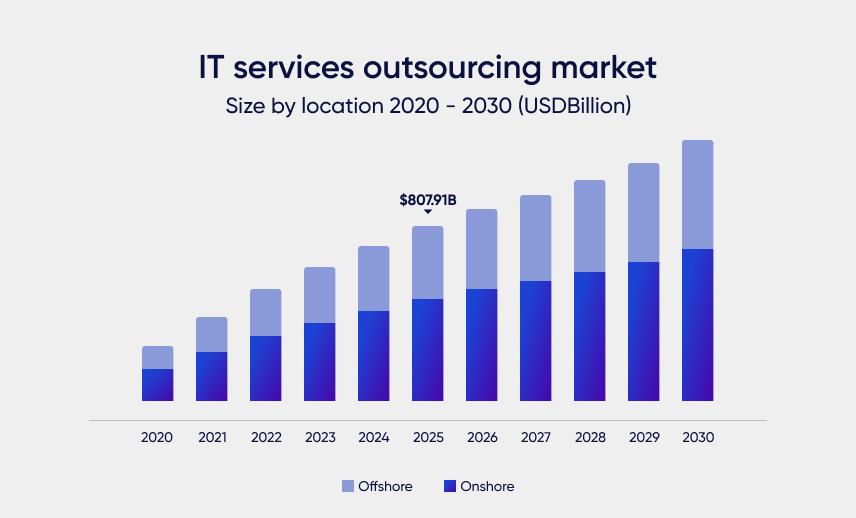
Alongside cost-effectiveness, today's offshore software development empowers businesses with access to a DevOps-first team that turns out to be an integral part of the agile delivery cycles – quickly adopting new technologies like cloud-native architecture, automatic testing, and AI-based development.
Businesses investing in offshore product development benefit from faster innovation, access to specialized engineering talent, and flexible delivery models that support everything from MVPs to enterprise software products.
To make the processes more scalable, the offshore IT providers leverage the build-operate-transfer or the BOT delivery method, offering the offshore teams an option for internalizing operations when stabilized.
Offshore software product development is one of the most widely adopted IT outsourcing models for startups and enterprises building scalable digital products. Before selecting the right engagement model, it's important to understand how offshore development compares with onshore, nearshore, and hybrid software development. If you want to get a full idea of software development outsourcing, you have to know about its three types:
- Onshore software development
- Nearshore outsourcing
- Hybrid software development
It is crucial to know the distinctions between all the software development models so that entrepreneurs can make a good decision when it comes to building a product. These models come with different combinations of speed, control, and cost, and their selection decision is significantly related to the organization's scope of project, team seniority, and priorities. Find the details below:
| Type | Onshore software development | Nearshore outsourcing | Hybrid software development |
| Overview | Refers to outsourcing software development to a team located in the same country as the organization. | Refers to outsourcing the software development to a team from a neighbouring region or country. Provides a middle ground between offshore and onshore software development models. | The model blends the best aspects of the nearshore and onshore collaboration models. It allows the companies to blend cost-effectiveness and speed delivery with full control of the operations, especially while backing continuous web development projects or scaling digital products. |
| Advantages |
|
|
|

Why are organizations across the globe are inclining more towards offshore development?
Let’s explore the factors that make offshore software development the most ideal choice for organizations worldwide:
Access to the best software development engineers
Offshore outsourcing development facilitates cooperation with various technically competent experts who are needed in multiple business domains. A wide pool of talent is one of the many reasons why many software outsourcing firms open their R&D centres and headquarters around the world.
Internal recruitment gets completed in just a matter of weeks, or even days, instead of months, and allows the organizations to recruit as many experts as needed. So, businesses can select the best offshore software developer or an entire team by considering different specialists with different expertise.
Also, offshore IT staff augmentation empowers businesses to expand their team seamlessly with specialized skills that provide the needed flexibility to scale resources down or up based on the demand of the project.
Reasonable cost of development
As a rule, offshore software development enables organizations to optimize their product creation cost with lower hourly rates. This cost-saving factor is the primary motivation for businesses to begin offshore IT development cooperation. Eastern and Central Europe have gained immense popularity among offshore software development companies due to their government support, vast pool of talented professionals, and favorable tax scenarios for the IT industry.
Most of the organizations in this region provide top-quality services and competitive pricing with an ideal balance of value for money with the software solutions they deliver.
The development costs can also be influenced by the software development time. Furthermore, a lot of offshore software development service providers offer organizations with additional services.
Higher scalability
Offshore software development can be tricky, and organizations may never know how many developers they need at any time during the project. One of the greatest advantages is its scalability. This flexibility makes offshore product development ideal for businesses building SaaS products, enterprise platforms, and customer-facing applications that require continuous iteration and rapid scaling.
Lower risk of development
Working with offshore software development professionals enables companies to acquire a final product that's dependable, tested, and corrected in time. For this sole reason, every offshore project includes a QA team as well as a project manager who is responsible for debugging the written code to ensure that the product functions smoothly in the future.
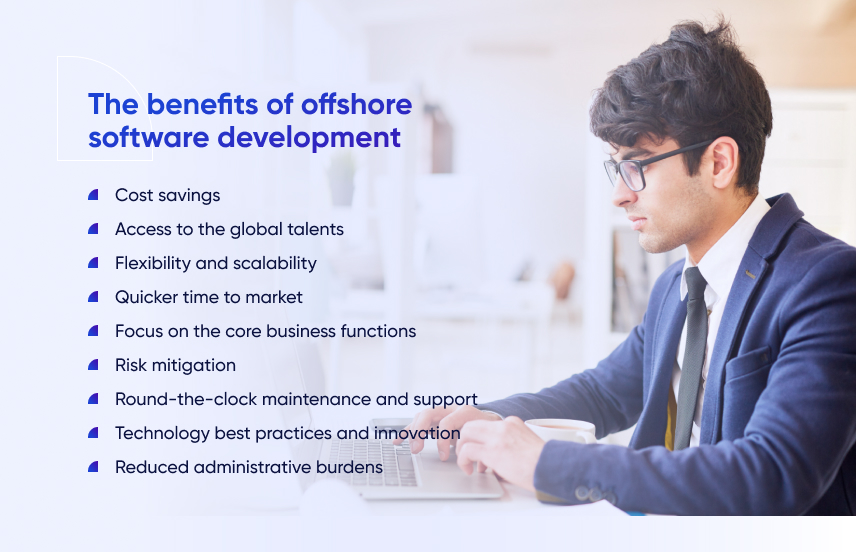
The benefits of offshore software development
Offshore software development has grown into a strategic approach for organizations to stay competitive in the digital world. Let's explore the benefits of the model:
Cost savings
Offshore software development enables businesses to get access to the top professionals in regions where the wages are significantly lower and deliver the same quality without any hefty investment involved with domestic hiring.
The cost-efficiency makes offshore hiring a great option for businesses that are looking to maximize their tech budgets. Beyond salary savings, offshore software development eliminates the factor of overhead costs like employee benefits, equipment, and office space maintenance that add up for in-house teams.
Access to the global talents
When businesses choose offshore software development, they get access to highly skilled developers from around the world. Such reach can enable the organizations to find the right match for the specific projects, often discovering talents that simply aren't available locally.
Flexibility and scalability
Whether you're launching a new SaaS platform or expanding an enterprise application, offshore software product development provides the flexibility to scale engineering resources based on evolving product requirements while maintaining cost efficiency.
Offshore software development teams provide remarkable flexibility while scaling the development efforts up or down. Whether a company requires a compact team for a quick project or a large workforce for software product development, offshore providers can optimally adjust the resources rapidly without any administrative burden of firing or hiring the internal staff.
Quicker time to market
Offshore software development comes with the ability to leverage various time zones for perpetual support. This follow-the-Sun approach takes place round-the-clock, significantly speeding up the development timelines and enabling businesses to launch products faster than their competitors, relying on traditional work schedules.
Focus on the core business functions
An organization, by partnering with offshore software development teams, can divert its internal resources towards the essential activities like enhancing customer relationships, sales, and marketing. The strategic approach of offshore outsourcing ensures that each element of the business gets proper attention while the technical development smoothly proceeds under the experts.
Risk mitigation
Offshore software development distributes risk across various geographical areas, which safeguards the businesses against all region-specific challenges, regulatory shifts, talent shortages, and economic disruptions. Such diversification enables organizations to ensure a better consistency in business continuity and project progress, irrespective of what may happen to any singular location.
Round-the-clock maintenance and support
Various offshore software development firms provide 24/7 maintenance and support that ensures the application remains functional all the time. Such continuous monitoring capability means that any issues will get resolved quickly, way before they impact the users.
Technology best practices and innovation
Offshore software development teams frequently bring exposure to the latest frameworks, technologies, and industry best practices from a diverse client base. Such teams stay active with the emerging trends and recommend innovative solutions that the internal teams may not have experienced.
Reduced administrative burdens
Organizations leveraging offshore software development services eliminate various administrative costs that are associated with the management of large development teams. Payroll management and HR tasks benefit administration as well as workspace requirements. Reduction in administrative tasks enables businesses to concentrate on strategic decision-making instead of day-to-day personnel management, improving the overall efficiency.
Companies that can hire offshore developers
Organizations pursuing product development offshore often choose experienced global engineering teams to accelerate innovation, shorten release cycles, and gain access to specialized technical expertise that may be difficult to hire locally.
Offshore software development has turned into a strategic move for businesses hailing from different sectors. It is particularly crucial for organizations that want to tap into cost-effective solutions without compromising expertise or quality. Let's have a look at the companies that gain the most from offshore software development.
Organizations pursuing product development offshore often choose experienced global engineering teams to accelerate innovation, shorten release cycles, and gain access to specialized technical expertise that may be difficult to hire locally.
- Small businesses – For startups and small businesses, keeping costs under control is everything. Offshore software development provides them with the power of accessing skilled talent without any financial obligations of maintaining full-time in-house teams.
- Companies functioning with stringent deadlines – When businesses have to get the product moving into the market faster, offshore teams come in handy, especially when they are from different time zones. This creates a continuous product development cycle that cuts down the overall time of development.
- Tech companies that want specialized skills – Sometimes, many companies require specific expertise that is hard to find locally. Offshore software development gives access to specialized tech professionals with expertise in mobile development, Blockchain, AI, or ML, who meet the unique project demands.
- Companies seeking scalability – Businesses that want to expand their capacity for development for projects find offshore assistance useful. Such partnerships come with the flexibility to adjust resources as required, based on each project, without any complication of local hiring.
- Businesses having limited in-house resources – Not every company has the resource-based capacity for building a complete in-house team. In such cases, offshore outsourcing comes as a handy solution.
- Global organizations – Companies that operate across multiple regions or countries find offshore software development beneficial. The model enables them to address the exclusive needs of various markets while ensuring that the local teams collaborate seamlessly across time zones.
- Businesses lacking tech expertise – When businesses lack technical expertise and infrastructure, offshore software development enables them with the right technical skills to build a product.
- Businesses that want to accelerate their time to market – Time is everything in software development. Choosing offshore developers means eliminating training and hiring time, and the companies get the best team to work with, since day one.
Services outsourced in offshore software development
Modern offshore software development companies offer far more than coding services. They support complete product lifecycles, including product strategy, UI/UX design, software architecture, quality assurance, DevOps, cloud infrastructure, and long-term maintenance. Whether you're planning offshore software product development or expanding an existing engineering team, partnering with the right offshore development company ensures faster delivery, greater scalability, and long-term business success.
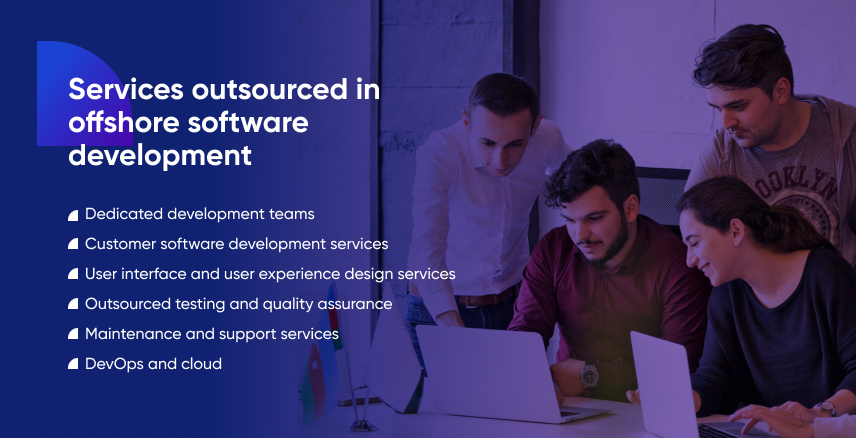
- Dedicated development teams – Why hire freelancers when you can hire a complete team of project managers, designers, QA engineers, and developers who can focus on the project? Offshore software development enables you to stay in charge of the workflow as well as communication, skipping recruiting and HR headaches.
- Customer software development services – Working with an offshore software development partner translates into getting software built exclusively for your operational workflows, customer requirements, and business needs. As part of Enterprise Software Development, whether it is mobile apps or enterprise applications functioning across various platforms, custom development provides flexibility along with quicker turnaround times while maintaining high quality and cost efficiency.
- User interface and user experience design services – When organizations outsource design work, they get access to experienced professionals who know how to create the best design concepts that the users want to use. They will deliver designs that not only look good but also convert.
- Outsourced testing and quality assurance – A great-looking software must also function perfectly. The outsourced QA teams manage everything right from automated processes and hands-on testing, which ensures that the software stays secure, functions properly, and performs as expected.
- Maintenance and support services – Once the software launches, it will require regular updates, performance, and bug fixes. Offshore teams provide round-the-clock coverage that ensures that everything runs seamlessly with quicker problem resolution and minimum downtime. These are especially crucial for customer-facing applications and business-critical systems.
- DevOps and cloud – A lot of businesses depend on offshore vendors for DevOps support and cloud infrastructure management. This includes setting up automated deployment pipelines, scaling environments, monitoring infrastructure, and migrating to cloud platforms like Google Cloud, Azure, and AWS. Such services help businesses create more reliable and more flexible backend infrastructure.

Factors to consider while choosing an offshore software development partner
Selecting among experienced offshore software development companies requires evaluating more than hourly rates. Businesses should assess technical expertise, communication practices, security standards, scalability, industry experience, and long-term partnership capabilities before making a decision.
Globally, there are numerous offshore software development companies around the world, and every single one of them claims to be the right one for every business out there. But how would you figure out the right one for your business? In most cases, selecting a reliable partner poses as the most crucial decision than the project itself, and it depends on the development team, their relevant skillsets, and abilities that tick all your boxes of needs.
So, how would you ensure the best-fitting offshore software development team? Take a look below for the evaluations:
Do they carry the needed technical expertise?
Choose partners that carry the relevant technology expertise and experience needed for your project. Look for their portfolio with similar expertise. Certification from major tech providers is a bonus. Having a partner with a proven track record provides confidence in their technical skill.
Can they collaborate and communicate effectively?
Your offshore partner must demonstrate soft skills like clear written and verbal communication skills, along with English proficiency. They must work within your organization's time zone or the overlapping hours. Choose an already established company that has cutting-edge communication channels like Microsoft Teams or Slack to provide you with regular updates on project progress.
Is the development process reliable?
An effective methodology for project management, like Scrum or Agile, is crucial. Ensure that they maintain clear documentation as well as structured workflows. Communicate how they are able to handle revisions, bugs, and scope changes. Also, request a demo of their tools to have a glimpse of their process in action.
Do they have a fair and transparent pricing model?
A transparent pricing model rules out chances of misunderstanding. Verify if the provider is offering you fixed, team-dedicated, or hourly rates. Also, compare the quotes other providers are giving and consider expenses for long-term, including support post-launch.
Will their model align with your work culture?
Cultural fit is the backbone of a smooth collaboration. Offshore developers must adapt to the values and work ethics of organizations. It is crucial to evaluate their approach to feedback as well as problem-solving. Look at their employment policies and company culture to see whether they foster a positive environment at work.
What is their model for time and process?
Creating software is a complex process, but with so many competitors around, organizations need faster development and marketing period to become a leader. Assess their timeline model to ensure their experts meet your time demands without quality compromise.
Are they aware of intranational legal considerations?
Lock in legalities before selecting the offshore software development team. Ensure that the IP rights stay with you so that when you decide to change the offshore company, you can do that seamlessly. Look for their code lock-in terms because, ideally, the codes should be transferred to you once the project is complete.
What are their project management and reporting tools?
Robust project management tools are non-negotiable, especially when the development takes place across different time zones. Various projects fall through as the team assumes communication takes place automatically without any effort. Confirm that your offshore team leverages tools like Microsoft Teams, Slack, or Jira, and more importantly, establish a transparent line for clear reporting schedules since day one. Status calls, milestone reviews, and weekly updates must keep everyone in the team aligned.
Are they aligned with compliance and security protocols?
Protecting your organization’s intellectual property is paramount. Ask them detailed questions about the security measures and their processes of handling security transfers and data handling. Ask whether they are compliant with ISO 27001 or GDPR. Don’t ask just verbally, demand properly documented proofs.
Do they have proven track records, like client testimonials?
The best offshore software development company will be able to show you what they have delivered to their clients.
Look for the teams that have worked on relevant projects and ask for case studies, testimonials, and examples of the challenges they have overcome. Ask them to show strong references for claims.
Cost of offshore software development
Pricing structure for offshore software development outsourcing depends on factors like tech stack of the project, seniority in roles, geography, and many more. Here's a quick breakdown of the costs across the top outsourcing regions, aiming to help you plan your budget for forming an extended team or full-scale delivery.
| Positions | South and Southeast Asia | Latin America | Eastern/Central Europe | Average Monthly Cost |
| DevOps Engineer | $22-$40/hr | $40-$60/hr | $60-$85/hr | $11,600 |
| Project Manager | $35-$48/hr | $55-$66/hr | $45-$70/hr | $9200 |
| QA Engineer | $15-$36/hr | $30-$50/hr | $45-$63/hr | $8640 |
| Backend/Frontend Developer | $18-$42/hr | $35-$61/hr | $55-$70/hr | $10000 |
| UI/UX Developers | $25-$36/hr | $40-$50/hr | $56-$76/hr | $10560 |
| Solutions Architect | $35-$48/hr | $60-$72/hr | $50-$77/hr | $10200 |
| Business Analyst | $30-$42/hr | $45-$55/hr | $50-$63/hr | $8960 |
Asia offers the lowest pricing at the entry-level, but Latin America has similar time zones to North America, while Eastern and Central Europe often provide the most reliable cost-to-quality ratio, especially for the complex projects that involve regulated domains like finance, healthcare, or cloud infrastructure or AI.
Depending on the region you choose, along with development costs and project complexity, the costs vary deeply.
Challenges in offshore software development
Offshore software development offers a lot, but like everything else, it has its share of hurdles as well. The following are some challenges companies can face in this model, along with insights on the ways to mitigate them. Take a look:

Culture and language
Ukraine, Poland, the Philippines, China, and India are among the countries where English is not the primary language of communication. This hurdle may sometimes result in miscommunication between regional vendors and the English-speaking clients, and the cultural differences can also raise certain ethical concerns, along with differences in holidays and working models.
How to overcome:
- Ensure all team members have proficiency in English
- Hold regular virtual meetings and open discussions on project vision
- Conducting cultural awareness workshops for improving team communication
Time zone difference
Time zones previously were an advantage. But working today with an overseas team often involves challenges in aligning with the team for a straight 9 hours. The delay in communication can slow down processes as the teams may have to wait for hours to resolve the issues.
How to overcome
- Schedule regular calls to discuss project delivery details beforehand
- Schedule overlapping work hours for daily standups
- Use modern communication tools like Teams, Slack, Trello, etc, for progress updates and task management
Security concerns and legal considerations
Before joining hands with a foreign offshore partner, businesses must consider exploring the lock-in legalities. Without a proper understanding of the offshore software developers' regulations, laws, and jurisdictions, founders may find themselves engulfed in legal complications. Risks if sharing intellectual property, data leakage, sensitive company information, unauthorized access, and breaches also remain.
How to overcome
- Ensure that the company has a net domestic product
- Verify the intellectual property rights in the agreement
- Make sure the IP belongs to you
- Specify clear objectives in payment, timelines, rejection, and acceptance procedures for avoiding misunderstandings.
- Establish strict security standards with data protection regulations. Confidentiality agreements, data transmission, etc.
Quality assurance
When the software development team is distant geographically, getting a quality software system can be immensely tricky. The offshore firm may have its own tech stacks, tools, standards, and methodologies, which may not always match those of the organization. Such a mismatch can lead to extra rework, subpar quality, and inconsistencies.
How to overcome
- Set the code of coding and quality standards
- Conduct on-site training visits periodically
- Implement testing and QA protocols frequently
When to consider outsourcing software development projects
Outsourcing is a flexible model that allows entrepreneurs to concentrate on the core business functions, alongside leveraging external expertise. Organizations must consider outsourcing their offshore software development needs when:

Organizations need specialized talents
When the organization's internal team with a solid skillset lacks specific expertise for projects based on advanced security, Blockchain, or Artificial Intelligence, outsourcing enables them to get access to a global pool of talent for filling such gaps. Companies can hire specialized developers from around the world without the limitations of a local talent pool.
Cost and budget are concerns
Offshore software development often proves to be more cost-efficient than hiring and training a full-time professional or a team. The model saves money that is otherwise given as salaries, benefits, office rents, equipment maintenance, license fees, etc. The organization only has to pay for the expertise as well as the time needed to avoid overhead costs associated with permanent employees.
Efficiency and speed are crucial
An outsourcing partner with an experienced, dedicated team often can complete the project faster than an in-house team, which is already at full capacity. This gives a significant competitive advantage. In case organizations need to scale up or down the development quickly, offshore software development firms offer the flexibility that in-house teams lack.
Organizations need to focus on core competencies
By choosing offshore software development from an external partner, the organization’s core team gets the bandwidth to focus on the marketing, sales, and strategic initiatives. The internal team can maintain productivity and avoid burning out by being overloaded with time-focused projects outside the primary focus.
There are different kinds of projects
When the project is short-term, the offshore software development model is the best option where permanent hiring does not seem viable. Delegating projects that are not central to the core businesses enables internal resources to be free for high-priority work. Overflow or small projects in medium and small-scale businesses or in large corporations with overflow work can leverage external teams to handle specific projects.
Managing offshore software development effectively
Successful offshore development depends on clear communication, well-defined project goals, agile collaboration, and continuous feedback between internal stakeholders and distributed engineering teams.
Offshore software development is effectively managed in the following ways:
Ensuring alignment of deliverables and goals
Establish documented success metrics, deliverables, and goals that are well understood by all the team members. Define the clear schedules as well as deadlines for project milestones and tasks. Use a comprehensive roadmap for reflecting the project's objectives, timelines, and scope, and consistently update it whenever there's a new requirement. Clearly define workflows and procedures for tasks like code deployment, reviews, and testing to ensure that the offshore team understands the process with zero confusion.
Choosing the right tracking tool
Choosing the right tracking tool is important for the creation of a collaborative virtual space that fosters transparent communication. Take a look at some of the tools below:
- Confluence/Notion – Centralized knowledge for documenting meeting notes, decisions, and requirements that ensure superior accessibility across zones.
- Bitbucket/GitHub/GitLab – Crucial for version control and collaboration, and enabling asynchronous code reviews.
- Asana – A great tool for tracking and managing tasks, day-to-day activities, and work progress.
- Trello – A simplistic visual management tool that leverages the Kanban boards – best fit for less complex projects and smaller teams.
- Jira – Ideal for software development teams and Agile project management. The features include comprehensive reporting, issue tracking, Kanban, and Scrum boards. And customizable workflows.
Eliminating micromanagement with Agile standups
Implement frameworks like Kanban or Scrum that rely on structured communication. Frequent releases and short sprints. Keep the meetings short and focused on individual blockers, plans, and progress. Delegate responsibilities as well as trust the team for managing their own tasks. Do not track efforts; instead, track outcomes to measure the team's performance based on the delivered results.
Building trust and accountability
Promote an inclusive work environment where the offshore and onshore work like a single unit. Provide clear ownership of modules, tasks, or even the sub-teams. Managers must model accountable behavior by owning mistakes, meeting their own deadlines, and being transparent about the hurdles. Schedule virtual team-bonding sessions, informal meetings, or coffee breaks to build a company-wide rapport.
Maintaining strong channels for communication
Identify the overlapping work hours for a real-time collaboration. Define when to leverage different communication channels. Use project discussion threads, shared documents, or video recordings for updates that do not need any immediate response. Conduct training in cultural sensitivity for bridging the differences in expectations and communication styles.
Continuous iteration and feedback
Schedule performance reviews and regular check-ins, focus on targeted issues instead of vague comments, actively listen to employee challenges as well as solutions, and hold retrospective discussions after completion of each sprint to talk about what went wrong and how to improve or refine processes.
Offshore Software Development Trends for 2026 and Beyond
For 2026 and beyond, offshore software development is still moving beyond just being a simple cost-cutting measure to become a strategic tool for business growth and innovation. The crucial trends include:
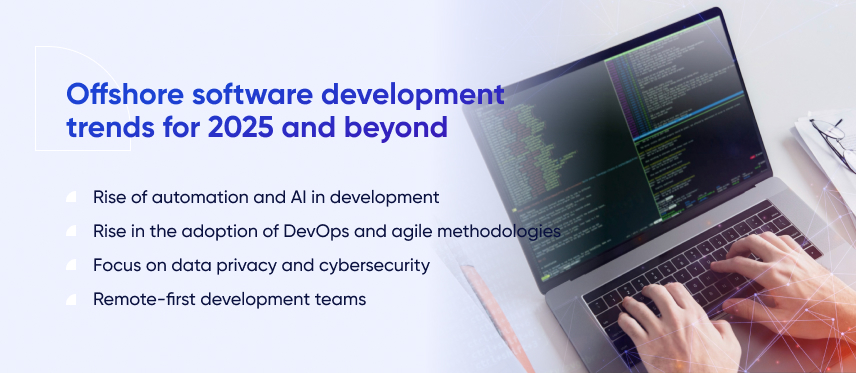
Rise of automation and AI in development
Automation and Artificial Intelligence are changing the offshore software development landscape by enabling developers to focus on high-level tasks with improved quality and efficiency. We can expect to see:
- AI in DevOps
- AI-powered insights
- AI-augmented development
Rise in the adoption of DevOps and agile methodologies
Offshore software development teams are rapidly adopting DevOps and agile practices for enhancing collaboration and accelerating project delivery, which allows quick adaptation to the dynamic market demands. We can expect to see:
- Enhanced collaboration
- Expansion of DevOps
- Agile adoption
Focus on data privacy and cybersecurity
With the rise of cyber threats and data protection laws, offshore software development partners today are required to meet strict compliance standards and stringent security protocols. We can expect to see:
- Virtual environments
- Secure development practices
- Adherence to strict international regulations like HIPAA, GDPR, and more.
Remote-first development teams
Hybrid and remote work models are now the standard for modern tech organizations. Where we can see the following development:
- Outcome-driven metrics
- Hybrid models
- Strategic talent access
Nearshoring playing a crucial role as an alternative outsourcing model
Outsourcing to the nearby country with a similar time zone, also known as nearshoring - is becoming a strategic alternative to traditional offshore outsourcing. We can expect to see:
- Regional tech hubs
- Value and cost alignment
- Improved collaboration
Cloud-based collaboration and development
Cloud-native development is a global trend for offshore services that enable greater efficiency, scalability, and foster real-time collaboration among distributed teams. We can see more of:
- Reduced overhead
- Integrated collaboration
- Cloud-native applications
A stronger adoption of IoT, Blockchain, and AR/VR
Offshore software development teams are increasing their capabilities for supporting specialized projects in emerging technologies, instead of the usual development tasks. The technologies that will be leveraged the most in offshore software development are:
- IoT
- Blockchain
- AR/VR
Best practices in offshore software development
Best practices in offshore software development cover the following seven key areas
| Practices | Description | Action |
| Defining clear requirements and scopes | Clearly defining expectations to prevent any confusion or misunderstandings |
|
| Choosing the right model of engagement | Select the most suitable project model based on your flexibility and budget requirements | Select between a flexible or fixed price scope or a dedicated team |
| Ensuring strong IP and legal protection rights | Protect your company’s intellectual property and information |
|
| Leveraging Scrum and Agile methodologies | Use Agile methodology for improving feedback loops, collaboration, and flexibility |
|
| Prioritizing transparent communication | Bridge cultural and geographical gaps with transparent communication |
|
| Conducting regular testing and code reviews | Ensure functional and high-quality code through consistent oversight |
|
| Building long-term partnerships over one-time projects | View your offshore development software provider as a strategic partner for the long term |
|
Real example of offshore software development success
Let’s have a glimpse at some successful cases of offshore software development:
- Spotify – Spotify hired offshore experts to expand its reach into the Latin American market. It leveraged the local teams to gain insights on the market and eventually drove an impressive growth in subscribers.
- Mercedes Benz (Formerly Daimler AG) – Daimler AG collaborated with expert offshore teams in India to create advanced automotive software. The collaboration shortened innovation cycles and gained the organization access to a skilled talent pool.
- Netflix – the streaming giant utilized offshore teams from Latin America to get market insights and produce region-focused content, which later on boosted its subscriber growth and gave it a competitive edge.
- JP Morgan and Chase – The company expanded its operations to the Philippines for IT and software functions and significantly reduced costs to get a competitive edge.
- Prequin – A UK-based FinTech firm, scaled its research and development section in India’s Bangalore and expanded to 450 employees. This demonstrates how offshore teams can skilfully address talent shortages and generate significant growth.
- Slack – Leveraged an offshore team for initial product development as well as design. This has helped to accelerate the launch and build of its globally popular communication platform.
- WhatsApp – WhatsApp hired developers from the Eastern European sector to build its core app. It was later scaled rapidly with a lower cost during its initial days.
- As a reliable offshore software development partner of many US, UK, and UAE-based firms, Proquantic Software, too, has proudly been a part of many organizations' journey towards success.
Case Study – PREVOUNCE
Prevounce is a US-based healthcare provider that provides remote care programs for clinicians and patients. Their focus is on preventive and chronic care services for promoting wellness.
What they needed
The client wanted to optimize its service delivery of its three core services
- Annual Wellness Visit Programs
- Chronic Care Management
- Remote Patient Monitoring
And to achieve this, they needed a unified solution that would solve their primary pain points, like
- Regulatory complexity
- Administrative burden
- Legacy issues
- Handling concurrent integration
What we provided them
- Analyzed needs with multiple in-depth consultations with the client
- Built a custom software solution based on advanced backend and frontend concepts, along with a robust database implementation process.
- We enabled them to overcome the technical challenges with a flexible integration framework, developed custom APIs for standardizing data ingestion, and implemented stringent security protocols for safeguarding sensitive patient data and company information.
- We also provided 24*7 service accessibility
How much do the offshore software development experts charge per hour?
The cost depends on various factors, and for a better representation, we are providing the insights in a tabular format below:
Hourly rates based on region
| Region | Price variation | Details |
| Africa | $20-$60+/hr | A consistently growing market offering competitive rates with varying levels of infrastructure |
| Asia (Vietnam, India, the Philippines, and more) | $15-$50+/hr | Offers some of the lowest rates due to the low cost of living |
| Latin America (Argentina, Brazil, Mexico, etc.) | $25-$100+/hr | Favored by North American companies due to comparably stronger proficiency in English than other regions, and having the same time zones. |
| Eastern Europe (Poland, Ukraine, etc.) | $25-$100+/hr | Carries higher technical expertise as well as cultural alignment with Western countries |
Hourly rates by experience
| Professional | Price variation | Details |
| Senior-level developers | $45-$100+/hr | Higher rates for specialized skills and extensive experience in advanced tech like Blockchain or AI/ML |
| Mid-level developers | $25-$65+/hr | Carries years of experience and might handle more complex tasks |
| Junior-level developers | $15-$45+/hr | Most affordable, carrying 2-3 years of experience |
Based on engagement models
| Models | Price Structure | Details |
| Time and Materials | Variable | Organizations pay for the hours worked. Ideal for flexible projects that have evolving requirements. |
| Project-Based | Fixed fee | Fixed price for projects with well-defined scope. Provides lesser flexibility for changes. |
| Dedicated Teams | Fixed monthly fee | Organizations hire a long-term, exclusive team. Provides high control but needs commitment for the long term. |

Maximizing ROI from offshore software development teams
To ensure a strong return on investment, organizations have to focus on proactive management and strategic planning of the project. Details below:
- Defining clear objectives – Define the project goals and expected outcomes from the very start. A comprehensive Scope of Work reduces rework and ambiguity.
- Select the right partner – Onboard the potential vendors based on track record, technical skills, and communication abilities. Testing with a pilot project is possible before a full commitment.
- Bridging communication and cultural gaps – Leverage clear communication protocols, use video calls, and schedule overlapping work hours for fostering real-time communication.
- Ensure efficiency and quality – Implement automated testing and regular code reviews to catch errors at the initial stages. Enable your offshore software development team and include them in decision-making for boosting innovation and building ownership.
- Mitigate risk – Leverage robust legal contracts that include NDAs for protecting intellectual property. Diversify your projects across various vendors to reduce risks.
How Proquantic Software empowers organizations with offshore software development
As one of the trusted offshore software development companies, Proquantic supports startups and enterprises throughout the entire offshore software product development lifecycle. From product discovery and MVP development to enterprise-scale applications, our offshore development teams deliver secure, scalable, and high-quality software solutions.
Why choose us
Unlike the competitors providing traditional outsourcing, Proquantic’s approach is focused on scalability, transparency, and reliability. With a rigorous vetting process, we ensure that the developers are not only technically skilled but also aligned with the project goals.
Here’s what we provide our clients:
- Pre-vetted talent pool from around the world
- Cost-effective engagement without any quality compromise
- Real-time communication with agile collaboration
- Flexibility of scaling teams as per project needs
Have a look at our engagement models:
Proquantic understands that every business operates differently, and that is why we offer multiple models that are tailored to your requirements:
- Project-based models – End-to-end delivery for defined projects
- IT staff augmentation – Plug in the specific skills for quickly filling talent gaps
- Dedicated teams – Build long-term capacity with a dedicated team or individual
Get started quickly with Proquantic
Getting started with us is simple. Connect with us, tell us your requirements, and we will connect back with you with the most suitable talent in just a few days. Get full control of your team while we take care of onboarding and providing backend support.
With Proquantic, offshore development is never a risk; it's efficient, seamless, and built for your journey towards growth and success.
Conclusion
Offshore software product development has become a strategic growth driver for organizations seeking faster innovation, global engineering talent, and scalable delivery models. By partnering with experienced offshore software development companies, businesses can accelerate product delivery, optimize costs, and improve long-term competitiveness.
Whether you're planning offshore product development for a new digital platform or expanding your engineering capabilities through offshore development, selecting the right technology partner is essential for delivering secure, scalable, and future-ready software products
FAQ (Frequently Asked Questions)
Q1. Why choose offshore software development?
The offshore software development model enables businesses to get global talent, speed up project delivery, and reduce costs without compromising quality. It's a great way of scaling without staying competitive.
Q2. How to choose the right offshore software development company?
Always look for a company with flexible engagement models, strong client reviews, transparent communication, and proven expertise. A trusted partner like Proquantic USA ensures value and reliability.
Q3. What are the pros & cons of offshore software engineering?
The positive sides involve round-the-clock productivity, access to global and specialized talent, and cost savings. The main challenges are managing communication and time zones, which a partner can readily solve.
Q4. What is the cost to hire an offshore development team?
Prices of offshore software development depend on expertise and region. For instance, hiring experts from South Asia costs up to 70% less than the US rates.
Q5. What's the difference between outsourcing and offshoring?
Outsourcing means delegating the work to an external service provider, while offshore software development specifically means involving hiring teams from another country to access talent and cut costs.
Q6. How do offshore developers ensure data security?
Reputed offshore software development firms follow all security and compliance standards, secure infrastructure, use encryption, and NDAs to keep the business data safeguarded.
Q7. Can offshore teams handle long-term projects?
Offshore software development teams are able to manage both long-term and short-term projects with dedicated models. They ensure ongoing support, scalability, and consistency.
Q8. Which is better: Nearshore or Offshore development?
Nearshore development provides time zone alignment, whereas offshore software development provides a wider talent pool and greater cost savings. The choice depends on collaboration and budget needs.